
Type & Discipline
Barrett’s theory of constructed emotion is a construct and theoretical framework in affective neuroscience and psychology, not a treatment modality or a stand-alone technique 4. It holds that emotions are not hardwired, universal reactions waiting in dedicated brain circuits but are constructed in the moment by the brain, which combines incoming interoceptive (bodily) signals with learned emotion concepts to make meaning of a situation 1. The framework sits at the intersection of predictive processing, interoception research, and the psychology of categorization, and it positions emotion as an act of perception and prediction rather than a reaction triggered by the outside world 1. For the practicing clinician, its value is explanatory and reframing: it offers a mechanistic account of why two people in the same situation feel different things, why bodily sensations get labeled as specific emotions, and how the vocabulary a person has for emotion shapes the emotion they actually experience 5.
The clinically portable idea embedded in the theory is emotional granularity — the ability to construct and distinguish fine-grained, specific emotional experiences rather than broad, undifferentiated ones 4. A person high in granularity can separate “anxious,” “ashamed,” “resentful,” and “disappointed”; a person low in granularity may register only “bad” 5. Because granularity can be cultivated, this construct functions as a bridge from a neuroscience theory to actual clinical work LLM.
Creators & Lineage
The theory of constructed emotion was developed by Lisa Feldman Barrett, a University Distinguished Professor of Psychology at Northeastern University with appointments at Massachusetts General Hospital and Harvard Medical School, who consolidated decades of her laboratory’s work into the framework 2. She set out the active-inference, interoception-and-categorization account in a 2017 paper in Social Cognitive and Affective Neuroscience, and presented the ideas for a general audience the same year in her book How Emotions Are Made: The Secret Life of the Brain 12. Her TED talk popularized the central claim that “you aren’t at the mercy of your emotions — your brain creates them,” and she has since discussed the clinical and everyday implications in long-form conversations such as the Huberman Lab podcast 36.
Barrett’s work is explicitly a challenge to the “classical view” of emotion — the assumption, traceable through Darwin and into the twentieth-century basic-emotion research of theorists like Paul Ekman, that emotions are biologically fixed, universal, and each marked by a distinct facial expression and neural fingerprint 4. Against this, her constructionist account draws on the broader tradition of psychological construction and on predictive-processing neuroscience, treating the brain as a prediction machine that builds experience rather than passively receiving it 1. The lineage that matters for therapists is less about who influenced Barrett and more about where her ideas converge with existing practice: the emphasis on naming and differentiating emotions echoes the emotion-labeling work in dialectical behavior therapy, the focus on bodily felt experience and its symbolization parallels emotion-focused therapy, and the mechanistic grounding sits squarely within affective neuroscience and complements the appraisal logic of cognitive behavioral therapy LLM.
Core Principles
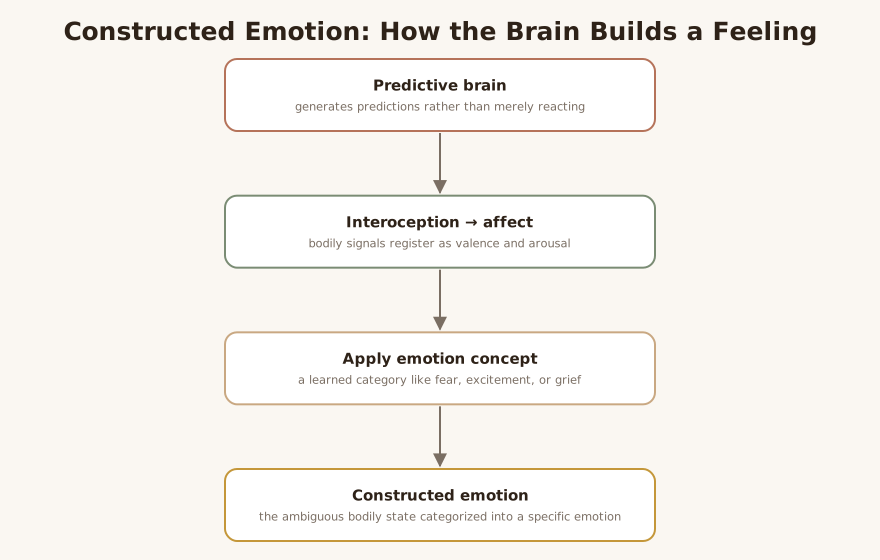
The first principle is that the brain is fundamentally predictive, not reactive 1. Rather than waiting for stimuli and then responding, the brain continuously generates predictions about what is about to happen — including what is happening inside the body — and uses incoming sensory input mainly to confirm or correct those predictions 1. Emotions, in this account, are among the brain’s predictions: constructions assembled to explain and act on bodily and contextual signals 1.
The second principle is the central role of interoception and the body budget 1. The brain is always managing the body’s internal resources, producing a constant stream of interoceptive sensation that registers, at a basic level, only as affect — pleasant or unpleasant (valence) and activated or calm (arousal) 5. This raw affect is not yet an emotion; it is the bodily data the brain must interpret 5.
The third principle is categorization with concepts 1. The brain makes an emotion by applying a learned emotion concept — “fear,” “excitement,” “grief” — to the present mix of affect and context, thereby categorizing an otherwise ambiguous bodily state into a specific, meaningful experience 1. Emotion concepts are learned, largely through culture and language, which is why the available concepts shape which emotions a person can construct 4.
The fourth principle, and the one with the most clinical leverage, is emotional granularity 4. Because emotions are constructed from concepts, a richer repertoire of emotion concepts yields finer-grained experience and, with it, more precise prediction and more options for action 5. Higher granularity has been associated with better regulation, while coarse, undifferentiated affect is the territory of alexithymia LLM. A consequence of these principles is that emotions are not universal “fingerprints” with one-to-one brain or facial signatures; the same emotion category is constructed variably across instances, people, and cultures, a finding Barrett calls the principle of variation 4.
Interventions & Techniques
The theory is not delivered as a protocol; it informs how a clinician conceptualizes affect and sharpens techniques that already exist LLM. Its most direct translation is affect labeling and emotion-concept building — helping clients move from “I feel bad” toward specific, differentiated labels, which the theory predicts will improve regulation by giving the brain better-fitting categories for its bodily data 5.
A second application is interoceptive literacy: because emotion construction starts with bodily signals, teaching clients to notice and describe interoceptive sensations — and to distinguish the raw sensation from the interpretation laid over it — gives them a point of leverage before the emotion is fully built 1. A third is vocabulary expansion: deliberately enlarging a client’s emotion lexicon increases the concepts available for construction, which the framework treats as a direct route to higher granularity 4. A fourth is recategorization — guiding a client to construct a different emotion from the same bodily state, for example experiencing pre-performance arousal as anticipation rather than dread, which Barrett describes as using the body’s signals as information the person can re-author 3.
The framework reframes the broader therapeutic project: many interventions can be understood as efforts to change the concepts and predictions a client brings to their bodily and situational data, so that the emotions they construct are more accurate and more useful 1. This makes constructed-emotion thinking a natural complement to skills-based and experiential modalities rather than a competitor LLM.
LLM-generated illustrative example (not a guideline): A client who reports only “I feel overwhelmed” before social events is helped to slow down, notice a racing heart and tight chest, and then sort the experience into more specific concepts — is this dread, anticipation, shame about being judged, or excitement? Over several weeks the client builds the habit of constructing “nervous-but-curious” instead of a global “overwhelmed,” and reports more room to choose how to act. LLM
Evidence Base
The maturity of this framework is established as an influential scientific theory, but “established” must be read carefully: it names the theory’s standing and the strength of certain component findings, not the existence of a manualized, trial-tested “constructed-emotion therapy” LLM. The constructionist program is grounded in a substantial body of Barrett’s peer-reviewed work and is articulated in a formal active-inference account, and it is widely taught and debated in affective science 1. Two component claims are especially well supported: that the brain operates predictively rather than purely reactively, and that there is no reliable one-to-one mapping between a named emotion and a single, specific brain region or facial expression — the meta-analytic failure to find consistent “emotion fingerprints” is a genuine empirical result Barrett marshals against the classical view 4.
Emotional granularity is the most clinically tractable strand, with research linking higher granularity to better emotion-regulation outcomes, which supports granularity-building as a reasonable intervention target 5. The honest caveats are these: the theory is contested within affective science, where basic-emotion theorists continue to argue for greater biological organization of emotion than the strong constructionist reading allows 4. Much of the supporting work is correlational, and there is no body of randomized trials testing the theory as a treatment LLM. The defensible stance is to use constructed-emotion thinking as a formulation lens and a rationale for affect-labeling and granularity work — techniques that already have support within established modalities — rather than to present the theory itself as a proven therapy LLM.
Populations & Indications
The framework is broadly applicable across adults and adolescents, since emotion-concept learning is lifelong and adolescence is a period of rapid expansion of emotional vocabulary and self-understanding LLM. It is most directly indicated where coarse or dysregulated affect is central 5. People with anxiety disorders are a strong fit, because the theory frames anxiety as a constructed prediction laid over interoceptive arousal, opening the door to recategorization and to distinguishing genuine threat from misread bodily signals 1. People with mood disorders are similarly served, where chronic unpleasant affect can be worked by building the specificity that lets a client tell apart sadness, guilt, fatigue, and emptiness 5.
People with borderline personality disorder are a notable indication, because the construct of granularity dovetails with the emotion-labeling and skills emphasis of dialectical behavior therapy, and low granularity plausibly underlies some of the rapid, undifferentiated affective shifts these clients describe LLM. Trauma survivors are indicated insofar as trauma can blunt or distort interoception and narrow the concepts available to interpret bodily states, leaving raw arousal that the person cannot name or contextualize LLM. Across populations, the indication is not a “Barrett therapy” but the use of the framework to formulate the problem as a construction process that can be retrained LLM.
Problems-for-Work
The framework reframes a recognizable set of clinical problems as features of how emotion is constructed LLM. Emotion dysregulation is the central case: when affect is built into coarse, undifferentiated states, the person has fewer precise predictions and fewer regulatory options, and building granularity is the mechanism of change 5. Alexithymia — difficulty identifying and describing feelings — maps almost directly onto low emotional granularity and a thin emotion-concept repertoire, making concept- and vocabulary-building the natural target LLM.
Generalized anxiety disorder and panic disorder can be worked as misconstrued interoceptive prediction, in which bodily arousal is automatically categorized as catastrophic threat; recategorization and interoceptive literacy let the client reinterpret the same signals 1. Major depressive disorder can be approached by helping a client differentiate within a global low mood, restoring specificity and actionable information 5. Borderline personality disorder is addressed by pairing granularity-building with the regulation skills it supports LLM. Interoceptive sensitivity, anger, and affect intolerance are each reframed as construction problems — heightened or misread bodily signal, a coarse high-arousal category, or an inability to sit with raw affect long enough to categorize it usefully 5.
LLM-generated illustrative example (not a guideline): A client with panic notices a surge of heart rate while shopping and instantly constructs “I’m having a heart attack.” Using the framework, the clinician helps the client treat the racing heart as ambiguous interoceptive data and practice constructing alternative categories — “this is the same arousal I feel climbing stairs” — so the bodily signal no longer defaults to the catastrophic emotion category. LLM
Contraindications, Cautions & Cultural Humility
A theory has no contraindications; the cautions concern how it is used LLM. The foremost is invalidation: the message “your brain creates your emotions” can be misheard as “your feelings aren’t real” or “you’re choosing to feel this way,” which is harmful and is not what the theory claims 4. Barrett’s point is that construction is largely automatic and outside conscious control, so the clinical framing must be that emotions are constructed, not chosen, and that this offers leverage over time, not blame in the moment 3. Pushing recategorization on a client who is acutely dysregulated or in genuine danger is both ineffective and disrespectful of their experience LLM.
A second caution is not to over-apply a single elegant mechanism; emotion-concept work belongs alongside, not in place of, assessment and evidence-based care, and some presentations are driven by factors the construction lens does not capture LLM. A third is to remember that the construct of granularity should never become a way to police how “well” a client labels feelings LLM.
Cultural humility is intrinsic here, because the theory itself holds that emotion concepts are learned through culture and language 4. Different cultures parse the emotional landscape differently and possess concepts that have no clean English equivalent, so a clinician must not treat their own emotion taxonomy as the standard against which a client’s granularity is judged 4. The work is to help clients build a richer repertoire within their linguistic and cultural world, and to stay curious about emotion concepts the clinician may not share LLM.
Treatment-Plan Suggestions & SMART Objectives
The framework does not generate goals about changing a client’s brain; the appropriate goals concern interoceptive awareness, emotion-concept building, granularity, and recategorization, delivered inside an established modality LLM.
| Goal | SMART objective (example) | Mechanism |
|---|---|---|
| Increase emotional granularity | Over 8 weeks, client logs a daily emotion using a specific (non-global) label on at least 5 of 7 days, expanding from 1-2 to at least 6 distinct terms | A richer emotion-concept repertoire yields finer-grained construction and better regulation 5 |
| Build interoceptive literacy | Within 6 weeks, client describes 3 distinct bodily sensations preceding a named emotion in at least 4 sessions | Construction begins with interoceptive signals; noticing them creates a point of leverage 1 |
| Separate affect from interpretation | Within 4 sessions, client distinguishes the raw sensation from the emotion label in at least 2 logged episodes | Raw affect (valence/arousal) is interpreted into emotion via concepts; separating them slows automatic categorization 5 |
| Practice recategorization | Over 6 weeks, client reframes a high-arousal state (e.g., dread to anticipation) before at least 3 triggering events | The same bodily signal can be constructed as a different emotion, changing the action it affords 3 |
| Expand emotion vocabulary | Within 5 weeks, client adds and uses at least 8 new emotion words drawn from their own cultural/linguistic world | More available concepts increase the emotions the brain can construct 4 |
| Reduce catastrophic interoceptive prediction | Over 8 weeks, client reinterprets at least 3 panic-linked sensations as ambiguous data rather than threat, logged | Anxiety is a constructed prediction over arousal; corrective concepts reduce automatic threat categorization 1 |
| Differentiate within low mood | Within 6 weeks, client names at least 3 specific states inside a global “bad” mood across sessions | Granularity restores specificity and actionable information within undifferentiated depression 5 |
Common Misconceptions
The most consequential misconception is that “your brain constructs emotions” means emotions are chosen or fake — that a person could simply decide not to feel afraid 4. The theory says the opposite about volition: construction is largely automatic and rapid, and the clinical promise is gradual influence over the concepts and predictions that feed it, not instant control 3. A related error is treating recategorization as suppression; reappraising arousal as anticipation is constructing a different, genuine emotion, not denying the bodily state 1.
A second misconception is that the theory denies the body or biology; in fact interoception and the body budget are central, and the claim is about how bodily signals are interpreted, not that the body is irrelevant 1. A third is that constructionism means “there are no real emotions” — rather, emotions are real experiences that are constructed rather than triggered, much as colors are real perceptions the brain builds LLM. Finally, the theory is sometimes taken as settled fact across affective science when it remains genuinely contested, with basic-emotion theorists defending more biological organization than the strong constructionist reading allows 4.
Training & Certification
There is no certification in “constructed emotion theory,” because it is a body of scientific knowledge rather than a credentialed therapy LLM. The accessible entry points are Barrett’s own materials — the book How Emotions Are Made, her TED talk, and long-form interviews — which are sufficient for the conceptual literacy most clinical use requires 236. Deeper engagement comes through the primary literature, beginning with the 2017 active-inference paper 1.
For applied competence, the relevant training is in the established modalities the framework informs LLM. Affect-labeling and emotion-differentiation skills live within dialectical behavior therapy, experiential emotion work within emotion-focused therapy, and cognitive reappraisal — the cousin of recategorization — within cognitive behavioral therapy, each with its own evidence base and supervised-training pathways LLM. The realistic goal is to understand the construction model well enough to formulate cases and explain rationale, while building credentialed skill in the treatments within which granularity work is actually delivered LLM.
Key Terms
Constructed emotion: the view that an emotion is built in the moment by the brain from interoceptive signals plus learned concepts, rather than triggered as a hardwired reaction 1.
Predictive (active-inference) brain: the principle that the brain continuously generates predictions and uses sensory input to correct them, treating emotion as a kind of prediction 1.
Interoception: the brain’s sensing of the body’s internal state, the raw signal from which emotions are constructed 1.
Affect: the basic, ever-present feeling of pleasantness/unpleasantness (valence) and activation/calm (arousal) that is not yet a specific emotion 5.
Emotion concept: a learned, culturally and linguistically shaped category (e.g., “fear”) the brain applies to affect and context to make a specific emotion 4.
Emotional granularity: the capacity to construct fine-grained, differentiated emotional experiences rather than broad, global ones 4.
Recategorization: constructing a different emotion from the same bodily state, used to change the meaning and the action the state affords 3.
Principle of variation: the finding that a given emotion category is constructed variably across instances, people, and cultures, with no single fingerprint 4.
Resources & Further Reading
▶ Watch — a video introduction to this concept:
- Barrett, L. F. (2017). The theory of constructed emotion: an active inference account of interoception and categorization (PMC)
- How Emotions Are Made: The Secret Life of the Brain — Lisa Feldman Barrett (book)
- Lisa Feldman Barrett: You aren’t at the mercy of your emotions — your brain creates them (TED Talk)
- Theory of constructed emotion — Wikipedia
- What is the Theory of Constructed Emotion — Simply Put Psych
- Dr. Lisa Feldman Barrett: How to Understand Emotions — Huberman Lab
Reflective / Supervision Questions
- When I explain construction to a client, am I conveying that emotions are constructed (and largely automatic) rather than chosen, so the message lands as leverage rather than blame? 3
- For this client, is the presenting problem better formulated as coarse, undifferentiated affect (a granularity problem) or as a specific misconstrued prediction (a recategorization problem), and does my plan match? 5
- Am I helping this client expand emotion concepts within their own cultural and linguistic world, or am I implicitly treating my emotion vocabulary as the standard? 4
- Where might recategorization tip into invalidating suppression, and how will I tell the difference for this person? 1
- Am I presenting constructed emotion honestly as a contested-but-influential framework and a formulation lens, rather than as a proven stand-alone therapy? LLM