
Type & Discipline
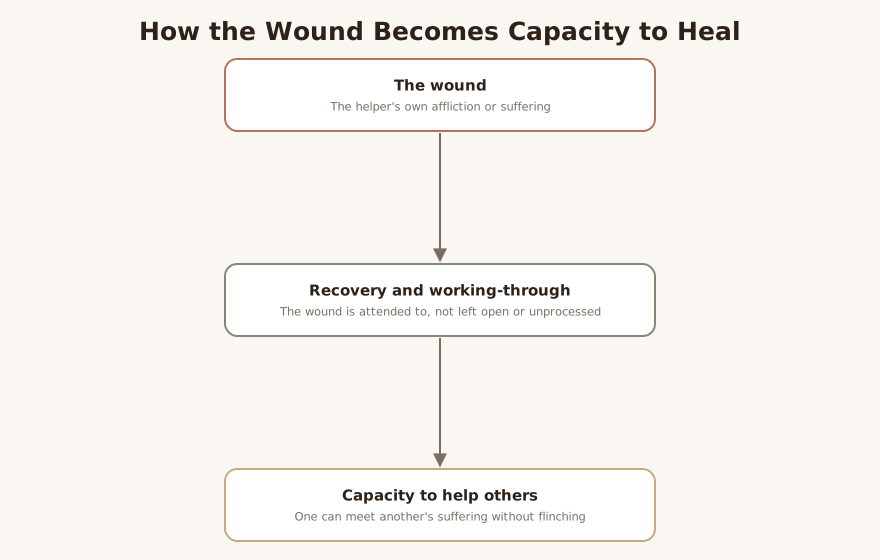
The “wounded healer” is a construct — a cross-cultural idea and clinical sensibility — rather than a treatment protocol or a school of therapy LLM. It belongs at the intersection of the anthropology of religion, where it describes a recurring pattern in shamanic and ritual healing, and depth psychology, where it was taken up as an archetype of the helping relationship LLM. The core claim is deceptively simple: the healer’s own affliction and recovery can become the very source of their power to help others LLM.
For practicing clinicians the construct functions less as a technique than as a lens on the therapeutic relationship and on the clinician’s own history LLM. It names the widely observed fact that many people are drawn to helping work in part through their own experience of suffering, and it asks what that woundedness contributes — and what it endangers — in the consulting room 1. A growing empirical literature now treats the idea seriously enough to test it, examining both clinicians’ behavioral-health histories and how disclosed or undisclosed woundedness shapes outcomes 23. But it is important to be clear from the outset that the wounded healer is a metaphor with emerging evidence, not an evidence-based intervention you deliver to a client LLM.
Creators & Lineage
The image is older than any named author. Its mythic prototypes are the Greek figures Asklepios, the physician-god whose own injury was bound up with his healing power, and Chiron, the centaur who, suffering an incurable wound, became the teacher of physicians — both standing as ancient expressions of the idea that healing flows from the healer’s own hurt LLM. In the anthropology of religion the pattern is most visible in shamanic initiation, where the future shaman characteristically passes through a crisis — illness, dismemberment in vision, near-death — and only by surviving and integrating that ordeal acquires the authority to heal others LLM.
In the twentieth century Carl Jung is the figure most responsible for carrying the idea into modern psychology, framing the wounded healer as an archetype activated within the analytic relationship: the patient’s wound constellates the healer’s own, and genuine treatment engages both LLM. This places the construct squarely within Jungian analytical psychology and the broader depth psychology tradition, which is its principal psychological lineage LLM.
The phrase entered wide circulation through the Dutch-born Catholic priest and pastoral theologian Henri J. M. Nouwen, whose 1972 book The Wounded Healer: Ministry in Contemporary Society made it a touchstone for ministry and the helping professions 6. Nouwen’s central paradox is that the minister, or by extension any helper, is called to make their own wounds available as a source of healing rather than hiding them as a private liability 4. For Nouwen the helper’s loneliness, suffering, and brokenness, when acknowledged rather than denied, become the ground of hospitality toward another’s pain 5. His contribution is explicitly theological and pastoral, reframing personal woundedness as a paradoxical resource for service 4.
A complementary modern lineage runs through humanistic and relational therapy. Carl Rogers’ emphasis on authenticity (congruence) and empathy gave the idea a more secular, person-centered home: the helper’s genuine, undefended presence — not a polished mask of expertise — is what makes the relationship healing LLM. And in contemporary behavioral health, peer support models operationalize the construct directly, positioning lived experience of a condition as the qualifying credential for helping others through it LLM.
Core Principles
Affliction as the source of authority. The defining principle is that the capacity to heal arises partly from the healer’s own wound and recovery, not in spite of it LLM. In the shamanic prototype the survived ordeal is what confers legitimacy; in the psychological reading the helper who has known suffering can meet it in another without flinching LLM.
Recovery, not the wound alone, is what heals. A consistent refinement — clinical and pastoral alike — is that an open or unprocessed wound is not therapeutic LLM. Nouwen’s paradox is not a celebration of brokenness for its own sake; it is about wounds that have been attended to and made available with discipline 4. The empirical literature echoes this, suggesting it is the clinician’s working-through and corrective emotional experience, rather than the raw fact of having been hurt, that matters 3.
Woundedness is common among helpers. A core, now partly evidenced, premise is that helping professionals carry meaningful rates of their own behavioral-health histories 2. A multistate study of licensed social workers documented substantial lifetime histories of mental-health and substance-use problems and adverse experiences, lending weight to the long-standing intuition that many enter the field carrying their own wounds 2.
Motivation is mixed, not pure. The construct should not be romanticized into a single noble story 1. Research on motivations to become psychotherapists argues that woundedness is one strand among several, and that the field benefits from moving beyond a simplistic wounded-healer narrative toward a more differentiated account of why people help 1.
The relationship is bidirectional. In the depth-psychological framing, the wound is constellated within the dyad: the patient’s suffering activates the clinician’s, which is precisely why disciplined self-awareness is non-negotiable LLM. This is the conceptual root of taking countertransference seriously as data rather than as mere interference LLM.
Interventions & Techniques
The wounded healer is a sensibility, not a manual, so its “techniques” are really disciplines of the clinician’s own use of self LLM. The first is rigorous self-knowledge: knowing one’s own wounds well enough that they inform empathy without intruding LLM. The relational literature frames the clinician’s task as letting their own history sensitize them to the client’s pain while keeping the work centered on the client 3.
A second discipline is the judicious, client-centered use of self-disclosure — sharing something of one’s own experience only when it serves the client’s process, never to relieve the clinician’s own need LLM. The pastoral tradition makes the offering of one’s wounds an act of hospitality, structured and bounded rather than confessional 5. A third is the corrective emotional experience: providing, within the relationship, a different and reparative response to wounds the client (and sometimes the clinician) carries — an emphasis the recent therapist-woundedness research highlights directly 3.
Operationally, in peer support contexts the “intervention” is the disciplined sharing of lived experience as a basis for connection, hope, and credibility LLM. Across all settings, the indispensable companion technique is the clinician’s own work — personal therapy, supervision, and reflective practice — to keep the wound a resource rather than a liability LLM.
LLM-generated illustrative example (not a guideline): A counselor in recovery from an eating disorder works with a client describing the same shame and secrecy. Noticing her own pull toward over-identification, she takes it to supervision and uses it to slow down and listen rather than to reassure prematurely. Later, judging it would normalize the client’s experience and instill hope, she discloses only that she “knows this territory personally” — without details — and immediately returns the focus to the client’s own story LLM.
Because these are disciplines of self rather than specified procedures, they are best practiced inside an established, evidence-based therapy and within ongoing supervision, not as a freestanding method LLM.
Evidence Base
The honest characterization of this construct’s maturity is metaphorical and conceptual, with an emerging — not yet decisive — empirical literature LLM. There is no manualized “wounded-healer therapy” with randomized controlled trials, and the idea makes no such claim LLM. Its strongest standing is as a durable, cross-culturally recurring image and as a framework for thinking about the clinician’s use of self 4.
What empirical work exists is mostly descriptive and correlational. The multistate study of licensed social workers establishes, with survey data, that meaningful proportions of practitioners carry their own behavioral-health histories — supporting the descriptive premise that helpers are often wounded, without proving that woundedness improves outcomes 2. A 2025 study in Counselling Psychology Quarterly moves closer to mechanism, examining therapists’ emotional woundedness in relation to corrective emotional experiences and suggesting it is the processing of woundedness that matters clinically 3. And a critical literature, including work on the motivations of psychotherapists, explicitly cautions against over-reliance on the wounded-healer narrative, calling for a more nuanced, evidence-based account 1. A concise overview of the concept appears in the indexed clinical literature as well 7.
The defensible position for clinicians is therefore: the wounded healer is a respected and useful conceptual frame, partially corroborated by survey and relational research, but not an empirically validated treatment LLM. It should inform reflective practice and supervision — not be offered to a client as an evidence-based intervention for a diagnosed disorder LLM.
Populations & Indications
The construct’s most immediate “population” is therapists and clinicians themselves, for whom it is a frame for understanding their own motivations, vulnerabilities, and use of self 12. It is also foundational to peer support specialists, whose role is built on lived experience as a qualification, and to people in addiction recovery, where the recovered helper (as in many mutual-aid traditions) embodies the idea directly LLM.
Among clients, the sensibility tends to fit trauma survivors and others whose suffering benefits from being met by a genuinely present, non-defended helper, and spiritual seekers drawn to meaning-centered framings of pain LLM. It is also clinically relevant to healthcare workers, for whom the construct illuminates how their own exposure to illness, death, and distress shapes their capacity to care — and their vulnerability to its costs LLM. In each case the construct is an indication for attending to the helper’s woundedness, not a prescription for a specific client-facing technique LLM.
Problems-for-Work
The wounded healer is most useful for problems that live at the intersection of the helper’s history and the helping relationship LLM. Application examples:
- Countertransference. The construct reframes the clinician’s activated wound as meaningful data; the work is to recognize, contain, and use it in supervision rather than enact it LLM.
- Vicarious trauma and compassion fatigue. Naming the helper’s own woundedness makes visible how repeated exposure to others’ pain reopens it, directing attention to the clinician’s recovery and self-care LLM.
- Burnout. The same lens connects depletion to the cost of helping from an unattended wound, supporting reflective practice and boundaries LLM.
- Shame and low self-esteem (client). A helper who has worked through their own shame can offer a corrective emotional experience, modeling that woundedness need not be hidden 3.
- Posttraumatic growth. The construct provides a meaning frame in which survived suffering becomes a source of capacity — for the client as well as the helper LLM.
- Moral injury and meaninglessness. Nouwen’s pastoral framing speaks directly to helpers and clients grappling with brokenness, loneliness, and the search for meaning in suffering 45.
- Identity disturbance (helper identity). For peers and clinicians-in-recovery, the construct helps integrate “the wounded one” and “the helper” into a coherent professional identity LLM.
Contraindications, Cautions & Cultural Humility
The central caution is that the wound must be processed, not open LLM. A clinician whose own injuries are active and unintegrated is at risk of over-identification, boundary erosion, and self-serving disclosure — using the client to soothe themselves LLM. The literature documents that helpers carry real behavioral-health burdens, which is precisely why active difficulties (untreated substance use, acute symptoms, unresolved trauma) are a contraindication to leaning on one’s woundedness and an indication for the clinician’s own treatment first 2.
A second caution is romanticization. The research on psychotherapists’ motivations warns explicitly against treating the wounded-healer story as a flattering self-explanation that obscures more complex, sometimes problematic, motives 1. Believing one’s wounds automatically qualify one to help can substitute for training, supervision, and evidence-based skill LLM. The construct is also not a treatment for acute risk states; it informs the clinician’s stance but never replaces established care for suicidality, psychosis, or other emergencies LLM.
On cultural humility: the construct as commonly taught is woven from Greek myth, Jungian theory, and Christian pastoral theology, and Nouwen’s articulation in particular is explicitly Christian and ministerial 46. These framings carry specific cosmologies that should not be imposed on clients (or supervisees) from other traditions LLM. The shamanic-initiation lineage, likewise, belongs to living Indigenous traditions and should be referenced with respect for its sources rather than flattened into a generic metaphor LLM. Used well, the wounded healer is offered tentatively, in the client’s own language of meaning, with explicit consent LLM.
Treatment-Plan Suggestions & SMART Objectives
These objectives apply the construct to the clinician’s reflective practice and to client-facing work where the helper’s use of self is in play — they are illustrative, not prescriptive LLM.
| Goal | SMART objective (example) | Mechanism |
|---|---|---|
| Increase clinician self-awareness of activated wounds | Over 8 weeks, clinician will identify in supervision at least 3 instances where a client’s material activated their own history | Countertransference as data; bidirectional wound LLM |
| Reduce risk of unhelpful self-disclosure | Within 6 sessions, clinician will articulate a decision rule for disclosure used in ≥2 sessions, reviewed in supervision | Client-centered, bounded use of self 5 |
| Mitigate vicarious trauma / compassion fatigue | Over 12 weeks, clinician will complete a weekly self-care and reflective log and review trends monthly | Attending to the helper’s own recovery 2 |
| Provide a corrective emotional experience (client) | Across 10 sessions, client will report ≥2 instances of being met with a reparative response to a shame-laden disclosure | Corrective emotional experience 3 |
| Support client posttraumatic growth | Over 12 weeks, client will articulate 2 ways their survived experience could become a source of meaning or capacity | Affliction reframed as resource LLM |
| Address client shame and low self-esteem | Within 8 sessions, client will name 1 hidden “wound” aloud and report reduced shame on a brief weekly rating | Woundedness made shareable, not hidden 4 |
| Strengthen integrated helper identity (peer/clinician-in-recovery) | Over 10 sessions, client will integrate “wounded” and “helper” self-narratives into 1 coherent written account | Identity integration; lived experience as resource LLM |
| Guard against romanticized motivation | Within 4 supervision sessions, clinician will name ≥2 non-altruistic motivations for their helping work | Beyond the simplistic wounded-healer narrative 1 |
Common Misconceptions
“The wound itself makes you a better healer.” It is the processed, recovered wound — not the raw, open one — that is a resource; an unintegrated wound is a liability and a risk to clients 34.
“Having suffered qualifies me to help.” Lived experience can sensitize and connect, but the literature warns against substituting it for training, supervision, and evidence-based skill, and against the romanticized self-narrative it can produce 1.
“It’s a type of therapy.” It is a metaphor and a stance, not a manualized, empirically validated modality; there is no controlled-trial evidence base for a “wounded-healer therapy” 7LLM.
“More self-disclosure is the point.” Disclosure is a bounded, client-centered tool, not the mechanism itself; the helping comes from disciplined presence, and unbounded disclosure serves the clinician, not the client 5.
“It’s purely a noble, altruistic motivation.” Research on why people become psychotherapists shows motivation is mixed and sometimes problematic; honesty about that mixture is part of competent practice 1.
“Only therapists are wounded healers.” The construct spans shamanic initiation, ministry, peer support, and recovery communities — clinical psychotherapy is one expression among many 4LLM.
Training & Certification
There is no credential called “wounded healer,” and the term confers no scope of practice LLM. Its disciplines are cultivated through the ordinary infrastructure of competent clinical training: personal therapy, clinical supervision, and reflective practice, where clinicians learn to know their own wounds and use the self responsibly 3LLM. The depth-psychological reading is transmitted within Jungian analytical training and depth-psychology programs, where the archetype is taught explicitly LLM.
The pastoral lineage is carried through Nouwen’s writings, beginning with The Wounded Healer, which remains a standard text in ministry and chaplaincy formation 6. In behavioral health, the most formalized expression is peer support specialist certification, which credentials lived experience as a basis for helping and trains its disciplined use LLM. A practicing clinician should hold an independent license in a recognized discipline and treat the wounded-healer construct as a reflective orientation layered onto that license — supported by supervision — rather than as a separate qualification LLM.
Key Terms
- Wounded healer: A healer whose own affliction and recovery are a source of their capacity to help others; a cross-cultural construct and clinical sensibility, not a treatment LLM.
- Archetype (Jungian): A universal, recurring pattern in the psyche; the wounded healer is one such pattern activated within the therapeutic relationship LLM.
- Shamanic initiation: The crisis-and-recovery ordeal through which, in many traditions, a healer acquires the authority to heal LLM.
- Paradox (Nouwen): The pastoral claim that acknowledged, attended wounds — not hidden ones — become a resource for ministering to others 4.
- Use of self: The disciplined deployment of the clinician’s own person, history, and presence in service of the client LLM.
- Corrective emotional experience: A reparative relational response that revises the client’s (or clinician’s) expectations formed by earlier wounds 3.
- Countertransference: The clinician’s reactions to the client, understood here as the constellated wound — data to be used, not enacted LLM.
- Lived experience: Personal experience of a condition that, in peer support models, serves as a basis for credibility, connection, and hope LLM.
Resources & Further Reading
▶ Watch — a video introduction to this concept:
- Motivations to become psychotherapists: beyond the concept of the wounded healer (PMC)
- Wounded Healers: A Multistate Study of Licensed Social Workers’ Behavioral Health Problems (PMC)
- The wounded healer: therapists’ emotional woundedness and corrective emotional experiences (Counselling Psychology Quarterly)
- The Paradox of Being a Wounded Healer: Henri Nouwen’s Contribution to Pastoral Theology (ResearchGate)
- The Wounded Healer as a Spiritual Guide — Henri Nouwen (Soul Shepherding)
- The Wounded Healer — Henri J. M. Nouwen (Goodreads)
- The Wounded Healer (PubMed)
Reflective / Supervision Questions
- Which of my own wounds are processed enough to be a resource, and which are still open enough to be a liability with this client? 4LLM
- When I feel the pull to self-disclose, whose need is being served — the client’s, or mine? 5
- How do I notice the moment a client’s material constellates my own wound, and what do I do with it besides enact it? LLM
- What are my actual, mixed motivations for doing this work, beyond the flattering wounded-healer story? 1
- Given the documented behavioral-health burden among helpers, am I attending to my own recovery and care with the same seriousness I bring to clients? 2
- Whose tradition does my framing of “the wounded healer” come from, and am I imposing its cosmology on a client or supervisee who does not share it? 4LLM
- How do I keep an evidence-based primary treatment in place while using the wounded-healer sensibility only as a reflective frame? LLM