
Most clinicians were taught that reinforcement strengthens behavior, full stop, as if a behavior existed in isolation and got “stronger” the more it paid off. Herrnstein’s matching law replaces that picture with something more useful and more honest: behavior is always choice, and an organism distributes its activity across the available options in proportion to the relative payoff each one delivers 35. A child does not simply have “too much” tantrum behavior; the child is allocating behavior between tantrums and appropriate requests in a way that tracks which one gets reinforced more reliably 4LLM. Understood this way, the matching law reframes nearly every behavioral problem as a problem of relative reinforcement, and it tells the clinician which levers move it 24LLM.
Type & Discipline
Herrnstein’s matching law is a quantitative empirical law within the experimental and applied analysis of behavior, not a therapy or a technique in itself 5LLM. It belongs to the operant tradition founded by B. F. Skinner, but specifically to the quantitative analysis of behavior, the branch that tries to express behavior-environment relations as mathematical functions rather than verbal descriptions 5LLM. The law states, in its strict form, that the relative rate of a response matches the relative rate of reinforcement it produces: in symbols, B₁/B₂ = R₁/R₂, where B denotes response rates and R denotes reinforcement rates at two alternatives 2. If one response yields twice as many reinforcers as another, the law predicts roughly twice as many of that response 2.
What makes the law a construct rather than a procedure is that it describes a lawful regularity in how behavior is allocated, from which interventions can be derived, rather than prescribing the intervention itself LLM. It sits upstream of techniques such as differential reinforcement and contingency management, supplying the choice-allocation logic those techniques exploit 4LLM. Its natural extension is behavioral economics, because once behavior is treated as a distribution of a limited resource (time and responses) across competing payoffs, the analysis becomes one of choice under constraint, the same problem economics studies 5LLM.
Creators & Lineage
The law is named for Richard J. Herrnstein, who formulated it from his early-1960s research on choice in pigeons 5. In the foundational experiments, pigeons were given two response keys, each delivering food on its own schedule, and the birds “tended to peck the button that yielded the greater food reward more often,” with the ratio of pecks tracking the ratio of rewards across concurrent variable-interval schedules 5. The use of concurrent variable-interval schedules was not incidental; these schedules keep both alternatives reinforcing some of the time, so the animal must continuously distribute behavior between them rather than abandoning one entirely, which is precisely the condition under which allocation can be measured 5LLM.
Herrnstein’s 1970 paper “On the Law of Effect” pushed the finding into theory, arguing that choice “is not a psychological mechanism so much as a certain measure extracted from observations of behavior,” and recasting Thorndike’s old law of effect as a quantitative statement about response strength and reinforcement frequency 3. The conceptual move that matters clinically is the claim that even a single response occurring “alone” is really a choice, because it competes against all the other, unmeasured reinforcers in the background environment 3LLM. Herrnstein’s 1974 “Formal Properties of the Matching Law” then developed the mathematics, treating total behavior as a constant pool distributed among measured and unmeasured (extraneous) sources of reinforcement 1LLM.
The lineage runs directly from Skinner’s operant conditioning into the quantitative analysis of behavior, and forward into reinforcement theory and behavioral economics 5LLM. A pivotal extension came from William Baum, whose 1974 generalized matching law added two free parameters to accommodate the systematic ways real behavior departs from strict matching, and which has become the working form for most applied analysis 52.
Core Principles
First, behavior is allocation, not amount: the unit of analysis is the relative rate of a response compared with its alternatives, so the question is never “how much does this behavior occur” but “what share of available behavior is this option capturing,” which is why the law is written as a ratio 23.
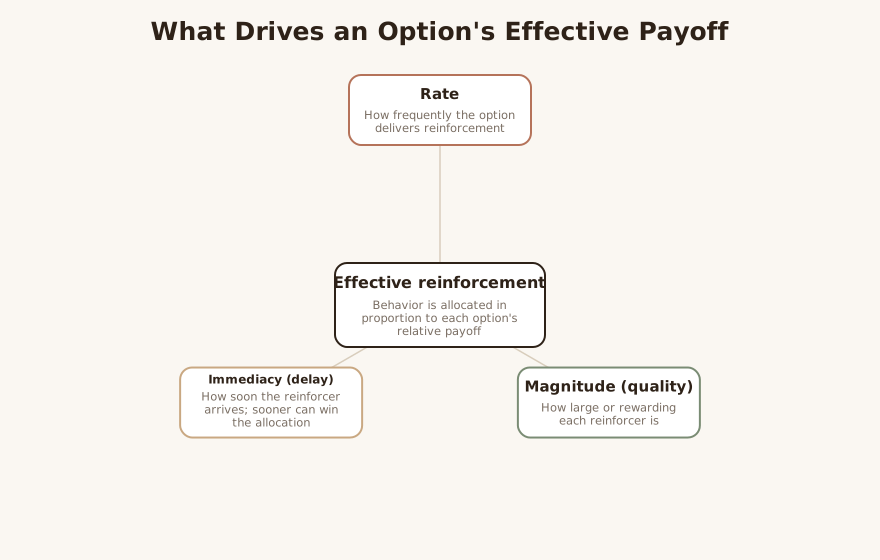
Second, relative reinforcement drives relative behavior: doubling the reinforcement for one option, or halving it for the other, shifts the behavioral distribution toward the richer alternative 24. Reinforcement here is multidimensional, since rate, magnitude (quality), and immediacy (delay) all contribute to an option’s effective payoff, so a less frequent but larger or sooner reinforcer can still win the allocation 23.
Third, the generalized matching law is the form clinicians should actually carry in their heads. Written logarithmically, log(B₁/B₂) = s·log(R₁/R₂) + b, it introduces sensitivity (s), “the amount of change in behavior associated with each change in reinforcement,” and bias (b), “how much preference the organism has for either behavior that cannot be accounted for by reinforcement alone”; strict matching is the special case where sensitivity equals 1 and bias equals 0 25.
Fourth, real behavior usually undermatches: sensitivity values average around 0.8 rather than the ideal 1.0, so organisms typically shift less than perfect matching would predict 5. Undermatching (sensitivity below 1) means too few responses go to the richer alternative, overmatching (above 1) the reverse, and a non-zero bias indicates preference independent of reinforcement rate, such as a side preference 25.
Fifth, the engine beneath all this is that all behavior competes against background reinforcement: every measured response occurs against a backdrop of extraneous reinforcement from everything else the organism could be doing, so the absolute rate of any one behavior depends on the total reinforcement available in the context, not its own contingency alone 13LLM. Raising the reinforcement available for other behavior can therefore reduce a target behavior even if nothing about the target’s own contingency changes 1LLM.
Interventions & Techniques
The matching law does not deliver a single named procedure; it supplies the rationale for a family of reinforcement-based interventions and a way to tune them 2LLM. Its central practical instruction is to engineer the environment so that the desired behavior captures the larger share of reinforcement. As the practitioner tutorial puts it, clinicians can “engineer the environment to favor appropriate responses by arranging contingencies that make it less effortful for the learner to obtain high rates of immediately available, high quality rewards for the desired behavior” 2. Every word there is a lever: rate, immediacy, quality, and effort 2.
In applied behavior analysis, the law is the logic behind differential reinforcement of alternative behavior. Problem behavior persists because “if one behavior is reinforced more often, responses tend to favor that behavior,” so the intervention reinforces an appropriate alternative more richly while withholding reinforcement from the problem behavior, shifting the allocation 4. A canonical move is to reinforce an appropriate communicative response, “like using words or gestures,” more frequently than the problem behavior it replaces, so the matching ratio tips toward communication 4. The four tunable dimensions follow directly from the law’s components: increase the rate at which the desired behavior is reinforced relative to its competitors; raise its reinforcer quality/magnitude, since magnitude enters the effective payoff; deliver that reinforcer with greater immediacy, exploiting the fact that a client may prefer “sooner rewards over higher-quality ones”; and lower the response effort required, because a high-effort “correct” response loses the competition even when its reinforcement is nominally favorable 24.
A notable advantage is that this approach “minimizes the heavy reliance on punishment or extinction procedures that can have adverse side effects like extinction bursts or aggression,” because it works by enriching an alternative rather than suppressing the target 4.
LLM-generated illustrative example (not a guideline): An eight-year-old screams to escape difficult worksheets; screaming reliably ends the task within seconds. A matching-law analysis frames screaming and hand-raising as two responses competing for the same reinforcer, escape. The team makes hand-raising pay better on every dimension: a raised hand earns an immediate brief break (immediacy and rate), the break is paired with a preferred activity (quality), and worksheets are trimmed to an easier level so requesting help is low-effort. As hand-raising’s share of reinforcement rises, its share of behavior rises with it 24LLM.
Evidence Base
The maturity of the matching law as an empirical phenomenon is best described as established: it is one of the most quantitatively replicated relations in the behavioral sciences, originally demonstrated in pigeons and subsequently confirmed across species and response types, including both the group aggregate and individual animals in rats responding on concurrent schedules 527. Its reach extends to naturally occurring human behavior outside the laboratory: stereotypic pain behaviors in chronic pain patients have been shown to relate hyperbolically (as Herrnstein’s single-response equation predicts), rather than proportionally, to reinforcement from significant others, adding generality to the law as a descriptive model 6. In applied human work, matching equations have “accounted for” between roughly 63% and 99.7% of the variance in children’s behavior across studies, with individual clients’ data sometimes falling “almost perfectly along this line” 2. The practitioner tutorial concludes that matching provides “a robust analytical tool in the description of behavior-environment interactions” 2.
Honesty requires three qualifications. First, the strict matching law is more the exception than the rule in real data; the generalized form, with its sensitivity and bias parameters, is what actually fits, and the typical sensitivity near 0.8 means undermatching is the norm rather than an artifact 5. Second, the law is primarily descriptive: it characterizes how behavior is allocated under known contingencies extremely well, but prediction in the field requires measuring reinforcement the clinician usually cannot fully observe, since real environments are saturated with uncontrolled background reinforcement 13LLM. Third, the leap from “matching describes allocation” to “manipulating relative reinforcement will reliably fix this problem” is supported but not automatic; it depends on correctly identifying what is actually reinforcing the competing behavior, an empirical question answered by functional assessment, not by the law itself 24LLM.
Populations & Indications
Because the matching law is a general principle of choice, its “indications” are less about diagnostic categories than about any situation in which a person is allocating behavior between a problematic option and a preferable one 2LLM. The clearest applied literature sits in applied behavior analysis with children and people with developmental and intellectual disabilities, where the tutorial documents matching applications across developmental disabilities (problem versus appropriate behavior), education (math-problem completion and task selection), ADHD (math-task performance and medication effects), and classroom management (problem behavior and attention-seeking) 24.
People with autism spectrum disorder and other developmental and intellectual disabilities are the populations most often served through ABA’s matching-derived interventions, where reinforcing functional communication over problem behavior is a daily application 24LLM. Children with disruptive behavior and noncompliance are addressed by the same allocation logic, as are classroom populations where attention is the operative reinforcer 2LLM. The law’s reach into substance use disorders and gambling disorder comes through behavioral economics: addictive and gambling behaviors are analyzed as choices that capture a large share of behavior because they deliver frequent, immediate, high-magnitude reinforcement relative to slower, more effortful healthy alternatives, exactly the configuration the law predicts will dominate allocation 5LLM. The same descriptive reach has been demonstrated in chronic pain syndrome, where pain and healthy behaviors stand in an inverse relationship governed by their reinforcement from others 6.
Problems-for-Work
The matching law turns a wide range of presenting problems into the same tractable question: which alternative is currently capturing the larger share of reinforcement, and how can that share be redistributed 24LLM?
- Problem behavior and challenging behavior (tantrums, disruption, aggression) are reframed as the favored option in a two-way allocation; the intervention enriches an appropriate alternative until it out-competes the problem behavior 42.
- Self-injurious behavior, when it functions to produce attention, escape, or sensory input, is analyzed as a response whose reinforcement share must be undercut by making a safe alternative pay more on rate, immediacy, quality, and effort 24LLM.
- Noncompliance and off-task behavior often reflect bias toward easier tasks: when material is above a student’s instructional level, the student shows bias toward easier responses “even when reinforcement favors the more effortful response” 2.
- Impulsivity and choice/allocation problems map onto sensitivity to delay: when a client systematically prefers “sooner rewards over higher-quality ones,” the analysis localizes the problem to immediacy and points the intervention there 2.
- Substance use disorder and gambling disorder are framed as the dominant option in a competition between immediate, dense reinforcement and delayed, sparse alternatives; widening healthy reinforcement and raising the cost or effort of the addictive option shifts allocation, the conceptual basis of contingency management 5LLM.
LLM-generated illustrative example (not a guideline): A client in early recovery describes weekday evenings as the high-risk window. A matching-law formulation treats “use” and “non-use activity” as competing responses; right now use wins because it is immediate, reliable, and effortless, while the alternatives are delayed and require planning. The plan deliberately stocks the evening with frequent, accessible, genuinely rewarding non-use activities and arranges immediate reinforcement for showing up to them, so the relative payoff of the healthy alternative climbs 5LLM.
Contraindications, Cautions & Cultural Humility
The matching law is a description of how reinforcement allocates behavior, so the cautions concern misapplication of the framing rather than a contraindicated population LLM. The first caution is against reducing a person to a payoff calculation. The law explains the form of choice allocation; it does not license treating a client’s distress, meaning, or context as nothing but reinforcement ratios, and a clinician who narrates suffering purely in those terms has overreached the construct 3LLM. Bias and undermatching are reminders that behavior carries preferences and histories the schedule does not capture, which is precisely where individual, cultural, and developmental difference lives 25LLM.
The second caution is empirical humility about what is actually reinforcing. Matching analyses repeatedly reveal “idiosyncratic biases for reinforcer dimensions,” so what the clinician assumes is rewarding may not be the operative reinforcer; assuming rather than assessing is the most common way matching-based plans fail 24LLM. The third caution is that enriching an alternative is not the same as suppressing a dangerous behavior on its own timeline; for behaviors with imminent risk, such as severe self-injury, allocation-shifting is a component of a safety-anchored plan, not a substitute for one 2LLM.
Cultural humility enters through the recognition that reinforcer value is not universal. What counts as a high-quality reinforcer, what level of immediacy matters, and what “effort” means are shaped by a person’s culture, community, and circumstances, so reinforcers and alternatives must be identified collaboratively rather than imposed from a generic menu 2LLM. The same allocation logic that explains a “problem” behavior can be turned, uncomfortably, on the environments that starve people of accessible healthy reinforcement, which reframes some apparent individual deficits as features of an impoverished reinforcement context 13LLM.
Treatment-Plan Suggestions & SMART Objectives
| Goal | SMART objective (example) | Mechanism |
|---|---|---|
| Identify the competing responses | Within 2 sessions, clinician and client will operationally define the target behavior and at least one appropriate alternative that competes for the same reinforcer | Allocation is between options, so both must be specified 24 |
| Identify the operative reinforcer | Within 3 sessions, complete a functional assessment identifying what reinforces the problem behavior (attention, escape, tangible, sensory) | Matching requires knowing the actual reinforcer, not the assumed one 24 |
| Increase relative reinforcement rate for the alternative | Over 4 weeks, the appropriate alternative will be reinforced at a higher rate than the problem behavior on at least 80% of opportunities | Relative reinforcement rate drives relative behavior 24 |
| Exploit immediacy | Within 2 weeks, reinforcement for the alternative will be delivered within seconds of the response | Immediacy is a payoff dimension the law and the client’s delay-bias make pivotal 2 |
| Raise reinforcer quality | Within 2 weeks, the alternative will earn a client-identified high-preference reinforcer rather than a generic one | Magnitude/quality enters the effective payoff 2 |
| Reduce response effort | Within 2 weeks, task or response demands for the desired behavior will be lowered to the client’s instructional level | High effort makes a “correct” response lose the allocation even when reinforced 2 |
| Enrich background reinforcement | Over 6 weeks, the client will add at least 3 accessible, frequently available sources of healthy reinforcement to high-risk contexts | Absolute rate of a behavior depends on total available reinforcement 13 |
| Verify the shift in allocation | Across 8 weeks, the proportion of appropriate-alternative responses to total relevant responses will increase session over session | The dependent measure of matching is relative, not absolute, rate 2 |
Common Misconceptions
The most common misconception is that reinforcement strengthens a behavior in isolation. The matching law insists that behavior is always allocated relative to alternatives, so a behavior’s rate depends on the competition, not on its own contingency alone 23. A second is that behavior should match reinforcement exactly; in practice it usually undermatches, with sensitivity averaging about 0.8, which is why the generalized form is the realistic one 52. A third is that only rate matters; magnitude (quality) and delay (immediacy) are full dimensions of payoff, and a client may be governed more by immediacy than by rate or quality 2. A fourth is that the solution to a problem behavior is to punish or extinguish it; the matching-law approach instead enriches an alternative and thereby “minimizes the heavy reliance on punishment or extinction procedures that can have adverse side effects” 4. A fifth is that the matching law predicts behavior; it primarily describes allocation given known reinforcement, and prediction in the field is limited by the clinician’s inability to measure the background reinforcement the law itself says is operating 13LLM. A final one is that matching reduces people to economic robots; the bias parameter exists precisely because behavior carries preferences and histories that reinforcement rate does not explain 25LLM.
Training & Certification
There is no certification in “the matching law”; it is a foundational principle taught within behavior-analytic training and applied by practitioners working in applied behavior analysis 4LLM. Competence in using it clinically rides on competence in the broader skill set of functional behavior assessment and reinforcement-based intervention, since the law is only as good as the clinician’s identification of the operative reinforcers and competing responses 24LLM. The practitioner literature is explicit that matching is offered as an analytical tool for describing behavior-environment interactions, which a trained clinician then uses to design and adjust contingencies 2.
For most therapists, the relevant learning path is two-layered: first, understanding the conceptual law well enough to reframe presenting problems as allocation problems, which any clinician can adopt; and second, the technical fluency to fit and interpret matching relations and to run the differential-reinforcement procedures that follow, which sits within formal behavior-analytic education and supervised practice 24LLM.
Key Terms
- Matching law: the principle that the relative rate of a response matches the relative rate of reinforcement it produces, B₁/B₂ = R₁/R₂ 2.
- Strict (perfect) matching: the special case in which behavior is allocated in exact proportion to reinforcement, with sensitivity 1 and bias 0 25.
- Generalized matching law: the working form, log(B₁/B₂) = s·log(R₁/R₂) + b, adding sensitivity and bias to fit real data 2.
- Sensitivity (s): “the amount of change in behavior associated with each change in reinforcement”; typically averages near 0.8 25.
- Bias (b): “how much preference the organism has for either behavior that cannot be accounted for by reinforcement alone” 2.
- Undermatching: sensitivity less than 1; the organism shifts toward the richer option less than reinforcement alone would predict 25.
- Overmatching: sensitivity greater than 1; the organism over-allocates to the richer option 2.
- Concurrent variable-interval schedules: the arrangement of two simultaneously available, intermittently reinforced options used to measure choice allocation 5.
- Melioration: the process by which organisms shift responding to “improve the local rates of reinforcement,” moving toward the better alternative until ratios equalize 5.
- Extraneous (background) reinforcement: the unmeasured reinforcement from everything else in the environment, against which any single response competes 13.
- Differential reinforcement of alternative behavior: reinforcing an appropriate alternative while withholding reinforcement from the problem behavior, the matching-law-based ABA technique 4.
Resources & Further Reading
▶ Watch — a video introduction to this concept:
- Formal Properties of the Matching Law — Herrnstein (1974), Journal of the Experimental Analysis of Behavior
- The Matching Law: A Tutorial for Practitioners — PMC
- On the Law of Effect — Herrnstein (1970)
- What Is Matching Law and How Does It Apply to ABA — Magnet ABA
- Matching Law — Wikipedia
- Response-Reinforcement Relationships in Chronic Pain Syndrome: Applicability of Herrnstein’s Law — PubMed
- The Matching Law in and Within Groups of Rats — PubMed
Reflective / Supervision Questions
- For this client’s target behavior, have I actually specified the alternative it is competing against, or am I still thinking about the problem behavior in isolation? 24
- Do I know what is genuinely reinforcing the problem behavior, by assessment rather than assumption, given how often matching reveals idiosyncratic reinforcer preferences? 24
- On which dimension is the problem behavior winning — rate, immediacy, quality, or low effort — and is my plan targeting that specific dimension? 2
- Have I made the appropriate alternative truly easier and more immediately reinforcing than the problem behavior, or have I designed a high-effort “correct” response that will lose the competition? 2
- Am I enriching an alternative, or merely trying to suppress the target behavior in ways that risk extinction bursts and aggression? 4
- Where am I treating the client as a payoff calculator, and what preferences, history, and cultural meaning is the bias term reminding me I have not accounted for? 25
- Is the reinforcement environment itself impoverished in a way that makes the “problem” behavior the rational allocation, and is that a target for change rather than the client? 13