
Type & Discipline
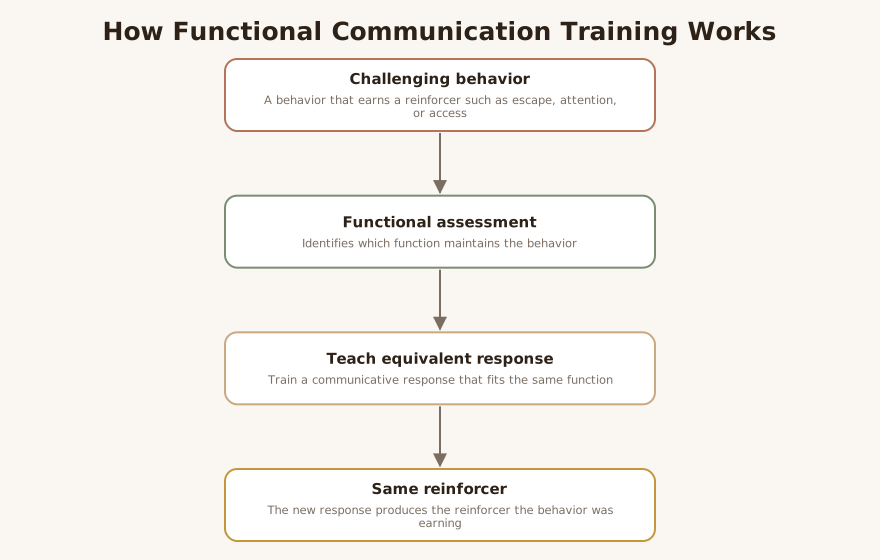
Functional Communication Training (FCT) is a behaviorally based procedure used to increase effective communication and reduce inappropriate or challenging behavior 4. It sits squarely within applied behavior analysis and belongs to the broader family of communication skills training, but its defining feature is narrower and more precise than “teaching communication” in the everyday sense 4. FCT works by identifying the function — the reinforcer — that a challenging behavior is producing, and then teaching the person an alternative communicative response that produces that same reinforcer more efficiently 4. It is best understood as a specific application of differential reinforcement of an alternative behavior, in which the alternative being reinforced is, by design, an act of communication 5LLM.
For practicing clinicians, the most useful framing is that FCT is not a freestanding therapy but a function-based intervention package embedded inside applied behavior analysis LLM. It assumes that behavior is lawful and purposeful: a child who hits, screams, or injures themselves is, in behavioral terms, “communicating” something through that behavior, even if no words are involved 4. FCT takes that implicit message seriously and gives the person a socially acceptable response that says the same thing and gets the same result 4. Because the new response and the old behavior compete for the same reinforcer, strengthening the former tends to weaken the latter 5LLM.
Creators & Lineage
FCT was first introduced by Edward Carr and V. Mark Durand in 1985 4. Their original paper, “Reducing behavior problems through functional communication training,” published in the Journal of Applied Behavior Analysis, demonstrated that when challenging behavior was maintained by escape from demands or by adult attention, teaching children to request that same consequence verbally sharply reduced the problem behavior 1. The procedure they described — assess the function first, then teach a functionally matched communicative replacement — became the template for everything that followed 14.
Carr and Durand’s contribution was to fuse two strands of behavioral work that had often run in parallel: functional assessment of problem behavior on one side, and communication and language intervention on the other LLM. Rather than treating problem behavior as something to be suppressed and communication as a separate curricular goal, they showed the two were the same problem viewed from opposite ends LLM. Durand and Carr extended this in subsequent work showing that the gains were not fragile laboratory effects: teaching functionally equivalent communication produced reductions that transferred across new tasks, environments, and teachers, and remained stable from 18 to 24 months after training 2. That demonstration of durability and generalization, unusual in the behavior-reduction literature, helped establish FCT as a durable function-based alternative to punishment-based approaches 2LLM.
Core Principles
The first principle is function over form 4. FCT does not ask what a behavior looks like but what it accomplishes 4. The literature consistently identifies three primary functions that maintain challenging behavior and that FCT addresses: escaping unpreferred situations or demands, gaining access to attention from others, and gaining access to preferred objects and activities 4. (Behavior maintained purely by automatic or sensory reinforcement — where the behavior is its own reward and no social mediator is involved — is a poorer fit, because there is no socially mediated consequence for communication to request 5LLM.) Identifying which function is operating is the indispensable first step 4.
The second principle is functional equivalence 5. The taught communicative response must produce the same reinforcer the problem behavior was producing, not merely a desirable behavior in the abstract 5. A child whose screaming gets them out of a hard worksheet must be taught to request a break — teaching them to request a toy would not address the escape function and would leave the screaming intact LLM. This is why a well-conducted functional behavior assessment is essential and why a poorly chosen communication response will prevent skill acquisition 4.
The third principle is response efficiency LLM. For the new response to outcompete the old behavior, it generally needs to be at least as easy and at least as reliably reinforced LLM. Years of refractory self-injury have made the problem behavior an extremely efficient way to get a result; a communicative alternative that is harder to perform, slower to be honored, or less reliably reinforced will lose the competition LLM. The practical corollary, drawn directly from Carr and Durand’s framework, is that the alternative response must be reinforced richly and immediately, at least at first, while the problem behavior is placed on extinction 15.
Interventions & Techniques
In practice FCT follows a recognizable sequence 4. First, identify the function of the challenging behavior through a functional behavior assessment, distinguishing escape, attention, and access to tangibles 4. Second, select and teach an alternative communicative response that serves the same purpose 4. Third, provide reinforcement — deliver the maintaining reinforcer — when the person uses the appropriate communication 4. Fourth, withhold reinforcement (extinction) following the inappropriate behavior, so that communication, not the problem behavior, now produces the desired outcome 4.
A central design decision is the mode of the communicative response, which must be matched to the learner’s repertoire 4. Research supports a wide range of request forms: spoken words or phrases, manual sign language, picture exchange, voice-output communication devices, and pointing 4. For a learner with no vocal speech, a single picture card or a button on a device can be the response; for a more verbal learner, a phrase such as “Help, please” or “Can I have a break?” may be taught 4LLM. In their extension study, Durand and Carr taught students specific assistance-seeking and attention-getting phrases to replace challenging behavior with verbal equivalents 2.
Two further techniques carry the intervention from acquisition to durability LLM. Schedule thinning gradually moves the learner from receiving the reinforcer every single time they communicate toward tolerating delays, and learning that the answer is sometimes “not now” — a critical step, because a world that honors every request instantly is not the world the person lives in 5LLM. Programming for generalization and maintenance deliberately practices the new response across settings, tasks, and communication partners, rather than assuming a skill trained in one room with one clinician will spontaneously appear elsewhere 2LLM.
LLM-generated illustrative example (not a guideline): A non-verbal child engages in head-hitting during table work; assessment indicates the behavior is escape-maintained because demands are paused when she hits. The clinician teaches her to hand over a “break” card; each card exchange immediately earns a 30-second break, while head-hitting no longer pauses the task. Once card use is reliable, the clinician thins the schedule so a break sometimes follows two or three completed items, building tolerance for delay LLM.
Evidence Base
The maturity of FCT is best labeled established LLM. It is one of the most extensively researched and widely used function-based interventions for severe problem behavior, with a foundation dating to Carr and Durand’s 1985 demonstration and reinforced by decades of replication across response modes, functions, and populations 14. Its standing rests both on the breadth of single-case and applied research and on the early demonstration that its effects maintain and generalize, which is precisely where many behavior-reduction procedures fail 2.
Honesty about the evidence requires two qualifications. First, classifications can be population-specific: the National Autism Center, as summarized by the Association for Science in Autism Treatment, classified FCT as an emerging intervention for individuals with autism under the age of 22 and an established intervention for adults over 22 4. The label thus depends on which evidence body and which age group one is citing, and “established” should not be read as “uniformly proven for every learner” 4LLM. Second, much of the strongest evidence comes from single-case experimental designs — multiple-baseline and reversal designs — rather than large randomized controlled trials, which is characteristic of the applied behavior analysis literature and a real limitation when comparing FCT to psychotherapies evaluated by group designs 2LLM. Within those constraints, the durability evidence is notable: Durand and Carr documented effects that transferred across new tasks, environments, and teachers and held from 18 to 24 months post-training 2.
Populations & Indications
FCT is indicated wherever challenging behavior appears to serve a communicative function and the person lacks an efficient appropriate way to obtain the same outcome 4. It has been used effectively across participants with intellectual and developmental disabilities, autism spectrum disorder, other health impairments, and multiple disabilities, and it benefits both children and adults 4. It is a frontline approach for people with autism spectrum disorder and children with developmental disabilities, populations in which severe self-injury, aggression, and disruption frequently co-occur with limited expressive communication 4LLM.
The intervention is especially well suited to individuals with minimal or emerging verbal communication, because the taught response can be non-vocal — a sign, a picture, or a device — and need not wait on spoken language 4. It is equally appropriate for adults with developmental disabilities, where the evidence classification is strongest, and for people with severe challenging behavior whose problem behavior has become an entrenched and dangerous means of getting needs met 4. The common thread across all of these is a behavior that is functional but harmful, paired with a communicative deficit that FCT directly targets 4LLM.
Problems-for-Work
- Self-injurious behavior. When head-hitting, biting, or scratching is maintained by escape or attention, the person is taught to request the break or attention directly, with the self-injury placed on extinction 14.
- Aggression and property destruction. Hitting others or destroying materials to obtain a tangible or to escape a demand is replaced by a request that produces the same outcome more efficiently 4LLM.
- Tantrums and disruptive behavior. Screaming or dropping to the floor to gain attention is replaced by an attention-getting phrase or signal, reinforced immediately at first 24.
- Escape-maintained behavior. Behavior that works by terminating demands is addressed by teaching a “break” or “help” request, then thinning toward delay tolerance 15.
- Attention-maintained behavior. Behavior that works by recruiting adult attention is addressed by teaching an appropriate bid for attention 12.
- Communication deficits. The underlying expressive deficit is itself a target: FCT builds a functional request repertoire where one was absent 4LLM.
LLM-generated illustrative example (not a guideline): An adult with intellectual disability bangs on the table when staff move away. A functional assessment points to attention. Staff teach him to press a “come here” button, respond to every press at first with brief attention, and stop responding to table-banging. Over weeks they thin the schedule so he learns to wait briefly between presses LLM.
Contraindications, Cautions & Cultural Humility
FCT has no medical contraindication, but it carries clear cautions LLM. The largest is assessment dependence: the entire procedure hinges on correctly identifying the function, and a poorly chosen communication response — one that does not match the maintaining reinforcer — will prevent skill acquisition and can leave the dangerous behavior untouched 4. FCT should not be attempted as a generic “teach them to ask nicely” strategy detached from a functional behavior assessment 4LLM.
A second caution concerns behavior maintained by automatic reinforcement 5. When a behavior is its own reward and no other person delivers the reinforcer, there is no social consequence for a communicative response to request, and FCT alone is a poor fit; other behavioral procedures are typically indicated 5LLM. A third caution is the extinction and thinning phase, where placing the long-reinforced problem behavior on extinction can provoke a temporary increase in its intensity, and where moving too quickly to delay or denial can overwhelm a learner who has not yet built tolerance — both require careful, data-guided pacing and a plan for safety 5LLM.
Cultural humility matters because the choice of which behaviors to reduce and which communicative forms to teach is never value-neutral LLM. Targets should be anchored in the learner’s safety, dignity, and quality of life and developed with the family rather than imposed as conformity to an adult-convenient norm LLM. With autistic and neurodivergent learners in particular, responsible practice honors all communication — including non-speech modes the family already uses — and does not treat spoken words as the only legitimate goal 4LLM.
Treatment-Plan Suggestions & SMART Objectives
| Goal | SMART objective (example) | Mechanism |
|---|---|---|
| Identify the function before intervening | Within 2 weeks, clinician completes a functional behavior assessment identifying the maintaining reinforcer for the target behavior | Functional assessment of escape, attention, or tangible function 4 |
| Establish a functionally matched request | Within 6 weeks, client emits the taught communicative response in 80% of trial opportunities across 3 consecutive sessions | Differential reinforcement of an alternative communicative response producing the same reinforcer 45 |
| Reduce the challenging behavior | Within 8 weeks, frequency of the target challenging behavior decreases by 50% from baseline, data-tracked | Reinforce communication; place problem behavior on extinction 14 |
| Build delay tolerance | Within 10 weeks, client waits up to 1 minute after a request before reinforcement in 70% of opportunities | Schedule thinning toward delay and denial tolerance 5 |
| Generalize across partners and settings | Within 12 weeks, client uses the response with 2 new communication partners in 2 new settings | Programming for generalization across people and environments 2 |
| Maintain gains over time | At a 3-month follow-up, the communicative response and the reduced rate of problem behavior are sustained | Maintenance programming; durability of functionally equivalent communication 2 |
| Match the response mode to the learner | Within 4 weeks, client reliably uses an appropriate communication mode (sign, picture, device, or speech) | Mode selection matched to the learner’s repertoire 4 |
Common Misconceptions
- “FCT just means teaching the person to talk.” It specifically means teaching a communicative response that produces the same reinforcer the problem behavior was producing, identified through functional assessment — not generic language instruction 45.
- “Any appropriate request will do.” The request must be functionally equivalent; a request that does not match the maintaining function leaves the problem behavior intact and can block skill acquisition 45.
- “FCT requires spoken language.” The communicative response can take many forms — sign, picture exchange, voice-output device, or pointing — so the procedure is available to learners with no vocal speech 4.
- “Teaching the new response is enough.” Without placing the problem behavior on extinction and reinforcing communication richly and immediately, the old behavior often remains the more efficient option 145.
- “It works only briefly in the training room.” The defining early evidence showed gains that transferred across tasks, settings, and teachers and held for 18 to 24 months — though generalization and maintenance must be deliberately programmed, not assumed 2LLM.
Training & Certification
FCT is a technique within applied behavior analysis rather than a separately credentialed modality, so there is no certification in FCT as such; competence is acquired within behavior-analytic training LLM. Clinicians typically learn it as part of preparation as a Board Certified Behavior Analyst or under behavior-analytic supervision, where it is taught alongside functional behavior assessment, differential reinforcement, extinction, and schedule thinning — the procedures FCT depends on 4LLM. Because the intervention stands or falls on the quality of the functional assessment, responsible use requires training in assessing behavioral function, not merely in delivering a communication curriculum 4. Practitioners outside behavior analysis who encounter FCT in interdisciplinary teams — speech-language pathologists, special educators, and mental health clinicians — should coordinate with a qualified behavior analyst rather than implementing the extinction and thinning components without that grounding LLM.
Key Terms
- Function (of behavior) — the reinforcer a behavior produces; in FCT, identified as escape, attention, or access to tangibles 4.
- Functional behavior assessment — the process of identifying the maintaining reinforcer of a challenging behavior; the indispensable first step 4.
- Functional equivalence — the property of the taught response producing the same reinforcer as the problem behavior, so the two compete 5.
- Differential reinforcement of alternative behavior — reinforcing a chosen alternative response while withholding reinforcement from the problem behavior; FCT is a communication-specific case 5.
- Extinction — discontinuing the reinforcement that previously maintained the problem behavior 4.
- Schedule thinning — gradually increasing the response requirement or delay before reinforcement, building delay and denial tolerance 5.
- Response efficiency — the relative ease, speed, and reliability of reinforcement of a response, determining whether the new response outcompetes the old behavior LLM.
- Generalization and maintenance — the transfer of gains across settings, tasks, and people, and their persistence over time 2.
Resources & Further Reading
▶ Watch — a video introduction to this concept:
- Reducing behavior problems through functional communication training — Carr & Durand (1985), JABA 1
- Functional communication training: maintenance and application in new settings — Durand & Carr (PMC) 2
- Functional Communication Training: A Review and Practical Guide — Behavior Analysis in Practice 3
- Functional Communication Training (FCT) — Association for Science in Autism Treatment 4
- Functional communication training — Wikipedia 5
Reflective / Supervision Questions
- Have I completed a functional behavior assessment that actually identifies the maintaining reinforcer, or am I guessing at function and teaching a response that may not match it? 4
- Is the communicative response I have chosen functionally equivalent — does it produce the same outcome the problem behavior was producing? 45
- Is the new response efficient enough to outcompete the problem behavior in ease, speed, and reliability of reinforcement, especially early on? 15
- Have I planned the extinction component with adequate attention to safety and the possibility of a temporary increase in the problem behavior? 45
- Am I thinning the schedule and building delay tolerance at a pace the learner can manage, rather than honoring every request indefinitely or withholding too soon? 5
- Have I deliberately programmed for generalization across settings, tasks, and partners, and for maintenance over months — rather than assuming the skill will transfer on its own? 2
- Whose goals do the target behaviors and chosen communication mode serve, and have I honored the learner’s existing communication and the family’s input rather than a conformity norm? 4LLM