
Type & Discipline
Kohlberg’s stages of moral development is a stage theory from developmental psychology, not a treatment or therapeutic modality 3. It describes how moral reasoning — the thinking process a person uses to decide whether an action is right or wrong — develops across the lifespan, rather than prescribing how to treat a clinical condition 4. The theory organizes moral judgment into three broad levels and six sequential stages, and it holds that this progression is driven by underlying cognitive development 1. For clinicians, it functions as an assessment lens and a developmental map that sits inside an existing modality, such as moral-dilemma discussion within cognitive behavioral therapy or family work, rather than as a standalone therapy in its own right LLM. Understanding both its structure and its well-documented limits keeps any clinical application appropriately modest LLM.
Creators & Lineage
The theory was developed by the American psychologist Lawrence Kohlberg, who began the work in his 1958 doctoral dissertation at the University of Chicago and elaborated it until his death in 1987 1. Kohlberg built directly on Jean Piaget’s 1932 account of moral judgment in the child, extending Piaget’s two broad phases into a more differentiated six-stage sequence that continues into adulthood 4. Like Piaget, he was a cognitive-developmental constructivist: he held that moral understanding is actively constructed through stages of increasing adequacy that occur in an invariant order and cannot be skipped 1. His philosophical lineage runs through Kantian ethics, and he treated justice — built from operations of equality and reciprocity — as the organizing principle of mature moral reasoning 1.
The most consequential figure in the theory’s later history is Carol Gilligan, who worked as Kohlberg’s research assistant before publishing an influential critique in the 1980s 2. Gilligan argued that Kohlberg’s framework was androcentric and proposed an alternative “ethic of care,” grounded in relationship and responsibility, to stand alongside his justice-centered model 2. The broader intellectual context of the theory is cognitive-developmental psychology and the field of moral psychology, where Kohlberg’s stages remain a foundational reference point even where they are contested LLM.
Core Principles
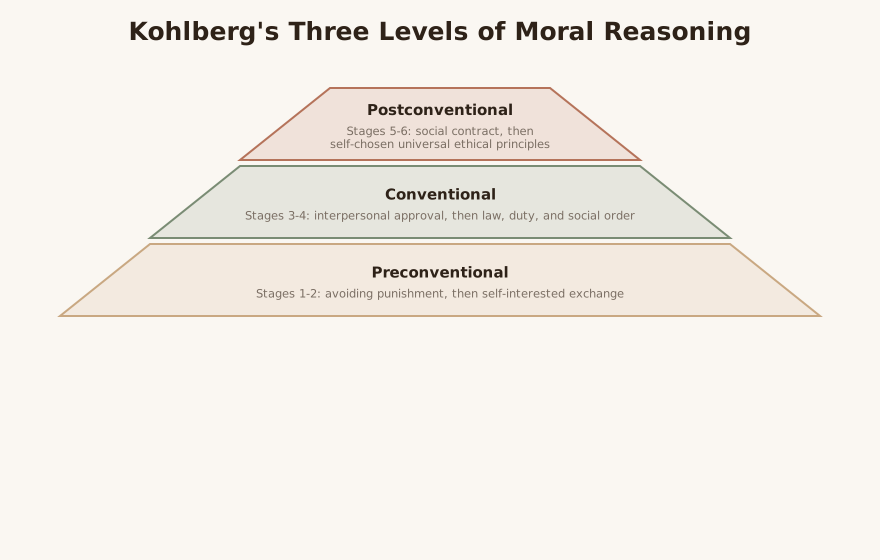
Kohlberg proposed three levels, each containing two stages, defined not by the moral choice a person makes but by the reasoning behind it 2. At the preconventional level, typical of younger children, morality is external: Stage 1 reasoning judges acts by their consequences and centers on avoiding punishment and obeying authority, while Stage 2 reasoning is instrumental and self-interested, framed as “what’s in it for me” and simple reciprocal exchange 1. At the conventional level, characteristic of older children, adolescents, and most adults, morality is anchored in social relationships: Stage 3 seeks interpersonal approval and being seen as a “good” person, while Stage 4 emphasizes law, duty, and maintaining social order for its own sake 1.
At the postconventional level, morality becomes principled and abstract: Stage 5 treats laws as social contracts that exist for the common good and can be questioned or changed when they fail to protect individual rights, holding for example that the protection of life can outweigh breaking a law 2. Stage 6, the apex, reasons from self-chosen universal ethical principles — justice, equality, and the dignity of persons — that take precedence over any particular law 2. Two structural commitments define the theory: the stages are an invariant, sequential progression in which higher stages cannot be reached without passing through lower ones, and movement is driven by cognitive development and perspective-taking rather than by simple instruction 4. Crucially, attainment thins sharply at the top: most adults reason predominantly at Stage 4, postconventional reasoning is uncommon, and Stage 6 proved so rare that Kohlberg himself struggled to identify people who consistently reasoned there 1.
Interventions & Techniques
Because Kohlberg’s stages constitute a theory rather than a therapy, “interventions” here means structured ways to embed the framework inside recognized clinical, educational, and supervisory activities LLM. The first and most direct application is moral-dilemma discussion: presenting an age-appropriate ethical dilemma and inviting the person to articulate their reasoning and weigh competing perspectives, which is the same method Kohlberg used to elicit and study moral judgment 2. The aim is to surface the structure of someone’s reasoning, not to extract a “correct” answer 2.
A second technique, drawn from the educational application of the theory, is plus-one teaching: deliberately introducing reasoning pitched one stage above the person’s current level to create productive cognitive conflict that pulls development forward, since the theory holds that exposure to slightly more advanced reasoning is what drives progression 2. A third is role-play and perspective-taking, which targets the perspective-taking capacity the theory treats as the engine of moral growth by having the person reason from another’s standpoint 2. In family and parenting work, the educational literature emphasizes consistent modeling of moral behavior, cultivating empathy through caring activity, and reflecting explicitly on family values, on the premise that children learn more from observation than from lectures 2.
LLM-generated illustrative example (not a guideline): A clinician working with a 15-year-old who justifies shoplifting purely in terms of “not getting caught” (Stage 1–2 reasoning) does not lecture him on right and wrong. Instead the clinician runs a structured dilemma about a friend’s trust, then offers a deliberately plus-one reframe — “what would it mean to your friend if he found out?” (Stage 3) — to invite the next step in reasoning without shaming the current one LLM.
Evidence Base
Kohlberg’s theory is best described as established — but “established” here means historically influential, foundational, and heavily cited in developmental and moral psychology, not validated as a clinical intervention 3. The stage sequence has reasonable empirical support at the lower levels: cross-cultural research finds that Stages 1 through 3 appear with reasonable consistency across societies 1. The theory’s standing weakens at the higher stages and at the boundary with clinical practice, and honest use requires naming several well-documented limits LLM.
First, the upper stages are empirically fragile: postconventional reasoning is uncommon, and statistical analyses have supported Stages 1 through 5 while finding no clear empirical basis for Stage 6 as a distinct, observable stage 1. Second, there is a substantial and well-replicated gap between moral reasoning and moral behavior; how a person scores on a dilemma correlates only weakly with how they actually act, because habit, peer pressure, and real consequences shape conduct beyond reasoning 4. Critics in the social-intuitionist tradition, such as Jonathan Haidt, argue further that moral judgments are often intuitive and that the articulate justifications Kohlberg scored may be post-hoc rationalizations 1. Third, the original sample was 72 Chicago boys aged 10 to 16, an all-male sample that grounds the gender-bias critique discussed below 2. Fourth, the artificial, hypothetical nature of the dilemmas raises ecological-validity questions, since children in particular have no experience of the scenarios they are asked to judge 2. For clinical purposes there is no outcome evidence that “applying Kohlberg” improves symptoms, because it is not a treatment and has not been studied as one; its value is as a developmental map for understanding reasoning, not as an evidence-based therapy LLM.
Populations & Indications
The theory was built by studying children and adolescents, and those remain its core populations: preconventional reasoning is typical before roughly age nine, conventional reasoning emerges across later childhood and adolescence, and postconventional reasoning, when it appears at all, does so in some adults 4. As a clinical lens it is most naturally indicated wherever the work involves moral reasoning, values, or the meaning of right and wrong to the person, including with emerging adults navigating identity and value commitments LLM. It also applies usefully to educators and parents, both as a population the framework was explicitly translated for and as a delivery channel through which dilemma discussion and modeling reach children 2.
In behavioral-health settings the framework is frequently invoked with forensic populations and justice-involved youth, where understanding the level at which someone reasons about rules, harm, and consequences can inform how interventions are framed — meeting a person who reasons primarily in terms of self-interest or punishment where they are rather than appealing to abstract principles they do not yet use LLM. The indication is reasoning-focused rather than diagnosis-specific: the theory shapes how a clinician understands and engages a person’s moral thinking, not which disorder is being treated, and it should be paired with the actual evidence-based modality doing the therapeutic work LLM.
Problems-for-Work
Several presenting problems map onto a Kohlbergian lens, always as an organizing frame rather than a treatment LLM. For moral reasoning deficits and value clarification difficulties, staging a person’s reasoning helps locate where it is anchored — punishment-avoidance, self-interest, approval-seeking, rule-following, or principle — and the work targets the developmentally next step through dilemma discussion and plus-one reframing 2. For conduct disorder, antisocial behavior, and oppositional defiant disorder, the framework offers a non-pathologizing way to understand reasoning that is stuck at a preconventional, consequence-focused level, informing how rules and consequences are presented — though it never substitutes for the structured behavioral interventions these conditions actually require LLM.
For empathy deficits, the theory’s emphasis on perspective-taking as the engine of moral growth points toward role-play and structured perspective-taking exercises as developmental supports 2. For decision-making difficulties and identity development concerns, particularly in emerging adults, examining the reasoning behind value-laden choices can clarify whether decisions rest on external approval, internalized rules, or self-chosen principles, which is often the live question in identity work 4. Across all of these, the contribution is diagnostic clarity about how a person reasons, which then informs a treatment delivered through an established modality LLM.
LLM-generated illustrative example (not a guideline): A justice-involved 16-year-old repeatedly frames rules as “stupid” and obeys only to avoid detention. Rather than treating this as defiance to be argued down, the clinician recognizes Stage 1–2 reasoning and, within an established behavioral program, uses dilemma discussion to build toward Stage 3 reasoning about how his choices affect people he cares about, pairing the reframe with the program’s concrete contingencies LLM.
Contraindications, Cautions & Cultural Humility
Kohlberg’s stages have no contraindications in the pharmacological sense, but several cautions are essential LLM. The most important is not mistaking a stage for a measure of a person’s worth or pathology: a low stage of moral reasoning describes the structure of someone’s thinking at a point in development, not their value, their intelligence, or a diagnosis, and labeling a client as morally “deficient” is both inaccurate and stigmatizing LLM. A second caution is the reasoning–behavior gap: because moral reasoning predicts conduct only weakly, a clinician must never infer how a person will act from how they reason on a hypothetical dilemma, nor treat advancing someone’s reasoning as evidence that behavior has changed 4.
The deepest caution concerns cultural humility. Kohlberg’s theory was developed within a Western, individualistic frame, and its higher stages privilege abstract, justice-centered, individual-rights reasoning; cross-cultural research finds that postconventional reasoning is uncommon in more traditional and collectivist societies that may instead value respect for authority, community, and relational obligation 2. Treating a justice-and-autonomy hierarchy as a universal standard risks misreading culturally grounded relational or communal moral reasoning as “lower,” which is a serious clinical and ethical error LLM. The gender critique belongs here too: because the original sample was all male, Gilligan argued the framework systematically undervalues a care-oriented moral voice and casts traits like sensitivity to others’ needs as developmental deficiency rather than as a different, equally mature orientation 2. Clinicians should therefore hold the stages as one descriptive lens among several, never as a ladder of moral superiority, and should weight care-based and culturally specific moral reasoning as legitimate in its own right LLM.
Treatment-Plan Suggestions & SMART Objectives
The stage framework can help structure measurable objectives around moral reasoning, values, and perspective-taking within a broader treatment plan; the examples below are illustrative templates to adapt, not prescriptions LLM.
| Goal | SMART objective (example) | Mechanism |
|---|---|---|
| Surface current moral-reasoning level | Within 2 sessions, client will articulate the reasoning behind one real-life value-laden choice during a structured dilemma discussion | Eliciting reasoning structure reveals the developmental anchor 2 |
| Advance reasoning by one developmental step | Over 6 weeks, client will generate at least one “plus-one” justification (one stage above baseline) in a discussed dilemma | Cognitive conflict from slightly advanced reasoning drives progression 2 |
| Build perspective-taking | Within 4 sessions, client will describe a conflict from two other people’s standpoints in role-play on three occasions | Perspective-taking is the proposed engine of moral growth 2 |
| Clarify values vs. external approval | Within 5 sessions, client will distinguish two decisions made for approval from two made on self-chosen principles | Locating reasoning from Stage 3 toward Stage 5 supports identity work 4 |
| Reframe rule-based reasoning in conduct work | Over 8 sessions, client will identify how one rule he dismisses protects a person he cares about, in four logged instances | Moving from self-interest (Stage 2) toward interpersonal concern (Stage 3) 1 |
| Coach a caregiver to scaffold moral reasoning | Within 4 sessions, parent will run one age-appropriate dilemma discussion per week and log the child’s reasoning | Modeling and dilemma discussion are the framework’s parenting applications 2 |
| Connect reasoning to behavior | Over 4 weeks, client will pair each discussed value with one concrete behavioral commitment and log follow-through | Deliberately bridging the reasoning–behavior gap the theory leaves open 4 |
Common Misconceptions
A frequent misconception is that the stages classify whether a person’s decision is right or wrong; in fact the theory scores only the reasoning behind a decision, so two people who reach opposite conclusions can be at the same stage 2. Another is that a higher stage makes someone a “better person” or more moral in conduct, when the theory is explicitly about cognitive structure and correlates only weakly with actual behavior 4. People also assume most adults reach the postconventional level, whereas most adults reason predominantly at Stage 4, and Stage 6 is so rare that its empirical status is doubtful 1.
A further misconception is that the stages are culturally universal in full; while the lower stages show cross-cultural consistency, the higher, individual-rights stages reflect Western individualistic values and are uncommon in many societies 2. Some treat Kohlberg’s framework as gender-neutral, ignoring that it was built on an all-male sample and that Gilligan documented its bias against a care-oriented moral voice 2. Finally, the most consequential clinical misconception is that Kohlberg’s stages are themselves a therapy or an evidence-based intervention; they are a developmental theory whose clinical value is as an assessment and framing lens inside an established modality, not as a treatment with outcome data LLM.
Training & Certification
There is no certification in Kohlberg’s stages of moral development and no credential is required to use the framework, because it is a public, widely disseminated developmental theory rather than a proprietary clinical method LLM. Clinicians typically encounter it in graduate coursework in developmental, lifespan, and educational psychology, and authoritative free summaries are maintained by university and educational sources 4. The most accessible orientations include encyclopedic overviews, lifespan-development course chapters, and applied training materials that lay out the stages, the dilemma method, and the major criticisms 145. A short animated explainer is also widely used as an introduction 6. No formal training is needed to apply the framework ethically, provided it is used as an assessment lens within a modality the clinician is already competent to deliver, and provided its limits — the reasoning–behavior gap, the gender critique, and the cultural bias of its upper stages — are held in view LLM.
Key Terms
Moral reasoning — the thinking process by which a person decides whether an action is right or wrong, which is what the theory classifies, as distinct from the choice itself 4. Preconventional level — Stages 1 and 2, where morality is external and based on avoiding punishment and serving self-interest 1. Conventional level — Stages 3 and 4, where morality rests on social approval and on maintaining law and social order, the level at which most adults reason 1. Postconventional level — Stages 5 and 6, where morality rests on social contract, individual rights, and self-chosen universal ethical principles 2. Invariant sequence — the claim that the stages occur in a fixed order that cannot be skipped, with higher stages built on lower ones 4. Heinz dilemma — Kohlberg’s signature moral dilemma, in which a man considers stealing a drug to save his dying wife, used to elicit the reasoning behind a moral choice 2. Ethic of care — Gilligan’s alternative orientation, grounded in relationship and responsibility for others, offered as a counterweight to Kohlberg’s justice focus 2. Plus-one teaching — the educational technique of presenting reasoning one stage above a learner’s current level to provoke developmental advance 2.
Resources & Further Reading
▶ Watch — a video introduction to this concept:
- Lawrence Kohlberg’s stages of moral development (Wikipedia)
- Kohlberg’s Stages of Moral Development (Simply Psychology)
- Lawrence Kohlberg’s stages of moral development (Britannica)
- Kohlberg’s Stages of Moral Development (Lumen Lifespan Development)
- Kohlberg’s Theory of Moral Development (training PDF, NWOSU)
- Kohlberg’s 6 Stages of Moral Development (Sprouts, video)
Reflective / Supervision Questions
- For a client you currently frame as “defiant” or “manipulative,” what would change if you described the structure of their moral reasoning instead, and which stage best fits the reasoning they actually use? LLM
- When you have seen a client’s moral reasoning grow more sophisticated, did their behavior actually change — and how do you keep the reasoning–behavior gap in view rather than mistaking insight for conduct change? LLM
- How might the Western, justice-centered bias of Kohlberg’s upper stages lead you to misread a client’s relational or community-based moral reasoning as “lower” rather than different? LLM
- Where in your work do you risk treating a moral-reasoning stage as a verdict on a person’s worth rather than a description of their current thinking? LLM
- How do you weight a care-oriented moral voice, of the kind Gilligan described, alongside the justice-oriented reasoning Kohlberg’s framework privileges? LLM