
Type & Discipline
Thermal biofeedback—also called peripheral skin-temperature or “hand-warming” biofeedback—is a discrete biofeedback technique within the broader discipline of applied psychophysiology and behavioral medicine 5. A small thermistor is attached to the fleshy underside of a finger, usually the middle finger of the dominant hand, and the resulting skin temperature is displayed back to the client in real time 5. Fingertip temperature serves as an inexpensive, non-invasive proxy for peripheral blood flow: under sympathetic activation, cutaneous vasoconstriction shunts blood away from the extremities, and the fingers cool; as arousal drops and vasodilation returns, the fingers warm 5. The client’s task is to raise that number—not by effort, but by relaxing—so the temperature trace becomes a moment-to-moment mirror of autonomic tone 5.
Because the signal it trains is vascular rather than electrical or muscular, thermal biofeedback occupies a particular niche among biofeedback modalities, sitting alongside surface electromyography, electrodermal activity, heart-rate variability, and electroencephalographic neurofeedback LLM. Its conceptual simplicity—warmer hands equal lower sympathetic drive—is part of why it became one of the earliest and most widely disseminated forms of clinical biofeedback LLM.
Creators & Lineage
Thermal biofeedback grew out of the broader biofeedback movement that emerged in the late 1960s and 1970s, when clinicians and researchers began demonstrating that physiological processes once thought to be wholly involuntary—including peripheral vasomotor tone—could be brought under a degree of voluntary control through instrumented feedback LLM. Its closest ancestor is autogenic training, a self-relaxation method built on repeated self-suggestive phrases, and the canonical hand-warming instruction—“my hands feel heavy and warm”—is borrowed almost verbatim from that tradition 5. Relaxation training more generally supplies the regulatory substrate that the temperature signal is meant to reinforce 5.
The discipline’s contemporary home is the Association for Applied Psychophysiology and Biofeedback, which maintains efficacy standards for biofeedback applications and curates the evidence base that practitioners draw on 3. The synthesis most often cited for grading those applications is the Yucha and Montgomery monograph on evidence-based practice in biofeedback and neurofeedback, which applied a five-level efficacy scheme across clinical indications including the headache and vasomotor disorders most associated with thermal training 6. No single individual “owns” the technique; its lineage is institutional and methodological rather than tied to a founding figure LLM.
Core Principles
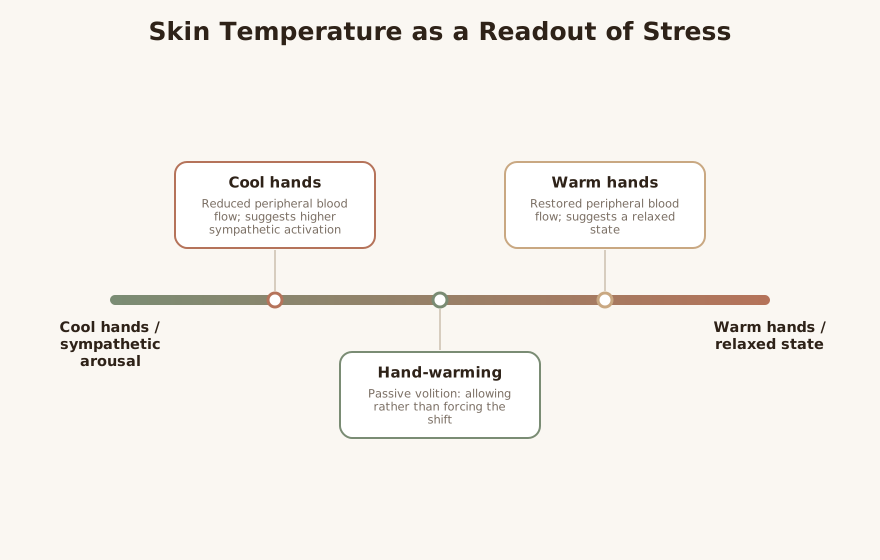
The governing model is straightforward. The fight-or-flight response decreases blood flow to the extremities while prioritizing the vital organs; deliberate relaxation reverses this, restoring peripheral blood flow and warming the hands 5. Skin temperature thus functions as a readout of stress: cooler hands suggest higher sympathetic activation, warmer hands suggest a relaxed state 5. Training a client to warm their hands is, mechanistically, training them to lower sympathetic vasomotor tone 5.
A second principle is passive volition—the paradoxical instruction to allow warming rather than to force it 5. Striving, straining, or “trying hard” tends to recruit sympathetic arousal and cool the hands, so the skill is one of releasing effort and permitting a physiological shift, which many clients find counterintuitive at first LLM. This is why thermal biofeedback pairs naturally with diaphragmatic breathing, calming imagery (a warm beach, a campfire), and autogenic phrasing—each is a vehicle for the same passive, parasympathetically-weighted state 5.
A third principle is generalization. The instrument is a teaching scaffold, not the treatment itself: clients learn the internal correlates of hand-warming with feedback present, then rehearse and apply the skill without the device—preventively or at the first sign of symptom onset 5. Typical training targets a sustained temperature in the mid-90s Fahrenheit (roughly 95–96°F) held for about ten minutes, against baselines that, in a normal-temperature office, often sit in the 80s for an unstressed person 5.
Interventions & Techniques
A standard course begins with baseline assessment: the client rests with the thermistor attached while temperature is recorded under quiet conditions, establishing a starting point and revealing how reactive the client’s peripheral vasculature is 5. Because ambient room temperature strongly influences the reading, sessions are run in a controlled environment, and this confound must be tracked across the course of treatment 2.
The core procedure is feedback-assisted hand-warming. The client watches (or hears) the temperature signal and uses some combination of 5:
- Autogenic phrases — silent repetition of statements such as “my hands feel heavy and warm” 5.
- Diaphragmatic breathing — slow abdominal breathing to engage the relaxation response 5.
- Warm imagery — vivid visualization of peaceful, heat-associated scenes 5.
- Passive, open-focus attention — sometimes supported by quiet music, oriented toward allowing rather than forcing the change 5.
Sessions typically progress from in-clinic, device-present practice toward home practice and fading of the instrument, so the client can reproduce the warming response unaided 5. For conditions such as migraine, the trained skill is deployed both as daily prophylaxis and as an abortive strategy at prodrome; for Raynaud’s, the emphasis is on raising and defending digital temperature, often with attention to cold provocation 52.
LLM-generated illustrative example (not a guideline): A clinician notices a client’s baseline fingertip temperature sits at 79°F and drops two degrees the moment the client describes their commute. The clinician reframes the trace as “your hands are showing me your nervous system in real time,” coaches slow exhalation and the phrase “warm and heavy,” and the client watches the number climb to 88°F over eight minutes—an in-vivo demonstration that reduces their sense of being at the mercy of stress LLM.
Evidence Base
The maturity of thermal biofeedback is best described as established: it has been studied for decades, is recognized within AAPB’s efficacy framework, and is graded in the Yucha and Montgomery evidence synthesis across multiple conditions 36. “Established” should not be read as “uniformly strong,” however, and honesty about the mixed picture is warranted LLM.
The most instructive case is Raynaud’s phenomenon, where thermal biofeedback is intuitively appealing because the target symptom is peripheral vasoconstriction. A literature review of primary Raynaud’s identified ten studies (seven randomized controlled trials, one controlled clinical trial, and two follow-ups), with notably mixed results 2. Six studies found thermal biofeedback no better than other relaxation methods, classical conditioning, non-thermal biofeedback, or a calcium-channel blocker, and two further studies reported difficulty teaching the hand-warming skill with no benefit over placebo or no treatment 2. Two small higher-quality trials did find thermal biofeedback superior to autogenic training or electromyographic feedback for reducing attack frequency—but the largest trial showed no reduction in attacks compared with a control biofeedback condition 2. A critical commentary concluded that the limited and unclearly reported evidence did not support the original authors’ favorable conclusion 2. The signal-to-noise problem is compounded by methodological flaws common across this literature: inconsistent reporting, predominantly female samples, inadequate controls, and—critically for a temperature-based outcome—failure to account for seasonal ambient temperature 2. Double-blind designs have been attempted in this area, underscoring that the field has taken control-condition rigor seriously even where results disappoint 1.
For migraine and recurrent headache, hand-warming biofeedback has a longer and more favorable clinical track record, and skin-temperature feedback for migraine is an explicit object of study within applied psychophysiology 45. AAPB’s efficacy ratings and the Yucha–Montgomery synthesis place headache among the better-supported indications for biofeedback, including in pediatric populations 36. A recurring interpretive caution applies across all indications: it is often unclear how much benefit is specific to temperature feedback versus attributable to the generalized relaxation the procedure induces, since comparators that also produce relaxation frequently match it 2LLM. The pragmatic clinical takeaway is that thermal biofeedback is a reasonable, low-risk, skills-building adjunct with the strongest case in headache disorders and a genuinely contested case in Raynaud’s LLM.
Populations & Indications
Thermal biofeedback is most clearly indicated for people with migraine and other headache disorders, including children and adolescents with recurrent headaches, for whom a non-pharmacological, self-regulatory skill is often especially attractive to families 365. People with Raynaud’s phenomenon are a classic indication on mechanistic grounds, with the caveat that the controlled evidence is mixed 2.
Beyond these, the technique is applied to stress-related presentations and anxiety, where hand-warming operationalizes “downshifting” sympathetic arousal in a way clients can see 5LLM. It is also used adjunctively with patients with hypertension, adults with chronic pain, and clients reporting insomnia and stress-linked digestive complaints, on the shared logic that lowering autonomic arousal supports each 5. In all of these broader indications, thermal biofeedback is best framed as a component of an arousal-regulation skill set rather than a stand-alone cure LLM.
Problems-for-Work
The technique maps onto several discrete clinical problems-for-work:
- Migraine / tension-type headache — building a portable hand-warming skill for prophylaxis and early intervention at prodrome 45.
- Raynaud’s phenomenon — raising and defending digital temperature against cold and stress provocation, with realistic expectations given the evidence 2.
- Autonomic dysregulation and stress-related disorders — using the temperature trace as a concrete, visible index of sympathetic arousal the client can learn to shift 5.
- Generalized anxiety disorder — pairing hand-warming with breathing and imagery to interrupt escalating physiological arousal 5LLM.
- Hypertension and chronic pain — adjunctive arousal reduction within a broader behavioral-medicine plan 5.
- Insomnia and somatic symptom disorder — practicing pre-sleep down-regulation and providing somatically-focused clients an interoceptive skill that reframes bodily sensation as controllable 5LLM.
LLM-generated illustrative example (not a guideline): For a client whose somatic symptom disorder centers on a persistent sense of “cold, tingling hands as proof something is wrong,” the clinician uses the thermistor to show that the same hands warm when the client breathes slowly—reframing the sensation from a feared sign of illness to a modifiable stress response, and giving the client an in-session experience of agency over the body LLM.
Contraindications, Cautions & Cultural Humility
Thermal biofeedback is low-risk, but several cautions apply LLM. It is not a substitute for medical evaluation or management of headache, hypertension, or Raynaud’s, and should be positioned as an adjunct—particularly for hypertension, where unmonitored substitution for pharmacotherapy could be harmful 5LLM. Raynaud’s that is secondary to an underlying connective-tissue disease warrants medical co-management, and clinicians should be candid that the controlled evidence for thermal biofeedback even in primary Raynaud’s is mixed 2LLM.
Practically, ambient temperature is a major confound: a cold room will defeat training and a warm one will flatter it, so progress must be interpreted against environmental and seasonal variation rather than taken at face value 2. The passive-volition demand can frustrate high-effort, achievement-oriented clients, whose striving cools their hands and can breed discouragement; explicit reframing of “success as letting go” is often needed 5LLM. Clients with peripheral neuropathy, vascular disease, or sensory changes may show atypical or unreliable signals and warrant a lower-confidence interpretation LLM.
Cultural humility matters in how the procedure is framed: the “fight-or-flight” and “relaxation” vocabulary, the imagery prompts (a beach, a campfire), and the very idea of voluntarily controlling internal states are culturally inflected, and clinicians should adapt language, imagery, and rationale to each client’s idioms of distress rather than impose a single script LLM. The technique’s apparatus can feel clinical or surveilling to some clients; transparent explanation of what the number means—and that it reflects, not judges, their nervous system—supports trust LLM.
Treatment-Plan Suggestions & SMART Objectives
| Goal | SMART objective (example) | Mechanism |
|---|---|---|
| Acquire the hand-warming skill | Within 4 sessions, client raises fingertip temperature by ≥4°F from session baseline using breathing and autogenic phrases, in ≥2 of 4 sessions | Voluntary reduction of sympathetic vasomotor tone produces peripheral vasodilation 5 |
| Reduce migraine frequency | Over 8 weeks, client reduces self-reported migraine days by ≥25% from a 2-week diary baseline while practicing hand-warming daily | Prophylactic down-regulation of autonomic arousal associated with headache 45 |
| Defend digital temperature in Raynaud’s | Within 6 sessions, client demonstrates ability to re-warm hands by ≥3°F within 5 minutes after a standardized cold/stress cue, in ≥2 trials | Voluntary peripheral vasodilation counters cold/stress-triggered vasoconstriction 25 |
| Generalize the skill off-device | By week 6, client reproduces a self-rated “warm, heavy hands” state ≥5×/week at home without the thermistor, logged in a practice diary | Internalization of trained physiological correlates; fading of the feedback scaffold 5 |
| Lower stress-linked arousal | Within 5 sessions, client identifies ≥3 daily cues to apply 2 minutes of hand-warming and reports them in session | Skill transfer to in-vivo stressors reduces sympathetic activation 5LLM |
| Support sleep onset | Over 4 weeks, client practices a 10-minute pre-sleep hand-warming routine ≥4 nights/week and rates sleep-onset distress weekly | Pre-sleep parasympathetic shift reduces hyperarousal interfering with sleep 5LLM |
| Reframe somatic symptoms | Within 4 sessions, client articulates ≥2 instances where a feared bodily sensation changed with self-regulation, demonstrated on the temperature trace | Interoceptive learning that bodily states are modifiable reduces catastrophic appraisal 5LLM |
Common Misconceptions
“Warmer hands cure the condition.” The temperature is a proxy for autonomic tone and a teaching signal, not the therapeutic endpoint; the goal is a transferable self-regulation skill, not a number on a screen 5LLM.
“The temperature feedback is what does the work.” Much of the literature cannot cleanly separate the benefit of temperature-specific feedback from the generalized relaxation any plausible comparator also produces—in Raynaud’s, several controls matched it 2LLM.
“It clearly works for Raynaud’s because the mechanism is obvious.” Mechanistic plausibility outran the controlled evidence: most studies found no advantage over other relaxation methods, conditioning, non-thermal feedback, or a calcium-channel blocker 2.
“Try harder to warm your hands.” Effortful striving recruits sympathetic arousal and cools the hands; the skill is passive volition—allowing the shift 5.
“The number is objective and self-evident.” Room temperature and season strongly shape the reading, so an uncontrolled rise or fall may reflect the environment rather than the client’s regulation 2.
Training & Certification
Thermal biofeedback is practiced within the applied-psychophysiology community, whose professional home is AAPB; the association maintains the efficacy standards and evidence-based-practice resources that orient competent use of the technique 3. The Yucha and Montgomery monograph is a standard reference for clinicians establishing that they are applying biofeedback to appropriately-supported indications 6. While this article does not enumerate a specific credentialing pathway from the provided sources, the field treats familiarity with the efficacy literature and adherence to evidence-based-practice ratings as baseline expectations for responsible practice 36LLM. Clinicians integrating thermal biofeedback should be competent in relaxation and autogenic methods, since those supply the regulatory skills the temperature signal reinforces 5LLM.
Key Terms
- Thermal (skin-temperature) biofeedback — feedback of fingertip skin temperature, a proxy for peripheral blood flow, used to train down-regulation of sympathetic arousal 5.
- Hand-warming — the trained response of raising fingertip temperature via relaxation, reflecting peripheral vasodilation 5.
- Peripheral vasoconstriction / vasodilation — sympathetically-driven narrowing (cooling) or relaxation-associated widening (warming) of cutaneous vessels in the extremities 5.
- Passive volition — allowing a physiological change rather than forcing it; effortful striving cools the hands 5.
- Autogenic phrases — self-suggestive statements (e.g., “my hands feel heavy and warm”) used to cue warming 5.
- Generalization / fading — transferring the trained skill to daily life and reproducing it without the instrument 5.
- Efficacy rating — the graded level of empirical support assigned to a biofeedback application within the AAPB / Yucha–Montgomery framework 36.
Resources & Further Reading
▶ Watch — a video introduction to this concept:
- Skin temperature biofeedback for Raynaud’s disease: A double-blind study (Applied Psychophysiology and Biofeedback)
- Thermal biofeedback for primary Raynaud’s phenomenon: a review of the literature (DARE / NCBI Bookshelf)
- Efficacy Information / Evidence-Based Practice ratings (AAPB)
- Skin temperature biofeedback and migraine headaches (Applied Psychophysiology and Biofeedback)
- Temperature Biofeedback — Hand Warming Explanation (Bio-Medical Resource Center)
- Evidence-Based Practice in Biofeedback and Neurofeedback (Yucha & Montgomery, AAPB)
Reflective / Supervision Questions
- For a given client, how will you decide whether observed gains reflect temperature-specific learning or the generalized relaxation any calming procedure would produce—and does that distinction change your treatment plan? 2LLM
- How are you controlling for and interpreting ambient and seasonal temperature so that a rising or falling trace is attributed to the client’s regulation rather than the room? 2
- When a high-effort client grows frustrated that “trying harder” cools their hands, how will you reframe success as passive volition without it sounding like a paradoxical trap? 5LLM
- For Raynaud’s specifically, how will you present the mixed evidence honestly while preserving the client’s motivation to practice a low-risk skill? 2LLM
- How will you adapt the relaxation imagery, autogenic language, and “fight-or-flight” rationale to fit a particular client’s cultural framing and idioms of distress? LLM
- What is your plan for fading the instrument and verifying that the skill has generalized to the settings where the client actually needs it? 5