
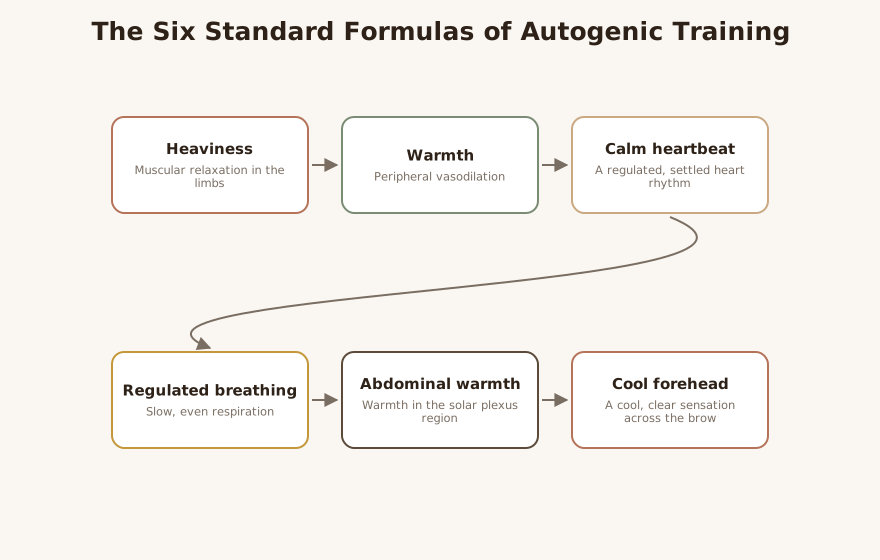
Autogenic Training (AT) is a structured self-regulation method in which the practitioner directs attention to a fixed sequence of bodily sensations—heaviness, warmth, a calm heartbeat, easy breathing, abdominal warmth, and a cool forehead—in order to elicit a low-arousal, parasympathetically weighted state 4. It sits at the intersection of behavioral medicine, psychophysiology, and psychotherapy, and carries roughly a century of mostly European clinical literature 17. This article orients practicing clinicians to what AT is, what the controlled evidence actually shows, and how to deploy it responsibly as an adjunct.
Type & Discipline
AT is best classified as a relaxation and self-regulation technique rather than a stand-alone school of psychotherapy, though its originators framed it as a “psychophysiologic approach in psychotherapy” capable of being extended into deeper analytic work 6. Its home discipline is behavioral medicine and psychophysiology, and it is routinely catalogued among mind-body relaxation interventions 5. Functionally it overlaps with progressive muscle relaxation, biofeedback, and meditative practices, but it is distinguished by its emphasis on passive concentration—a non-striving, non-controlling attentional stance—rather than active muscular manipulation or instrument-guided physiological control 7. Because the exercises are self-administered once learned, AT is positioned as a portable self-help skill that does not create dependence on a clinician or a feedback device 7.
Creators & Lineage
AT was developed by Johannes Heinrich Schultz, a German psychiatrist who first presented the method to a Berlin medical society in 1926 and published it formally in 1932 7. Schultz drew directly on hypnosis and sleep research conducted with the neurologist Oskar Vogt, who had observed that hypnotized subjects reliably reported sensations of heaviness and pleasant warmth in the limbs 7. Schultz’s key insight was that patients could self-induce a comparable low-arousal state simply by imagining these sensations, without an external hypnotist—effectively converting hetero-hypnotic phenomena into a self-directed exercise 7. The method was systematized and disseminated internationally largely through Wolfgang Luthe, a German-trained physician who emigrated to Canada and co-authored the foundational English-language texts, including the 1959 Autogenic Training: A Psychophysiologic Approach in Psychotherapy and the later multi-volume Autogenic Therapy 67. Subsequent threads in the lineage include the integration of psychodynamic material (“autogenic analysis”) and the marriage of autogenic imagery with thermal biofeedback by clinicians associated with the Menninger Foundation 7.
Core Principles
The defining principle is passive concentration: the practitioner gently rests attention on a target sensation and a verbal formula (for example, “my right arm is heavy”) while deliberately not trying to force the result 47. This non-volitional stance is what separates AT from effortful or performance-oriented relaxation; striving is understood to be counterproductive 4. The exercises proceed through a fixed, cumulative sequence of six “standard formulas,” each layered on top of the last as the prior one is mastered 47. A second principle is autonomic self-regulation through suggestion: the sensations of heaviness (muscular relaxation), warmth (peripheral vasodilation), and a regulated heartbeat and breath are construed as gateways to a generalized shift toward parasympathetic predominance 4. A third is structured daily repetition: brief sessions, typically on the order of 15 to 22 minutes, practiced daily over weeks to months, are considered necessary to consolidate the skill 24. Finally, AT incorporates a deliberate cancellation (resting) procedure to terminate each session and reorient the practitioner to ordinary alertness, treating exit from the relaxed state as a trained step rather than an afterthought 4.
Interventions & Techniques
The core protocol is the set of six standard exercises, learned sequentially 47:
- Heaviness — attention to the limbs feeling heavy and relaxed (e.g., “my right arm is heavy”) 47.
- Warmth — sensations of warmth in the limbs (“my right arm is warm”), reflecting peripheral vasodilation 47.
- Cardiac regulation — awareness of a calm, regular heartbeat (“my heartbeat is calm and regular”) 47.
- Respiration — observing easy, natural breathing (“it breathes me”) 47.
- Abdominal/solar-plexus warmth — cultivating warmth in the upper abdomen (“my solar plexus is warm”) 47.
- Forehead coolness — directing a sensation of coolness to the forehead (“my forehead is cool”) 47.
Each session is performed in a comfortable reclined or seated position with eyes closed, and closes with the cancellation/resting maneuver to return to full alertness 4. Beyond the six standard exercises, the original system extends into advanced “autogenic meditation” imagery exercises and, in some clinical applications, the combination of autogenic formulas with thermal biofeedback 7. A normal and clinically important phenomenon during practice is the autogenic discharge—a transient physical or emotional release (twitching, tearfulness, restlessness) understood as the nervous system rebalancing; clinicians should normalize and monitor these rather than treat them as adverse events 4.
LLM-generated illustrative example (not a guideline): A clinician introducing AT to an anxious client might begin with only the heaviness formula, having the client practice “my right arm is heavy” for one to two minutes twice daily for a week before adding warmth, so the passive-concentration stance is established before the protocol is expanded LLM.
Evidence Base
The evidence base for AT is established but modest, and honesty about its ceiling is warranted. The landmark quantitative synthesis is Stetter and Kupper’s 2002 meta-analysis, which examined 73 studies and pooled 60 of them (including 35 randomized controlled trials) across psychosomatic and psychological conditions 1. It found medium-to-large pre-post effects (effect sizes roughly 0.68–0.75) and a medium effect versus untreated or attention controls (about 0.61), with stable follow-up results 1. Crucially, however, when AT was compared head-to-head with other psychological treatments, the effect slightly favored the comparison therapies (about −0.28), leading the authors to position AT as an add-on to medical treatment rather than a first-line stand-alone intervention for severe disorders 1. A 2023 review focused on mental disorders (29 studies) reported consistent and significant anxiety reduction, medium-range effects for mild-to-moderate depression and dysthymia (though less effective than psychotherapy alone), and only limited positive signal for PTSD, with no usable evidence for bipolar, psychotic, or acute stress disorders 2. For chronic pain, a 2021 meta-analysis of 13 RCTs (576 participants) found a moderate effect on pain intensity versus passive controls (g = 0.58; number-needed-to-treat ≈ 3.1) but essentially no advantage over active comparators such as progressive muscle relaxation (g = −0.05), and no significant effect on mental distress or functioning—against a backdrop of small samples and substantial risk of bias 3. The consistent through-line across these syntheses: AT reliably outperforms doing nothing, performs comparably (not better) than other relaxation methods, and is constrained by older, methodologically limited trials 13.
Populations & Indications
AT has been studied and applied most credibly in adults with anxiety, where the signal is most consistent 2. It is a reasonable adjunct for tension-type headache and migraine, which dominate the chronic-pain literature, and for other chronic pain presentations including chest pain, irritable bowel syndrome, rheumatoid arthritis, and pain in multiple sclerosis and cancer, where it modestly reduces pain intensity relative to passive care 3. It has been used for mild-to-moderate depression and dysthymia as an adjunct, insomnia, and a range of stress-related and psychosomatic conditions 25. On the cardiovascular side, the historical literature includes hypertension and coronary heart disease, and AT has appeared in cardiology stress-management guidance 17. Selection matters: better candidates can sustain daily practice and tolerate the passive-concentration stance, and the 2023 review notes that effectiveness is reduced in the presence of cognitive impairment 2.
Problems-for-Work
- Physiological hyperarousal / anxiety. AT directly targets autonomic over-activation; the heaviness and warmth formulas are used to down-regulate sympathetic tone in clients who present with chronic tension and worry 24.
- Tension-type headache and migraine. The technique is applied as a self-managed prophylactic skill, with the strongest chronic-pain evidence concentrated in headache disorders 3.
- Chronic pain (non-headache). For conditions such as IBS or rheumatologic pain, AT is used to lower pain intensity and provide a portable coping skill, though it should not be expected to improve mood or functioning on its own 3.
- Insomnia and stress-related somatic symptoms. The low-arousal state and structured wind-down are applied as part of a sleep- or stress-hygiene plan 25.
- Mild-to-moderate depressive symptoms. AT is layered onto first-line treatment as an activating, structured daily practice rather than used as monotherapy 2.
LLM-generated illustrative example (not a guideline): For a client with tension-type headache, a clinician might pair twice-daily AT practice with a headache diary, using the warmth and forehead-coolness formulas at the earliest premonitory signs, while keeping pharmacologic prophylaxis unchanged LLM.
Contraindications, Cautions & Cultural Humility
Standard references list AT as contraindicated for very young children (below roughly age five) and for individuals whose symptoms cannot be adequately controlled or monitored 7. The VA overview cautions that AT may be inappropriate for some psychiatric presentations and for individuals who cannot sustain the required mental focus 4. There is no usable evidence supporting AT in bipolar, psychotic, or acute stress disorders, and any application in patients with psychotic disorders has historically been limited to those in remission and carefully selected 2. Clinically, the relaxation-induced state can surface autogenic discharges and, in trauma-affected or dissociation-prone clients, relaxation can paradoxically increase distress—so titration, grounding skills, and the cancellation procedure matter 4. Because formulas involve heart and breath awareness, clients with cardiac or respiratory anxiety may fixate on bodily sensations; medical clearance and a non-striving framing help 4. From a cultural-humility standpoint, the verbal formulas and reclined-eyes-closed posture are products of an early-twentieth-century European medical milieu, and clinicians should adapt language, avoid assuming comfort with closed-eye practice, and recognize that some clients will prefer overtly active or culturally familiar regulation methods over passive suggestion LLM. Clinicians should also be aware that the historical figure of Schultz is a contested one in the history of German psychiatry, and presenting AT as a technique rather than an endorsement of its originator is appropriate 7.
Treatment-Plan Suggestions & SMART Objectives
| Goal | SMART objective (example) | Mechanism |
|---|---|---|
| Reduce physiological hyperarousal | Client will practice the heaviness and warmth formulas twice daily for 10 minutes, 6 of 7 days per week, for 4 weeks, logging pre/post tension ratings | Passive concentration shifts autonomic balance toward parasympathetic predominance 4 |
| Decrease anxiety symptom burden | Client will reduce self-rated anxiety on a standardized weekly measure by a clinically meaningful margin over 8 weeks of daily AT practice plus first-line care | AT produces consistent medium-range anxiety reduction as an adjunct 2 |
| Lower headache frequency/intensity | Client will apply the full six-formula sequence at headache onset and record intensity in a daily diary for 6 weeks | Moderate effect on pain intensity versus passive care 3 |
| Improve sleep onset | Client will complete an AT session within 30 minutes of bedtime on at least 5 nights per week for 4 weeks | Low-arousal state supports sleep-conducive physiology 25 |
| Build a portable coping skill for chronic pain | Client will demonstrate independent, unguided AT practice in session by week 6 | Self-directed practice reduces reliance on clinician or device 7 |
| Augment treatment for mild depression | Client will pair daily AT practice with behavioral activation tasks, completing both 5 of 7 days for 6 weeks | Medium-range adjunctive effect for mild-to-moderate depression 2 |
| Master the protocol safely | Client will correctly perform the cancellation/resting procedure to exit each session, verified in session by week 3 | Trained exit prevents lingering grogginess and reorients alertness 4 |
Common Misconceptions
A frequent misconception is that AT is simply self-hypnosis under another name; while it descends from hypnosis research and shares the low-arousal target, it is defined by self-directed passive concentration rather than therapist-induced trance, and the practitioner remains in control throughout 7. A second is that AT is interchangeable with progressive muscle relaxation—they differ mechanistically, with AT relying on passive suggestion and PMR on active tense-release cycles, even though head-to-head trials show comparable outcomes 37. A third misconception is that effects are immediate; the literature emphasizes weeks-to-months of structured daily repetition before benefits consolidate 24. A fourth is that “more effort yields more relaxation”—the opposite is true, since striving undermines the passive stance that the method depends on 4. Finally, the breadth of historical conditions to which AT has been applied can be mistaken for proof of broad efficacy, when in fact the controlled evidence is strongest for anxiety and headache and largely null for mood and functioning in chronic-pain populations 13.
Training & Certification
There is no single global licensing body for AT in the sources reviewed; in clinical practice it is typically taught by trained clinicians and learned by patients through guided instruction over a course of sessions, with the six standard exercises introduced sequentially 47. The foundational training literature is Schultz and Luthe’s body of work, beginning with the 1959 text and extending through the multi-volume Autogenic Therapy series, which remain the canonical references for the standard exercises, the advanced meditative exercises, and clinical application 67. Clinicians intending to teach AT should be fluent in the passive-concentration stance, the cancellation procedure, and the management of autogenic discharges before introducing it to patients 4. Familiarity with the contraindications and with appropriate patient selection—particularly screening out presentations where relaxation may be destabilizing—is an expected part of competent delivery 24.
Key Terms
- Passive concentration — the non-striving, non-controlling attentional attitude central to AT, in which the practitioner rests attention on a sensation without forcing it 47.
- Standard exercises / formulas — the six cumulative verbal-attentional units (heaviness, warmth, heartbeat, breathing, abdominal warmth, forehead coolness) 47.
- Autogenic discharge — a transient physical or emotional release during practice, interpreted as nervous-system rebalancing rather than an adverse effect 4.
- Cancellation / resting procedure — the trained maneuver that ends a session and returns the practitioner to ordinary alertness 4.
- Autogenic meditation — the advanced imagery exercises built on top of the six standard formulas in the original system 7.
- Effect size (g / ES) — the standardized magnitude of treatment effect used across the AT meta-analyses to compare AT with passive and active controls 13.
Resources & Further Reading
▶ Watch — a video introduction to this concept:
- Stetter & Kupper (2002) — Autogenic training: a meta-analysis of clinical outcome studies (DARE quality-assessed)
- Autogenic Training in Mental Disorders: What Can We Expect? (2023, PMC)
- Autogenic Training for Reducing Chronic Pain: Systematic Review and Meta-analysis of RCTs (2021, PMC)
- Autogenic Training — VA Whole Health Library clinical overview (PDF)
- Autogenic Training — ScienceDirect Topics overview
- Schultz & Luthe — Autogenic Training: A Psychophysiologic Approach in Psychotherapy (1959)
- Autogenic training — Wikipedia
Reflective / Supervision Questions
- For a given client, is AT being offered as an evidence-matched adjunct (e.g., for anxiety or headache) or am I overextending it into a domain—such as mood or functioning in chronic pain—where the controlled evidence is weak? 23
- How will I screen for clients in whom relaxation may be destabilizing (trauma, dissociation, cardiac/respiratory health anxiety), and what grounding or titration plan is in place? 4
- Am I genuinely teaching the passive-concentration stance, or am I inadvertently reinforcing effortful striving that undermines the method? 4
- Have I set realistic expectations with the client about the weeks-to-months timeline and the comparable-not-superior standing of AT relative to other relaxation methods? 13
- Am I adapting the language, posture, and framing of the formulas to the client’s cultural context and preferences rather than delivering a fixed early-twentieth-century European script? LLM
- Is the cancellation procedure being taught and verified, and am I tracking autogenic discharges as expected phenomena rather than treatment failures? 4