
Type & Discipline
Facilitative Interpersonal Skills (FIS) is not a treatment model — it is a measurable construct and an associated performance task drawn from psychotherapy process-outcome research and therapist-training science 1. It names a therapist’s capacity to respond helpfully in interpersonally demanding moments, and it operationalizes that capacity through observable, ratable behavior rather than self-report 4. The construct lives at the intersection of common-factors research and the study of “therapist effects” — the well-replicated finding that some clinicians consistently obtain better outcomes than others, independent of the technique they nominally deliver 1.
Because FIS is a construct embedded in a measurement method, clinicians encounter it in two forms: as a way of thinking about what relational responsiveness actually looks like, and as a standardized task used to assess it 4. For practicing therapists, the value is less in the rating instrument than in the behavioral vocabulary it provides for what skilled relating consists of LLM.
Creators & Lineage
The FIS construct and its performance task were developed and popularized primarily by Timothy Anderson and colleagues, beginning with work that reframed therapist effects as partly a function of interpersonal skill rather than credential or orientation 1. The foundational 2009 study examined 25 therapists treating 1,141 clients and found that, among the therapist variables tested, FIS was the variable that accounted for outcome differences between clinicians 1.
The lineage runs back to Carl Rogers’s facilitative conditions — empathy, warmth, and genuineness — and forward through the therapist-effects literature that established the clinician, not just the protocol, as a meaningful unit of analysis 1. FIS can be read as an attempt to take the Rogerian intuition that relationship matters and render it into something observable, trainable, and predictively testable LLM. The measurement method has since been articulated explicitly around “difficult psychotherapy moments” and the idea of appropriate therapist responsiveness — matching response to the demand the moment presents rather than applying a fixed style 4.
Core Principles
The central premise is that therapist skill is best revealed under interpersonal pressure, not under easy conditions 4. FIS is assessed by showing clinicians short, standardized video clips in which an actor portrays a challenging client — hostile, withdrawn, confused, or demoralized — and asking the clinician to respond spontaneously, as if in session, with their response then rated by trained coders 1. The logic is that anyone can sound warm with a cooperative client; the discriminating signal appears when the client is difficult 4.
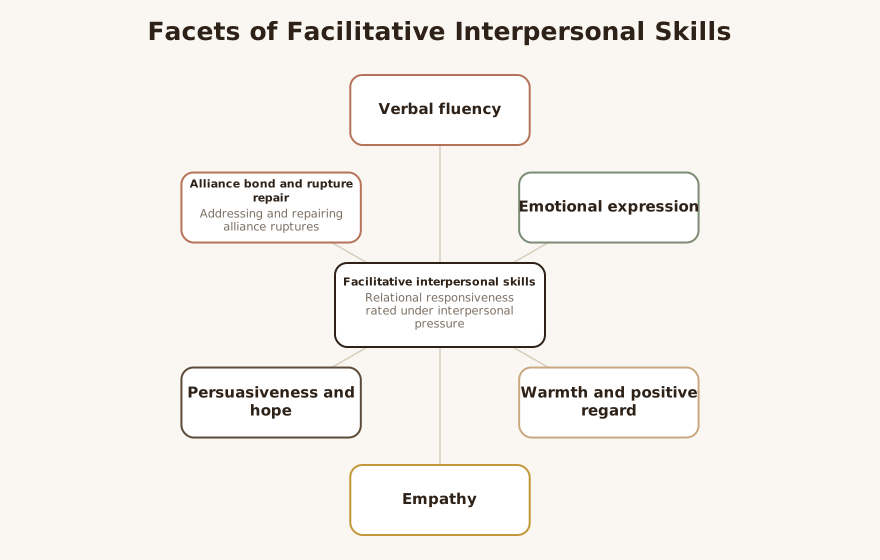
The construct is multidimensional. Across the FIS method, raters score a set of relational facets that typically include verbal fluency, emotional expression, warmth and positive regard, empathy, persuasiveness, hopefulness, the alliance bond, and the capacity to address and repair alliance ruptures 1. A second core principle is responsiveness: skilled responding is not a single template but the ability to read what a particular moment requires and meet it appropriately 4. A third is that this capacity sits largely outside formal training status — in a randomized trial, FIS predicted alliance and outcome while training level did not 3.
Interventions & Techniques
FIS is descriptive of skill rather than a set of prescribed interventions, but the dimensions map onto concrete in-session behaviors clinicians can recognize and cultivate LLM. Verbal fluency is the ability to speak clearly and stay composed under pressure rather than freezing or becoming tangled when a client challenges you 1. Emotional expression and warmth involve conveying genuine, non-defensive care, especially when the client’s behavior would pull most people toward coldness or counter-hostility 4.
Empathy in the FIS frame is accurate, in-the-moment understanding communicated back to the client, and persuasiveness is the capacity to offer a credible, hope-bearing rationale the client can lean on 1. The dimension most clinically distinctive is alliance-rupture repair — noticing when the bond has frayed, naming it non-defensively, and metabolizing the client’s frustration without retaliating or collapsing 1.
LLM-generated illustrative example (not a guideline): A client says, “You’re just like every other therapist — you don’t actually get it.” A low-FIS response defends or over-explains. A higher-FIS response stays regulated and curious: “You’ve felt unmet by people who were supposed to help, and I may have just done it again. Tell me where I lost you.” That move — staying warm, naming the rupture, inviting repair — is what the FIS dimensions are pointing at LLM.
The skills are observable and therefore, in principle, trainable through feedback and rehearsal, which is why FIS has become a reference point for deliberate-practice approaches to therapist development 4.
Evidence Base
The evidence base is best described as emerging: consistent in direction, but still concentrated in a relatively small number of studies and laboratories, and limited in sample size LLM. The originating 2009 study established the association between FIS and between-therapist outcome variance in a large naturalistic dataset, but it was correlational and could not establish causation 1.
A 2016 prospective study of 44 clinical-psychology trainees strengthened the case temporally: FIS measured at one time point predicted client symptom change in treatments conducted more than a year later 2. Importantly, that study also found a boundary condition — higher-FIS therapists outperformed lower-FIS therapists in shorter treatments (eight sessions or fewer), with the advantage attenuating in longer therapies 2. This nuance matters: FIS may be most decisive early, when alliance is being established and clients are deciding whether to stay LLM.
The strongest design to date is a randomized clinical trial in which 65 clients were assigned across therapists varying in FIS 3. High-FIS therapists produced greater pre-post improvement, faster change across sessions, stronger client-rated alliance from the first session, and better outcomes than a no-treatment control, while training status showed negligible effects 3. Measurement has continued to develop, including a complementary scale assessing FIS-relevant skills from the client’s perspective 5. The honest summary: FIS is one of the more robust therapist-level predictors we have, but it rests on a modest literature with small therapist samples, and large-scale independent replication remains thin LLM.
Populations & Indications
The construct was developed and validated principally with adult outpatient psychotherapy clients and with psychotherapy trainees and graduate students serving as the rated clinicians 1. It has been studied across treatment orientations rather than tied to one model, consistent with its common-factors roots 1. The randomized trial extended the work to screened community clients, supporting relevance beyond highly selected research samples 3.
There is active interest in extending FIS to child and adolescent therapy: relational factors such as alliance, empathy, validation, rupture-repair, attunement, and developmentally tuned playfulness appear to matter in youth treatment, yet no equivalent performance-based measure existed, prompting development of a FIS-Child task 6. For practicing clinicians, FIS is most directly indicated as a framework for self-assessment, supervision, and skill development across virtually any population where relationship quality drives engagement LLM.
Problems-for-Work
FIS is best understood as a lens on several recurring clinical and training problems rather than a treatment for a diagnosis LLM.
- Therapist effects / outcome variability between clinicians. When a practice or training program notices that outcomes differ by clinician more than by client mix, FIS offers a candidate explanation grounded in relational responsiveness rather than caseload 1.
- Weak or ruptured alliance. Because high-FIS therapists form stronger alliances from the first session, the FIS dimensions give a concrete behavioral map for what to strengthen when an alliance is thin or frayed 3.
- Early dropout and disengagement. The finding that FIS advantages concentrate in shorter treatments suggests targeting these skills at the front end of care, where clients decide whether to return 2.
- Difficult in-session moments. Hostility, withdrawal, and demoralization are precisely the “difficult psychotherapy moments” the method is built around, making FIS a useful frame for case consultation about hard interactions 4.
- Trainee selection and development. Because FIS predicts outcome largely independent of training status, it is relevant to how programs select, assess, and grow new clinicians 3.
Contraindications, Cautions & Cultural Humility
FIS is a measure and a framework, so “contraindications” concern its use rather than client safety, but several cautions are clinically important LLM. The construct should not be treated as a fixed trait or a gatekeeping verdict on a clinician’s worth; the trainable, responsiveness-based framing implies skill can develop with feedback, and reducing a person to an FIS score risks demoralizing the very clinicians who could grow 4.
The boundary condition that FIS predicted outcome in shorter but not longer treatments is a caution against overgeneralization — the construct’s predictive weight is not uniform across all treatment lengths 2. The evidence base is also still emerging and built on small therapist samples, so confident claims about magnitude or universality outrun the data LLM. Cultural humility is essential: dimensions like “warmth,” “persuasiveness,” and “appropriate” responsiveness are culturally and contextually shaped, and what reads as facilitative responding in one cultural frame may not in another, so the standardized clips and rating norms should not be assumed culture-neutral LLM. The push to develop developmentally specific measures such as the FIS-Child underscores that the adult-derived construct cannot simply be transplanted to other populations without adaptation 6.
Treatment-Plan Suggestions & SMART Objectives
FIS itself is not a billable modality; the table below frames it as a skills and process target that clinicians and supervisors can pursue inside established, evidence-based therapies LLM.
| Goal | SMART objective (example) | Mechanism |
|---|---|---|
| Strengthen early alliance | Within the first 3 sessions, clinician will elicit and reflect the client’s stated goals and check the bond at least once per session | High-FIS therapists form stronger alliances from session one 3 |
| Improve rupture repair | Over 6 weeks, clinician will name and process at least one alliance strain per occurrence without defensiveness, logged in supervision notes | Rupture-repair is a core FIS dimension 1 |
| Increase empathic accuracy | Within 4 sessions, clinician will offer reflective summaries the client confirms as accurate in ≥80% of attempts | Empathy is a rated FIS facet predicting outcome 1 |
| Build hopefulness/rationale | Each session for 8 weeks, clinician will offer a credible, hope-bearing treatment rationale the client can articulate back | Persuasiveness and hope are FIS dimensions linked to change 1 |
| Stay regulated under pressure | Over 8 sessions, clinician will maintain verbal fluency and warmth during 2 simulated difficult-moment rehearsals, rated by supervisor | Difficult moments are where FIS discriminates skill 4 |
| Front-load engagement | In the first 8 sessions of brief work, clinician will track session-by-session client engagement and adjust responsiveness weekly | FIS advantage concentrates in shorter treatments 2 |
| Reduce early dropout | Across the next 10 intakes, clinician will achieve a return-to-second-session rate improvement, reviewed monthly | Stronger early alliance supports retention 3 |
Common Misconceptions
A frequent misconception is that FIS is a therapy you deliver; it is not — it is a construct describing how a therapist relates, assessed via a performance task 4. A second is that FIS equals general likeability or social charm; the measure deliberately samples behavior under difficult, not easy, conditions, so smooth small-talk is not what is being scored 4. A third is that FIS is simply Rogerian warmth renamed; warmth is one facet, but the construct also includes fluency, persuasiveness, hope, and rupture-repair, and is explicitly multidimensional 1.
Clinicians sometimes assume more training automatically yields higher FIS, yet the randomized data showed training status contributed negligibly to alliance and outcome relative to FIS 3. Finally, it is a mistake to assume FIS predicts outcome uniformly: the predictive advantage was clearest in shorter treatments and attenuated in longer ones 2. It is also incorrect to assume the adult measure applies unchanged to children, which is precisely why a child-specific task is being developed 6.
Training & Certification
There is no licensure or formal certification in FIS; it is a research construct and assessment method, not a credentialed modality 4. Where it touches training, the relevant point is striking — formal training status did not meaningfully predict the alliance and outcome differences that FIS did, which has fueled interest in skill-focused development rather than credential accumulation 3.
In practice, engagement with FIS happens through the performance task and its rating system within research and training settings, where responses to standardized difficult-moment clips are coded on the FIS dimensions 1. For clinicians, the actionable training implication is deliberate, feedback-driven rehearsal of responding to difficult moments, since the skills are observable and the method was built explicitly around such moments 4. Extension to new populations follows the same logic of building population-specific tasks, as with the FIS-Child measure 6.
Key Terms
Facilitative Interpersonal Skills (FIS): a multidimensional, performance-based measure of a therapist’s relational responsiveness in difficult moments 1. FIS performance task: the standardized procedure of responding spontaneously to video clips of challenging clients, with responses rated by trained coders 1. Difficult psychotherapy moments: the demanding interactions (hostility, withdrawal, demoralization) the method samples because they discriminate skill 4. Appropriate responsiveness: matching one’s response to what the specific moment requires rather than applying a fixed style 4.
Therapist effects: the finding that outcomes vary systematically between clinicians, which FIS helps explain 1. Alliance-rupture repair: the FIS facet of noticing, naming, and mending strains in the therapeutic bond 1. Training status: formal level of clinical training, shown to contribute negligibly to alliance/outcome relative to FIS 3. FIS-Child (FIS-C): a developmentally specific task developed to extend FIS measurement to youth therapy 6.
Resources & Further Reading
- Anderson et al. (2009), Therapist effects: Facilitative interpersonal skills as a predictor of therapist success — Journal of Clinical Psychology
- Anderson et al. (2016), A prospective study of therapist facilitative interpersonal skills as a predictor of treatment outcome — Journal of Consulting and Clinical Psychology
- Anderson et al. (2016), Therapist facilitative interpersonal skills and training status: A randomized clinical trial on alliance and outcome — Psychotherapy Research
- The facilitative interpersonal skills method: Difficult psychotherapy moments and appropriate therapist responsiveness — Counselling and Psychotherapy Research
- Santos et al. (2023), Development and validation of the facilitative interpersonal skills scale for clients — Journal of Clinical Psychology
- Bate & Tsakas (2022), Facilitative interpersonal skills are relevant in child therapy too, so why don’t we measure them? — Research in Psychotherapy
Reflective / Supervision Questions
- In your last three difficult sessions, where did your verbal fluency, warmth, or empathy waver under pressure, and what pulled them off-line LLM?
- When a client expresses frustration with you, what is your default move — defend, over-explain, withdraw, or name and explore the rupture 1?
- The data suggest FIS matters most early in treatment; how do you front-load relational responsiveness in the first few sessions 2?
- If formal training contributes little beyond FIS, what deliberate, feedback-driven practice are you doing to grow these specific skills 3?
- How might your sense of “warm” or “persuasive” responding be culturally shaped, and how do you check whether it lands as facilitative for this client LLM?
- When you adapt these skills for children or adolescents, what changes — and what would a developmentally appropriate version of rupture-repair or playfulness look like in your work 6?