
Type & Discipline
Seeking Safety is a present-focused, manualized, coping-skills psychotherapy developed within clinical psychology for the treatment of co-occurring posttraumatic stress disorder (PTSD) and substance use disorder (SUD) 1. It is most accurately classified as an integrated, present-focused trauma/SUD model rather than a trauma-processing therapy, because it deliberately does not require clients to recount or narratively process traumatic memories as a condition of treatment 1. The model is cognitive-behavioral in its core architecture but draws on interpersonal and case-management traditions as well, and it can be delivered in individual or group format, in inpatient, outpatient, residential, and correctional settings 2. It is designed to be flexible: clinicians can deliver any number of its topics, in any order, over any length of treatment, which distinguishes it from more rigidly sequenced protocols 2.
The defining feature is its prioritization of safety. The model treats present-day safety from substances, self-harm, dangerous relationships, and other risk behaviors as the immediate clinical target, on the premise that destabilized, actively using, or unsafe clients are poorly positioned to tolerate exposure-based trauma work 1. This places it within the broad family of stabilization-phase or “phase 1” trauma-informed approaches, even though Najavits developed it as a complete standalone treatment rather than merely a precursor to other therapy 1.
Creators & Lineage
Seeking Safety was developed by Lisa M. Najavits, PhD, a clinical psychologist and researcher who authored the treatment manual published by Guilford Press in 2002 1. Najavits maintains the model and its training and certification infrastructure through Treatment Innovations, the organization she founded 2. She has remained the central figure in its dissemination, including continuing-education presentations of the model as an evidence-based practice for trauma and substance use 6.
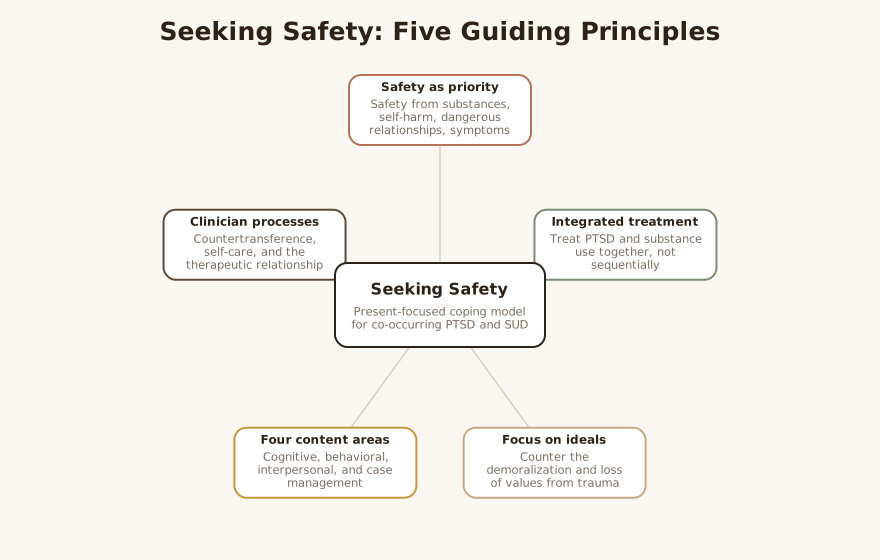
The model’s intellectual lineage is explicitly integrative LLM. Its cognitive and behavioral skills, cognitive restructuring of trauma- and substance-related beliefs, and structured session format derive from cognitive behavioral therapy 1. Its emphasis on identifying triggers, managing cravings, and preventing return to use is consistent with relapse-prevention frameworks LLM. Its attention to grounding, distress tolerance, and the regulation of overwhelming affect parallels skills emphasized in dialectical behavior therapy, and its overall orientation toward client empowerment, validation, and avoidance of retraumatization situates it within trauma-informed care LLM. Najavits framed the treatment around five central principles that bind these strands together rather than treating it as a loose collection of techniques 1.
Core Principles
Najavits organized Seeking Safety around five guiding principles that operate across every session and topic 1. The first is safety as the overarching priority of the first stage of recovery, encompassing safety from substances, from self-destructive behavior, from dangerous relationships, and from extreme symptoms 1. The second is the integrated treatment of PTSD and substance use together, rather than sequentially or in separate silos, recognizing that the two disorders interact and that treating only one often destabilizes the other 1.
The third principle is a focus on ideals to counteract the demoralization, loss, and erosion of values that frequently accompany trauma and addiction 1. The fourth is attention to four content areas — cognitive, behavioral, interpersonal, and case management — so that treatment addresses thoughts, actions, relationships, and the concrete logistics of a client’s life 1. The fifth principle concerns clinician processes and attention to the therapist’s own experience, including countertransference, self-care, and the use of the therapeutic relationship as a corrective and modeling vehicle 1.
Critically, the model is present-focused: it works on coping skills the client can use today rather than excavating the past 1. This is not a denial of trauma history but a clinical stance that stabilization and skill-building must precede, and may in some cases substitute for, narrative trauma processing 1.
Interventions & Techniques
Seeking Safety comprises 25 topics, each a self-contained module addressing a safe-coping theme, such as Asking for Help, Setting Boundaries in Relationships, Honesty, Compassion, Detaching from Emotional Pain (Grounding), Healthy Relationships, Coping with Triggers, and Creating Meaning 1. Each topic can stand alone, allowing the clinician to match content to the client’s most pressing need and to deliver as few or as many topics as the treatment length allows 2.
Every session follows a consistent four-part structure 1. It opens with a check-in covering how the client is doing, substance use, any unsafe behaviors, coping successes, and whether commitments from the prior session were met 1. The clinician then introduces a quotation to emotionally engage the client and orient them to the topic 1. The core of the session is relating the topic to the client’s life, working through the topic’s handout and skills in a personalized way 1. The session closes with a check-out, in which the client identifies what was useful, names a new commitment to practice before the next session, and reports on community resources or supports 1.
A signature technique is the use of safe coping skills — a long list of concrete behavioral alternatives to using or self-harm, which clients are taught to substitute in real time when triggered 1. Grounding techniques for managing dissociation, flashbacks, and overwhelming affect are taught explicitly so clients have a portable tool for acute distress 1. Throughout, the clinician models safety, hope, and respect, and reinforces the principle that the client can attain safety regardless of how they feel internally 1.
LLM-generated illustrative example (not a guideline): A clinician working with a client in early recovery might open with the topic “Coping with Triggers.” After the quotation, they map the client’s specific triggers — a particular bar, contact with an ex-partner, anniversary dates of an assault — onto the safe-coping list, and the client commits to texting a sober supporter and using a grounding script the next time a craving spikes. The next check-in reviews whether the commitment held, without dwelling on the trauma narrative itself LLM.
Evidence Base
The evidence base for Seeking Safety is established but nuanced, and clinicians should represent it honestly LLM. A 2023 meta-analysis by Sherman and colleagues synthesized controlled trials of Seeking Safety for comorbid PTSD and SUD and found benefits, while also underscoring heterogeneity across studies and the importance of comparing the model against active treatments rather than only waitlist or treatment-as-usual conditions 3. The general pattern across the literature is that Seeking Safety produces improvements in PTSD and substance-use outcomes but does not consistently demonstrate superiority over other active, bona fide treatments 3.
A U.S. Military Health System evidence brief reviewing Seeking Safety for PTSD with comorbid SUD reached a similarly measured conclusion, characterizing the evidence as supportive of present-focused integrated treatment while noting limitations in study quality and the absence of clear superiority over comparators 5. This is consistent with the broader field’s finding that present-focused models like Seeking Safety perform comparably to, and are better tolerated than, more demanding past-focused exposure protocols in some populations LLM.
The model has also been tested in specific populations. A randomized controlled trial by Najavits and colleagues evaluated Seeking Safety for adolescent girls with PTSD and substance use disorder, extending the evidence beyond the adult samples in which the model was originally developed 4. Taken together, the evidence supports Seeking Safety as a reasonable, well-tolerated, broadly applicable option for co-occurring PTSD and SUD, with the honest caveat that it is not demonstrably more effective than other credible integrated or present-focused treatments 35.
Populations & Indications
Seeking Safety was designed first and foremost for people with co-occurring PTSD and substance use disorder, the population in which it was developed and most extensively studied 13. It is broadly applicable to trauma survivors and to people in early recovery who need stabilization before, or instead of, trauma-processing work 1. Its flexibility in format and length has made it attractive across diverse settings and groups 2.
Specific populations in which the model has been used or studied include veterans and military-connected clients, for whom the integrated PTSD/SUD focus is highly relevant 5. It has been applied with women survivors of interpersonal violence, with incarcerated populations, and with adolescents — the adolescent-girls RCT being a notable example of downward extension 4. The model’s grounding and distress-tolerance components also make it relevant to clients presenting with complex trauma and significant emotional dysregulation, where overwhelming affect is a barrier to engagement LLM.
Problems-for-Work
Seeking Safety is well matched to a cluster of interrelated clinical problems LLM. For PTSD and substance use disorders occurring together — the model’s primary indication — it provides a single integrated framework rather than asking the client to navigate two separate treatments 1. For dual diagnosis more broadly, its case-management content area helps address the concrete instability (housing, legal, medical) that frequently derails treatment of co-occurring disorders 1.
For emotional dysregulation and coping-skill deficits, the safe-coping list and grounding techniques give clients immediately usable tools to interrupt the chain from trigger to harmful behavior 1. For self-harm and other unsafe behaviors, the model’s safety-first stance makes reduction of these behaviors an explicit, tracked session target via the check-in 1. For the sequelae of interpersonal violence, including difficulty setting boundaries and tolerating closeness, topics such as Setting Boundaries in Relationships and Healthy Relationships address relational repair without requiring disclosure of the index trauma 1. For complex trauma, the present-focused, stabilization-oriented approach offers a lower-risk entry point than immediate exposure work LLM.
LLM-generated illustrative example (not a guideline): A client with complex trauma and recurrent non-suicidal self-injury who is not yet ready to discuss her abuse history might begin with “Detaching from Emotional Pain (Grounding)” and “Asking for Help.” The clinician tracks self-harm urges at each check-in and reinforces every instance where the client used a grounding skill instead, building a track record of safety before any consideration of later trauma processing LLM.
Contraindications, Cautions & Cultural Humility
Seeking Safety has few absolute contraindications because it is a stabilization-oriented, present-focused treatment; its caution is more often about scope than safety LLM. Clinicians should be clear that the model does not, by design, process traumatic memories, so clients who specifically seek and are ready for trauma-focused exposure work may need a different or additional treatment, and the present-focused model should not be misrepresented as completed trauma processing 1. The evidence brief and meta-analytic literature caution against overstating the model’s effects relative to active comparators, which is an ethical disclosure issue in informed consent 35.
Acute, unmanaged risk — imminent suicidality, severe withdrawal requiring medical management, or psychosis — should be stabilized through appropriate level-of-care decisions before relying on outpatient Seeking Safety, since the model presumes a client able to participate in skills work LLM. Cultural humility is woven into the model’s emphasis on ideals, respect, and client empowerment, but the clinician must still adapt language, examples, and the meaning of “safety” to each client’s cultural, gender, and community context — what constitutes a safe relationship or an acceptable coping strategy is not culturally neutral LLM. With incarcerated and other involuntary populations, attention to coercion, confidentiality limits, and the power differential is essential to delivering the model in a genuinely trauma-informed way LLM.
Treatment-Plan Suggestions & SMART Objectives
| Goal | SMART objective (example) | Mechanism |
|---|---|---|
| Increase present-day safety from substance use | Client will use at least two safe-coping skills in place of substance use during high-risk situations, reported at each weekly check-in, for 6 consecutive weeks | Safe coping skills substitution; relapse-prevention trigger management 1 |
| Reduce self-harm and unsafe behaviors | Client will report zero episodes of self-harm across 4 consecutive sessions, using a grounding script when urges arise | Grounding and distress tolerance; safety-first session tracking 1 |
| Build affect-regulation capacity | Client will demonstrate three grounding techniques and rate distress before/after on a 0-10 scale in session, weekly for 8 weeks | Detaching from emotional pain; in-vivo skill rehearsal 1 |
| Improve relational safety | Client will identify and practice one boundary-setting statement in a real relationship per week for 4 weeks | Setting Boundaries / Healthy Relationships topics 1 |
| Strengthen help-seeking and supports | Client will contact one sober or safe support person before the next session and report the outcome at check-out, each session for 6 weeks | Asking for Help; community resource linkage 1 |
| Restore values and meaning | Client will name one personal ideal and one concrete action toward it per session for 5 sessions | Focus on ideals to counter demoralization 1 |
| Address concrete life instability | Client will complete one case-management task (e.g., appointment, benefits application) before the next session, tracked weekly | Case-management content area 1 |
| Integrate PTSD and SUD coping | Client will articulate how one trigger affects both PTSD symptoms and craving and apply a single coping plan, by session 8 | Integrated PTSD/SUD treatment principle 1 |
Common Misconceptions
A frequent misconception is that Seeking Safety is “trauma therapy” in the exposure sense — that it processes traumatic memories LLM. It does not; it is explicitly present-focused and works on current coping rather than the trauma narrative, which is a deliberate design choice, not an omission 1. A related error is treating it as merely a “pre-treatment” or warm-up before the “real” trauma work; Najavits developed it as a complete standalone treatment, even though it can also serve a stabilization role 1.
Another misconception is that the 25 topics must be delivered in a fixed sequence over a fixed number of sessions LLM. In fact the model is intentionally modular: any topic, any order, any length, individual or group 2. Finally, some clinicians overstate the evidence, presenting Seeking Safety as superior to other treatments; the honest position from the meta-analytic and military-health reviews is that it is effective and well tolerated but not clearly superior to active comparators 35.
Training & Certification
Training and certification in Seeking Safety are coordinated through Treatment Innovations, Lisa Najavits’s organization, which offers the manual, training materials, workshops, and pathways for clinicians and programs adopting the model 2. The published treatment manual itself is the foundational training resource and is designed so that a range of providers, not only doctoral-level clinicians, can deliver the model with fidelity 1. Continuing-education offerings featuring Najavits, such as university-hosted presentations of the model as an evidence-based practice, provide additional accessible entry points to learning the approach 6. Because the model is designed for broad dissemination across settings and provider types, formal training emphasizes adherence to the session structure and the five principles rather than gatekeeping by discipline 2.
Key Terms
- Present-focused treatment — an approach that targets current functioning and coping rather than processing past traumatic memories 1.
- Safe coping skills — concrete behavioral alternatives clients substitute for substance use, self-harm, or other unsafe behaviors when distressed 1.
- Grounding — techniques for detaching from emotional pain, dissociation, and flashbacks by reconnecting to the present moment 1.
- Integrated treatment — addressing PTSD and substance use disorder simultaneously within one framework rather than sequentially 1.
- Check-in / check-out — the structured opening and closing of each session that tracks safety, substance use, and commitments 1.
- Four content areas — cognitive, behavioral, interpersonal, and case-management domains addressed across the topics 1.
- Topics — the 25 modular session themes that make up the model’s curriculum 1.
Resources & Further Reading
▶ Watch — a video introduction to this concept:
- Seeking Safety: A Treatment Manual for PTSD and Substance Abuse (Najavits, 2002) — Guilford Press
- Treatment Innovations — Seeking Safety official site (Najavits)
- Sherman et al. (2023) — Seeking Safety for comorbid PTSD and SUD: A meta-analysis (Brain and Behavior)
- Najavits & colleagues — Seeking Safety RCT for adolescent girls with PTSD and SUD (PubMed)
- PHCoE Evidence Brief: Seeking Safety for PTSD with Comorbid SUD (U.S. Military Health System)
- Seeking Safety: An Evidence-Based Practice for Trauma and/or Substance Abuse (Adelphi CE, with Najavits)
Reflective / Supervision Questions
- How do I assess whether a given client needs stabilization-phase, present-focused work versus readiness for trauma-processing exposure, and how do I communicate that distinction in informed consent? LLM
- When I describe Seeking Safety’s evidence to a client or referral source, am I accurately conveying that it is effective and well tolerated but not clearly superior to active comparators? 35
- Which of the 25 topics am I drawn to or avoid, and what does that reveal about my own comfort with substance use, relational boundaries, or values-based work? LLM
- How am I attending to the fifth principle — my own countertransference, self-care, and modeling of safety — when working with chronically destabilized or involuntary clients? 1
- In what ways might my definition of “safety” or “healthy relationship” differ from my client’s cultural or community frame, and how do I adapt the topics accordingly? LLM
- How do I track and document safety behaviors at each check-in so that the work is both clinically rigorous and clearly a structured psychotherapeutic intervention? 1