
Type & Discipline
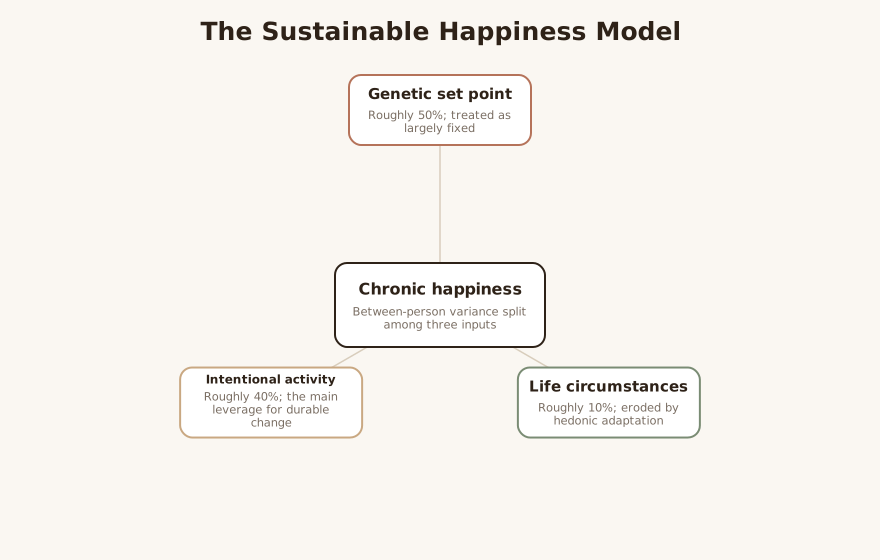
The Sustainable Happiness Model (SHM) is a theoretical heuristic within positive psychology, sitting in the literature on the determinants of subjective wellbeing.1 It is not a therapy or a manualized protocol; it is a framework that explains why some deliberate wellbeing practices produce durable change while others fade, and it supplies the rationale for a family of positive-activity interventions that clinicians can fold into established treatment.1 Its central organizing claim is that chronic happiness has three classes of input—a genetically influenced set point, life circumstances, and intentional activity—and that intentional activity is the most promising leverage point for lasting change.5 Understanding it as a model of mechanism rather than a treatment in its own right is the single most important framing point for clinical use.LLM
Creators & Lineage
The model was introduced by Sonja Lyubomirsky, Kennon Sheldon, and David Schkade in their 2005 Review of General Psychology paper, “Pursuing Happiness: The Architecture of Sustainable Change.”1 Lyubomirsky subsequently popularized the framework for general audiences in The How of Happiness (2007), which translated the model into a catalog of practical strategies.6 Sheldon and Lyubomirsky later revisited and partly revised the model in a 2021 paper responding to a decade of critique.3
Its intellectual lineage runs directly through positive psychology and the broader science of subjective wellbeing, and it draws heavily on hedonic-adaptation theory—the observation that people tend to return toward a baseline after positive (or negative) life changes.5 The applied descendants of the model include the positive-psychotherapy interventions (gratitude, kindness, savoring, optimism work) that many clinicians now recognize, as well as later mechanistic refinements such as the Hedonic Adaptation Prevention model and the Eudaimonic Activity Model.3
Core Principles
Three determinants of chronic happiness. The model partitions the between-person variance in chronic happiness into three sources: a genetic set point, life circumstances, and intentional activity.5 In the original and most-cited formulation, these were illustrated as a “happiness pie” of roughly 50% set point, 10% circumstances, and 40% intentional activity.5
Intentional activity is the leverage point. The argument for emphasizing intentional activity is comparative: the set point is treated as largely fixed and not directly modifiable, while changes in life circumstances tend to be eroded by hedonic adaptation.5 By contrast, intentional activities—effortful, self-initiated practices—are framed as the channel through which a person can both raise and sustain wellbeing.5
Hedonic adaptation as the central obstacle. The model’s organizing problem is that good things stop feeling good. People adjust quickly to improved circumstances, so a raise, a new home, or a recovered health status delivers a happiness bump that decays toward baseline.5 Sustainable change therefore depends not just on doing positive things but on counteracting adaptation to them.1
Variance decomposition is not an individual budget. A principle the original authors and later commentators both stress: the percentages describe how much variation between people in a sample is statistically associated with each factor—not a within-person ledger saying any given client “controls 40%” of their happiness.5 Misreading the pie chart as a personal control dial is the model’s most common distortion.5
Interventions & Techniques
The model does not prescribe a fixed protocol, but it underwrites a recognizable set of positive-activity techniques that clinicians can integrate as adjuncts.6 The How of Happiness organizes these into roughly a dozen evidence-informed strategies, including gratitude practice, cultivating optimism, acts of kindness, nurturing social relationships, savoring life’s pleasures, pursuing flow and engaging absorption, physical activity, meditation, forgiveness, and spiritual or meaning-oriented practice.65
The model adds several moderators that distinguish activities that stick from those that fade, and these are the clinically actionable part:1
- Person–activity fit. Activities should match the client’s values, interests, and strengths; a poorly fitting practice generates effort without reward.6
- Variety. Rotating the form of a practice (e.g., varying what one is grateful for, or how kindness is expressed) slows adaptation and keeps the activity feeling fresh.3
- Effort and intentionality. Durable gains require ongoing, deliberate engagement rather than one-off exercises.5
- Timing and dosing. How often and when an activity is performed affects whether it produces a sustained boost.1
- Social support and accountability. External structure helps maintain practice over time.1
The 2021 refinements describe the maintenance mechanism more precisely: positive activities generate a stream of positive events and emotions, and if a person keeps appreciating those gains and varies how they pursue them, the wellbeing boost can be prevented from fully decaying—the logic of the Hedonic Adaptation Prevention model.3
LLM-generated illustrative example (not a guideline): A clinician working with a client recovering from a depressive episode might, after acute symptoms stabilize, co-select a gratitude practice tied to the client’s stated value of family connection (person–activity fit), agree to vary it weekly to limit adaptation, and review adherence each session as a form of social accountability. LLM
Evidence Base
The evidence base is best described as established in its core premise but contested in its famous specifics.3 The well-supported claim is that people can raise their wellbeing through intentional behavior and maintain at least part of that gain over time; this premise has accumulated substantial empirical support across positive-activity intervention studies.3 The much-weaker claim is the precise 50/10/40 partition, which has been seriously challenged.4
In their own 2021 reappraisal, Sheldon and Lyubomirsky conceded considerable ground: they agreed with many of the critiques of the pie chart, characterized the original percentages as speculative rather than dogmatic, and proposed reframing the “set point” as a range of potential with a central tendency rather than a fixed value.3 Crucially, they also acknowledged that intentional-activity effects on wellbeing may be weaker than originally believed, even while maintaining that the central premise holds.3
The sharpest external critique comes from Brown and Rohrer, who argued there is little empirical basis for the variance decomposition itself.4 Their specific objections: the heritability figure used appears to be a lower bound, with estimates for stable happiness running closer to 70–80%, which would shrink the room attributed to intentional activity; the “10% circumstances” figure conflated narrow demographic variables with the broader concept of life circumstances, and on reanalysis circumstances explained closer to 18–26% of variance; the model omitted an error term and treated the three factors as independent when genes shape both circumstances and behavior; and the residual 40% for intentional activity is therefore not directly justified by the underlying data.4
For clinical purposes, the honest synthesis is: use the model as a heuristic and a source of techniques, not as a quantitative prescription. The “40% is in your control” message is not defensible, but “deliberate positive practices can produce real, partly durable wellbeing gains” is.LLM
Populations & Indications
The model was developed and validated primarily with the general adult population and with adults seeking to improve wellbeing rather than with clinical samples.1 It has been applied to students, older adults, and workplace populations, settings where wellbeing promotion and resilience are the goal.6 In clinical contexts, its positive-activity techniques are most appropriate as adjunctive components for low positive affect, low life satisfaction, anhedonia, stress, and low self-esteem.LLM
It is reasonable to introduce these practices with people recovering from depression or dysthymia—once acute risk is managed—where they can support relapse prevention and the restoration of positive affect alongside primary treatment.6 The model is best understood as a wellbeing-building framework that complements, rather than replaces, symptom-focused care.LLM
Problems-for-Work
- Anhedonia and low positive affect. Savoring and flow-oriented activities target the diminished capacity to experience and notice reward; the model’s emphasis on variety helps re-sensitize a flattened hedonic system.6
- Hedonic adaptation. The model’s defining problem-for-work: clients who repeatedly chase circumstantial change (a new job, a purchase, a move) and feel the lift evaporate can be helped to shift effort toward varied, intentional practices that adapt more slowly.5
- Low life satisfaction. Gratitude, optimism, and meaning-oriented practices can be matched to the client’s values to lift global satisfaction beyond what circumstance change delivers.6
- Stress. Physical activity, social connection, and savoring serve as regulation and recovery routines.6
- Low self-esteem. Acts of kindness and the cultivation of strengths can build a sense of efficacy and worth through behavior rather than reassurance.LLM
Contraindications, Cautions & Cultural Humility
The most important caution is a safety one: positive-activity practices are an adjunct, not a substitute for evidence-based treatment of major depressive disorder, dysthymia, or any condition carrying suicide risk.LLM Introducing gratitude or optimism exercises in place of indicated depression treatment is inappropriate, and these practices should generally follow stabilization of acute symptoms.LLM
A second caution is iatrogenic invalidation. Because the popular framing implies people “control” a large share of their happiness, clients in genuinely adverse circumstances—poverty, discrimination, abuse, chronic illness—can experience positive-activity prescriptions as blame or denial of real hardship.4 The reanalysis showing that circumstances explain considerably more variance than the original 10% should temper any message that situations don’t matter.4
Cultural humility is essential because the model’s evidence base skews toward Western samples, and the value placed on individual self-improvement, the meaning of gratitude, and the expression of optimism are culturally shaped.LLM Clinicians should treat person–activity fit as inclusive of culture and context, and avoid presenting any single practice as universally beneficial.1 Finally, clinicians should be candid that effect sizes are modest and partly time-limited, not transformational.3
Treatment-Plan Suggestions & SMART Objectives
| Goal | SMART objective (example) | Mechanism |
|---|---|---|
| Increase positive affect | Client will complete a values-matched savoring exercise 4x/week for 6 weeks, logging one savored moment each time | Counteracts hedonic adaptation by directing attention to positive events5 |
| Build gratitude habit | Client will record three specific, varied things they are grateful for weekly for 8 weeks, rotating domains to limit adaptation | Variety and intentional effort sustain the wellbeing boost3 |
| Reduce hedonic chasing | Client will identify, in 2 sessions, two recurring “if-then” circumstance goals and replace one with an intentional activity | Reorients effort from adaptation-prone circumstances toward durable activity5 |
| Strengthen social connection | Client will initiate one meaningful social contact weekly for 6 weeks and rate connection 0-10 | Social relationships are a high-yield, slowly-adapting source of wellbeing6 |
| Improve person–activity fit | Client and clinician will trial 3 candidate practices over 3 weeks and select the highest-fit, highest-enjoyment one | Person–activity fit predicts whether gains are maintained6 |
| Increase engagement/flow | Client will schedule two 30-minute flow-conducive activities weekly for 4 weeks | Absorbing, appropriately challenging activity raises sustained wellbeing6 |
| Support relapse prevention | Client will maintain one chosen positive practice 3x/week and review adherence at each session for 8 weeks | Adjunctive maintenance of positive affect alongside primary treatmentLLM |
Common Misconceptions
“You can control 40% of your happiness.” This is the central misreading. The percentages describe variance between people in research samples, not a controllable within-person budget; one person might gain enormous happiness from a practice that explains little population variance, and vice versa.5 The figure cannot be applied to an individual.5
“The pie chart is settled science.” It is not. The specific decomposition has been substantially challenged, the heritability figure used appears to be a lower bound, and the circumstances figure was based on a narrow demographic operationalization that, reanalyzed, accounts for considerably more variance.4 Even the original authors have since called the percentages speculative.3
“Circumstances don’t matter for happiness.” The model’s modest circumstances estimate has been read as license to dismiss material conditions, but the critique literature finds circumstances explain substantially more variance than the original 10%.4 Adverse situations are clinically relevant and should not be minimized.LLM
“Positive activities give a permanent boost.” The honest position is that gains are real but partly time-limited and require ongoing, varied effort to maintain; they are not a one-time fix.3
Training & Certification
There is no certification in the Sustainable Happiness Model itself; it is a theoretical framework rather than a credentialed modality.LLM Clinicians typically encounter it through positive-psychology coursework and continuing education, and through the applied positive-psychotherapy literature where its intervention techniques are operationalized.6 For practical implementation, The How of Happiness serves as the accessible foundational text, and the 2005 and 2021 papers provide the scholarly grounding and its honest reappraisal.613 Competent use depends less on a credential than on integrating the techniques within one’s existing, evidence-based clinical training.LLM
Key Terms
- Set point: A genetically influenced baseline level of happiness, treated in the model as largely stable; reframed in 2021 as a range of potential with a central tendency.3
- Hedonic adaptation: The tendency to return toward baseline happiness after positive or negative changes, eroding the impact of circumstance change.5
- Intentional activity: Effortful, self-initiated practices (e.g., gratitude, kindness, savoring) framed as the primary lever for sustainable wellbeing gains.5
- Person–activity fit: The degree to which a chosen practice matches the individual’s values, interests, and strengths, predicting whether gains are maintained.6
- Happiness pie: The illustrative 50% set point / 10% circumstances / 40% intentional activity decomposition, now widely regarded as overstated.54
- Hedonic Adaptation Prevention model: A later refinement describing how varied, appreciated positive activities sustain a wellbeing boost by maintaining a stream of positive events and emotions.3
Resources & Further Reading
▶ Watch — a video introduction to this concept:
- Lyubomirsky, Sheldon & Schkade (2005), Pursuing Happiness: The Architecture of Sustainable Change (Review of General Psychology)
- Full-text PDF: Pursuing Happiness: The Architecture of Sustainable Change (Greater Good / UC Berkeley)
- Sheldon & Lyubomirsky (2021), Revisiting the Sustainable Happiness Model and Pie Chart (author PDF)
- Brown & Rohrer (2019/2020), Easy as (Happiness) Pie? A Critical Evaluation of a Popular Model (Journal of Happiness Studies)
- Ed Batista — Sonja Lyubomirsky and The How of Happiness (explainer)
- Lyubomirsky (2007), The How of Happiness (foundational popular text)
Reflective / Supervision Questions
- When I introduce positive-activity techniques, am I framing them as a controllable “40% of happiness,” or am I honestly representing the modest, partly time-limited effect sizes the evidence supports?3
- For this client, have I assessed person–activity fit—values, culture, strengths—before prescribing a practice, or am I defaulting to a generic gratitude or kindness exercise?6
- Am I using positive-activity work as an adjunct to indicated treatment for depression and risk, or am I letting it substitute for evidence-based care?LLM
- Could a wellbeing-promotion message land as invalidation for a client facing genuine adversity, and how am I holding both the reality of their circumstances and the possibility of agency?4
- How am I building variety and maintenance into the plan so gains are not erased by hedonic adaptation?3