
Type & Discipline
Successful aging is a framework — a conceptual model of what optimal later life looks like — not a therapy, a diagnosis, or a manualized protocol. 2 It sits within developmental psychology and gerontology, the disciplines concerned with how functioning changes across the lifespan and, specifically, how people fare in old age. 1 Its central move is to distinguish successful aging from what Rowe and Kahn called usual aging: the average, non-pathological trajectory in which age-related declines accumulate even in the absence of overt disease. 1 By naming that distinction, the model argued that much of what had been attributed to “normal aging” is actually the product of modifiable lifestyle, behavioral, dietary, and psychosocial factors rather than chronological age itself. 1 For a clinician, the framework functions less as something you deliver and more as an assessment-and-goal-setting lens for later-life work — a structured way to ask which domains of a client’s aging are going well and which are being eroded by changeable factors. LLM Its enduring contribution is to reframe aging as a partly achievable optimum rather than a uniform slide into decline. 2
Creators & Lineage
The model was articulated by John W. Rowe, a physician-gerontologist, and Robert L. Kahn, a social psychologist, beginning with their 1987 Science paper “Human aging: usual and successful.” 1 That paper grew out of their work with the MacArthur Foundation Research Network on Successful Aging, an interdisciplinary group convened in the 1980s to study why some older adults maintain high function while others decline. 5 The Network’s longitudinal research — following a cohort of high-functioning older adults — became the empirical engine behind the model and was later popularized in Rowe and Kahn’s 1998 trade book Successful Aging. 4 They consolidated the framework into its now-canonical three-component form in a 1997 article in The Gerontologist. 2
The lineage of the idea runs against an older gerontological tradition. LLM Mid-twentieth-century theories such as disengagement theory had framed withdrawal from social roles as natural and even adaptive in old age; the activity tradition countered that continued engagement supports well-being. LLM Rowe and Kahn’s model is squarely in that second, engagement-favoring lineage, but it added the crucial claim that biomedical risk is itself substantially modifiable rather than fixed by age. 1 A notable later extension came from Crowther and colleagues, who argued that the original three components omitted positive spirituality as a “forgotten factor” and proposed adding it as a fourth dimension. 3 That revision is part of a broader pattern of critique-and-extension that the model has attracted across the decades. 3
Core Principles
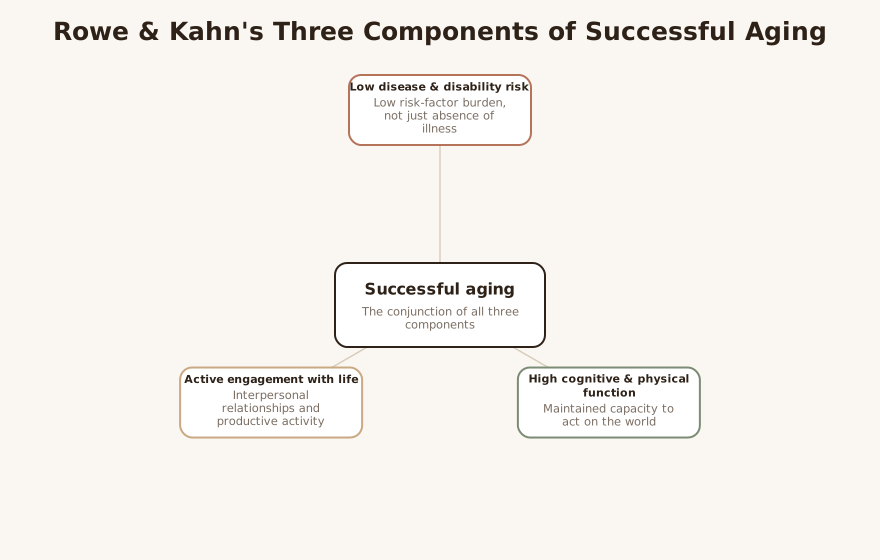
The framework’s first principle is that successful aging is not a single quantity but a conjunction of three components that must co-occur. 2 The first component is a low probability of disease and disease-related disability — and, importantly, low risk-factor burden, not merely the absence of diagnosed illness. 2 The second is high cognitive and physical functioning, the maintained capacity that lets an older adult act on the world. 2 The third is active engagement with life, which Rowe and Kahn defined principally through interpersonal relationships and productive activity. 2 Crucially, all three are required: a person who is disease-free and high-functioning but socially withdrawn does not, on this model, count as aging successfully. 6
The second principle is hierarchy and sequence. 2 Rowe and Kahn proposed that the components are loosely ordered — relative absence of disease and disability makes it easier to maintain mental and physical function, and maintained function in turn enables active engagement with life. 2 The third principle is modifiability: the gap between usual and successful aging is held open largely by extrinsic, changeable factors — diet, exercise, social support, sense of control — rather than by intrinsic, immutable aging. 1 This is the optimistic core of the model and its main departure from a fatalistic “decline-is-destiny” view. 1 A fourth, often-overlooked principle is that engagement is itself plural: it spans both close relationships and continued productivity, whether paid, volunteer, or caregiving. 6
Interventions & Techniques
There is no “successful-aging therapy”; the framework instead tells you which targets to assess and pursue, and supplies a shared vocabulary for later-life goals. LLM Used clinically, the natural workflow is to map a client across the three components, identify which are intact and which are eroding, and then deploy targeted, evidence-informed practices for the weakest domain. LLM For the disease-and-disability component, that means supporting health-behavior change — physical activity, nutrition, sleep, smoking cessation, and adherence to medical care — areas the model identifies as the modifiable substrate of healthy aging. 1 For the functioning component, it means protecting and exercising cognitive and physical capacity rather than assuming inevitable loss. 1
For the engagement component, the techniques are the most psychotherapeutically familiar: rebuilding and sustaining interpersonal connection, and restoring productive or contributory roles after losses such as retirement, widowhood, or relocation. 2 Behavioral activation, social-skills and relationship work, values clarification around contribution, and structured re-engagement with meaningful activity all map cleanly onto this domain. LLM The model’s own emphasis on control and self-efficacy points toward interventions that restore a sense of agency over one’s health and daily life. 1 Because the framework is a lens rather than a procedure, the actual change work is delivered inside whatever evidence-based modality the clinician is trained in. LLM
LLM-generated illustrative example (not a guideline): A 71-year-old client three years into retirement presents with low mood and “feeling useless.” Mapped against the model, his disease/disability and physical-cognitive functioning are intact, but the engagement component has collapsed — his identity and social contact had run almost entirely through work. The framework reframes a vague “depression” complaint into a specific, workable target: rebuilding productive and relational engagement, pursued through behavioral activation and values work. LLM
Evidence Base
The honest label is established as a framework, contested as a standard. LLM The model is one of the most influential and most-cited constructs in gerontology, and the empirical observation underneath it — that a meaningful share of “age-related” decline tracks modifiable lifestyle and psychosocial factors rather than chronology — is well supported and was grounded in the longitudinal MacArthur cohort. 1 The MacArthur Study followed high-functioning older adults over time and identified predictors of maintained function, lending the model a real prospective evidence base rather than mere theory. 5 Decades of subsequent research broadly confirm that physical activity, social engagement, and low risk-factor burden predict better outcomes in later life. 4
Two caveats are essential for practice. First, “successful aging” is a normative construct, and its specific operationalization is contested: studies using Rowe and Kahn’s strict criteria often classify only a minority of older adults as aging successfully, and the cutoffs are somewhat arbitrary. LLM Second, and more pointedly, critics argue the model can be exclusionary — by defining success partly as the absence of disease and disability, it risks implying that older adults with chronic illness or impairment have aged “unsuccessfully,” which sidelines a large and growing population. LLM The Crowther extension adding positive spirituality is itself a critique that the original three components are incomplete. 3 Clinicians should treat the model as a robust, useful organizing framework whose individual criteria are debated, not as a validated yardstick for grading a person’s old age. LLM
Populations & Indications
The framework was developed for, and is most directly indicated for, older adults, and it is most useful as a lens for later-life and aging-related clinical work. 2 It extends naturally to adults in midlife as a preventive frame, since its core claim is that the trajectory toward successful aging is shaped by behaviors adopted long before old age. 1 People navigating retirement transitions are a strong fit, because the engagement component directly addresses the role loss and identity disruption that retirement can bring. 6 Older adults experiencing social isolation or loneliness map onto the relationship facet of engagement. 2 People with chronic illness can be served by the model, but with explicit care — here the framework is best used to maximize function and engagement within illness rather than as a verdict on whether their aging counts as successful. LLM Caregivers and bereaved older adults are also apt, given the model’s emphasis on maintaining productive roles and interpersonal connection through major life losses. LLM
Problems-for-Work
The framework maps onto several presenting concerns in later-life work, used as an organizing lens rather than a treatment. LLM For late-life depression and demoralization, the engagement component directs attention to collapsed relationships and lost productive roles, which are often the maintaining factors behind low mood in older clients. 2 For adjustment to aging and retirement, the model gives a non-pathologizing structure: which of the three components has been disrupted by this transition, and how can it be rebuilt? 6 For social isolation and loneliness, the relationship facet legitimizes connection as a core component of aging well rather than a soft extra. 2
For health-behavior change, the disease-and-disability component reframes diet, exercise, and adherence as direct investments in successful aging rather than abstract medical advice. 1 For anxiety about cognitive decline, the functioning component supports a stance of protecting and exercising capacity, countering the fatalistic belief that decline is wholly fixed by age. 1 For grief and bereavement in older adults, the model orients work toward restoring engagement and productive contribution after loss. LLM For loss of purpose, the productivity facet of engagement anchors work on continued contribution as a route to meaning in later life. 6
LLM-generated illustrative example (not a guideline): A 68-year-old client who has just lost her spouse describes herself as “just waiting it out.” Rather than framing her aging as failing, the clinician uses the model to locate intact strengths — good health, sound cognition — and a single eroded domain, engagement. Sessions focus on rebuilding relational and contributory activity at a pace that honors her grief, turning a global sense of decline into a concrete, dignity-preserving plan. LLM
Contraindications, Cautions & Cultural Humility
Because this is a framework rather than a procedure, the cautions concern how it is used, not who is eligible. LLM The most important is its potential to invalidate: a model that defines success partly as the absence of disease and disability can, if applied bluntly, tell an older client with a chronic condition that they are aging “wrong.” LLM Clinicians should use it to identify modifiable strengths and engagement opportunities, never as a scorecard that pathologizes unavoidable illness, frailty, or disability. LLM It is also not a substitute for evidence-based treatment of diagnosable disorders; for moderate-to-severe late-life depression, anxiety, or cognitive disorders, it is at most an adjunct organizing lens alongside indicated care. LLM
A structural caution applies as well. LLM The “modifiable factors” the model emphasizes — diet, exercise, social support, control — are themselves heavily shaped by socioeconomic resources, neighborhood, discrimination, and access to care, so framing successful aging as a matter of individual behavior risks implying that disadvantaged older adults simply chose poorly. LLM Cultural humility is essential: the model carries Western, individualistic, productivity-centric assumptions about what a good old age looks like, and the relative value placed on independence, continued productivity, contemplative or spiritual life, and intergenerational interdependence varies widely across cultures. 3 The Crowther critique — that positive spirituality was a “forgotten factor” — is itself partly a cultural one, reminding clinicians not to treat the original three components as a universal, culture-free template. 3
Treatment-Plan Suggestions & SMART Objectives
| Goal | SMART objective (example) | Mechanism |
|---|---|---|
| Rebuild active engagement | Client schedules and completes 2 social or contributory activities per week for 6 weeks, logged | Strengthens the engagement-with-life component 2 |
| Restore productive role after retirement | Client identifies and begins one ongoing volunteer, mentoring, or caregiving role within 4 weeks | Engagement via continued productivity 6 |
| Reduce social isolation | Client initiates one meaningful interpersonal contact weekly for 6 weeks, tracked | Relationship facet of active engagement 2 |
| Support disease/disability risk reduction | Client adopts a specific health behavior (e.g., 150 min/week activity) and self-monitors for 8 weeks | Modifiable factors widen the gap from usual to successful aging 1 |
| Protect cognitive and physical functioning | Client engages in 3 weekly cognitively or physically stimulating activities for 6 weeks | Maintains the high-functioning component 1 |
| Restore sense of control and agency | Client sets and reviews one self-directed health or life goal weekly for 4 weeks | Control/self-efficacy as a driver of healthy aging 1 |
| Address purpose and meaning in later life | Client articulates a one-page statement of contribution and acts on it weekly for 4 weeks | Productive engagement as a route to meaning 6 |
| Integrate spirituality where valued | Client identifies one spiritual or values-based practice and engages it weekly for 6 weeks, if congruent | Positive spirituality as proposed extension domain 3 |
Common Misconceptions
The first misconception is that successful aging is a type of therapy; it is a framework that guides assessment and goal-setting in later-life work, not a treatment you deliver. LLM A second is that it equates successful aging with simply staying healthy; the model explicitly requires all three components, so an isolated but disease-free older adult does not meet the definition. 2 A third is that it treats aging outcomes as fixed by genetics or chronology, when its central claim is the opposite — that much of the usual-versus-successful gap is held open by modifiable factors. 1 A fourth is reading the model as morally judgmental of people who become ill or disabled; this is a known criticism, and using the criteria as a verdict rather than a guide misapplies the framework. LLM A fifth is assuming the three components are the complete and universal set, when later scholars have argued for additions such as positive spirituality and have questioned the model’s cultural assumptions. 3 Finally, some conflate the productivity facet of engagement with paid work alone, missing that volunteer, caregiving, and other contributory roles count fully. 6
Training & Certification
There is no licensing body, credential, or certification specific to successful aging, because it is a framework rather than a proprietary modality. LLM Clinicians typically encounter it through gerontology and lifespan-development coursework, continuing education in geriatric mental health, and the primary literature and overviews. 5 Practitioners who want to apply it in therapy generally train in an adjacent evidence-based approach — behavioral activation, interpersonal psychotherapy, problem-solving therapy, or other geriatric-mental-health methods — and use the model as an organizing scaffold for case formulation and goals. LLM Familiarity with the MacArthur Study and with the model’s major critiques is part of using it competently and ethically. 5 Competence rests on the host modality the clinician is already credentialed to deliver, with successful aging supplying structure rather than a new scope of practice. LLM
Key Terms
Usual aging — the average, non-pathological trajectory in which age-related declines accumulate even without overt disease, distinguished by Rowe and Kahn from successful aging. 1 Successful aging — the conjunction of low disease/disability risk, high cognitive and physical functioning, and active engagement with life. 2 Active engagement with life — the third component, comprising both interpersonal relationships and productive activity. 2 Modifiable factors — the lifestyle, behavioral, dietary, and psychosocial influences that Rowe and Kahn argued account for much of the gap between usual and successful aging. 1 MacArthur Study of Successful Aging — the interdisciplinary longitudinal research program that generated and supported the model. 5 Positive spirituality — the spiritual/religious dimension that Crowther and colleagues proposed as a “forgotten” fourth component. 3 Productivity — contributory activity (paid, volunteer, or caregiving) that, alongside relationships, constitutes engagement. 6
Resources & Further Reading
▶ Watch — a video introduction to this concept:
- Rowe JW, Kahn RL. “Human aging: usual and successful.” Science (1987)
- Rowe JW, Kahn RL. “Successful aging.” The Gerontologist (1997)
- Crowther et al. “Rowe and Kahn’s Model of Successful Aging Revisited: Positive Spirituality—The Forgotten Factor.” The Gerontologist (2002)
- Rowe JW, Kahn RL. Successful Aging (1998) — Google Books
- The MacArthur Study of Successful Aging — overview (WellPath Partners)
- What Are the Three Main Components of Successful Aging (Kendal at Home)
Reflective / Supervision Questions
- When an older client presents as “declining,” do I assess across all three components — disease/disability, functioning, and engagement — or do I default to the medical frame and overlook collapsed engagement? LLM
- Am I using the model to find modifiable strengths and dignified goals, or am I quietly grading whether this person has aged “successfully”? LLM
- How do I hold the tension between the model’s emphasis on individually modifiable behaviors and the socioeconomic and structural forces that constrain a given client’s choices? LLM
- For a client living with chronic illness or disability, how do I apply the engagement and functioning components without implying their aging has failed? LLM
- Whose vision of a good old age am I importing — the model’s productivity-centric, Western frame, or this particular client’s cultural and spiritual values around interdependence, contemplation, and rest? LLM
- Am I using successful aging as a structured lens for assessment and goals while delivering the actual change work inside a modality I am trained and credentialed to provide? LLM