
Type & Discipline
Socioemotional Selectivity Theory (SST) is a life-span theory of social and emotional motivation rather than a treatment model 3. It belongs to lifespan developmental psychology and the broader study of social-emotional aging 2. Its central claim is that the awareness of time passing is a powerful driver of human motivation and emotional experience 2. For clinicians, SST functions as an explanatory lens that reframes behaviors easily mistaken for decline, withdrawal, or pathology as motivated, often adaptive, responses to perceived time LLM. It is not itself a manualized intervention, and the present article treats it as a conceptual framework that informs work conducted within established modalities LLM.
Creators & Lineage
SST was developed by Stanford psychologist Laura L. Carstensen and articulated in its mature form in the landmark 1999 American Psychologist paper with Isaacowitz and Charles 1. Carstensen has continued to extend and refine the theory, including a 2021 synthesis that foregrounds perceived endings as the engine of motivation 2. The theory sits within lifespan developmental psychology and shares conceptual territory with frameworks that treat mortality awareness as motivationally central, such as Terror Management Theory and the existential tradition LLM. Its emphasis on meaning under finite time also resonates with Meaning-Centered Psychotherapy and with existential therapy, which clinicians may draw on when applying SST ideas in session LLM.
Core Principles
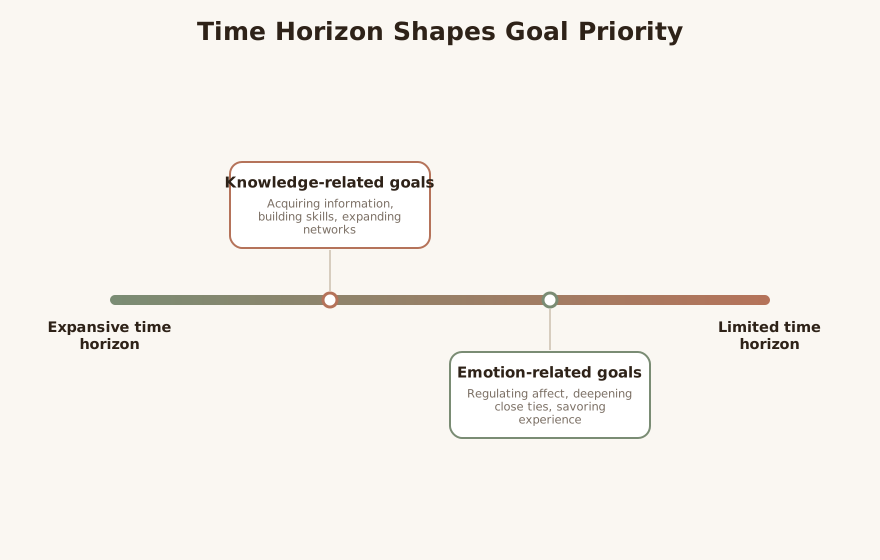
The organizing principle of SST is that perceived time horizon, not chronological age, shapes which goals people pursue 4. The theory distinguishes two broad classes of goals: knowledge-related goals oriented toward the future (acquiring information, developing skills, expanding networks, initiating relationships) and emotion-related goals oriented toward the present (regulating affect, deepening meaningful ties, savoring experience) 3. When the future is perceived as open and expansive, knowledge-related goals dominate; when time is perceived as limited, emotion-related goals take priority 3. Because younger people typically perceive expansive futures and older people typically perceive contracting ones, these motivational shifts track age in the aggregate, but the driver is subjective time, not the calendar 2.
A second core proposition concerns social networks. Across adulthood people systematically narrow their networks so that the partners who remain best satisfy their emotional needs 3. This pruning begins earlier in adulthood than commonly assumed and is associated with enhanced, not diminished, emotional well-being, which contradicts the intuition that a shrinking social world necessarily harms mental health 2. A third proposition is the positivity effect: relative to younger adults, older adults show a preference for attending to and remembering positive over negative information 4. This effect is reliable across roughly 100 studies, yet it diminishes when tasks impose explicit external instructions, suggesting it reflects motivational priorities rather than a cognitive deficit 2.
Critically, time horizons are manipulable independent of age 2. Experimental and naturalistic constrictions of perceived time, such as serious illness or imminent endings, shift younger people toward the emotion-focused preferences typical of older adults, while imagined expansions of time can reverse the pattern 2. This is why SST is clinically useful well beyond geriatric settings: any event that compresses a person’s felt future, a terminal diagnosis, a relocation, an existential confrontation, can reorganize their goals in predictable ways LLM.
Interventions & Techniques
SST contributes no native, branded techniques; it is a motivational framework rather than a therapy LLM. Its clinical value is in orienting the clinician’s formulation and in selecting and framing interventions drawn from established modalities 4. Approaches that align naturally with SST include life review therapy, Meaning-Centered Psychotherapy, Acceptance and Commitment Therapy, and relationship-focused work, rather than generic activity scheduling 4.
Practically, an SST-informed clinician can do several things LLM. First, assess perceived time horizon explicitly, asking how open or foreshortened the client’s felt future is, since this predicts goal orientation more than age does 2. Second, validate selective social narrowing as a potentially adaptive reallocation of finite emotional resources rather than as isolation 4. Third, support emotion-related and meaning-related goals when time is genuinely compressed, helping clients invest in the relationships and experiences that matter most 4. Fourth, leverage the positivity tendency in psychoeducation and behavior change, since gain-framed and emotionally meaningful messaging tends to land better with older adults than risk-framed messaging 2. None of these moves belongs to SST as a protocol; each is borrowed from an existing intervention and informed by the theory LLM.
Evidence Base
The evidence base must be described in two layers LLM. As a theory of aging and motivation, SST is well established 2. Its core predictions are supported by a substantial and convergent literature: longitudinal narrowing of social networks alongside preserved or improved emotional well-being, a positivity effect confirmed across roughly 100 studies, experience-sampling data showing fewer negative emotions and greater emotional stability in older adults, and time-horizon manipulation studies in which constricting perceived time shifts goal priorities in the predicted direction 2. Neuroimaging work is broadly consistent, with older adults showing reduced amygdala activation to negative stimuli and altered prefrontal engagement, interpreted as motivated emotion regulation rather than dysfunction 3.
The second layer is far less mature LLM. There is no manualized “SST therapy” with its own randomized controlled trials; the theory informs clinical practice but has not itself been packaged and tested as a treatment LLM. Clinicians should therefore present SST to clients and supervisees as a robust descriptive and motivational framework, while being candid that the step from theory to a specific therapeutic protocol rests on borrowed evidence and clinical reasoning rather than on dedicated efficacy trials LLM. Some boundary conditions are also acknowledged: cross-cultural data show that the positivity effect and patterns of emotional processing vary by culture and self-construal, so the theory’s predictions are not uniform across populations 3.
Populations & Indications
SST is most directly relevant to older adults, in whom contracting time horizons typically reorganize goals toward emotional meaning 2. It is equally pertinent, regardless of age, to people with terminal or chronic illness and to those facing the end of life, because illness and imminent endings compress the felt future and shift motivation toward emotion-related goals 2. Bereaved individuals and caregivers are also apt populations: loss and sustained proximity to another’s decline can alter one’s own sense of time and priorities, and the framework helps distinguish meaningful reprioritization from constriction driven by burden or depression 4. The theory is indicated less as a diagnosis-specific tool and more as a formulation aid wherever perceived time is a salient feature of a client’s situation LLM.
Problems-for-Work
SST gives clinicians a vocabulary for several common presenting problems LLM. For existential distress and meaning-making difficulties, the theory reframes the search for meaning under finite time as a normative motivational shift, legitimizing a pivot toward emotionally significant goals 2.
LLM-generated illustrative example (not a guideline): A 68-year-old recently retired client says he “doesn’t see the point” in the volunteer board he once enjoyed but lights up describing time with two grandchildren. Reframed through SST, his narrowing is reallocation toward emotionally meaningful ends, and therapy supports that pivot rather than pushing re-engagement everywhere LLM.
For anticipatory grief and adjustment to terminal illness, SST predicts and normalizes the turn inward toward closest relationships, which helps clients and families read selectivity as investment rather than rejection 2. For relationship prioritization and end-of-life adjustment, the network-narrowing principle directly supports values-based pruning of obligations in favor of cherished ties 3.
LLM-generated illustrative example (not a guideline): A client with metastatic cancer feels guilty for declining most social invitations while protecting weekly calls with a sister. SST language (“you are spending finite emotional energy where it matters most”) reframes the guilt and guides a values conversation LLM.
For depression in older adults, SST is most useful as a differential lens, distinguishing healthy, agency-driven selectivity from the pervasive anhedonia and collapsed meaning of depression 4.
Contraindications, Cautions & Cultural Humility
SST describes a framework, not an intervention, so it has no contraindications in the pharmacological sense; the cautions concern misapplication LLM. The central clinical risk is mistaking depression, untreated pain, internalized ageism, trauma, or caregiver burden for healthy selectivity, and so normalizing withdrawal that in fact warrants assessment and treatment 4. The differentiating questions are whether the narrowing feels purposeful and agency-driven, whether valued activities remain meaningful, and what the change has created space for; depression instead presents as anhedonia across domains, helplessness, and the sense that nothing is worth it 4.
Cultural humility is essential because the theory’s predictions are not culturally uniform 3. The positivity effect and patterns of emotional processing differ across cultural groups and forms of self-construal, so a clinician should not assume that a given client will show the prototypical positivity bias or value the same emotional goals 3. Time horizon itself is shaped by context, including health disparities and life expectancy differences across communities, which a clinician must hold in mind rather than treating perceived time as purely individual LLM.
Treatment-Plan Suggestions & SMART Objectives
| Goal | SMART objective (example) | Mechanism |
|---|---|---|
| Clarify perceived time horizon | Within 3 sessions, client articulates how open or foreshortened the future feels and links it to current priorities | Makes subjective time explicit so goals can be examined 2 |
| Validate adaptive selectivity | Over 4 weeks, client identifies 2 relationships to invest in and 2 obligations to release, without guilt-driven distress, rated weekly | Network narrowing reallocates finite emotional resources 3 |
| Reduce existential distress | Within 6 weeks, client rates meaning-related distress at or below 4/10 on a self-report scale for 2 consecutive weeks | Reframes search for meaning as normative under limited time 2 |
| Support anticipatory grief | Over 8 weeks, client completes one structured legacy or life-review activity and reports it as meaningful | Channels emotion-related goals toward closure and connection 2 |
| Differentiate selectivity from depression | By session 4, clinician and client complete a depression screen and document anhedonia-versus-selectivity findings | Protects against normalizing treatable depression 4 |
| Leverage positivity in change | Across 4 weeks, client adopts 2 gain-framed health behaviors and tracks adherence | Gain-framed, meaningful messaging fits older-adult motivation 2 |
| Strengthen emotion regulation | Within 6 weeks, client reports increased emotional stability on 3 of 5 weekly check-ins | Aligns with age-typical motivated emotion regulation 3 |
Common Misconceptions
A frequent misconception is that SST is a therapy or a set of techniques; it is a motivational theory that informs interventions borrowed from other modalities LLM. Another is that the positivity effect reflects cognitive decline or denial; the evidence instead points to a motivational preference that weakens under explicit external task demands 2. A third is that social-network narrowing in later life signals loneliness or failure; in SST it is typically a selective, well-being-enhancing process 2. A fourth is that the theory is only about old age; because the driver is perceived time, its predictions apply to anyone whose felt future has been compressed by illness or circumstance 2. Finally, SST is sometimes read as claiming older adults are simply happier; the data show greater emotional stability and fewer negative emotions, not uniformly higher happiness, and often more mixed, poignant emotion near meaningful endings 2.
Training & Certification
There is no certification in SST because it is a theory rather than a credentialed treatment model LLM. Clinicians build competence by reading the primary literature, beginning with the 1999 American Psychologist paper and Carstensen’s 2021 synthesis, and by integrating the framework into modalities they are already trained in, such as life review, meaning-centered, existential, and acceptance-based approaches 1. Supervision focused on aging, end-of-life care, and grief is the most practical route to skillful application LLM.
Key Terms
Perceived time horizon / future time perspective — the subjective sense of how much time remains, which drives goal selection more strongly than chronological age 2. Knowledge-related goals — future-oriented goals such as acquiring information, developing skills, and expanding networks, favored when time feels expansive 3. Emotion-related goals — present-oriented goals such as regulating affect and deepening meaningful ties, favored when time feels limited 3. Positivity effect — the relative tendency of older adults to attend to and remember positive over negative information 4. Social network narrowing — the systematic pruning of social partners across adulthood toward those who best meet emotional needs 3.
Resources & Further Reading
▶ Watch — a video introduction to this concept:
- Carstensen, Isaacowitz & Charles (1999). Taking time seriously: A theory of socioemotional selectivity. American Psychologist
- Carstensen (2021). Socioemotional Selectivity Theory: The Role of Perceived Endings in Human Motivation
- Socioemotional selectivity theory (Wikipedia)
- Socioemotional Selectivity Theory: Why Older Adults Thrive Even When Time Runs Short (Mental Health and Aging)
Reflective / Supervision Questions
- How does this client perceive their remaining time, and how might that perception, more than their age, be shaping the goals they bring to therapy? LLM
- When a client narrows their social world, what evidence would help me distinguish adaptive selectivity from depression, pain, or burden? LLM
- Am I applying the positivity effect as a universal assumption, or am I checking whether it fits this client’s culture and self-construal? LLM
- Where am I tempted to treat SST as a protocol, and how can I keep it as a lens that informs interventions I am actually trained to deliver? LLM
- How do health disparities and differing life expectancies in this client’s community shape their felt future, and am I holding that in mind? LLM