
Type & Discipline
Parental sensitivity is a measurable construct from developmental psychology, not a treatment modality in its own right LLM. It belongs to the family of infant-caregiver development research that grew out of attachment theory LLM. The construct names a specific quality of caregiving behavior — the degree to which a parent accurately reads and appropriately responds to an infant’s signals 3. For clinicians, it functions as both an explanatory variable (why a given dyad may be heading toward secure or insecure attachment) and a target that intervention can move LLM. Understanding it as a construct rather than a therapy is the key framing: you do not “deliver” sensitivity, you assess it and shape the conditions that increase it LLM.
Creators & Lineage
The construct is Mary Ainsworth’s 5. Working first in Uganda and then in the Baltimore longitudinal study begun in 1963, Ainsworth observed mother-infant dyads in the home and developed rating scales for the quality of maternal behavior 3. Her central methodological contribution, the Strange Situation, was a structured laboratory procedure observing infant behavior across separations and reunions with the caregiver 5. From those observations she derived classifications of attachment security and linked them theoretically to the caregiving she had rated at home 5. The Strange Situation remains roughly a twenty-minute protocol observing caregiver-child interaction, classically through one-way glass 3.
The empirical confirmation and important tempering of Ainsworth’s claim came later LLM. Marian De Wolff and Marinus van IJzendoorn conducted the landmark 1997 meta-analysis that quantified how strongly sensitivity actually predicts attachment security across studies 1. Their work, and the larger contemporary meta-analyses that followed, moved the field from Ainsworth’s strong single-cause framing toward a more calibrated multi-factor view 1. The lineage thus runs from Ainsworth’s rich observational scales to a quantitative literature that both validated and bounded her original claim LLM.
Core Principles
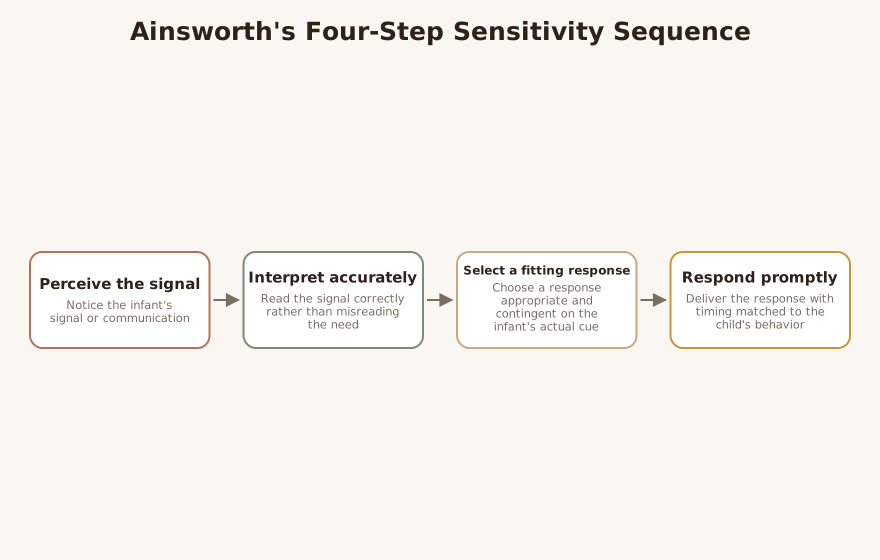
The defining principle is that sensitivity is a four-step sequence, not a global warmth trait LLM. Ainsworth’s original definition was a caregiver’s ability to perceive and interpret accurately the infant’s signals and communications, and then respond appropriately 3. Clinically that unpacks into four distinct competencies: noticing the signal, reading it correctly, selecting a fitting response, and delivering it promptly LLM. A parent can fail at any one link — a depressed parent may perceive but not respond promptly; an anxious parent may perceive and respond quickly but misinterpret a bid for space as distress LLM.
A second principle is contingency and reciprocity 3. Sensitivity later expanded beyond accurate reading to emphasize interactions that are contingent on the infant’s behavior, reciprocal in their give-and-take, and affectively positive 3. The response must be timed to the child’s actual cue, not the parent’s schedule or anxiety LLM.
A third principle is that sensitivity is dyadic and observable 3. It is rated from real behavior — Pederson and colleagues found that mothers of securely attached infants were more frequently characterized as noticing their babies’ signals and using those signals to guide their behavior 2. The construct lives in the moment-to-moment interaction, which is why it can be filmed, coded, and changed LLM.
Interventions & Techniques
Because sensitivity is a construct rather than a therapy, clinicians use it in two ways: to assess and to target LLM. On the assessment side, the established instruments are Ainsworth’s nine-point Maternal Sensitivity Scale, which rates sensitivity versus insensitivity to signals and acceptance versus rejection, and the Maternal Behaviour Q-sort, in which observers sort ninety behavioral items into piles describing the parent 3. Pederson’s group demonstrated the Q-sort approach in the home across two-hour visits, pairing a maternal behavior sort with an infant attachment behavior sort 2. The Strange Situation provides the downstream attachment classification that sensitivity is meant to predict 5.
On the intervention side, sensitivity is the mechanism most attachment-based parenting programs aim to move LLM. The clinical logic is to make the four-step sequence visible to the parent and rehearse it — most directly through video-feedback methods, where brief clips of the parent’s own interaction are reviewed to highlight the infant’s cues and the parent’s accurate responses LLM. These techniques sit inside broader dyadic treatments rather than standing alone LLM.
LLM-generated illustrative example (not a guideline): A clinician working with a postpartum parent who reports “I can never tell what she wants” reviews a two-minute feeding video frame by frame, pausing to name the infant’s gaze aversion as a cue for a pause rather than a rejection. Over sessions the parent begins anticipating the cue, and the response latency shortens LLM.
Evidence Base
The evidence here is established, and the honest version of it is more interesting than the slogan LLM. The 1997 De Wolff and van IJzendoorn meta-analysis pooled twenty-one studies with a combined sample of 1,099 dyads and found a correlation between sensitivity and attachment security of r = .24 1. By conventional standards that is a moderate association — real and replicable, but far from deterministic 1. Their stated conclusion is the line every clinician should internalize: sensitivity is an important but not exclusive condition of attachment security, with several other parenting dimensions playing a comparably important role 1.
Contemporary meta-analysis has confirmed the magnitude with much larger samples rather than overturning it LLM. A recent synthesis drawing on roughly 181 studies and over 22,000 caregivers reported a pooled correlation of about r = .25 across all caregivers, r = .26 for mothers and r = .21 for fathers, with sensitivity negatively associated with avoidant (r = -.24), disorganized (r = -.22), and resistant (r = -.14) classifications 4. The effect size was remarkably consistent with earlier work despite a far larger and more diverse sample, which the authors read as evidence of robustness across populations and methods 4. The takeaway for practice is twofold: sensitivity is the single most reliably replicated caregiving predictor of security, and it accounts for a modest share of the variance, leaving substantial room for temperament, context, and other parenting dimensions LLM.
Populations & Indications
The construct was developed with infants and their primary caregivers, and that dyad remains its core population 5. Clinically, sensitivity-informed assessment and intervention are most indicated where attachment is forming or repairing: postpartum and perinatal parents, NICU and other high-risk infant dyads, foster and adoptive placements where a new caregiving relationship is being built, and families where parental depression, trauma, or substance history may disrupt the four-step sequence LLM. Pederson’s findings add nuance for case formulation: sensitivity did not track with maternal age, income, or socioeconomic status, but did correlate positively with maternal education, and infants with more difficult temperaments tended to have less sensitive mothers 2. That last finding flags difficult-temperament dyads as an indication, because the child’s harder-to-read cues raise the difficulty of every link in the sequence LLM.
Problems-for-Work
Sensitivity gives clinicians a precise vocabulary for several presenting problems LLM.
- Caregiver misattunement to infant cues. When a parent consistently misreads or misses signals, the formulation names which of the four links is breaking down, and the work targets that link — for example, building cue-recognition before working on response timing LLM.
- Insecure or disorganized attachment risk. Where screening or the Strange Situation suggests an insecure trajectory, raising sensitivity is the mechanism with the strongest evidence for shifting it, given its negative association with avoidant and disorganized classifications 4.
- Postpartum depression affecting caregiving. Depression often degrades the prompt-response link specifically; the dyadic work can proceed alongside treatment of the parent’s mood, targeting contingent responsiveness directly LLM.
- Reflective-functioning deficits. When a parent cannot hold the infant’s mental state in mind, sensitivity work makes cues concrete and observable, scaffolding the interpretive step LLM.
Contraindications, Cautions & Cultural Humility
The single largest caution is the cultural boundedness of the construct LLM. Sensitivity was operationalized within a specific Western, largely middle-class research context, and what counts as an “appropriate” or “prompt” response is culturally patterned — face-to-face gaze, verbal contingency, and proximity norms vary widely across caregiving cultures LLM. The reference literature notes sensitivity’s correlation with maternal education, which should prompt the clinician to ask whether an instrument is measuring caregiving quality or a culturally specific interactional style 2. Rating a parent low on a scale calibrated to another culture’s norms risks pathologizing competent caregiving LLM.
A second caution is causal humility: the moderate effect size means sensitivity is one contributor among several, and a sensitive parent can still have an insecurely attached child for reasons outside the dyad 1. Clinicians should avoid parent-blaming framings, especially with parents who are depressed, traumatized, or under structural stress, where naming a “sensitivity deficit” can deepen shame and undermine the alliance LLM. Finally, sensitivity assessment is not a child-protection instrument and should not be used to make custody or safety determinations on its own LLM.
Treatment-Plan Suggestions & SMART Objectives
| Goal | SMART objective (example) | Mechanism |
|---|---|---|
| Improve cue recognition | Within 8 weeks, parent will accurately label 4 of 5 infant cues during a reviewed interaction clip | Strengthens the perception link of the sensitivity sequence LLM |
| Reduce response latency | Over 6 sessions, parent will respond to distress cues within an agreed window in 70% of observed instances | Targets prompt implementation 3 |
| Improve interpretive accuracy | Within 10 weeks, parent will distinguish bids for engagement from bids for a pause in 4 of 5 video segments | Targets correct interpretation 1 |
| Increase contingent responsiveness | Over 8 weeks, parent will demonstrate contingent, reciprocal exchanges in 3 consecutive observed feedings | Builds reciprocity and contingency 3 |
| Build reflective functioning | Within 12 weeks, parent will narrate the infant’s likely internal state in 3 of 4 prompts | Scaffolds the interpretive step LLM |
| Shift attachment trajectory | Over 6 months, dyad will show movement toward secure markers on repeat structured observation | Sensitivity as predictor of security 4 |
| Generalize skills to home | Within 8 weeks, parent will report and demonstrate cue-reading during 2 daily routines | Transfers in-session gains to context LLM |
Common Misconceptions
The most common misconception is that sensitivity means constant responsiveness or warmth LLM. It does not — appropriate response sometimes means restraint, giving the infant space when the cue is for a pause, which is why the construct is about accuracy and fit rather than quantity of attention 3. A second misconception is that sensitivity alone determines attachment; the meta-analytic record is explicit that it is important but not exclusive, with a moderate effect size 1. A third is that the Strange Situation measures sensitivity — it measures the infant’s attachment classification, which sensitivity is theorized to predict, and conflating the two confuses cause with outcome 5. A fourth is that low ratings imply a bad parent; ratings are behavioral and contextual, and difficult infant temperament and structural stress both depress observed sensitivity 2.
Training & Certification
There is no single certification in “parental sensitivity,” because it is a research construct rather than a credentialed modality LLM. Competence comes through training in the specific instruments and the dyadic interventions that target it LLM. Reliable use of Ainsworth’s Maternal Sensitivity Scale or the Maternal Behaviour Q-sort requires supervised coding training to reach acceptable inter-rater agreement, and Strange Situation classification requires its own certified coder training 3. Clinicians applying the construct in treatment typically pursue training in an established attachment-based parenting program that incorporates video feedback, where sensitivity is the operationalized target LLM.
Key Terms
- Sensitivity: A caregiver’s ability to perceive, interpret accurately, and respond appropriately and promptly to an infant’s signals 3.
- The four links: Perception, interpretation, response selection, and prompt implementation — the sequence a sensitive response passes through LLM.
- Contingency: Responses timed to and dependent on the infant’s actual behavior 3.
- Strange Situation: Ainsworth’s structured separation-reunion procedure for classifying infant attachment 5.
- Maternal Behaviour Q-sort: A 90-item observational sort used to rate caregiving behavior 3.
- Attachment security: The infant outcome that sensitivity predicts, at a moderate effect size of roughly r = .24–.25 1 4.
Resources & Further Reading
▶ Watch — a video introduction to this concept:
- De Wolff & van IJzendoorn (1997): Sensitivity and attachment — a meta-analysis
- Pederson et al.: Maternal sensitivity and the security of infant-mother attachment — a Q-sort study
- Maternal sensitivity — Wikipedia
- Maternal Sensitivity & Child Attachment Security: A Meta-Analysis — Simply Psychology
- Mary Ainsworth: Strange Situation Experiment — Simply Psychology
- Attachment theory: Strange Situation — Mary Ainsworth (video)
Reflective / Supervision Questions
- When you rate a parent as “insensitive,” which of the four links — perception, interpretation, response selection, or timing — is actually breaking down, and how would you know? LLM
- How confident are you that the sensitivity standard you are applying reflects clinical quality rather than a culturally specific interactional style? 2
- Given that sensitivity explains only a moderate share of attachment variance, what other contributors are you tracking in this dyad’s formulation? 1
- How do you raise concerns about sensitivity without inducing shame in a depressed or trauma-affected parent? LLM
- Where in your assessment are you distinguishing the infant’s attachment classification from the caregiving behavior meant to predict it? 5