
Type & Discipline
Stereotype threat is a construct from social psychology, not a therapy or a diagnosis. LLM It names a situational predicament: being “at risk of confirming, as self-characteristic, a negative stereotype about one’s group.” 3 The threat is provoked by the situation rather than by a stable trait, which is what makes it both clinically interesting and modifiable. 4
For practicing therapists, the construct matters because it offers a non-pathologizing, contextual explanation for why a capable client may underperform, disengage, or feel acute anxiety specifically in domains where their group is negatively stereotyped. LLM It sits within the broader family of stereotyping and identity processes and draws lineage from stigma theory, attribution theory, and self-efficacy theory. LLM Crucially, it locates part of the problem in the environment and the stereotype, not in the person — a framing that aligns naturally with culturally responsive and strengths-based clinical work. LLM
Creators & Lineage
The construct was introduced by Claude Steele and Joshua Aronson in their 1995 Journal of Personality and Social Psychology paper, “Stereotype threat and the intellectual test performance of African Americans.” 1 7 Across a series of experiments, they showed that Black college students underperformed on a difficult verbal test (GRE-style items) when it was framed as diagnostic of intellectual ability, but performed equivalently to White peers when the same test was framed as a non-diagnostic problem-solving exercise. 3 In a further manipulation, simply asking students to record their race before the test was enough to depress Black students’ scores — demonstrating how subtle the triggering cue can be. 3
Steele later synthesized two decades of this work for a general audience in Whistling Vivaldi (2010), whose title refers to a Black graduate student who hummed Vivaldi to signal non-threat and disarm others’ stereotypes as he walked at night. 4 The construct’s intellectual roots lie in stigma theory (how devalued identities shape experience), attribution theory (how people explain their own and others’ outcomes), and self-efficacy theory (how expectancies shape effort and performance). LLM A major theoretical advance came from Toni Schmader, Michael Johns, and Chad Forbes (2008), whose integrated process model specified the cognitive and physiological machinery behind the effect. 2
Core Principles
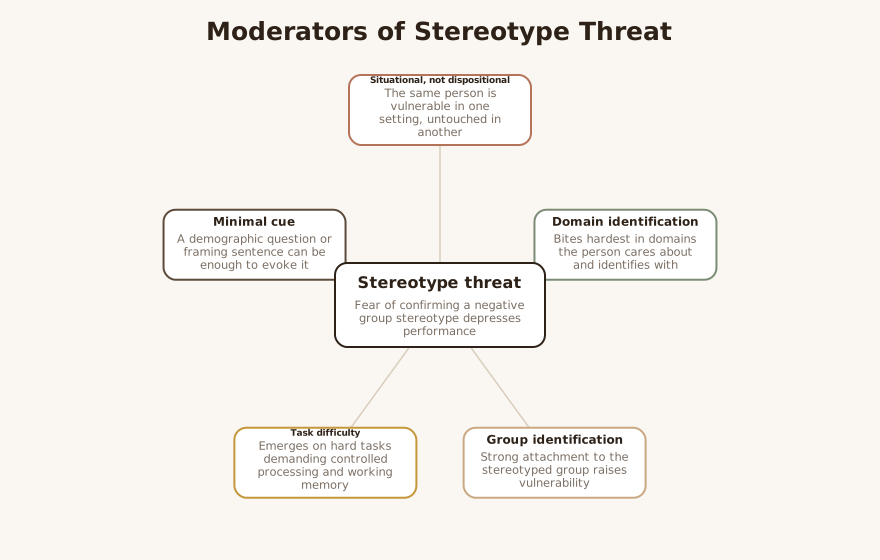
The threat is situational, not dispositional. The same person can be vulnerable in one setting and untouched in another; what changes is the salience of the stereotype and the relevance of the task to it. 4 3
Domain identification amplifies the effect. Threat bites hardest in domains the person cares about and identifies with — the math-identified woman, the academically invested minority student. 6 People who do not value the domain have less to lose and show smaller effects. 6
Group identification matters. Individuals who strongly identify with the stereotyped group appear more vulnerable than those with weaker group attachment. 6
Task difficulty is a moderator. Effects emerge most clearly on tasks that are hard enough to demand controlled processing and working memory; trivially easy tasks show little impairment. 2
The cue can be minimal. A demographic question, the gender composition of a room, or a single framing sentence (“this test measures ability”) can be sufficient to evoke threat. 3 5
Interventions & Techniques
Stereotype threat research has generated a toolkit of brief, environmentally targeted interventions. These are not psychotherapy techniques per se, but several translate readily into clinical and psychoeducational work. LLM
- Self-affirmation. Brief writing exercises in which people affirm a personally important value buffer against threat; one classroom study reduced the racial achievement gap by roughly 40%. 6 3
- Reframing the task as non-diagnostic. Presenting an evaluation as a learning exercise or as “not measuring ability” can eliminate the performance decrement seen under diagnostic framing. 3
- Teaching about stereotype threat itself. Simply explaining the phenomenon to people gives them an external attribution for their anxiety and has reduced its effect on women’s math performance. 3
- Growth mindset instruction. Framing intelligence as malleable rather than fixed has improved engagement and grades among students facing negative stereotypes. 3 6
- Counter-stereotypical role models. Exposure to credible same-group exemplars in the threatened domain improves subsequent performance. 3
- Reducing environmental cues. Adjusting representation and removing stereotype-signaling features of a setting lessens threat. 6
LLM-generated illustrative example (not a guideline): A first-generation college student reports “blanking” on exams despite strong preparation. The clinician introduces stereotype threat as one possible mechanism, normalizes the working-memory hijack, and pairs a brief values-affirmation writing exercise with a reframe of exams as “showing what you’ve learned” rather than “proving you belong.” LLM
Evidence Base
The evidence base is established but actively debated, and clinicians should hold it with appropriate nuance. LLM The original demonstrations have been replicated across many laboratories and extended to numerous groups; multiple meta-analyses and systematic reviews report significant evidence for the effect. 6
At the same time, the field has reckoned seriously with replication and effect-size concerns. Flore and Wicherts (2015) concluded that the average reported effect is small and likely inflated by publication bias. 6 A later large meta-analysis found that when analysis was restricted to studies using subtle stereotype manipulations, the observed effect was small to negligible. 6 Critics such as Sackett and colleagues have cautioned against treating stereotype threat as a full explanation for real-world performance gaps, noting that even when threat was reduced in the original experiments, a sizable achievement gap remained. 6
The honest clinical takeaway: stereotype threat is a real, mechanistically well-characterized laboratory phenomenon and a useful explanatory frame, but its magnitude in everyday performance is uncertain and probably modest. LLM It is one contributing factor, not the whole story, and should be offered to clients as a possibility rather than a diagnosis. LLM
Populations & Indications
The construct was first demonstrated with racial and ethnic minorities in academic testing, and the canonical race-and-testing finding remains its flagship evidence. 1 3 It has been extended to women and girls in mathematics — women underperform when a math test is described as producing gender differences but not otherwise. 3 People with low socioeconomic status show parallel effects: lower-SES participants underperform when a test is described as measuring intellectual ability but not when it is framed as non-diagnostic. 3
The phenomenon also appears among older adults (around memory and aging stereotypes) and, more broadly, among students and test-takers and people with stigmatized identities in any domain where a negative group stereotype is culturally available. 6 5 In clinical practice, these are precisely the populations who often present with performance anxiety, test anxiety, low academic self-efficacy, and identity threat — making stereotype threat a relevant lens for case formulation. LLM
Problems-for-Work
Stereotype threat maps onto several common presenting problems. LLM
- Performance anxiety / test anxiety. A pre-med student of color who freezes on standardized exams may be carrying threat-driven monitoring and intrusive worry that consume working memory. 2 LLM
- Underperformance and working-memory impairment under stress. The integrated process model attributes the performance hit largely to depleted working memory; clients may describe “going blank” or losing their train of thought under evaluation. 2
- Internalized stereotypes and low academic self-efficacy. Repeated threat experiences can erode a client’s belief in their ability within the domain, feeding a self-fulfilling cycle. 3 LLM
- Disengagement and disidentification. Chronic threat can lead people to protectively disengage from a valued domain (“I never cared about math anyway”), which the therapist can recognize as defense rather than disinterest. 4 LLM
- Identity threat and low self-esteem. When a person’s group identity is repeatedly devalued in a high-stakes setting, the cumulative cost can touch self-worth more broadly. 4 LLM
Contraindications, Cautions & Cultural Humility
Stereotype threat is an explanatory construct, not a treatment, so “contraindication” is better framed as misuse risk. LLM The central caution: do not overstate it. Given the contested effect sizes and the persistence of achievement gaps even when threat is mitigated, presenting stereotype threat as the cause of a client’s difficulties overpromises and can ring false. 6 LLM
A second caution is agency and attribution. Used well, the construct externalizes blame in a relieving, empowering way (“the situation is loading you, not your ability”). 4 Used carelessly, it can imply fragility or fixedness, or invite a client to attribute every setback to bias. LLM Cultural humility means holding the client’s own meaning-making as primary: some clients will find the frame liberating, others may experience it as dismissive of real structural barriers or of their individual effort. LLM The therapist’s job is to offer the lens tentatively and collaboratively, attend to the client’s lived experience of discrimination as real, and avoid substituting a tidy psychological label for genuine systemic injustice. LLM
Treatment-Plan Suggestions & SMART Objectives
| Goal | SMART objective (example) | Mechanism |
|---|---|---|
| Reduce evaluative anxiety in a stereotyped domain | Within 6 weeks, client will report a 2-point drop on a 0-10 anxiety rating before academic evaluations in 3 consecutive instances | Reframing and external attribution reduce monitoring load 3 |
| Protect working memory under pressure | Within 8 weeks, client will apply a pre-task self-affirmation or grounding routine before 4 of 5 high-stakes tasks | Self-affirmation buffers threat and preserves working memory 2 6 |
| Build domain self-efficacy | Over 10 weeks, client will log one mastery experience in the threatened domain weekly and rate confidence | Growth-mindset framing increases engagement and efficacy 3 |
| Reduce disidentification from a valued domain | Within 8 weeks, client will re-engage one previously avoided domain activity twice weekly | Reversing protective disengagement restores domain identification 4 |
| Normalize threat-driven blanking | By session 4, client will accurately describe stereotype threat as a situational mechanism in their own words | Psychoeducation provides external attribution 3 |
| Strengthen identity safety in evaluative settings | Within 6 weeks, client will identify and use 2 counter-stereotypical role models or supports | Role models reduce threat and signal belonging 3 6 |
| Decrease cognitive avoidance before tasks | Over 6 weeks, client will reduce avoidance behaviors before evaluations from baseline by 50% | Reducing thought suppression frees executive resources 2 |
Common Misconceptions
“Stereotype threat is the same as low self-esteem or being thin-skinned.” It is a situational state triggered by a stereotype-relevant cue, not a stable personality weakness; the same person is unaffected when the cue is absent. 4 3
“It only affects people who believe the stereotype.” Threat operates even among people who reject the stereotype, because the worry is about confirming it to others, not about endorsing it personally. 3 LLM
“It explains the entire achievement gap.” It does not; substantial gaps persist even after threat is reduced, and critics caution against treating it as a complete account of real-world disparities. 6
“The effect is huge and settled.” Recent meta-analytic work suggests the average effect is small and may be inflated by publication bias, especially for subtle manipulations. 6
“It’s only about race and tests.” It generalizes to gender and math, age and memory, socioeconomic status, and many stigmatized identities and domains. 3 6
Training & Certification
There is no certification in stereotype threat, because it is a research construct rather than a credentialed therapy. LLM Clinicians typically encounter it through social psychology coursework, multicultural and diversity competence training, and continuing education in culturally responsive care. LLM The primary literature — Steele and Aronson’s 1995 paper and Schmader, Johns, and Forbes’s 2008 integrated process model — together with Steele’s accessible book Whistling Vivaldi, constitute the core reading needed to apply the concept responsibly. 1 2 4 Educational handouts such as the Stanford teaching resource summarize practical implications for evaluative settings. 5
Key Terms
- Stereotype threat — the risk of confirming, as self-characteristic, a negative stereotype about one’s group. 3
- Diagnostic framing — presenting a task as measuring ability, which heightens threat. 3
- Domain identification — the degree to which a person values and identifies with the domain; greater identification increases vulnerability. 6
- Working memory — the limited-capacity executive attention system that threat depletes, the proposed common pathway for performance loss. 2
- Performance monitoring — heightened vigilance toward performance cues and failure signals under threat. 2
- Thought/emotion suppression — the effortful, resource-draining attempt to suppress anxious thoughts that further taxes working memory. 2
- Disidentification — protective disengagement from a domain to defend self-worth. 4
- Self-affirmation — affirming a valued personal value to buffer against identity threat. 6
Resources & Further Reading
▶ Watch — a video introduction to this concept:
- Steele & Aronson (1995), Stereotype threat and the intellectual test performance of African Americans (full text PDF)
- Steele & Aronson (1995), PubMed record
- Schmader, Johns & Forbes (2008), An Integrated Process Model of Stereotype Threat Effects on Performance
- Steele (2010), Whistling Vivaldi: And Other Clues to How Stereotypes Affect Us
- Simply Psychology — Stereotype Threat: Definition and Examples
- Stanford Center for Teaching and Learning — Stereotype Threat handout (PDF)
- Wikipedia — Stereotype threat
Reflective / Supervision Questions
- When a client underperforms in a valued domain, how do I distinguish stereotype threat from generalized performance anxiety, skill deficit, or structural barrier — and does the distinction change my plan? LLM
- Am I offering stereotype threat as a tentative, collaborative frame, or am I imposing it as an explanation that fits my own assumptions about the client’s identity? LLM
- How do I hold the tension between externalizing blame (relieving) and preserving the client’s sense of agency and effort? LLM
- Given the contested effect sizes, how do I talk honestly with clients about a construct whose real-world magnitude is uncertain? LLM
- When a client describes discrimination, am I validating its reality as well as exploring its psychological impact — or substituting a psychological label for a structural one? LLM
- Which of my own group identities might be salient in the room, and how might they shape whether a client feels identity-safe disclosing performance struggles? LLM