
Type & Discipline
Self-affirmation theory is a theory of social and motivational psychology rather than a branded clinical modality or a school of psychotherapy 3. It originated in the experimental social-psychology tradition and is most often studied in laboratory and field experiments rather than in the clinic 5. Its central object of study is self-integrity — a person’s global sense of being a competent, moral, and adequate actor capable of controlling important outcomes 1. For practicing clinicians, the practical takeaway is that self-affirmation is a mechanism and a framework — a way of understanding why people get defensive under threat, and a small set of procedures that can reduce that defensiveness — not a stand-alone treatment one delivers in place of an established therapy LLM. It is best thought of as a process construct that can be embedded inside the modalities clinicians already use LLM.
Because the theory describes a general human motive rather than a disorder-specific protocol, its reach is broad: the same affirmation procedure has been applied to smokers reading health warnings, students under identity threat, and people coping with acute stressors 5. This breadth is part of its appeal and part of the reason its effects are heterogeneous 5.
Creators & Lineage
The theory was introduced by social psychologist Claude Steele in his 1988 chapter, which proposed that people are motivated to maintain the integrity of the self and that this motive drives a wide range of self-protective behavior 1. Steele developed the idea partly as an alternative account of cognitive dissonance phenomena: where dissonance theory explained attitude change as a need to resolve a specific inconsistency, Steele argued that what people are really protecting is the global adequacy of the self, and that dissonance reduction is just one route to that end 1. Self-affirmation research grew out of, and remains in dialogue with, this dissonance lineage 5.
The contemporary program has been carried forward most prominently by David K. Sherman and Geoffrey L. Cohen, whose reviews consolidated three decades of findings and extended the theory from a laboratory phenomenon into a basis for real-world intervention 52. Their work reframed self-affirmation as a social-psychological intervention: brief, theory-driven exercises that can set off larger, self-sustaining changes over time 2. The construct is closely related to the broader idea of self-integrity theory, and it shares conceptual ground with motivational frameworks such as motivational interviewing, which likewise tries to reduce defensiveness and resistance rather than confront it head-on LLM.
Core Principles
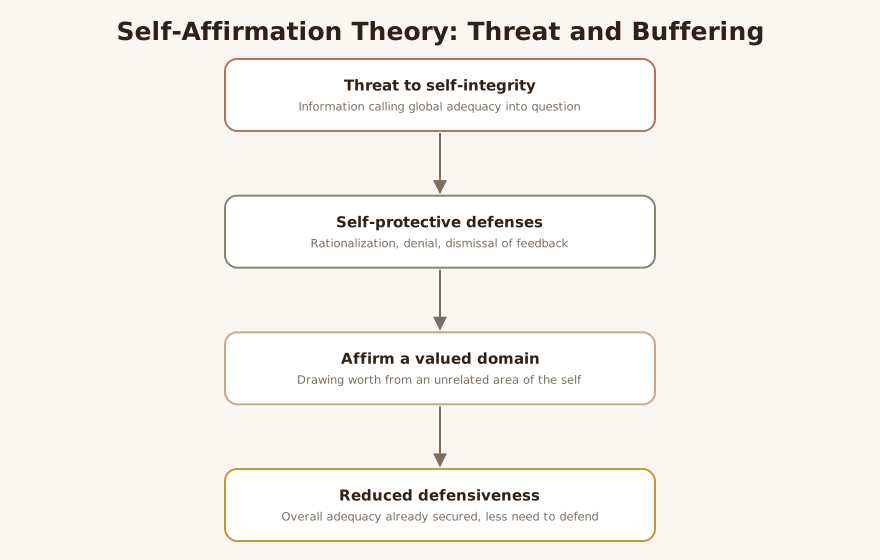
The foundational premise is that people are motivated to maintain a global perception of self-worth and adequacy, not merely their competence in any single domain 1. Because the self-system is global and flexible, a person can buffer a threat in one area by drawing on sources of worth in entirely unrelated areas 5. This flexibility is what allows a single brief exercise to have effects: affirming one’s value as a parent or friend can blunt a threat to one’s competence as a student or patient 5.
A second principle is that threatening events and information — anything that calls global adequacy into question — trigger stress and self-protective defenses 2. These defenses, such as rationalization, denial, and dismissal of unwelcome feedback, reduce the felt threat but can also block performance, learning, and adaptive change 2. In Steele’s framing, the defensive system is doing its job (protecting self-integrity) even when it produces maladaptive behavior 1.
The third principle is the resolution: when people affirm a valued aspect of the self, they have less need to defend against the threat, because their overall sense of adequacy is already secured from another source 1. Sherman’s integrative model describes three psychological shifts that follow affirmation: it boosts self-resources, it broadens the perspective from which a person views the threatening event (a higher level of construal), and it uncouples the self from the threat so the threat no longer reflects so heavily on overall self-worth 5. These shifts are pitched at a general level and are meant to explain why affirmation helps across very different problem domains 5.
Interventions & Techniques
The canonical technique is the values-affirmation exercise: a person identifies a personally important value (for example, relationships with family, creativity, faith, or community) and then writes briefly about why that value matters to them and a time it was important in their life 5. The instruction deliberately points away from the threatened domain — a struggling student writes about something other than academics — so that worth is sourced from elsewhere 5. Some versions use a ranked list of values and have the person elaborate on their top choice 5.
Many operationalizations exist beyond the writing task 5. Affirmation has been induced through positive feedback on a personally important skill, and researchers note that everyday acts such as reaffirming relationships can serve a similar function, though writing about values is the most reliable and best-studied form 5. Sherman cautions that some manipulations (for example, positive feedback) may work through different processes, such as mood, that values affirmations do not appear to rely on 5.
A critical design feature is timing and threat-relevance: affirmations reliably help people who are actually under threat, and the process for people not experiencing threat is likely different 5. Cohen and Sherman emphasize that affirmations are most effective when delivered before or early in a threatening experience, so that they interrupt the threat-defense cycle rather than arriving after defenses have already mobilized 2.
LLM-generated illustrative example (not a guideline): A clinician working with a client who bristles at any feedback about alcohol use might, before raising the topic, spend a few minutes having the client describe a value they live by — say, being a dependable grandparent. With that sense of worth in the foreground, the client may be able to look at the alcohol data with less defensiveness, because the feedback no longer threatens their whole sense of being a good person. LLM
In applied settings, the exercise is usually brief — minutes, not sessions — and is positioned as a setup for the harder conversation rather than as the intervention itself LLM.
Evidence Base
The evidence base is established: self-affirmation has been studied experimentally for more than thirty years and has produced replicated effects across health, education, and stress domains 5. On defensiveness, affirmed smokers are more open to anti-smoking information, and affirmed people more readily accept threatening health messages they would otherwise discount 5. On attribution and feedback, affirmed athletes take more responsibility for their teams’ defeats and claim less credit for successes, consistent with reduced ego-defensiveness 5.
The most striking applied findings come from education. In field experiments, African American middle-school students who completed brief in-class values-affirmation activities showed improved grades, with benefits maintained over a two-year period 5. Latino American middle-school students who completed values affirmations showed significantly improved grade point average over the school year 5. A classroom study of values affirmation reduced the gender achievement gap in college science 5. These are notable because very brief interventions produced effects that persisted long after the exercise itself 2.
Cohen and Sherman explain this durability through recursive processes: a timely affirmation can touch off a positive feedback loop between the self-system and the social system, so that early gains compound over time rather than fading 2. Affirmations, in their account, foster a more expansive view of the self and its resources, weakening the implications of a given threat for personal integrity, with benefits that sometimes persist for months and years 2.
Honesty about the maturity of the evidence is warranted on several points. The precise mechanism remains, in many researchers’ eyes, unresolved and a topic of ongoing study 5. Effects are heterogeneous and moderated; Sherman notes that affirmations may boost self-resources primarily for people with low self-esteem while broadening perspective for those with high self-esteem, so a single mediator does not link cleanly to outcomes across people 5. Timing of assessment also complicates interpretation, since psychological and outcome measures are often taken concurrently 5. The clinical bottom line: this is a real, replicated effect with established support, but it is context-dependent, not a guaranteed lever, and it can fail to help when threat is absent or the affirmation is poorly timed LLM.
Populations & Indications
The framework is most relevant to people experiencing identity or evaluative threat — situations where a person’s sense of adequacy is on the line 2. This includes students, particularly those in stigmatized or marginalized groups contending with stereotype threat, where affirmation has improved belonging and performance 5. It includes people facing health behavior change, such as smokers and others confronting health risk information they are inclined to dismiss 5.
It also applies to people experiencing stress, since affirmations have been shown to attenuate physiological and psychological stress responses to laboratory and naturalistic stressors 5. Finally, it is indicated for people resistant to feedback — clients whose defensiveness blocks them from taking in difficult information about themselves, their behavior, or their circumstances 5. Across these groups, the common thread is that affirmation is most useful precisely where threat and defensiveness are active 5.
Problems-for-Work
Defensiveness. When a client reflexively rejects feedback, a brief values affirmation beforehand can reduce the need to defend, making the feedback feel less like an indictment of the whole self 1. This is the problem-for-work most directly addressed by the theory 5.
Health behavior change resistance and treatment nonadherence. For a client who minimizes risk information or resists a regimen, affirming an unrelated valued identity can increase openness to the threatening message and to change talk 5.
Stress and threat reactivity. For clients facing an evaluative stressor, an affirmation can dampen the stress response and broaden perspective so the stressor looms smaller relative to the whole self 5.
Stereotype threat effects and performance anxiety. For students or clients underperforming under identity threat or evaluative pressure, affirmation has improved performance and belonging by uncoupling the self from the threatening situation 5.
LLM-generated illustrative example (not a guideline): A first-generation graduate student presents with performance anxiety before exams, describing a sense that “people like me don’t belong here.” Used as an adjunct within a broader therapy, a short values-affirmation reflection on family and community before high-stakes weeks might loosen the grip of that identity threat enough for the student to study and test more freely. LLM
Low self-esteem. Here the theory counsels caution rather than enthusiasm, since affirmation effects and mechanisms appear to differ by baseline self-worth 5. Affirmation is not a self-esteem treatment, and clinicians should not expect it to function as one LLM.
Contraindications, Cautions & Cultural Humility
Self-affirmation is not a stand-alone therapy and should not displace evidence-based treatment for any clinical condition LLM. Its effects depend heavily on the presence of threat; for clients who are not under threat, the same procedure may do nothing or operate through different, less predictable processes 5. Clinicians should therefore avoid applying it as a generic positivity exercise LLM.
The intervention is also sensitive to who the client is. Because mechanisms and benefits vary with self-esteem and with the personal meaning of the chosen value, a value that is genuinely central for one client may be hollow for another, and a poorly chosen or externally imposed value is unlikely to help 5. Cultural humility is essential here: the values a client elaborates must be theirs, drawn from their own relationships, faith, community, and identity, not the clinician’s assumptions about what should matter LLM. For clients from marginalized groups, where much of the strongest evidence was generated, affirmation should be offered as a way to honor existing sources of worth, never as an implication that the person needs fixing LLM. As with any technique, informed consent, attention to the therapeutic relationship, and ongoing assessment of fit take precedence over mechanical delivery LLM.
Treatment-Plan Suggestions & SMART Objectives
The table below offers example objectives that embed self-affirmation as a mechanism within broader, established therapy LLM. They are illustrations, not a protocol, and would be individualized in practice LLM.
| Goal | SMART objective (example) | Mechanism |
|---|---|---|
| Reduce defensiveness to feedback | Within 4 sessions, client will complete a brief values-reflection before each feedback discussion and rate defensiveness lower on 3 of 4 occasions | Securing global self-worth reduces need to defend a threatened domain 1 |
| Increase openness to health information | Over 6 weeks, client will engage a values affirmation prior to reviewing health-risk material and identify one acceptance-based response weekly | Affirmation increases receptivity to threatening messages 5 |
| Lower acute stress reactivity | Across 5 sessions, client will use a 5-minute values-writing exercise before an identified stressor and report reduced distress (0-10) twice | Affirmation attenuates stress responses and broadens perspective 5 |
| Mitigate identity/stereotype threat | Within the term, student will complete values affirmations before high-stakes weeks and track belonging weekly | Uncoupling the self from threat supports performance under identity threat 5 |
| Support treatment adherence | Over 8 weeks, client will pair a brief affirmation with each adherence check-in and increase self-reported follow-through | Reduced defensiveness opens space for change talk and follow-through 2 |
| Broaden perspective on a setback | Within 3 sessions, client will write about a core value after a perceived failure and reframe the event at a higher level of construal | Higher-level construal lessens the threat’s impact on overall self-evaluation 5 |
| Consolidate gains recursively | Over the treatment course, client and clinician will time affirmations early in threatening episodes and review compounding changes monthly | Early affirmation can trigger self-sustaining adaptive feedback loops 2 |
Common Misconceptions
A frequent misconception is that self-affirmation means repeating positive self-statements like “I am good enough” 4. In the research tradition the term means affirming broad personal values that are important to the self, not reciting flattering affirmations, and the two should not be confused 4. The popular-psychology sense and the social-psychology sense share a name but not a method LLM.
A second misconception is that affirmation works by boosting mood or self-esteem in general 5. The values-affirmation effects studied here have not generally been traced to mood, and the theory locates the action in reduced threat to self-integrity rather than in feeling happier 5. A third is that affirmation directly improves the threatened skill itself — that it makes someone a better test-taker per se; rather, it changes the relationship between the self and the threat so the person can deploy resources they already have 5. Finally, it is a mistake to assume affirmation helps everyone equally: effects are moderated and most reliable under genuine threat 5.
Training & Certification
There is no formal certification, credential, or licensing pathway specific to self-affirmation theory, because it is a body of social-psychological research rather than a proprietary clinical modality LLM. Clinicians do not become “self-affirmation therapists”; instead they integrate the construct into modalities for which appropriate training already exists LLM. Competent use depends on understanding the underlying theory and its boundary conditions, for which the primary sources are the original Steele chapter and the Sherman and Cohen reviews 152. Supervision and continuing education in the host modality — for example, motivational interviewing or acceptance-based therapies — are the appropriate venues for building skill in applying it LLM.
Key Terms
Self-integrity. A person’s global sense of being adequate, competent, moral, and able to control important outcomes; the thing the self is motivated to protect 1.
Values affirmation. The standard procedure in which a person writes about or otherwise elaborates a personally important value to bolster self-worth from a domain unrelated to the threat 5.
Threat / identity threat. Events or information that call global adequacy into question, triggering stress and self-protective defenses 2.
Psychological immune system. The flexible set of self-protective responses people draw on to defend self-integrity, which affirmation makes less necessary 5.
Self-resources, broadening, and uncoupling. The three psychological shifts in Sherman’s model: affirmation boosts self-resources, broadens perspective via higher-level construal, and uncouples the self from the threat 5.
Recursive process. A self-sustaining loop between the self-system and the social environment through which a brief, well-timed affirmation can produce lasting change 2.
Resources & Further Reading
▶ Watch — a video introduction to this concept:
- Steele, C. M. (1988). The psychology of self-affirmation: Sustaining the integrity of the self.
- Cohen, G. L., & Sherman, D. K. (2014). The psychology of change: Self-affirmation and social psychological intervention. Annual Review of Psychology.
- Sherman, D. K. (2013). Self-affirmation: Understanding the effects. Social and Personality Psychology Compass.
- Self-Affirmation Theory in Social Psychology — iResearchNet.
- Self-affirmation — Wikipedia.
Reflective / Supervision Questions
- When a client of mine becomes defensive, am I reading it as resistance to be confronted, or as a threat to self-integrity that might be eased before the harder conversation? LLM
- How do I help a client identify a value that is genuinely theirs, rather than steering them toward one I find admirable? LLM
- Am I positioning affirmation as a brief setup within an established treatment, or am I drifting into using it as a stand-alone fix? LLM
- For this particular client, is threat actually present — and if not, is an affirmation exercise even indicated? LLM
- How might a client’s baseline self-worth and cultural context change whether and how affirmation helps? 5
- What would tell me, over time, that an affirmation has set off a genuinely adaptive change rather than a momentary lift? 2