
Type & Discipline
The communication axioms are a body of theory, not a treatment, diagnosis, or billable modality LLM. They belong to communication theory and pragmatics — the study of how messages function in actual interaction rather than what words denote in the abstract 1. The axioms were articulated as a set of tentative “calculus” propositions about the properties of human communication, intended to describe regularities that hold whenever people exchange messages in a relationship 1. Two of these propositions are the focus here: that one cannot not communicate, and that every message carries both a content (report) level and a relationship (command) level 4. Because they are descriptive axioms about interaction, they inform case formulation, assessment of relational dynamics, and the way a clinician listens, rather than being something delivered as a stand-alone therapy LLM.
The framework sits at the intersection of cybernetics, systems theory, and clinical observation, and it deliberately shifts attention from the individual psyche to the observable pattern between people 2. Its discipline is therefore interactional and pragmatic: meaning is located in behavior-in-context and in the responses behavior evokes, not in inferred internal states alone 1. This makes the axioms a conceptual lens that travels across modalities — they are as relevant to a couple’s escalating argument as to a family’s chronic silence LLM.
Creators & Lineage
The axioms were formalized in Pragmatics of Human Communication (1967) by Paul Watzlawick, Janet Beavin Bavelas, and Don D. Jackson, working at the Mental Research Institute (MRI) in Palo Alto, California 1. The book set out to build a pragmatic calculus of communication and to apply it to interactional pathology, and it remains in print as a foundational text of the field 1. Paul Watzlawick, an Austrian-American theorist and clinician, became the most public face of this work and of the broader Palo Alto interactional view 3.
The intellectual lineage runs back to Gregory Bateson, whose research group on communication and the “double bind” theory of schizophrenic communication directly shaped MRI thinking 3. Bateson’s insistence that pathology could be understood as a property of communicational patterns — particularly contradictory messages across logical levels — is the seedbed from which the report/command distinction and the double-bind concept grow 2. Don D. Jackson, who founded the MRI, bridged this communication research with clinical practice and family therapy, and the resulting interactional view became a parent tradition for strategic family therapy and, later, brief and solution-focused approaches 3. The framework’s fiftieth-anniversary reappraisal in the systemic-therapy literature traces this continuity and examines how the axioms have aged in light of subsequent communication science 2.
Core Principles
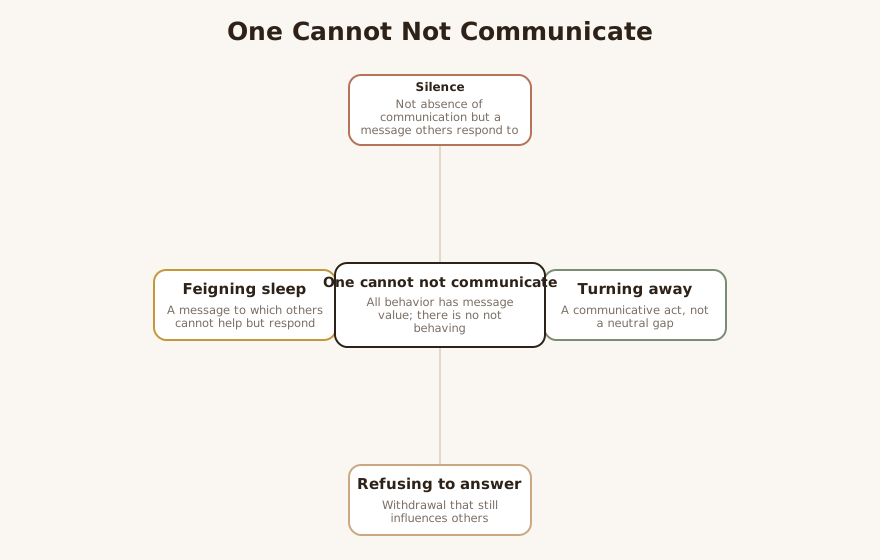
The first axiom — one cannot not communicate — holds that in an interactional situation all behavior has message value, and since there is no such thing as “not behaving,” there is no such thing as not communicating 4. Silence, turning away, refusing to answer, or feigning sleep are not the absence of communication; they are messages that influence others and to which others cannot help but respond 5. The clinical force of this principle is that withdrawal, stonewalling, and “doing nothing” are communicative acts, not neutral gaps 4.
The second principle of interest is that every communication has a content (report) aspect and a relationship (command) aspect, the latter classifying the former 1. The report level conveys the information or data of the message — what is literally said — while the command level conveys how that information is to be taken and what kind of relationship is being asserted between the parties 4. The relationship level is therefore metacommunication: communication about the communication and about the relationship itself 5. Crucially, the relationship aspect frames the content aspect, so the same words (“the door is open”) can be an offer, an order, a complaint, or an intimacy depending on the relational classification riding alongside them 5.
A linked principle is that healthy relationships tend to spend little energy on the relationship level, attending mostly to content, whereas distressed relationships become increasingly preoccupied with defining the nature of the relationship — who is in charge, who counts, what each means to the other 5. The axioms also describe communication as punctuated into sequences (each party reads the exchange as starting with the other’s behavior) and as proceeding in either symmetrical (equality-seeking) or complementary (difference-based) patterns — context the report/command distinction depends on 4. Together these form a calculus in which disturbances are understood as properties of the pattern rather than defects in one person 2.
Interventions & Techniques
Because the axioms are a theory rather than a therapy, there are no “axiom techniques”; their utility is in how they direct clinical attention and shape interventions delivered through recognized modalities LLM. The first practical move is to listen on two channels at once — tracking the content of what a client or couple says while simultaneously reading the relationship-level message about how it should be taken and who each is claiming to be to the other 1. Naming this split aloud is itself an intervention: helping partners distinguish “what you said” from “what you were doing to me by saying it” can defuse arguments that are nominally about content but are really contests over the relationship LLM.
A second technique is metacommunication — deliberately talking about the communication rather than continuing it 5. When a couple is locked in a content dispute that never resolves, shifting to the relationship level (“when we argue about the dishes, what are we really telling each other about respect?”) often reveals the actual stakes 5. A third move follows from “one cannot not communicate”: treating silence, withdrawal, or non-response as data to be made explicit, so that a withdrawing partner’s behavior is reframed as a powerful message rather than a non-event 4. The Palo Alto tradition further added reframing and the examination of punctuation — helping each party see that the other experiences the sequence as beginning with their own behavior, dissolving the “who started it” deadlock 2.
LLM-generated illustrative example (not a guideline): A couple presents because “she nags and he ignores me.” Listening on both channels, the clinician hears the content (requests about chores) and the relationship message (each feels uncared-for). The clinician notes that he reads the sequence as “I withdraw because she criticizes,” while she reads it as “I press because he withdraws.” Naming the punctuation and the relationship-level plea inside each content complaint, the clinician helps them metacommunicate about what they are signaling to each other rather than re-litigating the chores LLM.
Evidence Base
The honest appraisal is that the communication axioms are an established, historically foundational framework in communication theory and systemic therapy — widely taught, durably influential, and continuously cited for over half a century — but they are propositions about the nature of communication rather than an intervention with its own randomized outcome trials 2. Pragmatics of Human Communication is treated as a classic and remains in print, and its concepts seeded strategic, brief, and family-systems therapies whose own evidence bases developed separately 1. The framework’s standing rests on conceptual fertility and clinical usefulness more than on direct efficacy data for “the axioms” as such LLM.
The fiftieth-anniversary reappraisal in the systemic literature is candid that the axioms have aged unevenly 2. Some propositions — notably the value of attending to the relationship level and to interactional pattern — have held up well and align with later communication research, while others have drawn critique as overstated or imprecise 2. The slogan “one cannot not communicate,” in particular, has been contested: critics argue that for behavior to count as communication some intent or interpretation is required, and that the axiom blurs the line between behavior that merely can be interpreted and behavior that is genuinely communicative 2. A defensible clinical stance is to use the axioms as a generative heuristic — a reliable way to widen attention to relational and metacommunicative dynamics — rather than as proven causal laws LLM.
Populations & Indications
The framework’s primary population is relational systems rather than isolated individuals: couples, families, and parent-child dyads, where the report/command distinction and the inevitability of communication are most directly observable 1. It is especially indicated for distressed relationships in which partners are caught in repetitive, escalating exchanges that never resolve because the real conflict lives at the relationship level 5. Families with entrenched patterns of contradictory messaging, and communication-impaired systems where mixed signals dominate, are a natural fit, given the framework’s roots in studying disturbed family communication 2.
Parent-child dyads are an apt focus because so much parental communication is command-level — about authority, safety, and belonging — even when the content is mundane, and because children are acutely tuned to the relationship aspect of messages LLM. The therapist-client dyad is itself a relevant system: the axioms remind clinicians that they cannot not communicate, that every clinical utterance carries a relationship-defining command level, and that the alliance is negotiated as much at the relationship level as in the content of any intervention 4. Across these groups the axioms indicate where attention to pattern, metacommunication, and relational framing is likely to be most useful LLM.
Problems-for-Work
The axioms map onto a recognizable cluster of relational problems, with general communication problems and relationship conflict at the center, where partners talk past each other because they are fighting on the relationship channel while arguing on the content channel 5. Mixed or contradictory messages are a core target: when the report and command levels conflict — warm words in a cold tone, “I’m fine” delivered as an accusation — the recipient is left unable to respond coherently, a pattern the framework was built to describe 4. Misattunement and misunderstanding often resolve once the relationship-level meaning of a content message is surfaced and checked LLM.
Emotional withdrawal and silence as communication are addressed directly by the first axiom, which reframes stonewalling not as absence but as a potent, relationship-defining message 4. Power and control struggles and marital or relationship distress are illuminated by attending to whether the couple is locked in symmetrical escalation or rigid complementarity, and to whose definition of the relationship will prevail 4. Metacommunication failures — the inability to step back and talk about how the couple talks — are both a problem and a primary lever for change 5. Defensiveness and double-bind interactions, where a person is faced with contradictory injunctions across levels and is prohibited from commenting on the contradiction, trace directly to the Bateson lineage embedded in the framework 2.
LLM-generated illustrative example (not a guideline): A parent tells a teenager “I trust you completely” while reading their texts and imposing a strict curfew. The teen withdraws into silence at dinner. Formulated through the axioms, the clinician identifies a double-bind-like contradiction between the report level (“I trust you”) and the command level enacted by the surveillance, and treats the teen’s silence as a loud relationship message; the work shifts to helping the family metacommunicate honestly about trust and autonomy LLM.
Contraindications, Cautions & Cultural Humility
The foremost caution is conceptual restraint: the axioms are heuristics, not proven laws, and “one cannot not communicate” in particular has been seriously critiqued, so a clinician should not wield it as an irrefutable verdict that a client is “really” sending a message whenever they are quiet or still 2. Over-reading every behavior as intentional communication can pathologize ordinary silence, fatigue, neurodivergent communication styles, or culturally normative reticence, and can leave clients feeling that nothing they do is exempt from interpretation LLM. The framework should sharpen curiosity about relational meaning, not license mind-reading LLM.
A second caution concerns the framework’s individualistic, dyadic-Western roots: judgments about what counts as a “healthy” balance between content and relationship levels, about appropriate eye contact, directness, or expressiveness, and about symmetrical versus complementary relating, are culturally shaped 5. In many cultural contexts, indirectness, deference, and meaningful silence are skilled, valued forms of relating rather than communication “problems,” and the command level of messages is read against family and community norms the clinician may not share LLM. Cultural humility requires interpreting the relationship level of any message against the client’s own cultural and relational frame, checking inferences rather than asserting them, and remaining alert to power differences — including in the therapist-client dyad — that shape who gets to define the relationship 5.
Treatment-Plan Suggestions & SMART Objectives
| Goal | SMART objective (example) | Mechanism |
|---|---|---|
| Build awareness of content vs. relationship levels | Within 6 sessions, each partner will identify the relationship-level message inside 3 recent content disputes, demonstrated in session | Makes the command level explicit so conflict can be addressed where it lives 1 |
| Reduce mixed/contradictory messaging | Over 8 weeks, client will align tone and word in 80% of logged hard conversations, reducing report/command mismatch | Removes the double-message bind that blocks coherent response 4 |
| Increase metacommunication skill | Within 8 sessions, couple will pause an escalating exchange and talk about the exchange itself at least twice weekly, logged | Shifts stuck content fights onto the relationship channel where they can resolve 5 |
| Reframe withdrawal/silence as communication | Within 6 sessions, the withdrawing partner will name what their silence is signaling in 3 instances | Operationalizes “one cannot not communicate” to surface hidden messages 4 |
| De-escalate punctuation deadlocks | Over 10 sessions, each partner will articulate the other’s view of “who started it” in 3 recurring conflicts | Dissolves blame by exposing differing punctuation of the sequence 2 |
| Soften symmetrical escalation / rigid complementarity | Within 10 sessions, couple will interrupt an escalating symmetrical spiral using an agreed signal in 70% of instances | Targets the relational pattern, not the individual, as the unit of change 4 |
| Repair contradictory messages in a parent-child dyad | Over 8 weeks, parent will deliver one consistent report-and-command message on a recurring rule, observed across 3 sessions | Reduces double-bind-type contradictions across logical levels 2 |
Common Misconceptions
A frequent error is taking “one cannot not communicate” as an established law rather than a contested axiom; the proposition has been seriously critiqued on the grounds that communication arguably requires intent or shared interpretation, and treating it as incontrovertible overreaches its standing 2. A second misconception is collapsing the two levels — assuming the content of a message is its meaning — when the framework’s whole point is that the relationship level classifies and frames the content, so identical words can mean opposite things 1. A third is hearing “command level” as literally about giving orders; it refers to how a message defines the relationship and how it is to be taken, a far broader notion than commanding 5.
A fourth misconception is that the axioms are a therapy one “does,” when they are a descriptive framework that informs interventions delivered through other modalities LLM. A fifth is reading the framework as locating pathology in an individual; its interactional commitment is precisely the opposite — disturbance is a property of the pattern between people, which is why it pairs with systemic and strategic therapies rather than intrapsychic ones 2. Finally, the “double bind” is often misused to mean any difficult dilemma, whereas in this lineage it specifies contradictory injunctions across levels plus a prohibition on commenting on or escaping the contradiction 2.
Training & Certification
There is no certification in “the communication axioms”; they are foundational theory studied within communication science and within systemic and family-therapy training rather than a credentialed technique LLM. Clinicians typically encounter them inside graduate coursework and in training for couples, family systems, strategic, and brief therapies, where the interactional view is part of the canon 2. Reading the primary source, Pragmatics of Human Communication, remains the standard route to understanding the propositions in their original form 1.
For applied competence, the relevant training lives in the recognized modalities that operationalize the framework — couples and family therapy, strategic and Mental Research Institute brief therapy traditions, and related systemic approaches — where supervised practice teaches clinicians to track relationship-level dynamics, use metacommunication, and intervene in patterns rather than persons 3. Generalist therapists can legitimately use the axioms for formulation provided they represent the framework’s evidentiary status honestly and pursue supervised systemic training before treating complex couple or family systems LLM.
Key Terms
One cannot not communicate — the axiom that all behavior in an interactional context has message value, so there is no such thing as not communicating 4. Content (report) level — the information or data a message conveys, the literal “what is said” 1. Relationship (command) level — the aspect of a message that classifies the content and defines how it should be taken and what relationship is being asserted 4. Metacommunication — communication about the communication and about the relationship; talking about how we talk 5. Punctuation of the sequence — the way each party organizes an exchange so that it appears to begin with the other’s behavior, fueling “who started it” deadlocks 4. Symmetrical vs. complementary interaction — relational patterns based, respectively, on minimizing difference (equality-seeking, prone to escalation) or maximizing it (fitting-together difference) 4. Double bind — contradictory injunctions across logical levels combined with a prohibition on commenting on or leaving the situation, drawn from the Bateson lineage 2. Interactional view — the Palo Alto stance that locates meaning and pathology in patterns between people rather than within individuals 2.
Resources & Further Reading
▶ Watch — a video introduction to this concept:
- Watzlawick, Bavelas & Jackson — Pragmatics of Human Communication (W. W. Norton)
- Pragmatics of Human Communication 50 Years Later (Journal of Systemic Therapies, Guilford)
- Paul Watzlawick (Wikipedia)
- The five axioms of communication (IAPM)
- Watzlawick’s Five Axioms (Wanterfall, clinician-authored)
- The 5 Axioms of Communication by Watzlawick, Beavin and Jackson (YouTube)
Reflective / Supervision Questions
- When a client falls silent or withdraws, am I treating it as a meaningful relationship-level message, or am I overreading ordinary, culturally normative, or neurodivergent quiet as a covert communication 2?
- In a couple’s content dispute, can I hear the relationship-level plea inside each complaint, and am I helping them metacommunicate rather than re-litigate the surface issue 5?
- How often do my own clinical utterances carry a command-level message — about authority, judgment, or care — that I have not noticed, given that I too cannot not communicate 4?
- When partners are deadlocked over “who started it,” am I able to surface their differing punctuation of the sequence rather than adjudicating a beginning 4?
- Whose cultural frame am I using to judge a relationship’s balance of content and relationship levels, and have I checked my inferences against the client’s own norms rather than asserting them 5?