
Type & Discipline
Second-order cybernetics is a theory and an epistemology, not a treatment, diagnosis, or stand-alone billable modality LLM. It belongs to cybernetics — the study of “control and communication in the animal and the machine” — but specifically to the reflexive turn within that field that takes the observer’s presence seriously 3. Heinz von Foerster’s now-standard formulation states the distinction crisply: “First Order Cybernetics is the Cybernetics of observed systems” while “Second Order Cybernetics is the Cybernetics of observing systems” 3. Where first-order cybernetics describes a system from the outside as if the describer stood apart from it, second-order cybernetics insists that the describer is inside the system being described 1.
For a clinician, the discipline matters because it relocates the therapist LLM. The home field is cybernetics and, by extension, constructivist epistemology, but its clinical relevance is that it supplies a stance rather than a technique: the therapist is not a neutral instrument measuring a family but a participant whose observing helps constitute what is observed 1. Because it is a descriptive and epistemological frame rather than an intervention, it travels across systemic modalities and reshapes how a clinician understands their own role, their hypotheses, and the meaning of “the family system” they claim to see LLM.
Creators & Lineage
The cybernetics of cybernetics, as Glanville notes, “was given form between approximately 1968 and 1975, at a strange stage in the history of Cybernetics” 3. Margaret Mead’s 1968 paper, “The Cybernetics of Cybernetics,” delivered as the inaugural keynote at the founding meeting of the American Society for Cybernetics, is the conventional point of origin — though von Foerster, who organized the meeting, in fact gave Mead the title and the brief 3. The work then crystallized in von Foerster’s 1975 edited volume Cybernetics of Cybernetics, which grew out of a course he ran at the University of Illinois’s Biological Computer Laboratory 3. The American Society for Cybernetics still frames its own self-organizing challenge in these terms — that a cybernetic society ought to be run according to cybernetic principles 4.
Heinz von Foerster is the figure most associated with the approach, but the lineage is plural 3. Humberto Maturana and Francisco Varela contributed autopoiesis — the theory of self-producing living systems — and Maturana’s dictum that “everything said is said to an observer,” with its corollary “everything said is said by an observer,” is the hinge that ties second-order cybernetics to constructivism 3. Gordon Pask supplied conversation theory, a dialogical model of communication; Ernst von Glasersfeld developed the radical constructivism the approach presupposes; and Ranulph Glanville extended the theory of observing, objects, and circularity 1. The deeper roots run back to the Macy Conferences on “Circular Causal and Feedback Mechanisms in Biological and Social Systems,” where figures such as Gregory Bateson and Warren McCulloch already understood themselves as participant observers 1.
The clinical branch of the lineage runs from this body of theory into systemic and family therapy 1. Second-order ideas reshaped systemic and constructivist family therapy through clinicians such as Paul Watzlawick, Lynn Hoffman, and Bradford Keeney, who imported the observer’s inclusion into how a therapist conceives of joining and intervening in a family 1. The intellectual parents are general systems theory and first-order cybernetics; the conceptual siblings are constructivism and radical constructivism 1.
Core Principles
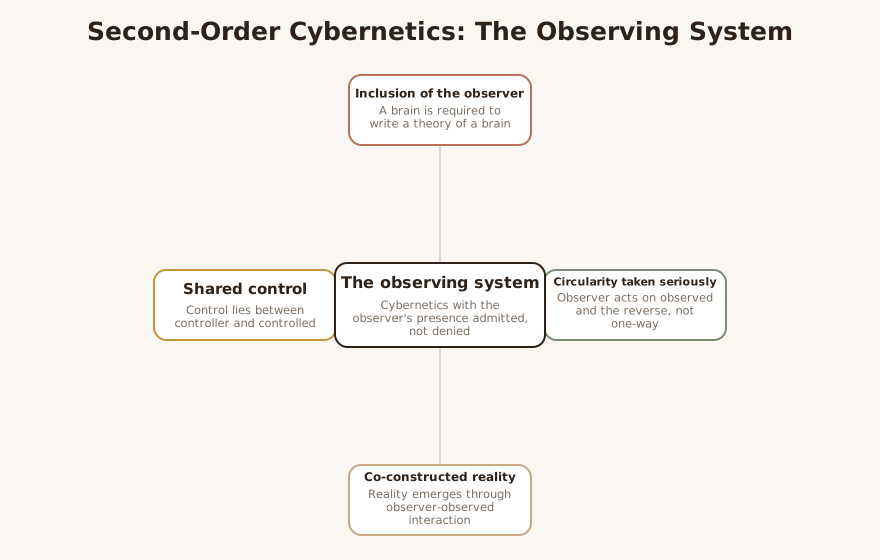
The first principle is the inclusion of the observer 3. Second-order cybernetics is “Cybernetics when the observer’s presence is admitted rather than disguised – or even completely denied” 3. The essential discovery behind the observed/observing distinction is simply “the presence of the observer”: a brain is required to write a theory of a brain, and the cybernetician, by entering their own domain, has to account for their own activity 3. Reality is therefore not read off a mind-independent world but emerges through the interaction between observer and observed — redness is not “in” the apple but arises from wavelength, detection, and interpretation taken together 5.
The second principle is that circularity is taken seriously 3. First-order cybernetics already had feedback, but it preserved a power relationship in which the observer acted on the observed and not the reverse, treating the small energy fed back as negligible 3. When circularity is taken seriously, control “can be neither in the controlled nor in the controller, but lies between them: it is shared” — in the thermostat example the switch turns the boiler on and off while the boiler, supplying heat, in turn turns the switch on and off 3. Applied to a relationship, this dissolves the idea that one party simply controls another; influence is mutual and located between the parties, not inside either LLM.
The third principle cluster concerns self-reference, constructivism, and the limits of objectivity 5. Systems that loop back to observe themselves generate meaning through recursion — the mind observing its own thinking is the paradigm case, and self-awareness emerges from this reflexive capacity 5. Knowledge is actively built through interaction rather than passively received, and all of it is provisional 5. Pure neutral observation is impossible: selection, interpretation, and the observer’s own frameworks shape what is seen, so the honest move is to acknowledge one’s position rather than pretend to a view from nowhere 5. Von Foerster’s ethical imperative — “Act always so as to increase the number of choices” — follows from this stance, treating ethical action as the expansion of possibilities for oneself and others 5.
Interventions & Techniques
Because second-order cybernetics is an epistemology rather than a therapy, there are no “second-order techniques”; its utility is in the stance it imposes and the way that stance is operationalized through recognized systemic modalities LLM. The first and most consequential move is the therapist’s own reflexivity — turning attention back on one’s own observing, hypotheses, and assumptions, recognizing that one is a participant in the system rather than a detached describer of it 5. This is why the approach is often summarized as shifting “from external observation to participant observation”: the clinician asks not only “what is this family doing?” but “what am I doing, and how does my observing shape what I see and what becomes possible?” 1.
A second move follows from circularity: replacing linear, blame-locating accounts (“he controls her,” “the mother is the problem”) with circular descriptions in which influence is mutual and shared between members 3. A third, drawn from Pask’s conversation theory, treats therapeutic communication as conversation rather than transmission — meaning is not sent and decoded but is “uniquely constructed by each partner individually” out of their interpretations of what the other offers, so the work is iterative mutual understanding-building, with communication about communication as its “sine qua non” 3. A fourth move is the deliberate use of reflexivity as a clinical good: pausing to examine one’s own automatic reactions and assumptions interrupts them and reveals blind spots 5. The overarching aim, in von Foerster’s terms, is to increase the number of choices available to clients rather than to steer them to a state the therapist has predetermined 5.
LLM-generated illustrative example (not a guideline): A family therapist notices she has privately concluded that “the father is rigid and the mother enables him.” Stepping into a second-order stance, she treats that conclusion as her own construction — a product of where she sits and how she has been observing — rather than a fact about the family. She asks how her questions may be eliciting exactly the rigidity she sees, shifts from a linear “father controls the family” story to a circular one in which each member’s moves call out the others’, and reframes her task as widening the family’s options rather than correcting a defect she has diagnosed LLM.
Evidence Base
The honest appraisal is that second-order cybernetics is an established, historically foundational framework — durably influential within cybernetics, constructivism, and systemic therapy, continuously taught and cited since the late 1960s — but it is an epistemology rather than an intervention with its own randomized outcome trials 1. Its standing rests on conceptual fertility and its reshaping of how whole therapeutic traditions conceive the observer, not on efficacy data for “second-order cybernetics” as a treatment LLM. Von Foerster’s Cybernetics of Cybernetics and Glanville’s analyses are treated as canonical theoretical statements, and the approach’s influence on family therapy is a matter of intellectual history rather than trial evidence 1.
The framework is also internally candid about the limits of certainty, which bears on how a clinician should hold it LLM. Its own claim is that pure objectivity is impossible and that all knowledge is provisional and observer-dependent, so it does not present itself as a set of proven causal laws but as a way of seeing 5. Glanville goes further in showing that in genuinely complex, variety-rich systems the variety required for control “can rapidly exceed the computable,” so that “such systems are essentially unmanageable” — a built-in humility about how much a therapist can predict or steer 3. A defensible stance is therefore to use second-order cybernetics as a generative epistemological discipline — a reliable way to keep the observer in the picture and to prefer circular over linear explanations — rather than as a validated technique with measurable effects of its own LLM.
Populations & Indications
The framework’s natural population is relational systems rather than isolated individuals: families, couples, groups in systemic therapy, and organizations or teams, where the patterns between members and the observer’s participation in describing them are directly at issue 1. It is especially indicated wherever a clinician is at risk of mistaking their own construction for an objective reading of “the system” — which is to say, in most complex family and couple work LLM. The approach was developed and absorbed precisely in systemic and constructivist family therapy, making those settings its home indication 1.
Two populations deserve special mention LLM. First, therapists and clinicians themselves are a target population, because the entire point of the second-order turn is that the observer must account for their own activity; the framework is as much a discipline of clinician self-reflection as a lens on clients 3. Second, organizations and teams are an apt application, given the approach’s origin in the question of whether a cybernetic society should be organized according to cybernetic principles — a question of institutional self-governance and self-observation 4. Across these systems, the framework indicates where attention to reflexivity, circular causality, and the co-construction of meaning is likely to be most useful LLM.
Problems-for-Work
The framework maps onto a recognizable cluster of relational and reflexive problems, with general communication problems and systemic relational patterns near the center, where members talk past one another and the therapist risks privileging one party’s account as the true one 3. Family conflict and relationship conflict are read here not through blame but through circularity: the clinical move is to replace “who is controlling whom” with a description in which influence is shared between members, dissolving the deadlock that linear blame sustains 3.
Therapeutic impasse is a core indication, because a stuck case often reflects the therapist’s own fixed construction of the family as much as anything in the family; the second-order remedy is for the clinician to examine how their observing is helping produce the impasse 5. Reflexivity in treatment is both a problem-for-work and the framework’s central lever: helping a system — and the clinician — notice and talk about their own patterns of relating and describing is the engine of change 5. Communication problems are reframed through Pask’s conversation model, in which the goal is not accurate transmission of a fixed message but iterative mutual construction of understanding, with communication about communication treated as essential 3.
LLM-generated illustrative example (not a guideline): A couple reaches an impasse: each insists the other “started it” and the therapist has begun to side, privately, with the partner who seems more reasonable. Recognizing this as his own observer-dependent construction, the therapist names the circularity aloud — each partner’s response is both a reaction to and a trigger for the other’s — and turns the work toward how the couple builds (and misbuilds) shared meaning in conversation, rather than adjudicating an objective account of who is at fault LLM.
Contraindications, Cautions & Cultural Humility
The foremost caution is conceptual: second-order cybernetics is an epistemology, not a proven clinical law, and its own commitments forbid the clinician from treating any formulation as the objective truth of a system 5. Because pure objectivity is held to be impossible and all knowledge provisional, the framework should make a therapist more tentative about their hypotheses, not license a new dogmatism in which “everything is constructed” becomes its own unfalsifiable verdict 5. There is also a practical risk of paralysis or self-absorption: a clinician so preoccupied with their own reflexivity that the client’s concrete suffering recedes from view; reflexivity is meant to serve the work, not replace it LLM.
A second caution concerns the relativism the framework can slide into LLM. If reality is co-constructed and objectivity unattainable, a careless reading can imply that all accounts are equally valid — a stance that becomes dangerous when a client reports abuse, risk, or material harm that requires the clinician to act on it as real LLM. The framework’s own ethical imperative — to “increase the number of choices” — supplies a useful corrective, orienting the work toward expanding a client’s options rather than toward a detached agnosticism about their reality 5. Cultural humility sits naturally with this approach, since its core claim is that the observer’s position, background, and frameworks shape what they see; the clinician should treat their own cultural lens as one constructed vantage among others and check their inferences against the client’s own meanings rather than asserting them 5. At the same time, the framework should not be used to relativize away a client’s lived cultural reality or to evade the power the therapist holds in deciding which constructions get privileged in the room LLM.
Treatment-Plan Suggestions & SMART Objectives
| Goal | SMART objective (example) | Mechanism |
|---|---|---|
| Increase clinician reflexivity about their own constructions | Over the course of treatment, the clinician will articulate, in supervision for 3 cases, how their own observing shapes the family story they hold | Admits the observer’s presence so hypotheses are held as constructions, not facts 3 |
| Replace linear blame with circular description | Within 6 sessions, each partner will describe one recurring conflict as a mutual loop rather than a one-way cause, demonstrated in session | Locates influence as shared between members rather than inside one 3 |
| Strengthen meta-communication in the couple | Within 8 sessions, the couple will pause an exchange and talk about how they are communicating at least twice weekly, logged | Operationalizes communication-about-communication as the core repair skill 3 |
| Build conversational, co-constructed understanding | Over 8 sessions, partners will reflect back and check the other’s intended meaning before responding in 70% of hard conversations | Treats meaning as mutually constructed, not transmitted and decoded 3 |
| Expand the family’s perceived range of options | Within 10 sessions, the family will generate at least 3 new responses to a stuck situation they previously saw as having one outcome | Enacts the ethical imperative to increase the number of available choices 5 |
| Surface and shift a therapeutic impasse | By session 6, the clinician will name one way their own stance may be sustaining the impasse and test an alternative | Treats stuckness as partly observer-produced and therefore changeable 5 |
| Hold formulations as provisional | Across treatment, the clinician will revise the working hypothesis at least twice in response to new family feedback, documented | Embeds the provisional, observer-dependent nature of clinical knowledge 5 |
Common Misconceptions
A frequent error is treating second-order cybernetics as a therapy technique one “does,” when it is an epistemology that reshapes the clinician’s stance and is delivered only through other modalities LLM. A second is collapsing it into first-order cybernetics — keeping the feedback-and-control machinery while leaving the observer outside the picture; the whole point of the second-order turn is that “I am in what I write,” that the observer is included in the description 3. A third misconception reads the approach as crude relativism in which all accounts are equally true; its actual claim is more disciplined — that knowledge is observer-dependent and provisional, which calls for tentativeness and checking, not for an “anything goes” indifference 5.
A fourth is hearing “control” in the engineering sense of one part dominating another; on the contrary, when circularity is taken seriously, control is shown to be shared and located between parties, “neither in the controlled nor in the controller” 3. A fifth is treating communication as accurate transmission of a coded message, when the framework’s conversational model holds that meaning is “uniquely constructed by each partner individually” and that unambiguous coded communication is the exception, not the rule 3. Finally, the approach is sometimes read as making the therapist all-powerful as the constructor of reality, whereas its sharper implication is humility — in complex systems variety can exceed the computable, so such systems are “essentially unmanageable” and not fully steerable by any observer 3.
Training & Certification
There is no certification in “second-order cybernetics”; it is foundational theory studied within cybernetics, systems theory, and constructivist epistemology rather than a credentialed clinical technique LLM. Clinicians typically encounter it inside graduate and post-graduate systemic training, where the inclusion of the observer and the move from first- to second-order thinking are part of the canon of systemic and constructivist family therapy 1. The American Society for Cybernetics remains a scholarly home for the field and continues to work out what it means for a body to organize itself according to its own cybernetic principles 4.
For applied clinical competence, the relevant training lives in the recognized systemic modalities that operationalize the stance — family systems therapy and constructivist and systemic couple and family approaches — where supervised practice teaches clinicians to hold hypotheses as provisional constructions, to think circularly, and to attend to their own participation in the system 1. Reading the primary theoretical sources, including von Foerster’s framing of observing systems and Glanville’s analyses of circularity and purpose, remains the standard route to understanding the ideas in their original form 3. Generalist therapists can legitimately adopt the second-order stance for formulation and self-reflection provided they represent its epistemological (not evidentiary) status honestly and pursue supervised systemic training before treating complex family systems LLM.
Key Terms
First-order cybernetics — “the Cybernetics of observed systems”; the system is described from the outside as if the observer stood apart 3. Second-order cybernetics — “the Cybernetics of observing systems”; cybernetics applied to itself, with the observer’s presence admitted 3. The observer (inclusion of) — the recognition that “everything said is said by an observer,” so the describer is part of the system described 3. Circularity — taking mutual, recursive influence seriously, such that control is shared and “lies between” parties rather than inside either 3. Autopoiesis — Maturana and Varela’s concept of self-producing living systems, fundamental to understanding biological autonomy 1. Constructivism / radical constructivism — the epistemology, associated with von Glasersfeld, that knowledge is actively built through interaction and is provisional, not received from a mind-independent world 5. Conversation theory — Pask’s dialogical model in which meaning is mutually constructed by partners rather than transmitted as code 3. Reflexivity — turning attention back on one’s own thinking and observing to reveal assumptions and enable change 5. Ethical imperative — von Foerster’s maxim, “Act always so as to increase the number of choices” 5.
Resources & Further Reading
▶ Watch — a video introduction to this concept:
- Second-order cybernetics (Wikipedia)
- Glanville, R. — “The purpose of second-order cybernetics” (cepa.info PDF)
- Second-order Cybernetics: An Historical Introduction (ResearchGate)
- Cybernetics of Cybernetics Competition (American Society for Cybernetics)
- 6 Key Ideas of 2nd Order Cybernetics Explained (Carlos E. Perez, Medium)
Reflective / Supervision Questions
- When I describe “the family system,” how am I accounting for my own presence as an observer — and how might my questions be helping to produce the very pattern I claim to have found 3?
- Where in this case am I telling a linear, blame-locating story (“X controls Y”), and what would change if I described the influence as circular and shared between them 3?
- Am I holding my formulation as a provisional construction open to revision, or have I let it harden into “the truth” about this family 5?
- In a stuck case, what part of the impasse might be a product of my own fixed way of observing, and what alternative stance could I test 5?
- Whose constructions am I privileging in the room, and how does the power I hold as therapist shape which version of reality gets to count 5?
- Am I using “everything is constructed” to stay genuinely humble and curious, or am I sliding into a relativism that lets me avoid acting on a client’s real risk or harm 5?