
Errorless learning is not a therapy model in its own right; it is a teaching procedure — a way of structuring how a person acquires new information so that mistakes are prevented during acquisition rather than corrected after the fact 6. The central wager is counterintuitive to most clinical training: instead of letting a client try, fail, and learn from the error, you arrange the task so the error never happens. For most cognitively intact learners this distinction barely matters. For people whose memory systems can no longer flag “that was the wrong answer,” it can be the difference between learning something and consolidating a mistake 1. This article is written for clinicians who may want to fold errorless principles into cognitive rehabilitation, skills training, or psychoeducation with memory-impaired clients.
Type & Discipline
Errorless learning is a technique drawn from learning theory and applied across neuropsychological rehabilitation, occupational therapy, and behavioral skills training 5. It is not bound to a single school: its roots are in operant conditioning and discrimination learning, but its best-developed clinical literature sits in memory rehabilitation 3. Functionally it is a delivery method — a set of rules about how stimuli, cues, and prompts are sequenced — that can be layered onto almost any concrete learning target, from a person’s name to a multi-step appliance routine 5. Because it is a method rather than a modality, you do not “do errorless learning” the way you “do” a course of therapy; you teach a specific target using errorless principles LLM.
Creators & Lineage
The lineage runs through two distinct eras. The first is basic behavioral science: Herbert Terrace’s 1963 pigeon discrimination studies demonstrated that animals could learn to discriminate between stimuli with almost no errors if the difficult (“negative”) stimulus was introduced gradually through a fading procedure 4. Terrace’s birds, trained errorlessly, averaged only about 25 errors across 28 sessions, against more than 3,000 errors under conventional trial-and-error training 6. A striking theoretical observation followed: the negative stimulus, never paired with error, did not develop into a conditioned inhibitor the way classical discrimination theory predicted 4. The conceptual groundwork — that “errors are a function of poor analysis of behaviour, a poorly designed shaping program” rather than learner deficiency — is usually credited to B.F. Skinner, with Charles Ferster introducing related programmed-instruction ideas in the 1950s 6.
The second era is clinical. In 1994 Alan Baddeley and Barbara Wilson, with colleagues, translated the principle to human memory rehabilitation, showing that amnesic patients learned new information substantially better when prevented from guessing during acquisition than when allowed to make errors 1. That paper is the field’s founding clinical reference and the reason errorless learning is now a standard entry in cognitive-rehabilitation toolkits 3.
Core Principles
The governing idea is that errors made during learning can themselves be encoded and later reproduced, and that for some learners this contamination is irreversible within the session 1. In a healthy adult, explicit episodic memory tags a wrong guess as wrong; the next time, the person recalls “not that one.” In dense amnesia, that monitoring system is damaged. What survives is often implicit memory — the system that strengthens whatever is repeated, without regard to whether it was correct 6. If an amnesic client guesses “Sarah” for a person actually named “Karen,” the guess is rehearsed, and implicit memory may consolidate “Sarah” as readily as the correct answer, leaving the clinician fighting an interference they created 1.
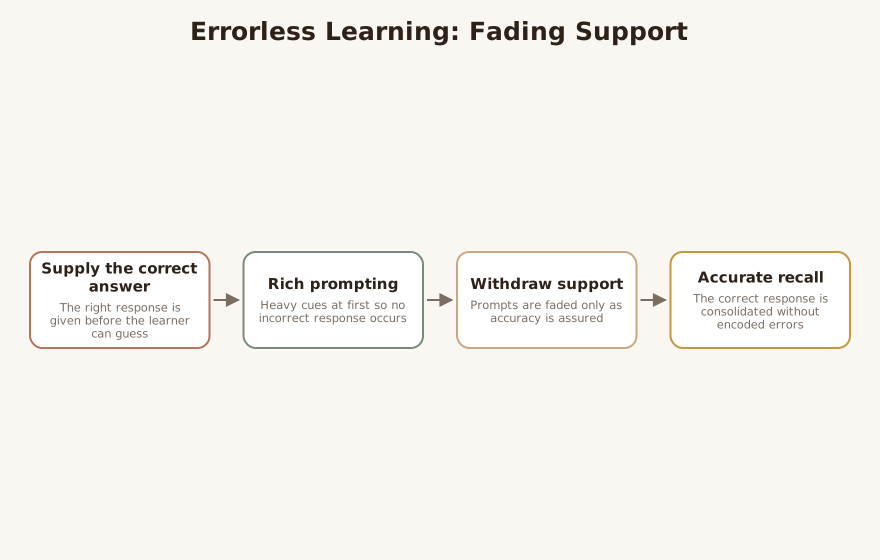
Errorless learning sidesteps this by never letting the incorrect response occur: the correct answer is supplied before the client can guess, prompts are rich at first, and support is withdrawn only as accuracy is assured 5. A second principle, clarified by later work, is that the benefit is not purely an implicit-memory phenomenon. Page and colleagues argued that much of the errorless advantage derives from sparing and exploiting whatever residual explicit memory the person retains, because errors actively interfere with that fragile explicit trace 2. The practical upshot is the same either way: protect acquisition from contamination LLM.
Interventions & Techniques
Several concrete procedures operationalize the principle, and most clinical protocols combine them 5.
- Method of vanishing cues (stimulus fading). The target is presented with strong support — for example, all the letters of a name — and cues are progressively removed (KARE_, KAR__, KA___) across trials so the client always produces the correct response with whatever prompting is currently needed 3. This is the direct descendant of Terrace’s fading procedure 4.
- Spaced retrieval. The correct response is rehearsed at expanding intervals (immediately, then after 30 seconds, a minute, two minutes), each successful recall extending the next delay, while the clinician pre-empts any anticipated error by supplying the answer if the client looks uncertain 3.
- Forward chaining / errorless modelling for procedures. Multi-step tasks (operating a phone, a coffee machine, a medication organizer) are taught one prompted step at a time so no step is ever performed wrongly 5.
- Guided practice with immediate prompting. The clinician instructs the client not to guess and to wait for the answer if unsure — converting “I think it’s…” into “I don’t know, please tell me,” which removes the error opportunity entirely 1.
LLM-generated illustrative example (not a guideline): A clinician teaching a brain-injured client the name of a new home health aide writes “GLORIA” on a card, has the client read and copy it, then fades to “GLOR__,” then “GL____,” then a blank — at each step the client succeeds, and is coached to say “I’m not sure, can you remind me?” rather than venture a wrong name LLM.
Evidence Base
The evidence maturity here is best labeled established. Across multiple controlled studies and a critical review, errorless methods reliably produce better acquisition of novel information in memory-impaired adults than trial-and-error methods 3. The original Wilson and Baddeley work demonstrated the effect across a series of memory-impaired patients, and it has been replicated in amnesia, dementia, and schizophrenia samples 1. Three honest caveats temper the enthusiasm. First, the mechanism remains debated — the early implicit-memory account was complicated by evidence that the advantage depends substantially on residual explicit memory, which matters because it predicts who will benefit and how much 2. Second, the magnitude of the advantage over a well-designed errorful condition is sometimes modest, and not every comparison favors errorless learning once effort and trial number are matched 3. Third, generalization and durability are the weak link: a 2025 scoping review of everyday functioning after brain injury found the technique can support functional task learning but flagged persistent gaps in evidence for transfer beyond the trained task and for long-term maintenance 5. The technique teaches what you train; it does not reliably produce broad cognitive improvement 5.
Populations & Indications
Errorless learning is indicated wherever a person must learn specific, concrete information but has impaired error-monitoring or new-learning capacity 3. The best-supported populations are adults with amnesic syndrome, in whom the effect was first and most clearly shown 1. It is widely used in dementia and Alzheimer’s disease, particularly for relearning names, faces, and daily routines while residual learning capacity persists 3. It has a growing literature in schizophrenia rehabilitation, where impaired learning and the cost of consolidating errors mirror the amnesia case 3. And it is applied across acquired and traumatic brain injury, especially in occupational-therapy-led functional retraining of everyday activities 5. The common thread is a target that is specific and trainable (a name, a route, a sequence of steps) rather than a diffuse cognitive capacity LLM.
Problems-for-Work
In practice, the technique is matched to discrete acquisition problems rather than to symptom clusters LLM.
- Difficulty learning new names — staff, family members, a new clinician — addressed with vanishing cues plus spaced retrieval 3.
- Route and orientation learning — finding the bathroom on a new ward, the way to the day room — taught with errorless prompted practice of the path 5.
- Procedural / device learning — using a pill organizer, a new phone, an assistive app — taught step-by-step with forward chaining so no step is performed incorrectly 5.
- Foundational fact relearning in dementia — the day, the location, a caregiver’s relationship — rehearsed at expanding intervals with pre-emptive prompting 3.
LLM-generated illustrative example (not a guideline): For a client with early Alzheimer’s who keeps misnaming the adult-day-program staff, the clinician selects three target names, teaches each with fading and a “don’t guess — ask” rule, and uses spaced retrieval across a session, prioritizing the names the client most wants to use socially LLM.
Contraindications, Cautions & Cultural Humility
Errorless learning is low-risk but not all-purpose. The main caution is scope: it is a tool for teaching specific targets, and presenting it to clients or families as a treatment that will “restore memory” oversells it — gains are typically task-specific and may not generalize or persist without continued practice 5. A second caution is client autonomy and dignity: heavy prompting and a “don’t guess” instruction can feel infantilizing if delivered without warmth, and some clients are accustomed to and motivated by problem-solving through trial and error LLM. The instruction to suppress guessing should be framed collaboratively and explained, not imposed 1. There is also a theoretical wrinkle worth knowing: because part of the advantage rides on residual explicit memory, clients with extremely dense, near-total amnesia may benefit less than moderately impaired clients, so a screen of preserved learning capacity is clinically useful 2. Finally, cultural humility applies to what is taught — names, routines, and “correct” answers are culturally embedded, and the clinician should ensure the target itself reflects the client’s world, language, and preferences rather than the institution’s defaults LLM.
Treatment-Plan Suggestions & SMART Objectives
| Goal | SMART objective (example) | Mechanism |
|---|---|---|
| Learn names of care team | Client will correctly name 3 of 3 regular staff across 3 consecutive sessions within 6 weeks, using vanishing cues | Prevents encoding of incorrect name guesses; exploits residual explicit memory 2 |
| Independent device use | Client will complete all 5 steps of filling a weekly pill organizer with no prompts on 2 consecutive sessions within 8 weeks | Forward chaining ensures each step is performed correctly from the start 5 |
| Ward / home orientation | Client will independently locate the bathroom from their room on 4 of 5 trials within 3 weeks | Errorless prompted route practice prevents reinforcing wrong turns 5 |
| Relearn personal facts (dementia) | Client will state today’s day and location correctly at 2-minute delay on 3 of 3 trials within 4 weeks, via spaced retrieval | Expanding-interval rehearsal of correct response without error 3 |
| Functional task in brain injury | Client will prepare a simple hot drink following a trained sequence with no errors on 3 consecutive sessions within 8 weeks | Errorless step-prompting supports everyday-functioning acquisition 5 |
| Social re-engagement | Client will correctly greet 2 named family members by name during visits, observed across 2 weeks | Names taught errorlessly to avoid consolidating misnaming 1 |
| Reduce reliance on guessing | Client will respond “I’m not sure, please remind me” instead of guessing on 80% of uncertain trials within 4 weeks | Suppressing guesses removes the error opportunity at source 1 |
Common Misconceptions
A frequent misconception is that errorless learning means the clinician simply gives the answer and the client passively absorbs it — in fact the client actively produces the correct response on every trial, with support faded as quickly as accuracy allows 3. A second is that errors are inherently bad for all learners; for cognitively intact people, productive struggle and error correction are valuable, and errorless methods are specifically indicated where error-monitoring is impaired, not as a universal upgrade 6. A third is that the benefit is purely implicit and “below awareness”; the more current account attributes much of the advantage to protecting fragile explicit memory from interference, which is why the method works best when some explicit learning capacity is preserved 2. Finally, clinicians sometimes assume gains will generalize automatically, but transfer beyond the trained target is not guaranteed and remains an evidence gap 5.
Training & Certification
There is no certification in errorless learning — it is a technique taught within broader training in neuropsychological rehabilitation, occupational therapy, and behavioral skills instruction rather than a credentialed modality LLM. Competence comes from understanding the underlying memory science (implicit versus explicit systems and interference), mastering the component procedures (vanishing cues, spaced retrieval, chaining), and supervised practice in selecting trainable targets and fading support appropriately 3. Clinicians already trained in cognitive rehabilitation or applied behavior-analytic methods will find the procedures familiar; the discipline-specific contribution is knowing when error prevention outperforms error correction 5.
Key Terms
- Fading / vanishing cues — gradual withdrawal of prompts so the correct response is always produced 4.
- Spaced retrieval — rehearsing a correct response at expanding time intervals 3.
- Implicit memory — non-conscious memory that strengthens whatever is repeated, regardless of correctness 6.
- Residual explicit memory — the spared portion of conscious, declarative memory thought to carry much of the errorless advantage 2.
- Errorful (trial-and-error) learning — the comparison condition in which guessing and correction are permitted 1.
- Discrimination learning — the behavioral paradigm (Terrace’s pigeons) in which errorless methods originated 4.
Resources & Further Reading
▶ Watch — a video introduction to this concept:
- Wilson, Baddeley, Evans & Shiel (1994). Errorless learning in the rehabilitation of memory impaired people. Neuropsychological Rehabilitation.
- Page et al. (2006). Investigation of errorless learning in memory-impaired patients: improving the technique and clarifying theory. Neuropsychologia.
- Errorless Learning in the Rehabilitation of Memory Impairment: A Critical Review. Neuropsychology Review (2008).
- Discrimination learning with and without ‘errors’ — errorless learning origins (Terrace). PMC overview.
- Errorless Learning for Everyday Functioning in Adults With Brain Injury: A Scoping Review (2025).
- Errorless learning (Wikipedia).
Reflective / Supervision Questions
- For this client, is the learning target specific and trainable (a name, route, or sequence), or am I trying to use an acquisition technique to fix a diffuse cognitive problem it cannot address? 5
- Have I screened for residual explicit memory, given that the errorless advantage partly depends on it — and what does that predict about how much this client will benefit? 2
- Am I delivering the “don’t guess” instruction collaboratively and warmly, or in a way that risks feeling infantilizing or removing the client’s sense of agency? LLM
- What is my plan for generalization and maintenance, knowing that gains are typically task-specific and may fade without continued practice? 5
- Have I been honest with the client and family that this method teaches specific information, not a general restoration of memory? 3