
Type & Discipline
The Recovery Model is a framework and orientation to care, not a manualized treatment protocol LLM. It belongs to the family of recovery-oriented care and sits at the intersection of medical sociology, mental health services research, and the consumer/survivor movement 3. Its central move is to distinguish personal recovery from clinical recovery: clinical recovery is a psychiatric construct involving alleviation of symptoms, restoration of social functioning, and a return to what is considered “normal,” whereas personal recovery is recovering a life worth living, with or without ongoing symptoms 5. The two are not mutually exclusive for any given person, but the model deliberately privileges the person’s own definition of a good life over the clinician’s symptom checklist 5.
This reframing matters for everyday practice because it changes whose definition of success governs the work LLM. A clinician trained primarily in symptom reduction is invited to hold that aim more lightly and to organize treatment around connection, hope, identity, meaning, and agency LLM. The model is best understood as a values orientation that shapes how any therapeutic modality is delivered, rather than as a technique applied in isolation LLM.
Creators & Lineage
The modern recovery paradigm emerged from the consumer/survivor/ex-patient movement of the late 1980s and early 1990s, particularly in the United States, where it grew through grassroots advocacy rather than from within academic psychiatry 3. Its most frequently cited definition comes from William (Bill) Anthony (1993), who described recovery as “a deeply personal, unique process of changing one’s attitudes, values, feelings, goals, skills, and/or roles” enabling “a satisfying, hopeful and contributing life, even within the limitations caused by illness” 5. This definition is now treated as foundational across recovery-oriented services 4.
The framework’s lineage draws on psychiatric rehabilitation, the peer support / self-help movement, strengths-based approaches, and concepts of social identity that foreground a self beyond the patient role 3. The empirical backbone arrived in 2011, when Mary Leamy, Mike Slade, and colleagues published a systematic review and narrative synthesis that distilled the recovery literature into a usable conceptual structure 1. Slade’s group at the University of Nottingham (Research Into Recovery) has since become a hub for translating personal recovery into service design 4. Mary Ellen Copeland, who developed the Wellness Recovery Action Plan, is associated with the self-management strand of this lineage LLM.
Core Principles
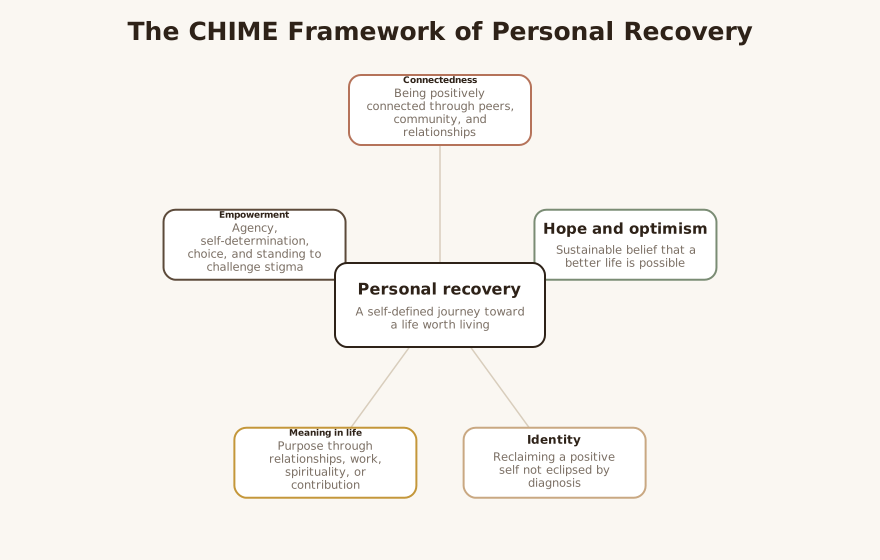
Leamy et al. screened 5,208 papers, reviewed 366, and included 97 in a narrative synthesis that produced the CHIME framework of five recovery processes 1. The components are Connectedness, Hope and optimism, Identity, Meaning in life, and Empowerment 1.
- Connectedness is the sense of being positively connected to others through peer support, community, family, or healing relationships with professionals 5.
- Hope and optimism is the sustainable belief that a better life is possible, which the recovery literature treats as a precondition for any change 5.
- Identity is the construction or reclaiming of a positive sense of self that is not eclipsed by diagnosis and that rejects stigmatizing beliefs 5.
- Meaning in life is the discovery of purpose, which may run through relationships, work, spirituality, or a sense of being a valued contributor 5.
- Empowerment is agency and self-determination, including choice, autonomy, and the standing to challenge stigma 5.
The synthesis also identified thirteen characteristics of the recovery journey and mapped recovery stages onto a transtheoretical, developmental progression rather than a fixed endpoint 1. Recovery is repeatedly framed as a journey and as a process of discovery and rediscovery, with planning, signposts, and roadblocks 5. Crucially, the model treats recovery as non-linear and self-defined, which is what separates it from a cure-or-fail binary LLM.
Interventions & Techniques
Because the Recovery Model is an orientation rather than a protocol, its “interventions” are ways of structuring care so that the CHIME processes can develop LLM. In practice this includes peer support and lived-experience roles, which directly build Connectedness and model Hope 5. Collaborative, co-produced goal-setting operationalizes Empowerment by putting the person’s own goals at the center of the plan 5.
The Mental Health Europe guide offers concrete starting prompts that clinicians can adopt verbatim: “What would personal recovery look like and feel like for me?”, “Who do I trust enough to talk to about this?”, “What have I found helpful in the past?”, “What has not been helpful?”, and “What one thing could I actually do that would make my life a bit better?” 5. These questions shift the locus of expertise toward the person and seed identity and meaning work LLM.
Other recovery-oriented practices include narrative and identity work that helps a person see beyond the service-user role, positive risk-taking and shared responsibility in care planning, and self-management tools such as wellness and crisis plans associated with the Copeland tradition 5LLM. Hope can be deliberately cultivated by connecting the person with others further along their journey 5. None of these require abandoning a person’s existing evidence-based therapy; they reshape how that therapy is delivered LLM.
LLM-generated illustrative example (not a guideline): A clinician working with a man whose life has narrowed to “schizophrenia patient” spends a session not on symptom rating scales but on a single question — “What would a good Tuesday look like for you?” His answer, returning to a community choir, becomes the organizing thread for connectedness, identity, and meaning across the next three months. LLM.
Recovery Management and Recovery-Oriented Systems of Care
The recovery paradigm did not stay inside mental health. Larry Davidson and William L. White argued in 2007 that recovery is the construct capable of bridging the long-standing divide between mental health and addiction services, because it offers a strengths-based route to integration where etiology-focused and pathology-focused attempts had failed 11. Their foundational value is the same one that animates CHIME: each person must be the agent of — or at minimum the central participant in — their own recovery journey, so services should be organized around the developmental stages of that journey rather than around a diagnostic category 11. From that value they derive a set of guiding principles that any reader of the preceding sections will recognize: both mental illnesses and addictions show broad heterogeneity of population and outcome, so recovery looks different for different people; care requires a long-term, longitudinal, developmental perspective that matches intervention to the person’s point in the process; environment shapes course and outcome, making person-environment fit a legitimate clinical target; recovery is non-linear, a process and a continuum rather than an outcome; and family involvement, peer support, and spirituality are supports rather than extras 11. Their conclusion is that once you begin from recovery, commonality between the two fields outweighs difference, and the fields only genuinely diverge at the level of specific treatments 11.
What the addiction side then contributed back was a temporal reframe LLM. If recovery is a long-term developmental process, the episode of care with a discharge date is the wrong unit of intervention — and that argument reshapes not just the clinician’s stance but the architecture of the service system LLM.
From acute-care episodes to chronic-condition management
White came to this through history. Slaying the Dragon, his history of American addiction treatment and recovery, traced how a field with deep mutual-aid roots became a network of professionalized, medicalized, commercialized treatment institutions 9. His 2008 monograph named what that trajectory had produced: an acute-care (AC) model, in which services are delivered “programmatically” as a uniform, encapsulated sequence — screening, admission, a single point-in-time assessment, a short course of minimally individualized treatment, discharge, brief aftercare, and then termination of the service relationship 8. He lists the model’s other signatures: a crisis-linked point of intervention; a focus on symptom elimination for a single primary problem; professionally dominated assessment and planning; an ever-shorter duration set by reimbursement design rather than clinical need; the impression conveyed at “graduation” that cure has occurred; evaluation at a short-term, single-point follow-up; and post-treatment relapse construed as the individual’s non-compliance rather than a possible flaw in the design or execution of the intervention 8.
The critique lands on two findings that recur across treatment modalities: treatment effects decay over time, and long addiction and treatment careers typically precede sustainable recovery 8. In a long-term follow-up of a Chicago cohort recruited from publicly funded treatment admissions, the median interval from first substance use to a first year of achieved abstinence was 27 years, and the span from first treatment admission to that first year of abstinence covered three to four treatment episodes over an average of nine years 12 — figures White uses as the empirical hinge of his argument 8. Against a natural history of that length, a single brief episode framed as a cure is a category error LLM.
His alternative operates at two levels. Recovery management (RM) is the microsystem philosophy: organizing addiction treatment and recovery support services to enhance pre-recovery engagement, recovery initiation, long-term recovery maintenance, and the quality of personal and family life in long-term recovery 8. A recovery-oriented system of care (ROSC) is the macrosystem counterpart: the complete network of indigenous and professional services and relationships that can support the long-term recovery of individuals and families, together with the cultural and policy environment in which those recovery processes are nested 8. The “system” in ROSC is deliberately not a state agency or a funding stream — it is the community ecology itself 8.
The microsystem: sustained monitoring, coaching, and early re-intervention
Assertive continuing care is the operational hallmark of a recovery management model, and White is specific about what “assertive” requires 8. Such approaches encompass every admitted client and family, not only those who successfully “graduate”; they place primary responsibility for post-treatment contact on the treatment institution rather than the client; they use both scheduled and unscheduled contact; they saturate check-ups and support during the first 90 days after discharge and intensify monitoring during identified windows of vulnerability; they individualize duration and intensity according to problem severity and the depth of the person’s recovery capital; and they use assertive linkage to communities of recovery rather than passive referral 8. The recommended horizon is measured in years, not weeks: post-stabilization monitoring, stage-appropriate recovery education, active recovery coaching, and early re-intervention where needed, for a period of at least five years, with at minimum an annual recovery check-up even for the most stable clients 8.
Three named practices carry the model LLM. Recovery management check-ups are scheduled post-treatment contacts designed to shorten the cycle of relapse, treatment re-entry, and recovery; White cites experimental evaluations indicating that they speed re-entry into care and reduce the need for later treatment 8. Assertive continuing care extends the same logic to adolescents leaving residential treatment, through home-based contact and active linkage rather than a referral slip 8. Recovery coaching is the relational vehicle — a sustained support relationship that spans levels of care, may be delivered by counselors, recovery coaches, or trained volunteer recovery support specialists, emphasizes contact in the person’s natural environment, and prioritizes continuity of the relationship itself 8. The workforce, certification, and competency questions these roles raise are treated separately in this wiki’s article on peer support services and peer specialists; what matters here is the temporal function the roles serve LLM.
The macrosystem: community-level recovery supports
ROSC’s distinctive move is to treat the community, not only the clinic, as a site of intervention LLM. White points to the growth and diversification of recovery mutual aid societies, the grassroots recovery advocacy movement, the rise of recovery community organizations that exist independently of both treatment programs and mutual aid societies, and the proliferation of recovery community institutions — recovery homes, recovery industries, recovery schools, recovery ministries and churches, peer-directed recovery support centers, and internet-based recovery communities 8. One stated goal of recovery management is to build community recovery capital to the point where recovery becomes socially contagious, which calls for community development strategies and the inclusion of indigenous healers and institutions alongside clinical ones 8. Recovery capital as a construct in its own right is covered in a separate article here LLM.
Federal policy codified the same vision. The SAMHSA/CSAT review of the National Summit on Recovery principles frames recovery as self-directed and empowering, holistic, culturally shaped, existing on a continuum of improved health and wellness, emerging from hope and gratitude, involving healing and self-redefinition, requiring that discrimination be addressed and shame and stigma transcended, supported by peers and allies, and realized through (re)joining and (re)building a life in the community — with the premise throughout that there are many pathways to recovery 10. Read alongside CHIME, these are the same processes stated as system-design requirements rather than as personal experiences LLM.
What this layer does and does not have behind it
The evidence is asymmetric, and it is worth naming the asymmetry precisely LLM. The component practices have the stronger footing: post-treatment monitoring and support have been evaluated experimentally in adults and adolescents, which is why White presents them as “promising practices” with a scientific rationale rather than as settled standards of care 8. Whole-system ROSC transformation is a different order of claim, and the monograph itself is framed as a rationale and a performance-measurement agenda for systems that were, at the time, only beginning to attempt it 8.
The cautions are equally specific. White warns that adopting recovery-oriented systems of care and recovery management language can reflect deep changes in treatment philosophy and practice — or a superficial adaptation to the latest funding fashion 8. He also documents that treatment is not inert: a review he cites concluded that between 7% and 15% of people treated for addiction deteriorate rather than improve, with high-severity clients assigned to short-duration treatment at particular risk, the proposed mechanism being demoralization following escalated hope 8. That finding cuts both ways for this section — it strengthens the case against brief acute-care episodes for severe presentations, and it warns that extending the service relationship is not automatically benign LLM. Sustained monitoring can shade into surveillance, particularly where contact is tied to funding, mandates, or criminal-legal supervision, and the CHIME criterion of empowerment is the right test to apply: is the extended relationship something the person directs, or something applied to them? LLM
LLM-generated illustrative example (not a guideline): A man completes a 28-day residential program and is discharged with a list of meetings. Under an acute-care frame, the episode is closed and a return to use six weeks later reads as his failure. Under a recovery management frame, his clinician schedules a check-up at 30, 60, and 90 days, walks him to his first mutual-aid meeting rather than naming one, and treats the return to use as a signal to step care back up — not as a discharge from the relationship. LLM.
Evidence Base
The maturity of the Recovery Model is best described as established as a policy and care paradigm, with a strong empirical synthesis underpinning the CHIME structure but more variable evidence for downstream clinical outcomes LLM. The Leamy et al. systematic review is a robust, transparently conducted narrative synthesis and is the most-cited empirical grounding for the framework’s five processes 1. CHIME is therefore not merely an opinion structure; it was derived inductively from a large body of recovery accounts 1.
There is also evidence bearing on the framework’s transdiagnostic reach. A 2024 study tested the fit of the CHIME framework against recovery narratives from people with lived experience of severe mental illness, examining whether personal recovery functions as a transdiagnostic concept 2. This line of work probes whether the same recovery processes hold across different diagnoses rather than being illness-specific 2.
Clinicians should be honest about the limits LLM. CHIME describes the processes of recovery well, but the model is a values framework, not a manualized intervention with a settled randomized-trial evidence base for symptom or functional outcomes LLM. Recovery-oriented services vary widely in how faithfully they implement the principles, and the evidence for any specific recovery-oriented program should be appraised on its own terms rather than assumed from the popularity of the paradigm LLM.
Populations & Indications
The model originated in serious mental illness, including schizophrenia and psychosis, where the gap between symptom control and a meaningful life is often widest 3. It is widely applied with adults in mental health services, people with bipolar disorder, and people with substance use disorders, and it underpins peer-support communities built around shared lived experience 35. The MHE guide frames recovery as relevant to “anyone who has experienced psychological distress, trauma, stigma or any other challenge to mental health and well-being” 5.
Indications are strongest where a person faces chronic or relapsing conditions, entrenched self-stigma, loss of identity or meaning, hopelessness, social isolation, or low empowerment — precisely the targets the CHIME processes are built to address 5LLM. The transdiagnostic testing of CHIME supports cautious extension beyond the diagnoses where the model first took hold 2.
Problems-for-Work
The model maps cleanly onto specific clinical problems LLM:
- Self-stigma and loss of identity. Identity work that rejects stigmatizing beliefs and helps a person “see beyond the identity of service user” is the direct CHIME counterpart 5. Application: reframing a person’s self-narrative away from “I am my diagnosis” toward chosen roles and values LLM.
- Hopelessness. Because the literature holds that “there can be no change without the belief that a better life is both possible,” hope-building (often via peer contact) is a primary intervention 5.
- Social isolation. Connectedness work mobilizes peer, community, and family relationships as therapeutic resources 5.
- Low empowerment. Collaborative goal-setting that emphasizes choice and autonomy restores agency 5.
- Loss of meaning. Exploration of purpose — through work, faith, or contribution — addresses the Meaning process 5.
LLM-generated illustrative example (not a guideline): A woman in early recovery from a substance use disorder describes herself only as “an addict who keeps failing.” The clinician anchors the work in empowerment and identity, co-writing a list of roles she still values (sister, gardener, volunteer), and uses a weekly one-small-thing goal to rebuild agency. LLM.
Contraindications, Cautions & Cultural Humility
There is no strict contraindication to a recovery orientation, but there are serious cautions LLM. Critics note that recovery language can be co-opted to withdraw services prematurely under the guise of “empowerment,” that it risks becoming a “new orthodoxy” that neglects structural inequities, that it can mask the continued dominance of the medical model, and that it may marginalize people who do not fit an upbeat recovery narrative 3. A person in acute crisis or with severe cognitive impairment may need stabilization and active clinical care before self-directed recovery work is appropriate LLM.
Cultural humility is essential because the paradigm is value-loaded LLM. The framework reflects North American individualist values and may not transfer cleanly across cultures, where “cultural biases and uncertainties” arise in implementation 3. Leamy et al. found that studies of Black and minority ethnic populations surfaced additional dimensions — greater emphasis on spirituality and on stigma, plus culturally specific facilitating factors and collectivist notions of recovery 1. Clinicians should not assume that “empowerment” or an individualized identity is the right frame for every person; for some, recovery is relational and communal first 1LLM.
Treatment-Plan Suggestions & SMART Objectives
| Goal | SMART objective (example) | Mechanism |
|---|---|---|
| Rebuild connectedness | Within 8 weeks, client will attend at least one peer-support or community group weekly and report on the experience in session | Connectedness 1 |
| Restore hope | Over 6 weeks, client will identify and articulate two specific, personally meaningful future possibilities | Hope and optimism 1 |
| Reclaim identity beyond diagnosis | Within 10 weeks, client will name and re-engage two valued life roles unrelated to the patient role | Identity 5 |
| Develop meaning and purpose | Within 12 weeks, client will commit to one regular purposeful activity (work, volunteering, faith, or creative) | Meaning in life 1 |
| Increase empowerment | Each session, client will set one self-chosen “small step” goal and review progress collaboratively | Empowerment 5 |
| Reduce self-stigma | Over 8 weeks, client will identify three stigmatizing self-statements and generate balanced alternatives | Identity / Empowerment 5 |
| Strengthen self-management | Within 6 weeks, client will co-produce a personal early-warning-signs and wellness plan | Empowerment / Hope 5 |
| Sustain support past the treatment episode | Client and clinician will agree a check-in schedule extending at least 12 months past the current episode, with contacts at 30, 60, and 90 days and quarterly thereafter | Connectedness / Hope 8 |
| Convert referral into linkage | Within 4 weeks, client will attend a first recovery-community meeting accompanied or actively connected by a peer, rather than by verbal referral alone | Connectedness / Empowerment 8 |
Common Misconceptions
“Recovery means cure or symptom remission.” No — personal recovery explicitly means living a satisfying, hopeful life with or without ongoing symptoms, and is distinct from clinical recovery 5. “It’s anti-medication or anti-psychiatry.” The model does not reject clinical care; personal and clinical recovery need not be mutually exclusive for an individual 5. “It’s just being positive.” CHIME is an empirically derived synthesis of recovery accounts, not a slogan 1. “It’s a discrete therapy you deliver.” It is an orientation that reshapes how other interventions are delivered, not a standalone modality LLM. “More empowerment is always better.” For some cultural contexts, recovery is collectivist and relational, and an individualist empowerment frame can miss the point 1.
Training & Certification
There is no single licensing body for “the recovery model”; competence is built through recovery-oriented practice training, peer-worker collaboration, and exposure to lived-experience leadership LLM. Resources from groups such as Slade’s Research Into Recovery support service-level implementation 4. Self-management tools in the Copeland (Wellness Recovery Action Plan) tradition have their own facilitator training pathways LLM. Practitioners should treat lived-experience educators and peer specialists as primary teachers of this framework, consistent with its co-production roots 5LLM.
Key Terms
- Personal recovery — recovering a life worth living, self-defined, with or without symptoms 5.
- Clinical recovery — symptom alleviation, restored functioning, and return to “normal” as defined clinically 5.
- CHIME — Connectedness, Hope and optimism, Identity, Meaning, Empowerment 1.
- Co-production — designing care in partnership with people who have lived experience 5.
- Self-stigma — internalized stigma that drains hope and eclipses positive identity 5.
- Recovery as journey / discovery and rediscovery — non-linear process of finding new strengths and reclaiming lost aspects of self 5.
- Acute-care (AC) model — treatment delivered as a brief, encapsulated episode with a discharge point, professionally directed, and evaluated as though cure had occurred 8.
- Recovery management (RM) — organizing treatment and recovery support services around pre-recovery engagement, recovery initiation, long-term maintenance, and quality of life in long-term recovery 8.
- Recovery-oriented system of care (ROSC) — the full network of indigenous and professional services, relationships, and supportive cultural/policy conditions in which long-term recovery is nested 8.
- Assertive continuing care — post-treatment contact that is the institution’s responsibility, extends for years, saturates the first 90 days, and scales to severity and recovery capital 8.
- Recovery management check-up — a scheduled post-treatment contact intended to shorten the cycle of relapse, treatment re-entry, and recovery 8.
- Assertive linkage — actively connecting a person to a recovery community rather than passively referring them to one 8.
- Recovery coaching — a sustained, relationship-centered support role spanning levels of care and delivered largely in the person’s own environment 8.
Resources & Further Reading
- Leamy et al. (2011), conceptual framework for personal recovery (systematic review)
- Taylor et al. (2024), is personal recovery a transdiagnostic concept? (CHIME and narratives)
- Recovery model — Wikipedia
- What is recovery and wellbeing? — Research Into Recovery (Slade group)
- A Short Guide to Personal Recovery in Mental Health — Mental Health Europe
- What is the CHIME framework of recovery? — video
- White (2008), Recovery Management and Recovery-oriented Systems of Care: Scientific Rationale and Promising Practices (monograph)
- Sheedy & Whitter (2009), Guiding Principles and Elements of Recovery-Oriented Systems of Care — SAMHSA/CSAT
- Davidson & White (2007), recovery as an organizing principle for integrating mental health and addiction services
- Dennis et al. (2005), the duration and correlates of addiction and treatment careers
Reflective / Supervision Questions
- In my current caseload, whose definition of “getting better” is driving the treatment plan — the client’s or mine? LLM
- Which of the five CHIME processes do I most reliably attend to, and which do I tend to neglect? LLM
- Where might I be using “empowerment” or “recovery” language in a way that could justify withdrawing support a client still needs? 3LLM
- For clients from collectivist or minority backgrounds, am I imposing an individualist recovery frame, or am I making room for relational and spiritual meanings of recovery? 1LLM
- How am I drawing on peer and lived-experience expertise, rather than treating recovery as something I deliver to a passive recipient? 5LLM
- When a client’s episode of care ends, what actually happens next — and whose responsibility is it to make contact? 8LLM
- Do I read a return to use or a rehospitalization as the client’s failure, or as information about how the care was designed? 8LLM
- If I extended the service relationship for years, would the client experience that as sustained support or as surveillance — and what would make the difference? 8LLM