
Rumination-Focused Cognitive Behavioral Therapy (RFCBT) is a structured, process-focused adaptation of cognitive behavioral therapy that treats rumination — repetitive, passive dwelling on distress and its causes and consequences — as a central, modifiable target rather than a symptom to be tolerated 4. Developed by Edward Watkins, it reframes rumination as a learned mental habit and teaches clients to recognize and interrupt it, shifting the style of thinking rather than only disputing thought content 5. This article orients practicing clinicians to its lineage, mechanisms, techniques, evidence, and clinical application.
Type & Discipline
RFCBT is a manualized psychotherapeutic modality within clinical psychology, most commonly delivered as individual or group therapy and usually conceptualized as a brief, time-limited intervention 4. It belongs to the third-wave, process-focused family of CBT: like metacognitive therapy and behavioral activation, it shifts attention from the content of negative thoughts to the process and function of how clients think 5. Rather than asking whether a thought is true, RFCBT asks whether a particular mode of thinking is helpful, and whether it can be replaced with a more adaptive processing style 4.
The modality is grounded in experimental cognitive science: Watkins’s work draws explicitly on findings that distinguish maladaptive from constructive forms of repetitive thought, and operationalizes that distinction into therapeutic procedures 5. This empirical-process orientation is part of what places RFCBT alongside other contemporary CBT derivatives that target transdiagnostic mechanisms LLM.
Creators & Lineage
RFCBT was developed by Edward Watkins, a clinical psychologist and researcher whose program of work formalized the treatment and produced its foundational trial and treatment manual 15. The manual, Rumination-Focused Cognitive-Behavioral Therapy for Depression, published by Guilford Press, is the canonical clinician reference for the approach 5.
The intellectual lineage is layered. RFCBT extends standard cognitive behavioral therapy by inheriting its structure — agenda-setting, between-session practice, functional analysis — while redirecting the target 4. It is built on Susan Nolen-Hoeksema’s response styles theory, which identified rumination as a response to distress that prolongs and deepens depression, distinguishing it from more adaptive responses such as active problem-solving or distraction LLM. It incorporates behavioral activation principles, using functional-analytic methods to map the antecedents, contexts, and consequences of ruminative episodes 5. And it is conceptually adjacent to Adrian Wells’s metacognitive therapy, which similarly treats repetitive negative thinking as a process to be modified rather than a set of beliefs to be tested LLM.
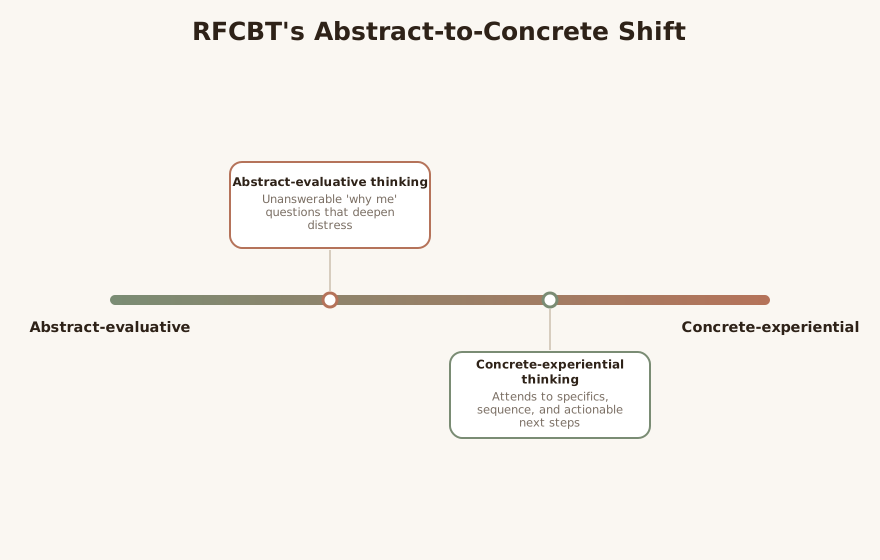
What is distinctive in Watkins’s synthesis is the abstract-versus-concrete processing distinction. RFCBT operationalizes the insight that rumination is characterized by an abstract, evaluative, “why” mode of thinking, and that training clients toward a concrete, experiential, “how” mode reduces its harms 5.
Core Principles
The central premise of RFCBT is that rumination is a habit — a learned, often automatic response triggered by particular cues — and that habits can be unlearned and replaced 4. This reframing matters clinically: it moves the client from “I am a worrier” toward “I have a ruminative habit that activates in specific situations,” which is more tractable LLM.
A second principle is the distinction between unhelpful and helpful forms of repetitive thought. Not all dwelling is pathological; the same content processed in a concrete, problem-focused way can support coping, while the same content processed abstractly and evaluatively deepens distress 5. RFCBT therefore does not aim to eliminate thinking about problems but to change how clients engage with them 4.
Third is the abstract-to-concrete shift. Abstract processing asks unanswerable evaluative questions (“Why does this always happen to me? What’s wrong with me?”), whereas concrete processing attends to the specifics of a situation, the sequence of events, and actionable next steps 5. Training this shift is a core mechanism of change 5.
Fourth, RFCBT uses functional analysis to identify the warning signs, triggers, and contexts of ruminative episodes, and to find more adaptive alternative responses that serve the same function 5. The approach is collaborative and experiential, relying on guided discovery and behavioral experiments rather than didactic persuasion 4.
Interventions & Techniques
RFCBT applies a recognizable CBT skeleton to a rumination-specific set of techniques 4. Treatment typically opens with psychoeducation that frames rumination as a habit and a normalizable, common process, reducing the shame that often accompanies it LLM.
Functional analysis of rumination. Clients and clinicians examine specific ruminative episodes in detail — the trigger, the context, the moment-to-moment unfolding, and the consequences — to surface patterns and identify points of leverage 5. This builds awareness of warning signs and antecedent cues so that the habit can be caught earlier 5.
Concreteness training. A signature technique trains clients to move from abstract “why” questions toward concrete “how” questions and detailed, sensory, situation-specific descriptions, which interrupts the abstract-evaluative loop 5. Practiced repeatedly, this shifts the default processing mode 5.
If-then plans and alternative responses. Drawing on functional analysis, clients develop contingency plans that pair identified triggers with adaptive alternative responses, so a known cue prompts a rehearsed, more helpful action rather than rumination 5.
Experiential and imagery methods. RFCBT uses experiential exercises, imagery, and contrasting techniques to help clients access more adaptive states — for example, recalling a time of absorbed, concrete engagement and using it as a template 5. Behavioral experiments test whether shifting processing style changes outcomes in real situations 4.
LLM-generated illustrative example (not a guideline): A client who ruminates after perceived slights at work is helped, via functional analysis, to notice the cue (“a curt email”) and the abstract spiral (“why am I always disrespected?”). The clinician trains a concrete alternative (“what exactly was said, and what is one specific reply I could send?”) and an if-then plan: if I catch myself replaying the email, then I will write down the next concrete action and take a short walk LLM.
Evidence Base
The evidence base for RFCBT is best described as emerging rather than established LLM. The anchoring study is Watkins and colleagues’ phase II randomised controlled trial, which evaluated RFCBT as an adjunct to medication for residual depression — patients who had not fully responded to antidepressant treatment 1. In that trial, adding RFCBT to treatment as usual produced significant improvements in residual depressive symptoms and rumination relative to treatment as usual alone 12. As a phase II trial, it was designed to establish proof of concept and effect estimates, not to provide definitive confirmatory evidence 2.
A 2024 systematic review of RFCBT for depressive symptoms synthesized the subsequent literature and supports a cautiously positive reading: across studies, RFCBT was associated with reductions in depressive symptoms and in rumination 3. However, the review also reflects the field’s limitations — a relatively small number of trials, heterogeneity in populations, formats, and comparators, and variable methodological quality — which constrain how strongly conclusions can be drawn 3.
Clinicians should therefore frame RFCBT honestly: it is theoretically coherent, manualized, and supported by promising trial and review-level data, but it does not yet have the breadth of replication that would place it among first-line, gold-standard treatments LLM. It is reasonable to offer it as an evidence-informed option, particularly where rumination is a prominent and treatment-resistant feature, while being candid about the maturity of the evidence LLM.
Populations & Indications
RFCBT was developed and tested primarily with adults experiencing depression, and its strongest evidence concerns people with residual or recurrent depression — those whose symptoms persist after treatment or who are vulnerable to repeated episodes 15. Because elevated rumination predicts relapse, RFCBT is also positioned as a relapse-prevention strategy for adults with a depressive history 5.
The model extends conceptually beyond depression. Because rumination and worry are closely related forms of repetitive negative thinking, RFCBT has been articulated for anxiety as well as depression, making it potentially relevant to generalized anxiety, chronic worry, and anxious apprehension 6. Applications to adolescents have also been described, reflecting interest in intervening early when ruminative habits are forming LLM. The unifying indication across these groups is the prominence of repetitive negative thinking as a maintaining factor 4.
Problems-for-Work
RFCBT is most directly indicated when rumination or worry is a salient, identifiable problem-for-work rather than a background feature LLM.
- Rumination in major or recurrent depression. When a depressed client spends large portions of the day dwelling on causes and consequences of low mood, RFCBT targets that process directly, using functional analysis and concreteness training to interrupt it 15.
- Residual depressive symptoms. For clients with persistent symptoms after partial response to medication, RFCBT can be added to existing treatment to address the ruminative process that maintains the residue 12.
- Worry and generalized anxiety. Where chronic worry and anxious apprehension dominate, the same process-focused techniques can be applied to the worry habit 6.
- Relapse prevention. For clients in remission with a history of recurrence, work focuses on recognizing ruminative warning signs and deploying rehearsed alternative responses 5.
- Perfectionism and self-critical rumination. Abstract, evaluative self-criticism (“why am I not good enough?”) is a natural target for the abstract-to-concrete shift LLM.
- Co-rumination. Repetitive negative talk within relationships can be examined functionally and redirected toward concrete problem-solving LLM.
Contraindications, Cautions & Cultural Humility
There are no formally established absolute contraindications documented in the provided literature, but several cautions follow from clinical reasoning LLM. RFCBT was developed and validated chiefly as an adjunctive or focused treatment for depression and rumination; it is not a substitute for risk management, and active suicidality, severe depression requiring stabilization, psychosis, or acute crisis should be addressed through appropriate care before or alongside a process-focused rumination intervention LLM. The phase II trial studied RFCBT as an addition to ongoing treatment rather than a standalone replacement, which should inform how it is positioned 1.
Clinicians should also be careful not to convey that rumination is simply a choice the client could stop; the habit framing is meant to be destigmatizing and empowering, not blaming 4. A client who hears “you’re choosing to ruminate” may feel invalidated, which is the opposite of the intended stance LLM.
Cultural humility is essential. What counts as adaptive “concrete problem-solving” versus “dwelling,” and which contexts trigger rumination, are shaped by culture, gender, family norms, and lived experience of discrimination or adversity LLM. Repetitive thinking about real, ongoing injustice or material hardship is not the same as content-free rumination, and the goal is not to talk a client out of legitimate concern but to support more workable processing of it LLM. Clinicians should hold the model’s distinctions lightly and collaboratively, checking that the client experiences the reframe as accurate to their world LLM.
Treatment-Plan Suggestions & SMART Objectives
The following examples illustrate how RFCBT targets can be translated into measurable objectives; they are templates to be individualized, not prescriptions LLM.
| Goal | SMART objective (example) | Mechanism |
|---|---|---|
| Increase awareness of rumination | Within 3 weeks, client will self-monitor and log at least 5 ruminative episodes per week, noting trigger and context | Functional analysis of warning signs and cues 5 |
| Shift from abstract to concrete processing | Over 6 weeks, client will practice concreteness training in 4 sessions and apply a “how/what specifically” prompt to ≥3 real situations weekly | Abstract-to-concrete processing shift 5 |
| Interrupt ruminative habit at onset | Within 4 weeks, client will implement an if-then plan in response to ≥2 identified triggers per week | Cue-driven alternative response replacing the habit 5 |
| Reduce residual depressive symptoms | Over 8 weeks, client will reduce self-rated depression score by a clinically meaningful margin | Targeting rumination as a maintaining process 12 |
| Reduce worry/anxious apprehension | Within 6 weeks, client will apply RFCBT process techniques to worry episodes on ≥4 days per week | Process-focused redirection of repetitive negative thinking 6 |
| Build adaptive alternative responses | Over 5 weeks, client will identify and rehearse 3 adaptive responses that serve the same function as ruminating | Functional substitution of helpful for unhelpful response 5 |
| Prevent relapse | By end of treatment, client will produce a written relapse-prevention plan listing personal ruminative warning signs and responses | Early recognition and rehearsed coping 5 |
Common Misconceptions
“RFCBT is just standard CBT for depressed thoughts.” It shares CBT’s structure but differs in target: standard CBT often disputes thought content, whereas RFCBT modifies the process and style of thinking, leaving content questions secondary 45.
“The goal is to stop the client from thinking about their problems.” RFCBT does not aim to suppress or distract away all reflection; it aims to shift maladaptive abstract dwelling toward concrete, constructive engagement, and accepts that some repetitive thought is helpful 5.
“It’s a fully established, first-line treatment.” The evidence is promising but still emerging, resting on a phase II trial and a modest, heterogeneous subsequent literature; it should not be presented as definitively proven 13.
“It only applies to depression.” Because rumination and worry share a repetitive-negative-thinking core, the approach has been articulated for anxiety as well, though depression remains its evidential center 6.
Training & Certification
The primary clinician resource is Watkins’s treatment manual, Rumination-Focused Cognitive-Behavioral Therapy for Depression, which provides the conceptual model, session structure, and techniques in implementable detail 5. Continuing-education and professional-development offerings exist, including a recorded webinar by Watkins through the Association for Behavioral and Cognitive Therapies (ABCT) eLearning platform covering RFCBT for depression and anxiety 6. Practitioner-facing explainer resources, such as the Psychology Tools technique guide, summarize the approach and can orient clinicians new to it 4. The provided sources do not describe a formal credentialing or certification pathway, so clinicians should treat competence as built through the manual, supervised practice, and continuing education rather than through a single certificate LLM.
Key Terms
- Rumination — repetitive, passive dwelling on distress and its causes and consequences, treated in RFCBT as a modifiable habit 45.
- Repetitive negative thinking — the broader process category encompassing both depressive rumination and anxious worry 4.
- Abstract (evaluative) processing — a “why”-focused, generalizing mode of thought that characterizes maladaptive rumination 5.
- Concrete (experiential) processing — a “how”-focused, specific, situation-anchored mode that RFCBT trains as the adaptive alternative 5.
- Concreteness training — the technique used to shift clients from abstract toward concrete processing 5.
- Functional analysis — examination of the triggers, context, and consequences of ruminative episodes to find leverage points and alternative responses 5.
- If-then plan — a contingency pairing a known trigger with a rehearsed adaptive response 5.
- Residual depression — persisting depressive symptoms after partial treatment response, the population of the anchoring RFCBT trial 1.
Resources & Further Reading
▶ Watch — a video introduction to this concept:
- Watkins et al. (2011), Phase II RCT — PubMed record 1
- Watkins et al. (2011), Phase II RCT — Cambridge Core full record 2
- Systematic review of RFCBT for depressive symptoms (Frontiers in Psychology, 2024) 3
- Rumination-Focused Cognitive Behavioral Therapy (RFCBT) — Psychology Tools 4
- Rumination-Focused Cognitive-Behavioral Therapy for Depression — Watkins, Guilford Press 5
- Ed Watkins Recorded Webinar: RFCBT for Depression and Anxiety — ABCT eLearning 6
Reflective / Supervision Questions
- For a given client, can I clearly distinguish content work (is this thought accurate?) from process work (is this style of thinking helpful?), and am I choosing the right one LLM?
- How would I introduce the “rumination as habit” frame in a way that destigmatizes rather than implies the client is choosing to suffer 4?
- When a client’s repetitive thinking concerns real, ongoing adversity or injustice, how do I support concrete processing without invalidating legitimate concern LLM?
- Am I representing the evidence base honestly to clients — as promising and emerging rather than definitively established 13?
- For a depressed client with residual symptoms, how am I positioning RFCBT relative to their existing treatment, and have I confirmed risk is being managed appropriately 1?
- What concrete, individualized warning signs and alternative responses has this client actually rehearsed, and how will we measure whether they are using them 5?