
Type & Discipline
Interpersonal psychoanalysis is a theory of personality and a psychotherapeutic tradition within the broader discipline of clinical psychology and psychoanalysis LLM. It belongs to the interpersonal/cultural family of psychoanalytic thought, distinguished by its emphasis on the “interactional” over the “intrapsychic” and by the conviction that cultural and relational forces, rather than instinctual drives alone, shape mental life 6. Its founding figure, Harry Stack Sullivan, framed his system explicitly as “a theory of psychiatry based on interpersonal relationships,” holding that personality can never be isolated from the relationships in which a person lives 16. For the practicing clinician, this is less a manualized treatment than a conceptual lens — a way of understanding symptoms as embedded in patterns of relating that play out, in real time, between patient and therapist LLM.
Creators & Lineage
Harry Stack Sullivan (1892–1949) was an American psychiatrist born in Norwich, New York, who earned his M.D. from the Chicago College of Medicine and Surgery in 1917 16. His clinical reputation was built on unusual skill with severely disturbed patients; he argued that “it is possible to understand schizophrenics, no matter how bizarre their behaviour, with sufficient contact,” and interpreted such conditions as arising from disturbed early relationships rather than purely biological derangement 1. Sullivan published comparatively little during his lifetime and worked largely through lectures; his major synthesis, The Interpersonal Theory of Psychiatry, appeared posthumously in 1953 and carried continually growing influence in American psychoanalytic circles 12. He helped found the William Alanson White Psychiatric Foundation (1933), the Washington School of Psychiatry (1936), and the journal Psychiatry (1938) 1.
The institutional home of the tradition is the William Alanson White Institute (WAWI), established in New York City in 1943 as “a revolutionary alternative to mainstream, orthodox Freudian psychoanalysis” by six founders — Sullivan, Clara Thompson, Erich Fromm, Frieda Fromm-Reichmann, David Rioch, and Janet M. Rioch 45. Clara Thompson served as its first director, Fromm-Reichmann was known for an empathic approach to schizophrenic patients, and Fromm merged social psychology with analytic theory while rejecting the primacy of libido theory 5. The lineage thus runs from classical psychoanalysis, through Sullivan’s interpersonal theory of psychiatry, into the relational psychoanalysis and object relations theory for which his interpersonal approach laid the groundwork 6.
Core Principles
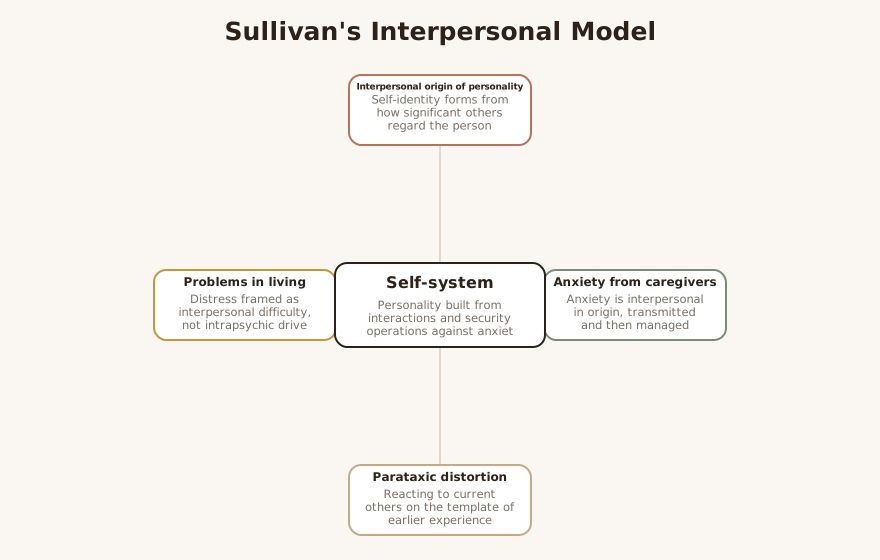
The organizing claim is that personality develops through “a series of interactions with other people,” with self-identity forming from a person’s perceptions of how significant others regard them 1. Sullivan introduced the term significant other into the psychological literature to name those figures whose appraisals are formative 6. From this follows the self-system: a personality configuration built up in childhood through positive affirmation and through “security operations” designed to avoid or minimize anxiety 6. Anxiety, in this model, is fundamentally interpersonal in origin — transmitted from caregiver to infant and thereafter managed by maneuvers that protect self-esteem and relational security LLM.
A second pillar is parataxic distortion: perceiving and reacting to current others on the template of earlier experience, a concept Sullivan treated as analogous to, though broader than, Freud’s transference 6. Sullivan also gave us the durable phrase “problems in living” for interpersonal and personal difficulties, and he characterized loneliness as “the most painful human experience” 6. The clinical upshot is that distress is not located inside the patient in isolation but in recurring, anxiety-driven patterns of relating that the therapy can observe and revise LLM. The WAWI tradition operationalized this by emphasizing “the exploration of unconscious aspects of relationships, including the present tense ‘here-and-now’ dimension of the patient-psychoanalyst relationship” 5.
Interventions & Techniques
Because the data of the work are interpersonal, the central instrument is the analyst’s own participation LLM. Sullivan’s framing rejected the model of the detached, mirror-like analyst; the WAWI tradition foregrounds “the human qualities of the psychoanalyst as a factor in therapeutic change” 4. The clinician functions as a participant observer — simultaneously engaged in the interaction and studying it — rather than a neutral screen LLM. Technique therefore privileges close, collaborative inquiry into what is actually happening between the two people in the room, and into the patient’s recurring patterns of relating outside it 5.
In practice this means tracking moments of anxiety and the security operations that follow them, naming parataxic distortions as they surface in the transference, and using “consensual validation” — checking the patient’s perceptions against shared reality — to loosen distorted appraisals LLM. The “detailed inquiry,” Sullivan’s method of patient, specific questioning about the texture of a patient’s interactions and developmental history, is a hallmark technique LLM.
LLM-generated illustrative example (not a guideline): A patient reports that her supervisor “obviously despises” her after a terse email. The interpersonally oriented clinician notes a flush of anxiety, asks in fine detail what was said and felt, and gently observes that the same conviction — “they secretly can’t stand me” — arose last month about the therapist after a missed appointment. Rather than interpreting a drive, the therapist treats the moment as a parataxic distortion enacted in the room, and they examine together how withdrawing (a security operation) tends to confirm the very rejection she fears LLM.
Evidence Base
Honesty about maturity matters here. Interpersonal psychoanalysis is established as an influential theoretical school — its concepts shaped a major lineage and its institutional base has trained clinicians for over eighty years — but “established as influential” is not the same as “validated as a discrete, manualized treatment in controlled trials” 45LLM. None of the foundational literature in this tradition rests on randomized outcome data; its standing derives from clinical, conceptual, and historical influence, not from efficacy trials LLM. Its mechanisms — attention to the here-and-now relationship, to recurring relational patterns, and to anxiety regulation — survive most visibly inside relational psychoanalysis and general psychodynamic psychotherapy, where the broader psychodynamic family has accumulated a more substantial empirical record 6LLM. Clinicians should present it to patients and reviewers in those terms: a well-grounded conceptual framework delivered within recognized psychodynamic practice, not a separately efficacy-tested protocol LLM.
A critical point of hygiene: interpersonal psychoanalysis (Sullivan) must not be conflated with interpersonal psychotherapy (IPT), the manualized, time-limited treatment for depression developed by Klerman and Weissman, which has its own robust trial base LLM. They share a word and a relational sensibility but are distinct traditions with different evidence (see Common Misconceptions) LLM.
Populations & Indications
Sullivan’s own clinical contributions were forged with the most disturbed patients, and the WAWI tradition explicitly rejected the orthodox belief that psychoanalysis was unsuitable for severe conditions such as schizophrenia and borderline disorders 15. In contemporary practice the lens is most often applied with adults in open-ended psychotherapy whose presenting difficulties are fundamentally relational LLM. It is particularly apt for people with personality disorders and people with anxiety disorders, given the framework’s native focus on character-level relational patterns and on anxiety as an interpersonal signal 6LLM. It is also frequently useful with trauma survivors, people with relational difficulties, and general psychotherapy clients whose symptoms — depression, low self-esteem, identity disturbance — are organized around how they imagine others see them 1LLM. The Institute’s history of low-cost clinics and service to underserved, often uninsured populations signals a tradition deliberately not restricted to a narrow demographic 4.
Problems-for-Work
- Anxiety. Treated as the central organizing affect: the work maps the situations that spike it and the security operations that manage it, aiming to expand tolerance rather than only suppress symptoms 6LLM.
- Maladaptive interpersonal patterns and relationship conflict. Recurring cycles (pursue–withdraw, idealize–devalue) are observed as they appear in the transference and in reported relationships, then made explicit 5LLM.
- Personality disorders and identity disturbance. The self-system framework offers a way to understand chronically unstable self-states as relationally constructed and relationally revisable 6LLM.
- Low self-esteem and depression. Addressed via the appraisals of significant others that the patient has internalized, and via consensual validation that tests those appraisals against present reality 6LLM.
- Dissociation and trauma sequelae. Understood as anxiety-driven exclusions from awareness; the here-and-now relationship becomes a place where warded-off experience can be re-approached safely 5LLM.
Contraindications, Cautions & Cultural Humility
There are no absolute contraindications to thinking interpersonally, but there are clear cautions about dose and pacing LLM. Open-ended, insight-oriented work that leans heavily on the transference can be destabilizing for patients in acute crisis, active psychosis, or severe dissociation without first establishing safety and stabilization; a relational-pattern focus does not substitute for risk management LLM. The emphasis on the therapist as participant observer also raises the standing risk of enactment: countertransference is data, but unexamined it can replicate the patient’s harmful relational patterns LLM.
Cultural humility is structurally important to this tradition, not an add-on. Sullivan’s system held that cultural forces “largely drive mental illness,” and WAWI was founded partly to integrate social and cultural perspectives that orthodox analysis neglected 64. The clinician must therefore avoid mistaking culturally normative interpersonal patterns for pathology, attend to how power, race, gender, and immigration shape what counts as a “security operation,” and recognize that the therapist’s own appraisals are themselves a cultural product LLM. “Consensual validation” loses meaning if the therapist’s consensus is treated as the only valid reality LLM.
Treatment-Plan Suggestions & SMART Objectives
| Goal | SMART objective (example) | Mechanism |
|---|---|---|
| Increase awareness of anxiety triggers | Patient will identify and log 3 interpersonal situations that spike anxiety each week for 6 weeks | Tracking anxiety and security operations 6LLM |
| Reduce reliance on avoidant security operations | Patient will, within 8 weeks, name one habitual avoidance move in session at least twice per month | Making security operations explicit 6LLM |
| Correct parataxic distortions | Patient will test one assumption about another person’s regard against observable evidence weekly for 4 weeks | Consensual validation 6LLM |
| Improve self-appraisal | Patient will articulate 2 internalized appraisals from significant others and one updated appraisal within 10 weeks | Revising self-system 6LLM |
| Interrupt a maladaptive relational cycle | Patient will describe one recurring conflict pattern and one alternative response by week 12 | Here-and-now pattern recognition 5LLM |
| Use the therapy relationship as a laboratory | Patient will, twice per month, reflect on a here-and-now reaction to the therapist | Participant-observation 4LLM |
| Reduce isolation | Patient will initiate one reciprocal social contact weekly for 8 weeks and review it in session | Countering loneliness as relational signal 6LLM |
Common Misconceptions
The most consequential error is conflating interpersonal psychoanalysis (Sullivan and the WAWI tradition) with interpersonal psychotherapy (IPT) — they are different traditions, and importing IPT’s depression trial evidence to justify Sullivanian analysis is a category mistake LLM. A second misconception is that “interpersonal” means the work ignores the inner world; in fact the tradition examines unconscious aspects of relationships, simply locating them in interaction rather than in isolated drives 56. A third is that Sullivan rejected transference: parataxic distortion is closely related to transference, broadened rather than discarded 6. Finally, the participant-observer stance is sometimes read as license for unbounded self-disclosure; it actually demands disciplined attention to the therapist’s contribution as data, not informal chattiness 4LLM.
Training & Certification
There is no brief certificate that makes one an “interpersonal analyst”; competence is acquired through formal psychoanalytic or psychodynamic training LLM. The William Alanson White Institute remains the field’s principal training home and was notable for pioneering full psychoanalytic training for psychologists alongside medical candidates, at a time when organized analysis largely restricted this to physicians 4. WAWI’s path was contested: after an independent New York charter in 1946, the American Psychoanalytic Association rejected its 1948 membership application over training-standard and theoretical concerns, and the Institute developed independently for decades before finally gaining APsaA approval in 2009 5. For most practicing therapists, the realistic route is to absorb interpersonal concepts within psychodynamic supervision and continuing education rather than to pursue full analytic candidacy, reserving formal training for those seeking the analyst credential LLM.
Key Terms
- Self-system: the personality configuration built in childhood to secure approval and minimize anxiety, including the security operations that protect it 6.
- Security operations: maneuvers that reduce or avoid anxiety and protect self-esteem in relationships 6.
- Anxiety: an interpersonally transmitted affect, central to symptom formation in this model 6LLM.
- Parataxic distortion: perceiving present others through templates of past relationships; akin to transference 6.
- Significant other: a formative figure whose appraisals shape the self; a term Sullivan introduced 6.
- Participant observation: the therapist’s stance of being engaged in, and simultaneously studying, the interaction 4LLM.
- Consensual validation: checking private perceptions against shared reality to correct distortions LLM.
- Problems in living: Sullivan’s phrase for interpersonal and personal difficulties 6.
Resources & Further Reading
▶ Watch — a video introduction to this concept:
- Harry Stack Sullivan | Biography, Contributions, & Facts — Encyclopaedia Britannica
- The Interpersonal Theory of Psychiatry — Encyclopaedia Britannica (work entry)
- Harry Stack Sullivan: Interpersonal Theory and Psychotherapy — American Journal of Psychiatry
- Our History — William Alanson White Institute
- A Selective History of the William Alanson White Institute — Journal of the APsaA
- Harry Stack Sullivan — Wikipedia
Reflective / Supervision Questions
- When my patient describes a relationship conflict, do I reflexively look inward for a drive or symptom, or do I track the interpersonal pattern and the anxiety driving it? LLM
- What security operations does this patient rely on, and how do they show up in our here-and-now relationship? LLM
- Where am I a participant rather than a neutral observer — and what enactments might my own anxieties be contributing to? LLM
- Am I distinguishing genuinely maladaptive patterns from culturally normative ways of relating that differ from my own? LLM
- If I name a parataxic distortion in the transference, is the therapeutic alliance strong enough to bear it, or do we need more stabilization first? LLM
- How am I documenting this work as recognized psychodynamic psychotherapy while staying honest about its evidence status? LLM