
Type & Discipline
Prediction error is a construct from the neuroscience of learning, not a therapy 4. It names the brain’s response to a violated expectation: when what is predicted by prior learning differs from what is actually encountered, the resulting mismatch signal flags that an internal model is out of date and may need revising 7. In the memory-reconsolidation literature this same signal carries a specific clinical job — it is the trigger that, paired with memory reactivation, destabilizes an existing emotional learning and opens it to change 4.
For clinicians the construct matters because it specifies the active ingredient of transformational work LLM. Reactivating a painful learning is not enough; proponents argue that without a salient expectancy violation the memory simply re-stabilizes unchanged 4. Prediction error is therefore best understood as the hinge between two neuroscience families — predictive processing, where mismatch drives perception and model-updating, and memory reconsolidation, where mismatch unlocks the lability window 7. Bruce Ecker’s clinical term for engineering this mismatch in session is the juxtaposition experience 4.
Creators & Lineage
The basic-science notion of prediction error runs through reinforcement learning and predictive coding, where mismatch between expected and actual input is the currency of learning and of perceptual updating 7. Electrophysiology gives it a measurable signature: the mismatch negativity, including its visual analogue (visual mismatch negativity, vMMN), is described as a “prediction error signal” generated when a stimulus violates a regularity the brain had come to expect 7. This grounds the abstract idea in observable neural response rather than metaphor 7.
The clinical lineage is associated most prominently with Bruce Ecker and colleagues (Robin Ticic and Laurel Hulley), whose work translated reconsolidation neuroscience into a replicable therapeutic methodology 5. Ecker drew on animal and human reconsolidation findings — that a reactivated memory becomes labile only when retrieval is accompanied by a mismatch — and named the in-session version the juxtaposition experience 4. Unlocking the Emotional Brain is the central practitioner text articulating this sequence 5. The construct sits at the intersection of memory reconsolidation, Coherence Therapy (Ecker’s own modality), predictive processing, and the experiential, emotion-focused tradition that supplies the techniques for activating emotion 2.
Core Principles
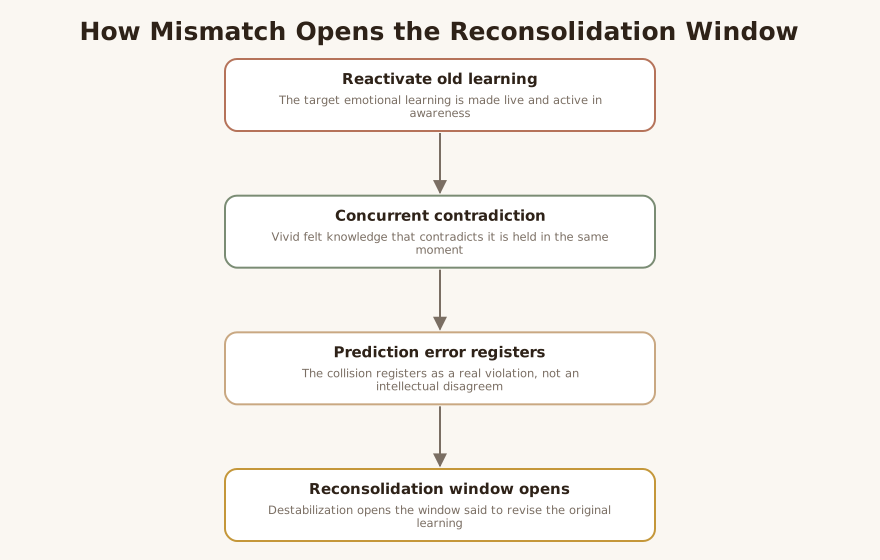
The foundational principle is that retrieval alone does not change a memory; mismatch does. The reconsolidation literature is explicit that prediction error is the necessary condition for destabilization — reactivating an emotional learning without violating its expectation leaves the learning intact 4. Ecker frames the clinical corollary as a precise requirement: the client must concurrently experience the old learning and vivid, felt knowledge that contradicts it, so that the contradiction registers as a real violation rather than an intellectual disagreement 4.
A second principle is salience and concurrency LLM. The mismatch must be experienced, not merely understood, and the disconfirming knowledge must be live in awareness at the same moment the target learning is active 5. A neutral fact filed away for later does not generate the error signal; the two predictions have to collide in the same emotional moment 5. This is why proponents distinguish reconsolidation-based change, which is said to revise the original learning, from counteractive change, which builds a competing learning that can relapse 6.
A third principle is the direction of the error. The expectancy that must be violated is the one encoded by the symptom-generating emotional learning itself — for example a prediction that “needing closeness leads to abandonment” — so the disconfirming experience has to target precisely that prediction 4. Vague positivity or reassurance does not qualify; the mismatch has to land on the specific expectation the old learning holds 4. The synthesis for practice: locate the prediction, reactivate it, and deliver a felt experience that contradicts that prediction while it is active LLM.
Interventions & Techniques
Because prediction error is a mechanism, “interventions” means the procedures used to manufacture mismatch LLM. Ecker’s juxtaposition sequence is the canonical clinical procedure: (1) bring the target emotional learning into vivid, present-moment awareness so its prediction is emotionally live; (2) identify a contradictory knowledge the client already holds or can be helped to access; and (3) hold both simultaneously in repeated juxtaposition experiences, so the old prediction is violated in real time 4. The mismatch generated in step three is what is thought to open the reconsolidation window 4.
A practical discipline within this is retrieval of the disconfirmation from the client’s own experience rather than from the therapist’s persuasion 5. The disconfirming material is most potent when it is the client’s lived counter-evidence, because that is what makes the contradiction feel true rather than argued 5. Across modalities, the same mismatch logic can be read into emotion-focused and experiential work, into the corrective emotional experience, and into exposure when the feared prediction is explicitly violated rather than merely habituated 2.
LLM-generated illustrative example (not a guideline): A clinician helps a client re-enter the conviction “if I set a limit, people leave,” then guides the client to a recent, embodied memory of setting a limit with a friend who stayed warm and present — holding the felt expectation of abandonment alongside the felt reality of connection, so the old prediction is contradicted while it is active LLM.
Verification is itself a technique LLM. Ecker describes checking for markers of successful change — the old learning no longer producing its emotional response when probed — to confirm that a genuine mismatch occurred rather than a temporary mood shift 6.
Evidence Base
Honesty about maturity requires splitting the question LLM. As a basic mechanism, prediction error is well established: mismatch signals are measurable at the neural level (e.g., visual mismatch negativity as a prediction-error response), and the requirement of prediction error for reconsolidation-based updating is supported in animal and human studies 7. That mismatch drives learning is not seriously in doubt at the bench 7.
The picture is more cautious in two respects. First, the human behavioral reconsolidation literature has notable replication failures, and a unifying analysis attributes many of them precisely to inadequate or mistimed prediction error — too little mismatch, or mismatch outside the destabilization window — rather than to absence of the effect 3. The boundary conditions are real and the procedure is finicky 3. Second, the clinical claim that engineering mismatch is the common mechanism of transformational change across therapies remains a hypothesis advanced within an explicit “crisis of mechanism” in psychotherapy, where mechanisms are debated rather than settled 2.
So the responsible summary is: prediction error as a learning signal is established; its necessity for reconsolidation is well supported but condition-dependent; and its status as the lever of therapeutic transformation is plausible, increasingly used, and still contested 2. The replication difficulties are a feature to respect, not a footnote — they suggest the mismatch must be done well to do anything at all 3.
Populations & Indications
The construct is most discussed for presentations driven by a discrete, reactivatable emotional learning whose prediction can be specified and violated LLM. This includes adults and trauma survivors, where an implicit threat prediction (“the danger is still here”) is the explicit target of destabilization-and-update work 4. Anxiety disorders and phobias are natural candidates because the feared prediction is well defined and a disconfirming experience can be aimed directly at it 4.
Beyond fear, the framework is applied across clients in psychotherapy broadly — those with longstanding emotional schemas, attachment-related distress, and depression — wherever a symptom can be traced to an emotional learning carrying a predictable expectation 4. Ecker positions this as a trans-theoretical leverage point: the same mismatch requirement is claimed to underlie change regardless of the surface modality, which is why the construct is offered as a route to unifying the effectiveness of psychotherapy 4. The common thread is that the prediction must be retrievable into present awareness and must admit a genuine contradiction 5.
Problems-for-Work
The construct is most useful when a problem-for-work can be restated as a retrievable prediction that can be violated LLM. Below are brief applications.
- Phobias / anxiety disorders: the feared prediction (“this situation will harm me”) is reactivated and then met with a disconfirming experience aimed at that exact expectation, generating the error signal 4.
- PTSD / persistent emotional learnings: the trauma-encoded prediction (“the threat is present now”) is briefly reactivated and contradicted by present, felt safety so the prediction is updated rather than re-rehearsed 4.
- Maladaptive emotional schemas / depression: the schema’s prediction (“I am unlovable / nothing will change”) is brought into vivid awareness and juxtaposed with the client’s own contradictory lived evidence 5.
- Attachment-related distress / avoidance: the relational prediction (“closeness ends in abandonment”) is activated and violated by an experienced moment of need being met, which also reduces the avoidance the prediction sustains 4.
LLM-generated illustrative example (not a guideline): For social anxiety, a clinician might help a client reactivate the prediction “if I speak up, I’ll be humiliated,” then guide a vivid recall of a recent meeting where they spoke and were met with interest — aiming for a felt collision between the catastrophic expectation and the remembered reality, not reassurance LLM.
Contraindications, Cautions & Cultural Humility
The most important caution is conceptual restraint about “erasure” LLM. Because successful destabilization depends on a well-timed, well-aimed prediction error and has documented failure conditions, clinicians should not promise that a learning has been permanently deleted 3. The high rate of replication difficulty in the human literature is a direct reminder that the mismatch may not “take,” and outcomes should be checked rather than assumed 3.
Procedurally, this work deliberately activates distressing predictions, so the same precautions that govern any emotional reactivation apply: adequate stabilization, affect-regulation capacity, and a window-of-tolerance lens are prerequisites, and reactivation without a genuine felt contradiction risks re-rehearsing distress rather than updating it LLM. Mismatch that is merely cognitive — the client “knows” the belief is false but does not feel it violated — is a common way the procedure fails silently 5.
Culturally, the prediction being targeted is shaped by context — family, community, faith, migration, and structural experience — and what looks like a “maladaptive” expectation to a clinician may be an accurate forecast of a real environment LLM. Cultural humility means collaboratively deciding which predictions the client wants to revise, and sourcing the disconfirming evidence from the client’s own life rather than imposing the therapist’s values as the “correct” expectation 5.
Treatment-Plan Suggestions & SMART Objectives
| Goal | SMART objective (example) | Mechanism |
|---|---|---|
| Name the target prediction | Within 3 sessions, client can state the implicit expectation driving the symptom in their own words | Brings the emotional learning’s prediction into vivid present awareness so it can be violated 4 |
| Identify disconfirming evidence | By session 4, client identifies at least one lived experience that contradicts the target prediction | Locates client-sourced counter-knowledge for the mismatch 5 |
| Create a juxtaposition experience | By session 6, client completes 2 in-session juxtapositions where the old prediction and contradictory knowledge are felt at once | Concurrent mismatch / prediction error opening the reconsolidation window 4 |
| Reduce phobic avoidance | Within 6 weeks, client approaches the feared cue on 3 graded occasions with the feared prediction explicitly disconfirmed | Update of the feared prediction via reactivation plus targeted violation 4 |
| Stabilize affect first | Within 2 sessions, client demonstrates one grounding skill rated effective during reactivation | Keeps reactivation in tolerance so mismatch updates rather than re-traumatizes LLM |
| Test that mismatch “took” | At session 8, the target prediction, when probed, no longer evokes its prior emotional charge on a 0–10 scale | Verification that a genuine prediction error, not mood shift, occurred 6 |
| Confirm durability | At 4- and 8-week follow-up, gains persist without symptom return on a standardized measure | Distinguishes reconsolidation-based updating from temporary suppression 3 |
Common Misconceptions
A frequent misconception is that prediction error is just “cognitive disputation” — telling the client the belief is irrational LLM. In the reconsolidation framework the violation must be experienced and concurrent with the activated learning; an intellectually accepted contradiction that is not felt does not generate the destabilizing signal 5.
A second misconception is that any novelty or surprise counts LLM. The error must land on the specific prediction encoded by the symptom-producing learning; generic positivity, distraction, or reassurance does not target that prediction and so does not update it 4. Aiming the mismatch is as important as producing one 4.
A third is treating the clinical mechanism claim as settled LLM. That prediction error is the common lever of transformational change across therapies is offered within an open debate about mechanism, and the human reconsolidation literature’s replication failures show how condition-dependent the effect is 2. The honest stance is confidence in the signal and humility about reliably engineering it 3.
Training & Certification
There is no standalone credential in “prediction-error therapy,” because it is a mechanism rather than a licensed modality LLM. Clinicians most often acquire structured training through Coherence Therapy and the associated reconsolidation methodology, whose materials are built explicitly around generating the juxtaposition experience 6. Unlocking the Emotional Brain serves as the foundational practitioner text for the sequence 5.
Because the construct is trans-theoretical, clinicians also engage it through the modalities it is used to explain — emotion-focused, experiential, exposure-based, and trauma-focused work — and then apply the prediction-error lens to sharpen the mismatch step they may already be performing implicitly 2. Reading Ecker’s methodology papers directly is a concise on-ramp for practitioners who want the procedure stated explicitly 4.
Key Terms
- Prediction error: the signal generated when an actual experience violates what prior learning predicted; the necessary trigger for reconsolidation-based updating 4.
- Mismatch negativity / vMMN: an electrophysiological prediction-error response elicited when a stimulus breaks an expected regularity, evidence that mismatch is a real neural signal 7.
- Juxtaposition experience: Ecker’s term for holding the activated emotional learning alongside contradictory felt knowledge to produce the mismatch in session 4.
- Reconsolidation window: the transient post-reactivation period of lability that prediction error opens, during which the learning can be revised 4.
- Counteractive vs transformational change: building a competing learning that can relapse, versus revising the original learning via mismatch 6.
- Replication failures (boundary conditions): the conditions — including insufficient or mistimed prediction error — under which behavioral reconsolidation updating does not occur 3.
- Disconfirming knowledge: the client’s own lived counter-evidence that supplies the contradicting prediction in juxtaposition 5.
Resources & Further Reading
▶ Watch — a video introduction to this concept:
- Clinical translation of memory reconsolidation research: Therapeutic methodology for transformational change (Ecker)
- Memory reconsolidation and the crisis of mechanism in psychotherapy (Lane, Ecker et al., 2022)
- Reconsolidation Behavioral Updating of Human Emotional Memory: review of prediction error and replication failures
- How the Science of Memory Reconsolidation Advances the Effectiveness and Unification of Psychotherapy (Ecker)
- Unlocking the Emotional Brain — Ecker, Ticic & Hulley (Routledge)
- Bruce Ecker: Coherence Therapy & memory reconsolidation (Coherence Psychology Institute)
- Visual mismatch negativity (vMMN): a prediction error signal in the visual modality
Reflective / Supervision Questions
- For this case, can I state the specific prediction encoded by the emotional learning, or am I working at the level of symptom or general belief? 4
- Is the disconfirming knowledge I am using felt and concurrent with the activated learning, or only intellectually agreed to? 5
- Am I aiming the mismatch at the exact expectation the old learning holds, rather than offering generic reassurance or positivity? 4
- Given the known replication difficulties, how will I check that a genuine prediction error occurred rather than a passing mood shift? 3
- Is the contradicting evidence sourced from the client’s own lived experience, or am I supplying my own values about which prediction is “correct”? 5
- Have I established enough affect-regulation capacity that reactivation will update the prediction rather than re-rehearse the distress? LLM
- When I describe change to clients, am I honest about boundary conditions, or implicitly promising permanent erasure? 3