
Type & Discipline
Polyvagal-informed therapy is a conceptual framework rather than a standalone, manualized treatment modality LLM. It sits within trauma-focused and body-oriented practice and belongs to the autonomic, or polyvagal, family of approaches LLM. The framework borrows the physiological language of polyvagal theory and applies it to the consulting room, using a map of autonomic states to orient assessment, pacing, and intervention 4. Because it is informational rather than prescriptive, clinicians most often layer polyvagal concepts onto an existing modality — somatic experiencing, sensorimotor psychotherapy, or broader trauma-focused work — rather than practicing “polyvagal therapy” as a discrete protocol LLM.
The framework’s defining move is to treat autonomic state as a clinical variable in its own right, prioritizing physiological regulation before cognitive processing 1. This bottom-up emphasis distinguishes it from primarily top-down, cognitively oriented therapies and aligns it with somatic and attachment-informed traditions LLM.
Creators & Lineage
Polyvagal theory was introduced by Stephen Porges in 1994 while he directed the Brain-Body Center at the University of Illinois at Chicago 7. The theory grew from his earlier observation that heart rate variability declined during attention tasks and recovered rhythmically afterward, which led him to investigate the neurophysiological links between autonomic state, behavior, and cognition 2. Porges developed the foundational science, including the constructs of neuroception and the social engagement system 1.
The translation of this science into accessible clinical tools is associated with Deb Dana, a contemporary clinician credited with advancing therapeutic applications of polyvagal principles 4. Popularizations such as the “polyvagal ladder” metaphor for moving between autonomic states are part of this clinical lineage, though detailed protocol descriptions remain sparse in the primary literature 7. Trauma clinicians including Bessel van der Kolk have also applied polyvagal concepts within trauma treatment 7. The framework’s nearer relatives are somatic experiencing and sensorimotor psychotherapy, which share its bottom-up, body-first orientation to trauma LLM.
Core Principles
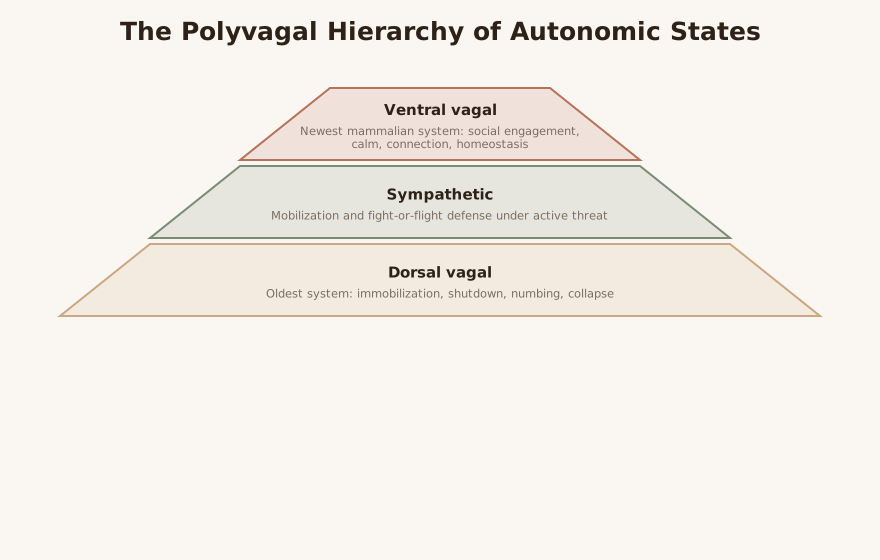
The framework rests on a hierarchical model of three autonomic states arranged by evolutionary age 1. The ventral vagal state — the newest, mammalian system — supports social engagement, calm, connection, and homeostasis through myelinated vagal fibers originating in the nucleus ambiguus 2. The sympathetic state supports mobilization and fight-or-flight defense under active threat 1. The dorsal vagal state — the oldest system, arising from unmyelinated fibers of the dorsal motor nucleus — governs immobilization, shutdown, numbing, and collapse during overwhelming threat 4.
Under threat, the theory proposes a hierarchical recruitment: the nervous system disengages the ventral vagal complex first, then mobilizes sympathetically, and finally drops into dorsal vagal shutdown if escape fails 1. A second pillar is neuroception, defined as the nervous system’s implicit, subconscious detection of safety or danger that determines which state becomes accessible before conscious awareness 1. A third is the social engagement system, an integrated circuit linking cranial nerves that coordinate facial expression, vocal prosody, and orienting behavior to support connection and co-regulation 1. Clinically, the central reframe is that freeze and shutdown are biological survival adaptations, not psychological resistance or willful non-compliance 4.
Interventions & Techniques
Polyvagal-informed work favors bottom-up interventions that aim to restore access to the ventral vagal state and rebuild autonomic flexibility 4. Commonly described practices include paced breathing, safe touch, rhythmic movement, vocalization, and co-regulation with an attuned therapist 4. These are intended to improve parasympathetic flexibility, indexed in research by heart rate variability and respiratory sinus arrhythmia 4. A guiding clinical heuristic is to sequence state shifts before cognitive processing, on the premise that a dysregulated nervous system cannot productively engage in reflection or meaning-making 1.
Acoustic and auditory interventions are a distinctive branch of the applied work. The Safe and Sound Protocol, developed by Porges, is described as an evidence-based auditory intervention now administered through Unyte Integrated Listening; the Rest & Restore Protocol is a related auditory intervention 3. State mapping — helping clients identify and name their current autonomic state and its triggers — is a core psychoeducational technique drawn from the clinical lineage 7.
LLM-generated illustrative example (not a guideline): A clinician notices a client’s voice flattening and gaze dropping mid-session, neurocepts a slide toward dorsal vagal shutdown, and pauses content to offer an orienting cue — inviting the client to look around the room and feel their feet on the floor — before resuming LLM.
Evidence Base
The maturity of this framework is best described as emerging, and clinicians should hold a clear distinction between the theory’s mechanism and the clinical practices derived from it LLM. The underlying physiology is actively contested. A 2023 literature review by Paul Grossman concluded that there is broad expert consensus that polyvagal theory’s basic physiological assumptions are untenable and that its core hypotheses have been falsified 7. Critics including Neuhuber and Berthoud (2022) and Taylor and colleagues (2022) reject central anatomical claims, arguing against the notion of a unified “smart vagus” and disputing how the theory characterizes the freeze response 7.
Evolutionary claims have drawn particular fire. The discovery of myelinated vagal fibers running from the nucleus ambiguus to the heart in lungfish contradicts the assertion that such pathways are uniquely mammalian 7. Critics also argue that respiratory sinus arrhythmia is confounded by respiratory and sympathetic influences and is therefore an unreliable index of vagal tone, with meta-analytic evidence linking it to psychopathology described as inconclusive 7. Porges and allied authors have responded that homologous structures need not imply functional equivalence, that respiratory sinus arrhythmia reflects coordinated brainstem output rather than mere mechanical artifact, and that the theory generates specific, testable predictions 12.
Here the honest clinical point: a 2026 commentary concedes that the evolutionary claims, the cleanliness of the ventral/dorsal anatomical distinction, and the reliability of respiratory sinus arrhythmia are all legitimately disputed, yet argues that the derived practices can work independently of mechanistic accuracy 5. It invokes the analogy of aspirin, which physicians prescribed effectively for decades before its mechanism was identified 5. For the practitioner, this means polyvagal-informed techniques rest on a contested theoretical scaffold, while the practices themselves — extended exhalation, social connection, rhythmic movement — have plausible independent rationale 5. Direct outcome trials of “polyvagal-informed therapy” as a packaged intervention remain limited, which is the core reason for the emerging label LLM.
Populations & Indications
The framework was developed primarily for trauma and is most often applied with survivors of trauma, people with PTSD, and those with complex trauma 4. It is also commonly extended to people with anxiety disorders, panic disorder, and dissociative disorders, where the autonomic state map offers an intuitive language for hyper- and hypoarousal LLM. Porges and colleagues report that the framework has been used to interpret outcomes across trauma, autism, functional gastrointestinal disorders, and developmental conditions 1.
With children, polyvagal concepts inform attention to co-regulation, caregiver attunement, and rhythmic, predictable environments that build vagal flexibility across development 1. Early physiological markers such as respiratory sinus arrhythmia have been proposed as tools for identifying at-risk infants and monitoring autonomic flexibility across the lifespan 2. The framework is best suited to clients whose presenting difficulties center on dysregulated arousal and a felt absence of safety, rather than those whose primary concerns are purely cognitive or skills-based LLM.
Problems-for-Work
The framework lends itself to problems organized around autonomic dysregulation LLM. For hyperarousal and hypervigilance, the work targets a client’s chronic sympathetic mobilization, using orienting and paced breathing to widen the window in which they can stay present without escalating LLM. For hypoarousal, dissociation, and emotional numbing, the framework reframes dorsal vagal shutdown as a survival adaptation and uses gentle movement, vocalization, and co-regulation to support re-engagement 4.
LLM-generated illustrative example (not a guideline): A client with complex trauma reports going “blank and far away” during conflict; the clinician maps this as a dorsal vagal protective state, normalizes it as adaptive, and pairs grounding cues with brief, titrated returns to the difficult material LLM.
For panic and anxiety, the autonomic map helps clients distinguish a neuroception of danger from objective threat, reducing the secondary fear of their own bodily sensations LLM. For emotional dysregulation and chronic stress, the work centers on rebuilding access to the ventral vagal state and strengthening co-regulation within the therapeutic relationship 4. For autonomic dysregulation broadly, the framework offers a shared vocabulary that supports state tracking between sessions LLM.
Contraindications, Cautions & Cultural Humility
The first caution is intellectual honesty: clinicians should not present polyvagal theory to clients as settled neuroscience, given the active falsification debate in the literature 7. Overstating the mechanism risks misinforming clients and overpromising LLM. The framework’s language can be reified — clients and clinicians may start treating “ventral,” “sympathetic,” and “dorsal” as fixed identities rather than provisional, descriptive states, which can foreclose nuance LLM.
Bottom-up techniques involving breath, touch, and interoception are not universally safe. Paced breathing and interoceptive focus can paradoxically increase distress in some clients, and any use of touch requires explicit consent, cultural sensitivity, and attention to trauma history LLM. The construct of “safety” is culturally and contextually shaped; what one client’s nervous system neurocepts as safe — eye contact, proximity, vocal tone — may differ markedly across cultural backgrounds, and clinicians should not assume their own baseline LLM. Porges and colleagues themselves frame future applications as requiring integration of ancestral and cultural practices with neuroscience rather than displacing them 1. Polyvagal-informed work should supplement, not replace, evidence-based trauma treatments where those are indicated LLM.
Treatment-Plan Suggestions & SMART Objectives
| Goal | SMART objective (example) | Mechanism |
|---|---|---|
| Build state awareness | Client will name their current autonomic state and one trigger in 4 of 5 sessions over 6 weeks LLM | Neuroception made explicit through psychoeducation and state mapping 1 |
| Reduce hyperarousal | Client will use a paced-exhale practice during 3 distress episodes per week, logging arousal before and after, for 8 weeks LLM | Extended exhalation supports parasympathetic shift and reduces sympathetic mobilization 5 |
| Counter dissociative shutdown | Client will apply one orienting cue at early signs of numbing in 3 situations weekly for 6 weeks LLM | Sensory orienting interrupts dorsal vagal collapse and supports re-engagement 4 |
| Strengthen co-regulation | Client will engage in one structured co-regulation exercise with the clinician each session for 8 weeks LLM | Attuned relational contact recruits the social engagement system 1 |
| Reframe freeze responses | Client will reframe one freeze or collapse episode as adaptive rather than failure each week for 6 weeks LLM | Cognitive reappraisal of shutdown as biological survival adaptation 4 |
| Widen window of tolerance | Client will tolerate 5 additional minutes of a difficult topic without state collapse by week 10 LLM | Titrated exposure paired with regulation builds autonomic flexibility 4 |
| Increase ventral access | Client will identify and engage two reliable cues of felt safety daily for 8 weeks LLM | Repeated access cues strengthen pathways to the ventral vagal state 4 |
Common Misconceptions
A frequent misconception is that polyvagal theory is settled, consensus neuroscience; in fact its foundational physiological assumptions are disputed by multiple expert reviews 7. A second is that the clinical tools must be discarded if the theory is contested — but mechanism falsification and clinical inefficacy are distinct questions, and several derived practices have independent rationale 5. A third is that freeze or shutdown reflects client resistance or low motivation, when the framework explicitly recasts these as automatic survival adaptations 4.
Clinicians sometimes assume polyvagal-informed therapy is a discrete, manualized modality; it is more accurately a conceptual lens applied within established modalities LLM. Another error is treating the three states as rigid categories rather than a descriptive heuristic for fluid, blended autonomic conditions LLM. Finally, the claim that the ventral vagal pathway is unique to mammals is specifically contradicted by evidence such as myelinated vagal fibers in lungfish 7.
Training & Certification
There is no single licensing body for “polyvagal-informed therapy,” and competence is generally built within a clinician’s broader trauma and somatic training LLM. The Polyvagal Institute, a non-profit referenced on Porges’s official site, provides training and information on applying polyvagal theory across disciplines including psychotherapy, education, healthcare, and wellness 3. Specific auditory interventions carry their own training pathways: the Safe and Sound Protocol is administered through Unyte Integrated Listening, and the Rest & Restore Protocol is a related branded intervention 3.
Clinicians seeking deeper background may also draw on Porges’s explanatory presentations of the theory and the work of contemporary clinical translators such as Deb Dana 64. Given the contested evidence base, practitioners should pursue this training as an adjunct to grounding in established trauma modalities rather than as a substitute LLM.
Key Terms
Neuroception — the nervous system’s implicit, subconscious detection of safety or danger that shapes physiological state before conscious awareness 1. Ventral vagal state — the social engagement and calm state mediated by myelinated vagal fibers from the nucleus ambiguus 2. Sympathetic state — the mobilization or fight-or-flight state 1. Dorsal vagal state — the immobilization, shutdown, or freeze state mediated by unmyelinated vagal fibers 4.
Social engagement system — the integrated cranial-nerve circuit coordinating facial expression, vocal prosody, and orienting to support connection 1. Co-regulation — the use of an attuned relationship to help shift autonomic state 4. Respiratory sinus arrhythmia — a non-invasive index of cardiac vagal tone, the reliability of which is scientifically disputed 27. Polyvagal ladder — a clinical metaphor for movement between autonomic states 7.
Resources & Further Reading
▶ Watch — a video introduction to this concept:
- Polyvagal Theory: Current Status, Clinical Applications, and Future Directions (PMC)
- Polyvagal theory: a journey from physiological observation to neural innervation and clinical insight (Frontiers)
- Stephen W. Porges, PhD — Polyvagal Theory (official site)
- Autonomic Nervous System and Polyvagal Theory (Institute for Psychotraumatology)
- Polyvagal Theory Has Not Been ‘Debunked’ (Psychology Today)
- Dr. Stephen Porges: What is the Polyvagal Theory (YouTube)
- Polyvagal theory (Wikipedia)
Reflective / Supervision Questions
- How do I describe polyvagal concepts to clients in a way that is clinically useful without overstating contested science LLM?
- When a client shuts down in session, can I reliably distinguish a dorsal vagal protective state from disengagement that calls for a different response LLM?
- Whose definition of “safety” am I working from, and how might my client’s cultural and relational history shape what their nervous system neurocepts as safe LLM?
Am I using the autonomic map as a flexible heuristic, or have I started treating the three states as fixed identities for this client LLM? If the underlying theory were fully set aside tomorrow, which of the practices I use would I still defend on independent grounds, and why LLM? Where does polyvagal-informed work fit alongside the established trauma treatments this client may also need LLM?