
Type & Discipline
Attachment-Based Family Therapy (ABFT) is a manualized, structured family therapy model developed specifically to treat adolescent depression and suicidality 3. It sits within the discipline of family therapy and is delivered as a brief, time-limited intervention—typically organized around 12 to 16 weekly sessions, though the duration is adapted to clinical need 5. Unlike generic supportive family work, ABFT is “process-oriented” and trauma-informed: the therapist actively shapes in-session emotional conversations rather than simply teaching skills or dispensing advice 3. LLM
The model is distinctive in family therapy for being explicitly theory-driven and emotion-focused while remaining tightly manualized through a sequence of five treatment tasks 3. It treats the parent-child relationship itself as the central change mechanism, positioning the family—rather than the individual adolescent—as the primary vehicle for recovery 5. LLM
Creators & Lineage
ABFT was developed by Guy S. Diamond and colleagues, who built the model and authored its foundational theory, clinical manual, and the early efficacy trials 3. Diamond and his collaborators (including Gary M. Diamond and Suzanne Levy) consolidated the approach in the American Psychological Association treatment manual Attachment-Based Family Therapy for Depressed Adolescents 5. The model is now disseminated and certified through the ABFT International Training Institute 4.
The intellectual lineage is integrative. ABFT draws directly on attachment theory—the idea that adolescents are biologically primed to seek their caregivers as a secure base, and that ruptures in this bond contribute to depression and despair 3. It also incorporates emotion-focused and experiential techniques aimed at transforming “in-session” affect, an emphasis it shares with Emotionally Focused Therapy 3. From structural and systemic family traditions, ABFT borrows the use of enactments and the deliberate restructuring of family interaction patterns within the session itself 3. LLM
Core Principles
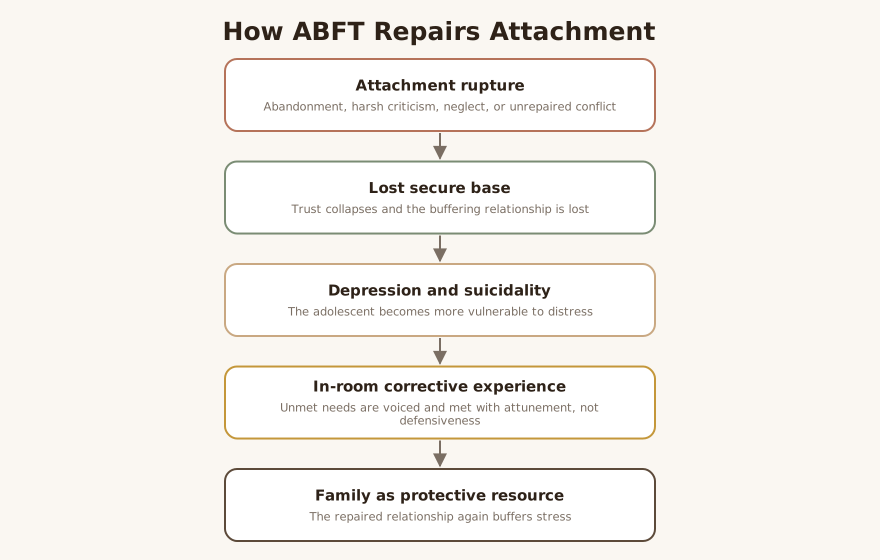
The organizing premise of ABFT is that attachment ruptures—experiences of abandonment, harsh criticism, neglect, abuse, or unrepaired conflict—erode the adolescent’s trust that parents can serve as a reliable source of comfort and protection 3. When that trust collapses, adolescents lose access to the interpersonal “secure base” that buffers stress, and they become more vulnerable to depression and suicidal thinking 3. ABFT therefore reframes the clinical goal: rather than treating the depression in isolation, the therapist works to repair the relationship so the family can again function as a protective resource 5. LLM
A second principle is that the corrective experience must happen between the adolescent and the parent, in the room, rather than being narrated to the therapist 3. The therapist’s role is to create enough safety and emotional intensity that a previously avoided conversation can finally occur—one in which the adolescent voices unmet needs and grievances and the parent responds with attunement rather than defensiveness 3. LLM
A third principle concerns parental capacity. ABFT assumes that most parents want to help but are blocked by their own stress, attachment histories, or emotional dysregulation, so part of the work is building parental empathy and emotion-coaching ability before the repair conversation is attempted 3. LLM
Interventions & Techniques
ABFT is operationalized through five sequential treatment tasks that give the model its structure 3.
Task 1 — Relational Reframe. In the opening session, the therapist shifts the family’s understanding of the problem away from “fixing the depressed adolescent” toward repairing the broken relationship, and secures everyone’s agreement to work on trust and connection 3. LLM
Task 2 — Adolescent Alliance. The therapist meets with the adolescent alone to build a working alliance, identify the attachment ruptures behind the symptoms, and prepare the teen to eventually voice these grievances directly to the parent 3. LLM
Task 3 — Parent Alliance. In a separate session, the therapist allies with the parents, explores their own attachment and stress histories, and coaches emotion-regulation and validation skills so they can later listen non-defensively 3. LLM
Task 4 — Attachment Task (Repair). This is the pivotal corrective conversation: with the therapist’s support, the adolescent directly expresses previously avoided feelings and unmet needs, and the parent responds with empathy, building a new, more secure emotional transaction 3. LLM
Task 5 — Promoting Autonomy / Competency. Once trust is partially restored, treatment shifts toward consolidating the parent as a secure base from which the adolescent can pursue age-appropriate autonomy, competence, and relationships outside the family 3. LLM
LLM-generated illustrative example (not a guideline): A 15-year-old reports passive suicidal ideation and has stopped speaking to her father since a blow-up about her grades. In Task 2 the therapist helps her name the underlying hurt (“when you yelled, I felt like nothing I do matters to you”). In Task 3 the father, who grew up with a critical parent himself, practices listening without rushing to defend. In Task 4 the daughter voices the hurt directly and the father, instead of arguing, says he had no idea she felt unseen. The shared emotional moment becomes the foundation for renewed trust. LLM
Across these tasks the therapist uses enactments (directing family members to speak to each other rather than to the clinician), affect-deepening, and reframing to keep the work relational and emotionally alive 3. LLM
Evidence Base
ABFT’s evidence base is best described as established but still maturing, with stronger support for adolescent depression and suicidal ideation than for other presentations 3. LLM
The landmark study is a randomized controlled trial by Diamond and colleagues comparing ABFT to enhanced usual care for adolescents with clinically elevated suicidal ideation; ABFT produced significantly greater reductions in suicidal ideation and depressive symptoms, with gains maintained at follow-up 1. A broader review of the empirical support summarizes multiple trials and open studies indicating that ABFT reduces depression, suicidal ideation, and attachment-related distress, and identifies attachment processes as a plausible mechanism of change 6. The theory-and-evidence synthesis by Diamond and colleagues likewise concludes that ABFT has demonstrated efficacy for depressed and suicidal adolescents while calling for larger and more diverse replications 3.
A more recent systematic review and meta-analysis examined ABFT specifically for suicidal adolescents and young adults; it pooled the available controlled and uncontrolled evidence and supported ABFT’s effect on suicidality outcomes, while noting heterogeneity and methodological limitations across the included studies 2. Honest appraisal: the literature is still dominated by trials from the developers’ own group, sample sizes are modest, and independent replications and head-to-head comparisons remain limited 2. Clinicians should regard ABFT as a well-specified, promising, and reasonably supported approach for its core indication rather than a fully settled, broadly replicated standard 2. LLM
Populations & Indications
ABFT was designed for and is best validated with adolescents presenting with depression and suicidal ideation, treated together with their parents or caregivers 1. Because the unit of treatment is the family, the model directly engages families as the agent of change rather than treating the teen in isolation 5.
The developers and subsequent adaptations have extended ABFT to suicidal teens across settings and to LGBTQ+ individuals youth, where attachment ruptures often involve a parent’s rejection or non-acceptance of the adolescent’s identity, making relational repair particularly salient 3. The recent meta-analytic work also extends the suicidality evidence into young adults, suggesting the relational-repair framework may apply beyond mid-adolescence 2. LLM
Appropriate indications include adolescent depression and major depressive symptoms, suicidal ideation, and clinically significant parent-child relational disruption where a caregiver is available and willing to participate 1. LLM
Problems-for-Work
ABFT is organized around relational and affective targets, and clinicians can map presenting problems onto its tasks:
- Adolescent depression / major depressive disorder: ABFT treats depressive symptoms as downstream of attachment rupture; reducing the rupture and restoring a secure base is the pathway to symptom relief 3. Application: use Task 4 to convert chronic withdrawal into a re-engaged, supported relationship. LLM
- Suicidal ideation and self-harm: the original RCT and the meta-analysis specifically target suicidal ideation, with the family relationship reframed as a protective factor and a reason for living 1. LLM
- Family conflict and emotional disconnection: the relational reframe (Task 1) and enactments shift entrenched conflict cycles toward repair and reconnection 3. LLM
- Insecure attachment and parent-child relational problems: the model directly works to convert an insecure or ruptured bond into a more secure one through the corrective attachment conversation 3. LLM
LLM-generated illustrative example (not a guideline): A teen with recurrent self-harm and an emotionally distant mother is framed not as “the patient with a behavior problem” but as a young person whose self-harm signals an unmet need for comfort; the work becomes helping the mother become someone the teen can turn to instead. LLM
Contraindications, Cautions & Cultural Humility
ABFT requires an available, participating caregiver, so it is poorly suited to situations where no caregiver can safely or consistently be involved 5. LLM Where a parent has perpetrated ongoing abuse, where there is active untreated parental psychopathology, or where the repair conversation could expose the adolescent to further harm, the therapist must prioritize safety and may need to defer or modify the attachment task—relational repair is never pursued at the cost of the adolescent’s protection 3. LLM
ABFT is not a crisis-stabilization protocol on its own; for acutely suicidal adolescents it should be embedded within a comprehensive safety plan and appropriate level of care, consistent with how it was studied alongside risk monitoring 1. LLM
Cultural humility is integral, not optional. Definitions of attachment, autonomy, parental authority, and acceptable emotional expression vary substantially across cultures, and the “secure base” and autonomy-promotion goals must be calibrated to each family’s values rather than imposed 5. LLM With LGBTQ+ individuals youth in particular, the therapist must hold the parent’s cultural or religious framework while still protecting the adolescent’s safety and identity, recognizing that the attachment rupture may center on acceptance itself 3. LLM
Treatment-Plan Suggestions & SMART Objectives
| Goal | SMART objective (example) | Mechanism |
|---|---|---|
| Reframe the problem relationally | Within 1 session, family will verbally agree to a treatment focus on rebuilding trust rather than only “fixing” the adolescent | Relational reframe (Task 1) shifts attribution and engagement 3 |
| Build adolescent alliance & voice | Within 2-3 sessions, adolescent will name at least 2 specific attachment ruptures they want to address with the parent | Adolescent alliance (Task 2) prepares direct expression 3 |
| Strengthen parental emotion-coaching | Within 2-3 sessions, parent will demonstrate validating, non-defensive listening in a role-play with the therapist | Parent alliance (Task 3) builds caregiver capacity 3 |
| Complete a corrective attachment conversation | Within 4-6 sessions, adolescent will directly express an unmet need and parent will respond empathically in session | Attachment task / repair (Task 4) creates new secure transaction 3 |
| Reduce suicidal ideation | Over the course of treatment, adolescent will report a measurable decrease in suicidal ideation on a standardized measure | Restored secure base functions as protective factor 1 |
| Reduce depressive symptoms | Over the course of treatment, adolescent will show a clinically meaningful drop on a depression measure | Repaired attachment reduces depressogenic distress 6 |
| Restore age-appropriate autonomy | By treatment end, adolescent will identify and pursue 1-2 autonomy goals (school, peers, activities) with parental support | Promoting autonomy/competency (Task 5) consolidates the secure base 3 |
| Improve family communication | By treatment end, family will report reduced conflict and increased direct, supportive communication | Enactments restructure interaction patterns 3 |
Common Misconceptions
“ABFT is just supportive family counseling.” It is not generic; it is a manualized, five-task protocol with a specific theory of change and structured therapist behaviors 3. LLM
“It blames parents.” ABFT explicitly reframes away from blame, treating most parents as well-intentioned but blocked, and devotes a full task to building parental capacity before any repair conversation 3. LLM
“It is only about catharsis.” The emotional repair conversation is a means, not an end—the goal is a durable shift in the attachment relationship and, ultimately, restored autonomy and symptom reduction, not a single tearful session 3. LLM
“The evidence is conclusive and broad.” The support is real but still concentrated in adolescent depression and suicidality, with modest samples and limited independent replication 2. LLM
Training & Certification
Formal ABFT training and certification are offered through the ABFT International Training Institute, which provides the structured pathway for clinicians to learn and become certified in the model 4. The Institute also maintains a public YouTube channel with instructional and demonstration content that supplements formal training 7. The foundational clinical text and manual is the APA-published Attachment-Based Family Therapy for Depressed Adolescents, which clinicians typically use alongside supervised training 5. LLM
Key Terms
- Attachment rupture: a breach in the parent-child bond (abandonment, criticism, neglect, abuse, unrepaired conflict) that undermines the adolescent’s trust in the caregiver as a source of safety 3.
- Secure base: the relational function of a caregiver who provides safety and support, enabling the adolescent to manage distress and explore autonomy; restoring it is ABFT’s central aim 3.
- Relational reframe: the Task 1 intervention that redefines the clinical problem from “the depressed teen” to “the ruptured relationship to be repaired” 3.
- Attachment task (repair): the Task 4 corrective, in-session conversation in which the adolescent voices unmet needs and the parent responds with attunement 3.
- Enactment: directing family members to speak directly to one another in session so new interaction patterns can form, a technique drawn from structural/systemic family therapy 3.
Resources & Further Reading
- Diamond et al. (2010), RCT for adolescents with suicidal ideation (PubMed)
- Effectiveness of ABFT for Suicidal Adolescents and Young Adults: Systematic Review & Meta-Analysis (PMC)
- ABFT for depressed and suicidal adolescents: theory, clinical model and empirical support (PubMed)
- Diamond, Russon & Levy — ABFT: A Review of the Empirical Support (Family Process PDF)
- Attachment-Based Family Therapy for Depressed Adolescents (APA book)
- ABFT International Training Institute
- ABFT International Training Institute — YouTube channel
Reflective / Supervision Questions
- In your current adolescent cases, how often do you formulate depression as a downstream signal of an attachment rupture versus an individual-level disorder, and how would Task 1 change your case conceptualization? LLM
- When you have a parent who is defensive or dysregulated, are you investing enough in the parent-alliance task before attempting any repair conversation, and what is your threshold for proceeding? LLM
- How do you decide when an attachment-repair conversation would be corrective versus potentially harmful—what safety and abuse-history criteria do you apply? LLM
- With LGBTQ+ individuals youth or families from cultural backgrounds where autonomy and parental authority are framed differently, how do you adapt the “secure base” and autonomy goals without imposing your own values? LLM
- Given that the evidence base is concentrated in adolescent depression and suicidality, how do you communicate the strength and limits of ABFT’s support to families when obtaining informed consent? LLM