
Type & Discipline
Panksepp’s Seven Primary Emotional Systems is a theory within affective neuroscience — the cross-species study of the neural substrates of emotion — rather than a manualized treatment package 1. Jaak Panksepp coined the term “affective neuroscience” and built the framework on decades of electrical and chemical brain stimulation, lesion, and behavioral work in mammals, arguing that emotions are grounded in ancient, evolutionarily conserved subcortical circuits shared across species 5. The core claim is that there are a small number of genetically endowed “primary-process” emotional systems that generate raw, felt affect, and that these systems are anatomically and neurochemically specifiable in the brain 2.
Because it is a theory of emotional architecture rather than a discrete protocol, the framework operates at the level that explains what emotions are and where they come from, not at the level of a fixed sequence of sessions 2. Clinicians most often encounter it as a conceptual lens layered onto emotion-oriented modalities — emotion-focused, somatic, attachment-based, and trauma-focused work — supplying a neurobiological vocabulary for the primary affects that those therapies already engage 6. This distinction matters for treatment planning: the seven-systems model informs how you understand and work with a client’s emotions, but it is not itself a standalone modality with its own outcome-trial base LLM.
Creators & Lineage
The framework is overwhelmingly associated with Jaak Panksepp (1943–2017), an Estonian-American neuroscientist and psychobiologist who coined “affective neuroscience” in 1990 and synthesized the field in his 1998 textbook Affective Neuroscience: The Foundations of Human and Animal Emotions 5. Panksepp is also widely known for his discovery that rats emit ultrasonic “chirps” interpreted as a primordial form of laughter during play and tickling, work that became emblematic of his cross-species approach to emotion 5. He spent his later career at Washington State University and the Falk Center for Molecular Therapeutics, and continued developing the theory and its clinical extensions until his death 5.
The lineage runs from older ethological and neurobiological traditions — the brain-stimulation studies of the mid-twentieth century and evolutionary accounts of emotion — into a unified taxonomy of subcortical affect 1. Panksepp’s signature methodological commitment was a “dual-aspect monism,” using homologous mammalian brains as a window onto the neural sources of human feeling, on the premise that the deep subcortical emotional systems are highly conserved across species 2. The framework has since been carried forward and operationalized by collaborators, most notably through the Affective Neuroscience Personality Scales (ANPS), which Panksepp co-developed and which later authors have used to link the primary systems to human personality 3.
Core Principles
The central principle is that emotions originate in primary-process circuits — subcortical, genetically provided systems that produce raw affect before any cognitive appraisal — which are then elaborated by learning (secondary process) and cognition (tertiary process) 2. Panksepp insisted that these primary affects are intrinsically felt experiences with positive or negative valence, not merely behavioral reflexes, and that they are conserved across mammals because they solved recurrent survival problems 2.
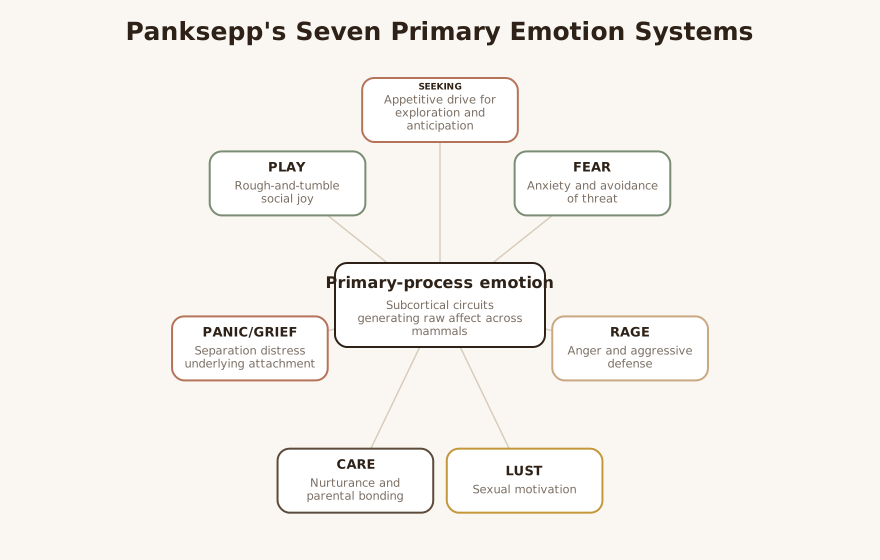
The seven systems are conventionally written in capital letters to mark that they refer to specific, neuroanatomically grounded networks rather than the loose everyday meanings of the words 4. SEEKING is the appetitive, dopaminergic system that drives exploration, anticipation, and engagement with the environment; FEAR generates anxiety and avoidance of threat; RAGE underlies anger and aggressive defense; LUST governs sexual motivation; CARE supports nurturance and maternal/parental bonding; PANIC/GRIEF (the separation-distress system) produces the pain of social loss and underlies attachment; and PLAY drives rough-and-tumble social joy and the development of social competence 4.
Each system has a describable neuroanatomy and neurochemistry 2. SEEKING is centrally dopaminergic; PANIC/GRIEF is modulated by opioids, oxytocin, and prolactin, which is why social bonds and their loss feel the way they do; CARE involves oxytocin and prolactin; and FEAR, RAGE, and the others each have characteristic transmitters and pathways 2. A further principle is that these systems are not isolated — they interact, oppose, and regulate one another, so that, for example, robust CARE and PLAY can buffer FEAR and PANIC/GRIEF 4. Finally, the systems are proposed as the evolutionary foundation of human temperament and personality, a claim made testable through the ANPS 3.
Interventions & Techniques
The framework does not supply a discrete technique manual; it reframes the affective substrate of whatever emotion-oriented modality the clinician already practices 6. Its principal clinical contribution is a shared, precise language for primary emotion that helps therapist and client identify which deep system is active, rather than working only with vague global distress LLM.
In practice this means using the seven systems as an assessment and formulation lens: mapping a presenting problem onto an over- or under-active primary system — for example, a hypoactive SEEKING system in anhedonic depression, a hyperactive FEAR system in anxiety, or chronic PANIC/GRIEF activation in separation-driven distress and grief 4. The model directs attention to the kind of affect at work and to its likely neurochemical and motivational logic, which can guide where to intervene 2.
Because the framework is mechanistic rather than procedural, its “techniques” are borrowed from the modalities it informs: deepening and differentiating emotion in emotion-focused work, restoring approach motivation and reward engagement in behavioral activation, mobilizing CARE and PLAY through relational and play-based interventions, and titrating FEAR and PANIC/GRIEF in trauma and attachment work 6. Panksepp himself argued that promoting positive primary affects — particularly SEEKING, CARE, and PLAY — has therapeutic value, framing healthy play and social joy as resources rather than mere recreation 4.
LLM-generated illustrative example (not a guideline): A client describes feeling “flat and pointless,” with no pull toward anything they used to enjoy. Rather than treating this only as low mood, an affective-neuroscience-informed clinician frames it as a dampened SEEKING system and prioritizes small, scheduled approach behaviors that re-engage anticipation and reward, while watching for whether PANIC/GRIEF activation (loss, disconnection) is suppressing it LLM.
Evidence Base
The framework is best characterized as an established and influential theory whose foundational text and cross-species program of research have been widely cited across neuroscience and clinical psychology 1. Panksepp’s primary-process model is grounded in a large body of animal brain-stimulation, lesion, and pharmacological data that consistently localizes emotional behaviors to specific subcortical circuits 2. The translation to humans is supported most directly by the Affective Neuroscience Personality Scales, which operationalize six of the systems (SEEKING, FEAR, RAGE, CARE, PANIC/GRIEF, and PLAY, with LUST typically excluded for measurement reasons) and have been used across a substantial body of psychological and psychiatric studies 3.
Honesty about maturity is warranted. The theory is “established” in the sense of being well-developed, broadly disseminated, and methodologically serious, with a measurement instrument that has generated a sizable peer-reviewed literature 3. It is not, however, an empirically validated standalone treatment with its own randomized controlled trial base; it is an organizing neuroscientific framework delivered through other therapies 6. Some of its strongest claims — that animals have genuinely felt, conscious affects homologous to human feelings, and that exactly seven primary systems carve emotion at its joints — remain debated, and alternative emotion theories (constructionist and appraisal-based models) contest the idea of discrete, hardwired affect programs LLM. Clinicians should therefore treat the seven systems as a powerful explanatory and formulation tool, while grounding measurable claims of efficacy in the evidence-based therapies through which its principles are applied LLM.
Populations & Indications
The framework is most directly useful for clients whose central difficulty is emotional — people with mood and anxiety disorders, where over- or under-activity of FEAR, PANIC/GRIEF, and SEEKING maps onto anxiety, depression, and anhedonia respectively 4. It is frequently applied with individuals carrying trauma histories, where the FEAR and PANIC/GRIEF systems are understood as chronically dysregulated and where restoring CARE and PLAY is framed as part of recovery 6.
Clients in emotion-focused therapy are a natural fit, since that modality’s emphasis on accessing, differentiating, and transforming primary emotion aligns closely with Panksepp’s primary-process framework LLM. People with attachment difficulties are addressed through the PANIC/GRIEF separation-distress system, which Panksepp positioned as the neurobiological substrate of social bonding and its disruption 2. Individuals with addiction are relevant because the dopaminergic SEEKING system is implicated in compulsive appetitive behavior and craving 4. People with depression and anhedonia are a specific indication, given the model’s account of low SEEKING engagement and, in some formulations, of depression as sustained PANIC/GRIEF activation following loss 4.
Problems-for-Work
The framework organizes a wide range of presentations around which primary system is dysregulated 4. Major depressive disorder and anhedonia are conceptualized in terms of a hypoactive SEEKING system and, in loss-driven cases, chronic PANIC/GRIEF activation — directing work toward re-engaging approach motivation and addressing disconnection 4.
Generalized anxiety disorder and posttraumatic stress disorder are framed around a hyperactive FEAR system, with PTSD additionally involving entrenched threat-circuit conditioning, pointing toward fear-titration and safety-building work 4. Grief and attachment-related distress map onto the PANIC/GRIEF separation-distress system, normalizing the visceral pain of loss as the activation of an ancient bonding circuit 2. Anger and rage dysregulation are located in the RAGE system, distinguishing reactive, defensive anger from other affects 4. Substance use disorder is approached through the SEEKING/dopamine system and its hijacking by appetitive cues 4. Emotion dysregulation more broadly is reframed as imbalance among interacting primary systems rather than as a single global deficit 4.
LLM-generated illustrative example (not a guideline): For a recently bereaved client who says the pain feels “physical, like withdrawal,” the clinician can normalize this as PANIC/GRIEF separation-distress — a system neurochemically related to opioid and bonding circuitry — which validates the bodily intensity of grief and reframes the urge to seek comfort and connection as adaptive rather than weak LLM.
Contraindications, Cautions & Cultural Humility
The framework is a conceptual lens rather than a procedure, so it carries no formal contraindications of its own; cautions instead attach to how it is used LLM. The most important caution is overreach: the seven systems should not be presented to clients or in records as an empirically validated standalone treatment, because the model is a mechanistic theory delivered through other modalities 6. The capital-letter system labels are heuristic maps of complex, interacting circuitry, and clinicians should avoid reifying them into a rigid “seven boxes” account of a person’s emotional life LLM.
A neurobiological theory built on conserved, “universal” emotional systems also risks importing assumptions about how emotions should be expressed. While the underlying circuits are proposed as cross-species universals, the display, naming, and regulation of emotions are heavily shaped by culture, and therapists should not treat one culture’s norms for expressing FEAR, RAGE, CARE, or grief as the standard LLM. The cross-species, animal-model foundation of the theory remains scientifically contested with respect to claims about felt animal consciousness, and clinicians should communicate it with appropriate epistemic humility LLM. Finally, the framework should complement, not replace, careful diagnostic assessment, risk evaluation, and attention to social and structural contributors to a client’s distress LLM.
Treatment-Plan Suggestions & SMART Objectives
| Goal | SMART objective (example) | Mechanism |
|---|---|---|
| Re-engage reward and motivation | Within 8 weeks, client completes 3 scheduled approach/pleasure activities per week and rates anticipated vs. experienced enjoyment in 4 of 5 sessions | Re-activating a hypoactive SEEKING (dopaminergic) system 4 |
| Reduce anxiety and avoidance | Over 10 weeks, client tolerates one previously avoided situation per week with a self-rated distress drop of ≥2 points | Down-regulating a hyperactive FEAR system through graded approach 4 |
| Process and metabolize grief | Within 12 weeks, client identifies and tolerates separation-distress in 3 of 4 affect-laden sessions without shutting down | Working with the PANIC/GRIEF separation-distress system 2 |
| Build affect literacy across systems | Within 6 weeks, client labels which primary emotion (e.g., fear, anger, sadness, seeking) is active in 4 of 5 distressing episodes | Differentiating primary-process affects rather than global distress 2 |
| Modulate reactive anger | Over 8 weeks, client identifies early RAGE-system cues and applies one regulation strategy in 3 of 4 logged provocations | Recognizing and down-regulating defensive RAGE activation 4 |
| Strengthen social bonding and play | Within 10 weeks, client initiates 2 connected, low-stakes social or playful interactions per week | Mobilizing CARE and PLAY to buffer FEAR and PANIC/GRIEF 4 |
| Reduce craving-driven behavior | Within 90 days, client maps appetitive cues and uses a delay/alternative strategy in 4 of 5 craving episodes | Interrupting SEEKING-system cue reactivity in addiction 4 |
Common Misconceptions
A frequent misconception is that the seven systems are a brand of therapy you can be “certified in”; the framework is an affective-neuroscience theory that informs practice rather than a packaged protocol 6. Another is reading the capital-letter labels as the ordinary English words — “PLAY” refers to a specific rough-and-tumble social-joy circuit and “PANIC” to a separation-distress (not panic-disorder) system, so the technical meanings differ from everyday usage 4.
A third error is treating the model as fully settled science; while strongly grounded in animal data and an established personality instrument, its claims about discrete, hardwired affect programs and felt animal emotion are debated against constructionist and appraisal theories of emotion LLM. A fourth is assuming exactly seven systems is a closed, final list, when Panksepp himself treated the taxonomy as a working framework open to refinement LLM. Finally, the model is sometimes misused as a deterministic, “your dopamine made you do it” account; the theory explicitly layers learning and cognition on top of primary affect, leaving substantial room for regulation and change 2.
Training & Certification
There is no single credentialing body or formal certification in Panksepp’s primary emotional systems, consistent with its status as a theory rather than a manualized treatment 6. Clinicians typically acquire it through primary reading — most directly Panksepp’s Affective Neuroscience: The Foundations of Human and Animal Emotions — alongside the peer-reviewed literature elaborating the systems and the Affective Neuroscience Personality Scales 13. Concise scholarly overviews of the core principles and of the systems’ link to personality provide an efficient entry point 24.
In practice, therapists operationalize the framework by training in the emotion-oriented modalities that engage primary affect — emotion-focused, somatic, attachment-based, and trauma-focused therapies — and by using the model as a formulation lens within supervision 6. Clinicians interested in measurement can familiarize themselves with the ANPS, which provides a validated way to assess the primary systems as personality dimensions 3.
Key Terms
- Primary-process emotions: Subcortical, genetically provided systems that generate raw, felt affect before cognitive appraisal 2.
- SEEKING: The dopaminergic appetitive system driving exploration, anticipation, and engagement 4.
- FEAR: The system generating anxiety and avoidance of threat 4.
- RAGE: The system underlying anger and defensive aggression 4.
- LUST: The system governing sexual motivation 4.
- CARE: The system supporting nurturance and parental/maternal bonding, modulated by oxytocin and prolactin 2.
- PANIC/GRIEF (separation-distress): The system producing the pain of social loss and underpinning attachment, modulated by opioids and oxytocin 2.
- PLAY: The system driving rough-and-tumble social joy and the development of social competence 4.
- Affective Neuroscience Personality Scales (ANPS): A validated questionnaire operationalizing the primary systems as human personality dimensions 3.
Resources & Further Reading
▶ Watch — a video introduction to this concept:
- Panksepp, J. (1998). Affective Neuroscience: The Foundations of Human and Animal Emotions (Oxford University Press)
- Montag, C., & Panksepp, J. (2018). Selected Principles of Pankseppian Affective Neuroscience (PMC6344464)
- Affective Neuroscience Theory and Personality: An Update (PMC7219919)
- Montag, C., & Davis, K. L. (2018). Primary Emotional Systems and Personality: An Evolutionary Perspective (Frontiers in Psychology)
- Jaak Panksepp (Wikipedia)
- Affective Neuroscience — Institute for Psychotraumatology body of knowledge
Reflective / Supervision Questions
- When a client presents with global “distress,” am I working to identify which primary emotional system is active, or am I staying at the surface of undifferentiated affect? 2
- Where might I be reifying the seven capital-letter systems into rigid boxes rather than holding them as interacting, heuristic maps? LLM
- Am I representing this framework honestly in my formulation — as a neuroscientific lens delivered through an evidence-based modality, rather than a validated standalone treatment? 6
- How do my own cultural assumptions about how fear, anger, care, and grief “should” look shape what I notice and validate in a client’s emotional expression? LLM
- For clients with anhedonia or addiction, how am I attending to the SEEKING system — restoring healthy approach motivation rather than only reducing symptoms? 4
- Am I making space for the positive primary systems — CARE and PLAY — as therapeutic resources, or focusing only on down-regulating FEAR, RAGE, and PANIC/GRIEF? 4