
Type & Discipline
The SEEKING system is a neuroscientific construct, not a therapy model or a manualized intervention LLM. It belongs to affective neuroscience — the field that studies the neural mechanisms of emotion, a term coined by the Estonian-American neuroscientist Jaak Panksepp 4. Within that field, SEEKING is one of seven genetically endowed “primary emotional systems” Panksepp identified across mammalian brains 4. It names the mesolimbic dopaminergic appetitive/approach circuit that generates curiosity, anticipation, motivation, and active engagement with the world 3.
For practicing therapists, the value of the construct is interpretive rather than procedural LLM. It does not tell you what to do in session; it gives you a precise, biologically grounded language for a clinical phenomenon you see constantly — the client who is not in pain so much as flat, uninterested, unable to get moving LLM. Panksepp’s compact reframing is that “depression is not a lack of pleasure; it’s a lack of enthusiasm” 6. That single shift — from a deficit of pleasure to a deficit of appetitive drive — is the clinical heart of why the construct matters LLM.
A useful boundary to hold from the outset: SEEKING is a primary-process emotional disposition, meaning it operates from ancient subcortical structures and is experienced as raw affect before it is cognitively elaborated 2. It is therefore upstream of the thoughts and stories clients tell about their motivation, which is part of why purely cognitive interventions sometimes fail to move it LLM.
Creators & Lineage
The construct is inseparable from Jaak Panksepp (1943–2017), who fled Soviet-occupied Estonia as a child, trained as a psychobiologist, and spent his career arguing — against a behaviorist establishment that included B.F. Skinner — that animals have genuine, neurally specifiable emotions 4. He coined “affective neuroscience” and developed his framework through cross-species methods, including electrical and deep-brain stimulation, lesion studies, and pharmacology, to map emotional circuits conserved across mammals 14. His best-known demonstration of the cross-species claim was that rats emit high-frequency vocalizations when tickled, which he interpreted as a homolog of laughter 4.
Panksepp laid out the full architecture in his 1998 book Affective Neuroscience: The Foundations of Human and Animal Emotions, the foundational text for the seven-system model 5. He later co-authored The Archaeology of Mind (2012) with Lucy Biven, extending the framework toward clinical and developmental application 4. The deeper synthesis of SEEKING specifically — its identity as the mesolimbic dopamine system — came through collaborative work with Antonio Alcaro and others, who reframed mesolimbic dopamine not as a “pleasure” or “reward” chemical but as the substrate of an appetitive SEEKING disposition 32.
The seven primary systems Panksepp named are SEEKING, FEAR, RAGE, LUST, CARE, PANIC/GRIEF, and PLAY 4. SEEKING holds a special place among them: it is the appetitive engine that energizes pursuit and is, in a sense, the system the others recruit when an organism must go get something or get away from something 3. It is worth noting that this is a strong theoretical position; Panksepp’s claims about emotional consciousness drew principled caution from researchers such as Lisa Feldman Barrett, who emphasized that some of these statements remain hypotheses rather than settled facts 4.
Core Principles
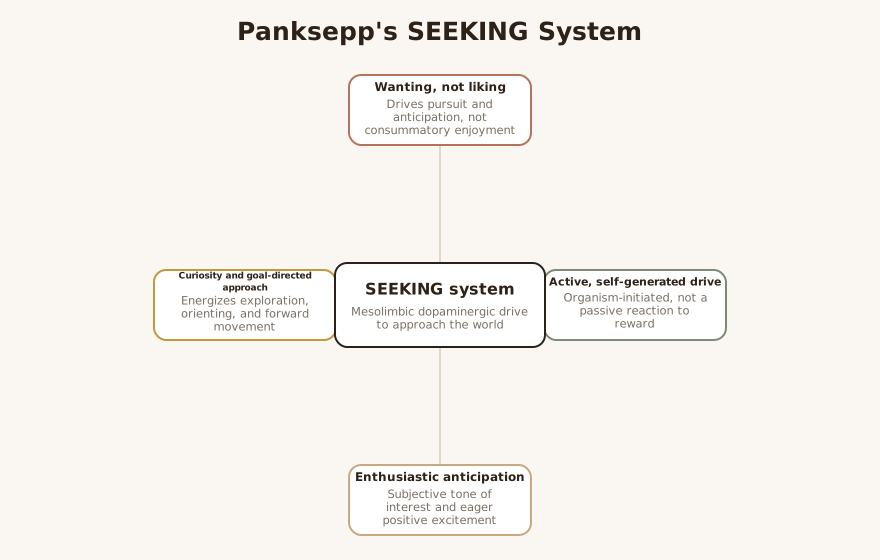
Wanting is not liking. The central principle is a dissociation between the appetitive phase of behavior (pursuit, anticipation, “wanting”) and the consummatory phase (enjoyment, “liking”) 3. Mesolimbic dopamine is far more concerned with wanting than with liking: blocking dopamine in the nucleus accumbens sharply reduces a rat’s drive to run a maze toward a reward, yet leaves intact its consumption and apparent enjoyment of the reward once reached 3. Clinically, this means a client can retain the capacity to enjoy something in the moment while having lost the drive to seek it out — which is exactly what flat, avolitional presentations look like LLM.
SEEKING is an active, self-generated disposition. It is not a passive reaction to external rewards but an organism-initiated drive to move through, investigate, and engage the environment 3. In animals it manifests as forward locomotion, orienting, sniffing, and exploratory vocalization; the system “promotes positive expectancies and anticipatory states” that energize approach 3. The subjective tone Panksepp attributed to it is “enthusiastic positive excitement,” interest, and eager anticipation — distinct from sensory pleasure 3.
Anticipation over consummation. Because the system is appetitive, its affective payoff is loaded onto the journey toward a goal rather than its attainment 3. This is why the reward literature frames the “wanting” component as incentive salience — the desire or craving and motivation that draws an organism toward a reward — rather than the hedonic hit of getting it 7.
A primary-process substrate. SEEKING is carried to the forebrain by the mesolimbic dopamine pathway and expressed neurodynamically through transient, synchronized gamma oscillations (>30 Hz) in limbic and basal-ganglia–thalamic–cortical circuits 2. Mechanistically, dopamine appears to favor subcortical, exploratory sequence generation over rigid top-down cortical control 3. The clinically relevant abstraction: this is bottom-up motivational energy, not a top-down decision LLM.
Interventions & Techniques
The SEEKING construct does not come with its own technique set; it is a lens you apply through existing modalities LLM. Its most natural clinical home is behavioral activation, where the explicit logic — schedule approach and engagement before motivation arrives — maps directly onto the principle that the appetitive system is energized by movement toward goals rather than by waiting to feel like it 3LLM.
Several translational moves follow from the construct LLM:
- Activate the appetitive phase deliberately. Because the affective payoff lives in anticipation and pursuit, building in genuine novelty, curiosity, and graded approach toward valued goals targets SEEKING more directly than arranging for the client to simply receive pleasant outcomes 3LLM.
- Distinguish “can’t enjoy” from “can’t pursue.” When assessing anhedonia, separate consummatory anhedonia (the in-the-moment enjoyment is gone) from a wanting/motivational deficit (the drive to initiate is gone), because they imply different in-session emphases 3LLM.
- Reframe avolition for the client. Psychoeducation that names low drive as a dampened seeking circuit, not a character failing, can reduce self-blame and support activation work 6LLM.
At the biological end of the spectrum, the construct has informed somatic treatment research: deep-brain stimulation work for treatment-resistant depression moved electrode placement toward the medial forebrain bundle — described as the most rewarding site within the SEEKING system — and Panksepp pursued novel antidepressant molecules (e.g., GLYX-13) on the logic of stimulating positive seeking-related affect 16. These are not office interventions, but they show the construct doing real translational work LLM.
LLM-generated illustrative example (not a guideline): A client with major depressive disorder reports she still “kind of enjoys” coffee with a friend once she’s there, but cannot make herself initiate anything. Rather than treating this as global anhedonia, the clinician frames it as intact liking with collapsed wanting, and structures graded, curiosity-led approach tasks (one small novel outing per week) to re-engage the appetitive phase. LLM
Evidence Base
Honest appraisal: the maturity here is split LLM. As a basic-science construct, SEEKING is well established — it rests on decades of cross-species electrical-stimulation, lesion, and pharmacological data showing that mesolimbic dopamine drives appetitive approach and anticipation, and the wanting/liking dissociation is among the more robust findings in reward neuroscience 31. The link to psychiatric conditions is empirically supported in direction: depressed patients show lower self-reported SEEKING on the Affective Neuroscience Personality Scales than healthy controls, consistent with a hypoactive appetitive system 1. The reward-system literature similarly ties this circuitry to anhedonia, depression, and ADHD 7.
In addiction, the model is coherent and influential: drugs of abuse are understood to hijack SEEKING circuitry, with the system reorganizing around ultra-specific appetitive memories and compulsive activities, so that normal motivation narrows into craving 23.
The caution is at the level of clinical translation and consciousness claims LLM. Panksepp’s broader thesis that these circuits generate felt emotional experience drew explicit caution from peers as hypothesis rather than fact 4. And while the construct richly informs therapy (especially behavioral activation), “SEEKING-targeted therapy” is not itself a validated, manualized, outcome-tested treatment — the therapeutic payoff is conceptual and is delivered through established modalities LLM.
Populations & Indications
The construct is most clinically illuminating for presentations where the motivational engine is the problem LLM:
- Depression, especially with prominent avolition and apathy — the prototypical “lack of enthusiasm” presentation, supported by lower measured SEEKING in depressed patients 61.
- Anhedonia, where the wanting/liking split helps target the specific deficit 37.
- Substance use disorders and craving, understood as a reorganized, hyper-narrowed SEEKING system 23.
- ADHD, where dopaminergic dysregulation of the seeking/reward circuitry is implicated 7.
- Clients in motivational treatment broadly — anyone for whom “I know what I should do but can’t get moving” is the core complaint LLM.
It is also a useful frame for the apathetic or behaviorally inactivated client who does not meet full criteria for any disorder but is stalled LLM.
Problems-for-Work
The construct converts cleanly into problems-for-work that therapists can name and target LLM:
- Avolition / low motivation — frame as a dampened appetitive phase; pair with graded behavioral activation to re-energize approach 3LLM.
- Anhedonia — disaggregate into wanting vs. liking deficits and target the one that is actually impaired 3LLM.
- Behavioral activation deficits — use the principle that pursuit precedes and generates the affect, so action is scheduled ahead of motivation 3LLM.
- Substance craving — psychoeducation that craving is the SEEKING system captured by a narrow cue can externalize the urge and support relapse-prevention work 2LLM.
- Apathy in depression — target enthusiasm and curiosity, not pleasure, consistent with Panksepp’s reframing 6LLM.
- Anxiety presentations — note that an over-recruited appetitive/expectancy system can also drive restless, future-oriented anticipatory states, which can be worked with alongside fear-system content 1LLM.
Contraindications, Cautions & Cultural Humility
There are no “contraindications” to a construct, but there are ways to misuse it LLM. The most important caution is reductionism: telling a client their depression “is just low dopamine” can be invalidating and can flatten the relational, historical, and contextual roots of their distress LLM. The neuroscience is a lens, not the whole picture, and several of its strongest interpretive claims — particularly about subjective emotional experience — remain contested hypotheses rather than established fact 4.
A second caution is over-claiming therapeutic specificity: the construct enriches existing interventions but does not license marketing a stand-alone “SEEKING therapy” with an evidence base it does not have LLM. Somatic interventions derived from the model (deep-brain stimulation, experimental pharmacology) are research-stage, specialist domains and outside the scope of psychotherapy practice 1LLM.
On cultural humility: what counts as appropriate “drive,” ambition, exploration, or engagement is culturally shaped, and an apparently low-SEEKING presentation may reflect context, values, oppression, exhaustion, or grief rather than a circuit deficit LLM. Clinicians should hold the biology lightly and let the client’s meaning lead LLM.
Treatment-Plan Suggestions & SMART Objectives
| Goal | SMART objective (example) | Mechanism |
|---|---|---|
| Re-engage appetitive drive | Client will initiate one curiosity-led, novel activity per week for 6 weeks, logged in a tracker | Activates the SEEKING/appetitive phase ahead of felt motivation 3 |
| Reduce avolition | Client will complete 3 scheduled approach tasks weekly, rated for ease of initiation, over 8 weeks | Behavioral activation harnessing pursuit-before-affect 36 |
| Target the right anhedonia | Within 2 sessions, client and clinician will distinguish “wanting” vs. “liking” deficits across 5 valued activities | Separates appetitive from consummatory impairment 3 |
| Externalize craving | Client will identify and log SEEKING-cue triggers daily for 4 weeks and rate craving intensity 0–10 | Names craving as captured appetitive drive, supporting relapse prevention 2 |
| Rebuild anticipation | Client will plan and anticipate one valued future event weekly and rate pre-event interest for 6 weeks | Loads affect onto anticipation rather than outcome 3 |
| Reframe low enthusiasm | Client will articulate, by session 4, a non-self-blaming account of low drive as a dampened seeking process | Psychoeducation reducing shame around avolition 6 |
| Sustain motivation gains | Client will maintain ≥80% of scheduled engagement tasks across a 4-week maintenance phase | Consolidates re-activated approach behavior 3 |
Common Misconceptions
- “It’s the brain’s pleasure system.” No — SEEKING/mesolimbic dopamine governs wanting and anticipation far more than hedonic liking; pleasure and pursuit are separable 3.
- “Depression is a pleasure deficit.” Panksepp’s reframing is the opposite emphasis: it is more a lack of enthusiasm and drive than a lack of pleasure 6.
- “Dopamine = reward.” The neuroethological account treats dopamine as the engine of an appetitive disposition to explore and approach, not a signal of received reward 3.
- “SEEKING is a therapy.” It is a basic-science construct that informs therapy; the intervention is the modality (e.g., behavioral activation), not the construct itself LLM.
- “It’s settled that these circuits produce conscious feelings.” That stronger claim remains a debated hypothesis 4.
Training & Certification
There is no certification in the SEEKING system; it is a body of knowledge, not a credential LLM. Clinicians who want to ground themselves go to the primary literature — Panksepp’s Affective Neuroscience (1998) for the foundational framework, and the Alcaro/Panksepp papers for the SEEKING-specific neuroethology 532. The Affective Neuroscience Personality Scales (ANPS) operationalize the seven systems, including SEEKING, for measurement and have been used to show reduced SEEKING in depression 1. Practical clinical competence comes from training in the modalities that carry the construct — behavioral activation and broader CBT, and motivational approaches LLM.
Key Terms
- SEEKING system — the mesolimbic dopaminergic appetitive/approach system driving curiosity, anticipation, motivation, and engagement 3.
- Appetitive vs. consummatory — the pursuit/wanting phase vs. the enjoyment/liking phase of motivated behavior 3.
- Wanting vs. liking — incentive motivation vs. hedonic enjoyment; dopamine mediates the former more than the latter 3.
- Incentive salience — the desire/craving and motivation that draws an organism toward a reward 7.
- Primary emotional systems — Panksepp’s seven evolutionarily conserved affective circuits: SEEKING, FEAR, RAGE, LUST, CARE, PANIC/GRIEF, PLAY 4.
- Affective neuroscience — the study of the neural mechanisms of emotion; the field Panksepp named 4.
- Medial forebrain bundle — a maximally rewarding site within the SEEKING system, targeted in deep-brain-stimulation research for depression 1.
Resources & Further Reading
▶ Watch — a video introduction to this concept:
- Selected Principles of Pankseppian Affective Neuroscience — Frontiers in Neuroscience (2018)
- The SEEKING mind: appetitive incentive states in addictions and depression (Alcaro & Panksepp) — PubMed
- Behavioral Functions of the Mesolimbic Dopaminergic System: an Affective Neuroethological Perspective — PMC
- Jaak Panksepp — Wikipedia
- Affective Neuroscience: The Foundations of Human and Animal Emotions (Panksepp, 1998) — Oxford University Press
- Jaak Panksepp lectures on emotions in animals, humans — Cornell Chronicle
- Seeking system / Reward system — Wikipedia
Reflective / Supervision Questions
- When a client presents as “flat,” do I reflexively assess for loss of pleasure, or do I also assess loss of drive to pursue — and how would that change my plan? LLM
- Where in my caseload have I treated avolition as a motivational or moral failing rather than a dampened appetitive process, and what shifts if I reframe it? LLM
- How do I hold the SEEKING construct as a useful lens without sliding into reductive “it’s just your brain chemistry” language that invalidates a client’s story? LLM
- For clients with substance craving, how might framing the urge as a captured seeking system change the relapse-prevention conversation? LLM
- What cultural, contextual, or systemic factors might be producing an apparently “low-SEEKING” presentation that no behavioral activation plan will touch? LLM