
Type & Discipline
Oxytocin and the broader “social-bonding neurochemistry” it anchors are a theoretical and empirical model drawn from social neuroscience and neuroendocrinology, not a therapy or a manualized treatment 1. Oxytocin itself is a nine-amino-acid neuropeptide that functions both as a circulating hormone and as a central neuromodulator, synthesized chiefly in the hypothalamus and released from the posterior pituitary 5. Its classical peripheral roles — uterine contraction in labor and milk ejection during lactation — were described long before its behavioral functions, and the behavioral story is, in important respects, still being written 7.
For clinicians, the relevant claim is mechanistic: oxytocin, together with the closely related peptide vasopressin and downstream dopaminergic and endogenous opioid systems, is part of the neurobiology that supports attachment, affiliation, parental care, and the physiological calming associated with safe social contact 1. This positions the topic as an explanatory lens — a way of understanding why relational safety regulates the nervous system — rather than as something a therapist administers or “does” in session LLM. The intranasal-oxytocin literature that attempts to turn the molecule into an intervention is a separate, and far more contested, body of work that we treat with deliberate caution below 3.
Creators & Lineage
There is no single founder of oxytocin science; the field is a convergence of endocrinology, comparative biology, and social neuroscience 7. Two figures are most often associated with the social-bonding framing relevant to mental health practice. Kerstin Uvnäs-Moberg, a Swedish physiologist, developed an influential account of oxytocin as the organizing chemistry of a “calm and connection” system — an anti-stress, restorative counterpart to the fight-or-flight response, engaged by warmth, touch, and safe closeness LLM. C. Sue Carter, working initially with prairie voles, helped establish oxytocin and vasopressin as central to pair-bonding and social attachment, and has more recently become one of the field’s most candid critics of its own overreach 6.
The work that pushed oxytocin into public consciousness in psychology was Kosfeld and colleagues’ 2005 Nature study reporting that intranasal oxytocin increased trusting behavior in an economic exchange game — the origin of the durable “trust hormone” label 2. The lineage relevant to clinicians runs alongside attachment theory, which supplies the developmental and relational framework; polyvagal theory, which offers a complementary autonomic account of safety and social engagement; and the affective and social neuroscience traditions that locate emotion and bonding in identifiable neural and neurochemical systems LLM. Oxytocin is best understood as the neuroendocrine layer beneath these psychological theories of connection, not a replacement for them LLM.
Core Principles
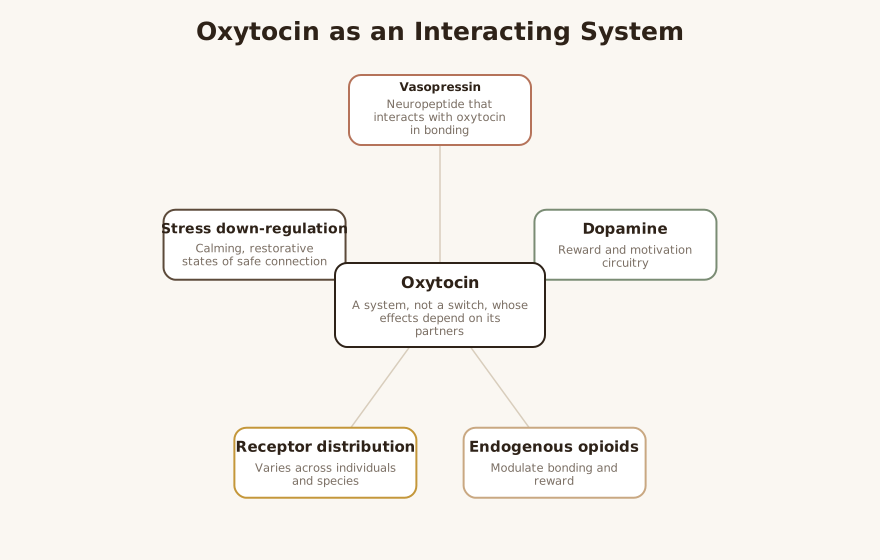
The first principle is that oxytocin is a system, not a switch. It rarely acts alone; its effects on bonding depend on interaction with vasopressin, dopamine (reward and motivation), and endogenous opioids, and on the distribution of receptors that varies across individuals and species 1. Social bonding, in this model, is the product of neuropeptide regulation of these interacting circuits rather than a single molecule producing a single feeling 1.
The second principle is context-dependence. Oxytocin’s behavioral effects are powerfully shaped by the social situation, prior experience, and individual differences; the same release does not produce the same behavior in every person or setting 6. This is why Carter argues that calling oxytocin “the love hormone” is a metaphor that obscures more than it reveals — the molecule’s functions are plural, ancient, and tied as much to physiological safety and homeostasis as to romance 6.
The third principle is the link between affiliation and stress physiology. A consistent thread across the literature is that oxytocin is associated with the down-regulation of stress responses and with the restorative, calming states that accompany safe social contact 4. Safe connection, in other words, is not merely pleasant; it is physiologically regulating LLM. The fourth principle is bidirectionality: positive social interaction, warmth, and certain forms of touch are associated with oxytocin release, which in turn supports further approach and bonding — a feedback loop between behavior and chemistry rather than one-way causation 4.
Interventions & Techniques
It is essential to be clear that oxytocin neurochemistry does not supply techniques a therapist performs; it supplies a rationale for relational and regulatory interventions that already exist LLM. There is no oxytocin “protocol” for psychotherapy LLM.
What the model does is provide a neurobiological frame for psychoeducation: explaining to clients why safe connection, predictable warmth, and co-regulation reduce stress reactivity, and why isolation and chronic threat do the opposite 4. Many naturally affiliative behaviors — supportive touch where appropriate and consented, warm vocal tone, sustained attuned attention, and stable caregiving relationships — are discussed in the popular and clinical-organization literature as associated with oxytocin and with felt calm and trust 45. In dyadic and family work, the parent-infant bond is the paradigm case the biology was built to explain, and the framework supports interventions that strengthen sensitive, contingent caregiving 1.
The pharmacological route — intranasal oxytocin as an add-on to therapy for social anxiety, autism, or PTSD — is where caution is greatest. Trials exist, but the evidence is mixed and methodologically fraught, and clinicians should not present intranasal oxytocin as an established treatment 3.
LLM-generated illustrative example (not a guideline): A clinician working with a client who shuts down during conflict offers a brief psychoeducational frame: “When you feel safe with someone, your nervous system has a built-in ‘calm and connection’ chemistry that helps you settle; chronic threat keeps that offline.” The frame is used to motivate co-regulation skills and graded relational risk-taking, not to promise a chemical fix LLM.
Evidence Base
Honesty about maturity requires splitting this into two claims with very different evidential standing LLM.
The foundational claim — that oxytocin and related neuropeptides are involved in mammalian social bonding, parental care, and the regulation of social and stress behavior — is established and well supported across comparative and human research 1. The peptide’s basic physiology, its role in labor and lactation, and its presence in social-bonding circuitry are not in serious dispute 7. As a model of affiliative neurobiology, it is mature 1.
The applied and behavioral claims are where the field has had to retrench. Kosfeld et al.’s 2005 finding that intranasal oxytocin increases trust was enormously influential, but a careful critical review by Nave, Camerer, and McCullough concluded that the evidence that oxytocin reliably increases trust in humans is weak, with small samples, inconsistent replication, questions about whether intranasal administration even meaningfully reaches the brain, and a literature vulnerable to publication bias 23. Carter’s own reassessment underscores that much of the popular “love hormone” narrative rests on metaphor rather than settled mechanism, and that oxytocin’s effects are conditional and sometimes even appear to heighten social wariness rather than indiscriminate trust 6. The practical implication for clinicians is firm: treat the bonding-and-regulation framework as a sound explanatory model, but treat specific, dramatic behavioral claims — and any notion of oxytocin as a “trust drug” — as unproven 3.
Populations & Indications
Because oxytocin is an explanatory lens rather than a treatment, “indications” here means populations for whom the social-bonding-and-regulation frame is clinically useful, not populations who should receive a substance LLM.
The framework is most directly relevant to the parent-infant dyad, the relationship the biology evolved to support, where it informs attachment-strengthening and sensitive-caregiving work 1. It is a natural fit for individuals with attachment difficulties and for clients whose presenting struggles center on trust, intimacy, and closeness, offering a non-shaming, body-based account of why connection feels both desired and dangerous LLM. People with trauma histories often show altered stress physiology, and the model helps explain why relational safety is foundational to trauma work 4. Couples and families are an apt setting because the chemistry is fundamentally dyadic and bidirectional 4. Autistic individuals and people with social anxiety have been the focus of much intranasal-oxytocin research; clinically, the conceptual frame about social motivation and safety may be useful even though the pharmacological application remains unproven 3.
Problems-for-Work
Attachment insecurity is the central organizing problem: the framework reframes difficulty trusting and depending on others as, in part, a regulated nervous-system pattern rather than a character flaw, which can reduce shame and motivate corrective relational experiences LLM. Difficulty with trust and intimacy maps onto the same terrain, with the important corrective that oxytocin does not simply manufacture trust on demand 3.
For stress reactivity and emotion dysregulation, the model supports interventions that build co-regulation and safe connection as physiological down-regulators of threat states 4. Loneliness and social withdrawal can be framed around the loss of the affiliative inputs that support calm-and-connection physiology, motivating graded re-engagement 4. For posttraumatic stress disorder, social anxiety disorder, and relationship conflict, the neurobiology is best used as a scaffold for established, evidence-based treatments rather than as a treatment in itself 3.
LLM-generated illustrative example (not a guideline): For a chronically lonely client who has stopped reaching out, a clinician might use the calm-and-connection frame to reframe small social contacts as “doses” of nervous-system regulation, pairing the psychoeducation with behavioral-activation-style scheduling of low-risk connection — while being explicit that the goal is lived experience of safety, not a biochemical guarantee LLM.
Contraindications, Cautions & Cultural Humility
As a conceptual lens the framework has no formal contraindications, but its misuse carries real risks LLM. The foremost caution is biological overclaim: presenting oxytocin to clients as a “love” or “trust” hormone that explains relationships, or implying that intranasal oxytocin is an established therapy, misrepresents a contested literature 36. Neuro-reductionism is a second risk — collapsing the meaning of a client’s relational pain into “low oxytocin” strips it of context, agency, and history LLM. Self-administration of oxytocin products purchased online is unproven and unsafe to endorse, and any pharmacological question belongs with a prescribing physician 5.
Cultural humility is essential around touch, eye contact, and expressions of warmth, which are frequently invoked as affiliative, oxytocin-associated behaviors but are profoundly culturally and individually variable LLM. What reads as safe, bonding contact in one cultural or personal context may read as intrusive or threatening in another, and for trauma survivors touch can be activating rather than soothing LLM. Consent, individual preference, and cultural context must govern any relational technique, and the “safe connection” frame should never be used to pressure clients toward closeness LLM.
Treatment-Plan Suggestions & SMART Objectives
| Goal | SMART objective (example) | Mechanism |
|---|---|---|
| Increase felt relational safety | Within 8 weeks, client reports feeling “safe enough” with one trusted person in 3 of 4 weekly check-ins | Affiliative contact associated with stress down-regulation 4 |
| Build co-regulation skills | Over 10 weeks, client and a partner practice one paired soothing routine (e.g., paced breathing together) 3x/week, logged | Bidirectional affiliation–calming feedback loop 4 |
| Reduce social withdrawal | Within 90 days, client initiates 2 low-risk social contacts per week for 6 consecutive weeks | Restoring affiliative inputs that support calm-and-connection physiology 4 |
| Strengthen caregiver attunement (dyadic work) | Over 12 weeks, caregiver responds to infant distress cues with a soothing response in 3 of 4 observed interactions | Parent-infant bonding circuitry the neuropeptide system supports 1 |
| Reframe trust difficulty without shame | Within 4 sessions, client articulates a non-pathologizing, body-based account of their trust pattern | Psychoeducation on context-dependent neurochemistry of bonding 6 |
| Lower stress reactivity in relationships | Over 12 weeks, client uses a grounding/co-regulation skill during conflict in 4 of 5 instances | Safe connection as a physiological regulator of threat states 4 |
| Correct “love hormone” misconceptions | By session 3, client can state that oxytocin’s effects are conditional and that no oxytocin “fix” is being prescribed | Accurate, evidence-honest psychoeducation 3 |
Common Misconceptions
The most pervasive misconception is that oxytocin is “the love hormone” or “the trust hormone” — a single molecule that reliably produces love or trust 6. The behavioral evidence does not support this clean story, and the trust-game findings in particular have not replicated robustly 3. A related error is assuming oxytocin always promotes positive, prosocial feeling; its effects are context-dependent and can include increased wariness or in-group favoritism rather than indiscriminate warmth 6.
A third misconception is that intranasal oxytocin is an established treatment for autism, social anxiety, or PTSD; the trial literature is mixed and methodologically limited, and clinicians should not present it as proven 3. A fourth is treating oxytocin as a switch that acts alone, when bonding depends on a network of neuropeptides, dopamine, and opioids interacting with experience 1. Finally, a subtle clinical error is using the neurochemistry to replace psychological understanding — reducing a client’s relational history to a hormone level — rather than using it as one explanatory layer among several LLM.
Training & Certification
There is no certification in “oxytocin therapy,” consistent with the topic’s status as a body of science rather than a treatment modality LLM. Clinicians build competence by reading the primary and review literature directly — comparative and human work on neuropeptide regulation of bonding, the original trust study, and, crucially, the critical reappraisals that temper it 123. Carter’s reflective writing on the myths and metaphors surrounding oxytocin is particularly valuable for developing an evidence-honest stance 6.
Accessible, reliable overviews from clinical organizations and academic health publishers provide a solid foundation in the basic physiology and functions for client-facing psychoeducation 45. In practice, the framework is operationalized through training in the relational and trauma-focused modalities that actually deliver co-regulation and attachment repair, supported by supervision on touch, consent, and cultural responsiveness LLM.
Key Terms
- Oxytocin: A nine-amino-acid neuropeptide acting as both a circulating hormone and a central neuromodulator, involved in labor, lactation, and social-bonding circuitry 5.
- Vasopressin: A closely related neuropeptide that interacts with oxytocin in the regulation of social and bonding behavior 1.
- Neuropeptide regulation of bonding: The model that affiliation and pair-bonding arise from interacting neuropeptide, dopaminergic, and opioid systems rather than a single molecule 1.
- “Calm and connection” / anti-stress response: The restorative, stress-reducing physiological state associated with safe social contact and oxytocin activity 4.
- Intranasal oxytocin: Administration of oxytocin via nasal spray, studied as a potential adjunct in social and psychiatric conditions, with mixed and contested evidence 3.
- Context-dependence: The principle that oxytocin’s behavioral effects vary with situation, experience, and individual differences 6.
Resources & Further Reading
▶ Watch — a video introduction to this concept:
- Social bonding: regulation by neuropeptides (PMC review)
- Kosfeld et al. (2005) — Oxytocin increases trust in humans (Nature)
- Nave, Camerer & McCullough (2015) — Does Oxytocin Increase Trust in Humans? A Critical Review (PubMed)
- Oxytocin: The love hormone (Harvard Health)
- Oxytocin: What It Is, Function & Effects (Cleveland Clinic)
- Carter — Oxytocin and love: Myths, metaphors and mysteries (PMC)
- Oxytocin (Wikipedia)
Reflective / Supervision Questions
- When I invoke oxytocin or “the love hormone” with a client, am I conveying accurate, evidence-honest science, or reinforcing a popular myth? 6
- How do I use the calm-and-connection frame to support co-regulation without pressuring clients toward closeness they have not consented to? LLM
- For touch and warmth as “affiliative” behaviors, how am I accounting for cultural, individual, and trauma-related variation in what feels safe? LLM
- Am I keeping the neurochemistry as one explanatory layer, or am I letting it flatten a client’s relational history into biology? LLM
- If a client asks about intranasal oxytocin or oxytocin products, can I accurately convey that the evidence is mixed and that this is a medical question? 3
- Where in my caseload would a non-shaming, physiological account of trust difficulty open up the work that a purely cognitive frame has not? LLM