
“Build a support network,” “find your people,” “connect more” — the clinical reflex to prescribe belonging is so automatic that the motive underneath it is rarely examined. Baumeister and Leary’s belongingness hypothesis supplies that missing layer: it argues that the desire to belong is not a soft preference or a culturally optional value but a fundamental human motivation, an evolved drive that, when frustrated, produces broad and patterned damage to thought, emotion, and health 1. For clinicians, the payoff is precision: belonging stops being a vague virtue and becomes a defined need with specifiable conditions for satisfaction, predictable consequences of deprivation, and a clear separation from mere social contact LLM.
Type & Discipline
The need to belong is a descriptive and motivational theory drawn from social psychology, concerned with the proposition that human beings are driven to form and maintain lasting, positive interpersonal relationships 1. Baumeister and Leary advanced it as a candidate for a fundamental human motivation, meaning a drive that is innate, universal across people and cultures, directs cognition and emotion, and produces ill effects when thwarted 1. The theory is sometimes labeled the “belongingness hypothesis,” and it sits at the intersection of motivation, evolutionary, and interpersonal psychology rather than within any single school of therapy 7.
The disciplinary location matters for how a clinician should hold it. The theory was built as basic science: a review and synthesis of empirical literature meant to establish that belongingness meets the criteria for a fundamental need, not a treatment manual 1. Its relevance to the consulting room is therefore inferential and adjunctive — it explains why isolation, rejection, and relationship loss are so reliably toxic, and what would count as remedy, which informs formulation and treatment planning without itself constituting a therapy LLM. It is closer in kind to a theory of human nature than to an intervention model 5.
Creators & Lineage
The theory is dated to Roy Baumeister and Mark Leary’s 1995 review in Psychological Bulletin, “The need to belong: Desire for interpersonal attachments as a fundamental human motivation” 12. They defined the hypothesis as the proposition that “human beings have a pervasive drive to form and maintain at least a minimum quantity of lasting, positive, and significant interpersonal relationships” 1. Their method was to set out criteria a fundamental motivation should satisfy and then survey a wide empirical literature to test whether belongingness met them, concluding that the evidence was extensive and consistent enough to support the claim 1.
The lineage runs back through several earlier traditions that the 1995 paper consolidated rather than invented 7. The intuition that affiliation is a basic need has roots in Maslow’s hierarchy, where belonging and love sit above safety; in attachment theory, which supplies a developmental account of the bond between infant and caregiver; and in earlier work on affiliation motivation 7. Baumeister and Leary’s contribution was to gather the scattered evidence under a single, testable hypothesis and to argue forcefully that belongingness is not derivative of other needs but fundamental in its own right 17. Downstream, the construct seeded Leary’s later sociometer theory of self-esteem and a large contemporary literature on belonging, loneliness, ostracism, and social connection that continues to refine and extend it 3.
Core Principles
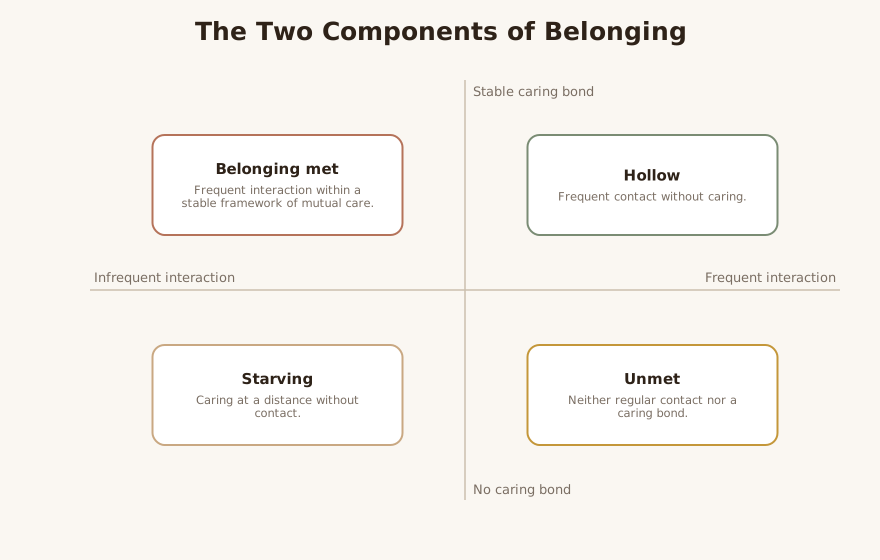
The first principle is the two-part definition of what the need actually requires. Baumeister and Leary argued that satisfying the need to belong has two components: people need frequent, affectively pleasant interactions with a few other people, and these interactions must take place in the context of a stable, lasting framework of mutual affective concern 1. Neither part alone is sufficient — frequent contact without caring is hollow, and caring at a distance without contact is starving 1. Belonging, in this account, is the conjunction of interaction and relational bond 5.
The second principle is minimum quantity and satiation. The drive is for “at least a minimum quantity” of relationships, which implies that the need is satiable: once a person has a small number of close, caring bonds, the motivation to form additional ones diminishes 1. A handful of good relationships does most of the work; the marginal value of further bonds falls off 1. This is clinically consequential because it predicts that a person can be objectively surrounded by people and still unmet, or have few ties and yet be satisfied, depending on whether the minimum of close, caring bonds is reached LLM.
The third principle is substitutability, within limits. Because the need is for a quantity of close bonds rather than for any specific person, relationships can to some degree substitute for one another, so the pain of losing one tie can be partly offset by others — though the theory also recognizes that bonds are not perfectly interchangeable and that particular relationships carry meaning that is not fully replaceable 1LLM.
The fourth principle is the breadth of effects when the need is thwarted. Baumeister and Leary marshaled evidence that belongingness shapes emotion, cognition, and behavior pervasively: a great deal of human emotional life is tied to gaining or losing belonging, much of cognition is devoted to interpersonal relationships, and deprivation of belonging is linked to a wide range of negative outcomes 1. Forming social bonds tends to produce positive emotion, while real, imagined, or potential loss of belonging produces anxiety, depression, grief, jealousy, and loneliness 1.
The fifth principle is evolutionary grounding. The theory holds that the need to belong is plausibly an evolved adaptation, because group membership conferred survival and reproductive advantages — shared food, protection, cooperative care of offspring — so a drive to seek and maintain bonds would have been selected for 17. This framing explains the need’s universality and its emotional urgency without requiring that any individual consciously calculate its benefits LLM.
Interventions & Techniques
The belongingness hypothesis does not prescribe a protocol, but its principles convert into recognizable clinical moves LLM. The most direct is assessing belonging against the two-part definition rather than by headcount: the clinician asks not merely whether a client “has people” but whether they have frequent, pleasant interactions and whether those interactions sit inside a stable framework of mutual caring, because the theory predicts that contact without bond, or bond without contact, leaves the need unmet 1LLM. A client with a busy social calendar and no one who cares whether they live or die is, on this model, belongingness-deprived LLM.
A second technique is calibrating to the minimum, not the maximum. Because the need is satiable at a small number of close bonds, an intervention can aim modestly and realistically: helping a client establish or deepen one or two caring relationships may satisfy the need more effectively than pressure to “be more social,” which can misread the need as a deficit of volume 1LLM. A third is distinguishing belonging deprivation from related but separate problems — for instance, recognizing when depressive or anxious symptoms are downstream of thwarted belonging (rejection, loss, isolation) versus arising independently, since the theory predicts that belonging frustration produces exactly these affective signatures 1LLM. A fourth works at the level of meaning and appraisal of rejection, helping a client whose need has been frustrated to interpret a specific exclusion without globalizing it into a verdict on their worth — consistent with the theory’s claim that belonging and felt social value are tightly linked 1LLM. These moves are delivered inside established modalities rather than as a freestanding therapy LLM.
LLM-generated illustrative example (not a guideline): A client reports a wide acquaintance network but persistent emptiness. Assessing against the two-part definition reveals frequent interaction but no relationship characterized by mutual caring; everyone is “fun” and no one is invested. The clinician reframes the work away from “meeting more people” and toward deepening two existing ties into stable, caring bonds, on the rationale that a small number of close relationships, not a larger number of casual ones, is what the need actually requires LLM.
Evidence Base
The belongingness hypothesis is established as theory and basic science. Baumeister and Leary’s review assembled a large and varied body of evidence — across emotion, cognition, health, and behavior — and concluded that belongingness satisfies the criteria for a fundamental human motivation 1. They documented that people form social bonds readily and resist breaking them, that deprivation of belonging is associated with a broad range of harms, and that much of emotional and cognitive life is organized around interpersonal attachments, a synthesis that has been heavily cited and broadly influential in the decades since 13. Subsequent reviews treat belonging as a well-supported and central construct in psychology, while noting that the field still wrestles with how to define and measure it consistently 3.
The honest caveats matter. First, “established theory” is not “established therapy”: the evidence concerns the existence and effects of the need in human populations, not randomized trials of a “belonging intervention,” which is not a discrete, manualized modality LLM. Second, much of the foundational evidence is correlational and synthetic — a review of existing studies rather than a single decisive experiment — so the strength of the case rests on convergence across many lines of evidence rather than on one clean causal demonstration 1LLM. Third, more recent scholarship highlights genuine conceptual untidiness: belonging has been defined and operationalized in many overlapping ways, which complicates measurement and means that not every study labeled “belonging” is measuring the same thing 3. The robust core — that humans need close, caring bonds and suffer predictably without them — is well supported; the precise boundaries and best measures remain active questions 3.
Populations & Indications
The framework applies wherever connection, rejection, or loss is central to a presentation, but several populations are especially indicated LLM. Socially isolated and lonely adults are the paradigm case, since loneliness is, in this model, the felt signal of an unmet need to belong, and the two-part definition helps distinguish genuine deprivation from solitude that is not distressing 1LLM. Older adults face network attrition through bereavement, retirement, and reduced mobility, which threatens the stable, caring bonds the need requires 4LLM. Bereaved individuals lose a specific close bond, and the theory predicts the resulting grief precisely as a belongingness response to relationship loss 1.
People with depression or anxiety are indicated because the theory ties both affective states directly to belonging: loss or threat of belonging produces depression and anxiety, so low or threatened belonging functions as a risk and maintaining factor 1LLM. Adolescents and young adults, for whom peer acceptance is developmentally salient, are a natural target, as are people experiencing rejection, ostracism, or exclusion, whose distress maps onto the theory’s account of thwarted belonging 17. Newcomers, migrants, and the displaced face the dismantling of an existing belonging framework and the demand to rebuild one, a stressor the hypothesis frames sharply LLM. Across these groups, the clearest indication for invoking the theory is a presentation in which a deficit, threat, or loss of close, caring bonds is contributing to distress LLM.
Problems-for-Work
The need to belong gives clinicians a precise vocabulary for a cluster of presenting problems LLM.
- Loneliness and social isolation. The theory separates objective isolation from the subjective sense of unmet belonging, directing the clinician to assess whether the minimum of close, caring bonds is reached, not merely how many contacts exist 1.
- Rejection and ostracism. Exclusion is, in this model, a direct frustration of a fundamental need, which explains why even minor or anticipated rejection can produce outsized pain and why the work often involves containing the meaning a client assigns to it 1.
- Grief and relationship loss. Bereavement and breakup remove a specific bond; the theory frames the resulting grief as the expected belongingness response and points toward rebuilding caring bonds across the remaining network 1.
- Depression. Where depressive symptoms follow loss, rejection, or isolation, thwarted belonging is a plausible driver, and restoring close bonds becomes a maintaining-factor target 1LLM.
- Anxiety. Threat to or anticipated loss of belonging produces anxiety in the model, so social-evaluative and relational fears can be formulated as belonging threats 1LLM.
- Low self-esteem and felt unworthiness. Because felt social value tracks belonging, chronic rejection or exclusion can corrode self-worth, linking belonging work to esteem 1LLM.
LLM-generated illustrative example (not a guideline): A young adult presents after being cut from a friend group, describing herself as “fundamentally unlikeable.” The clinician formulates the spiral as a belongingness frustration that has globalized into a verdict on her worth, and the work targets two things at once: containing the meaning of the specific rejection and helping her invest in one or two stable, caring bonds, rather than chasing readmission to the group that excluded her LLM.
Contraindications, Cautions & Cultural Humility
The first caution is against reading belonging as a number to maximize. The need is satiable at a small quantity of close, caring bonds, so pushing a client toward more social activity when their actual deficit is the quality and stability of caring can miss the mechanism and add pressure rather than relief 1LLM. “Be more social” is not the intervention; “have someone who genuinely cares, reliably” is closer to what the theory specifies 1LLM.
A second caution concerns clients for whom connection is complicated. For survivors of relational trauma or those with attachment difficulties, the capacity to form and trust stable, caring bonds may itself be impaired, so prescribing belonging without addressing that capacity can be experienced as invalidating; the developmental, attachment-rooted lineage of the construct is the relevant frame here 7LLM. Mobilizing belonging is also contraindicated where the available group is a source of coercion or harm — belonging to an abusive or exploitative network is not the remedy the theory intends LLM.
Cultural humility is essential because what a “stable framework of mutual affective concern” looks like, and which relationships properly supply it, is culturally patterned 1LLM. In collectivist contexts, belonging may be organized around extended family and community obligation, and a Western clinician should be wary of pathologizing dense, obligated networks as enmeshment or of treating individual self-reliance as the healthy default LLM. Contemporary scholarship also stresses that belonging is multilevel — operating through individual, relational, and broader social and institutional layers — so a client’s difficulty may reflect exclusion at the level of community, workplace, or society rather than a personal deficit, and locating the problem solely in the individual can compound harm 3.
Treatment-Plan Suggestions & SMART Objectives
| Goal | SMART objective (example) | Mechanism |
|---|---|---|
| Assess belonging against the two-part definition | Within 2 sessions, client will map relationships, distinguishing frequent-but-uncaring contact from stable, caring bonds | Separates interaction from relational bond per the definition 1 |
| Deepen toward the minimum of close, caring bonds | Over 8 weeks, client will increase the depth of 1-2 existing relationships through scheduled, meaningful contact | Need is satiated by a small number of close bonds 1 |
| Reframe a specific rejection without globalizing | By week 4, client will articulate one exclusion as situation-specific rather than as evidence of unworthiness | Contains the belonging-to-worth link the theory predicts 1 |
| Rebuild belonging after a loss | Within 8 weeks, bereaved client will identify and invest in 1-2 remaining or new caring ties | Bonds are partly substitutable across the network 1 |
| Reduce loneliness via quality, not volume | Over 6 sessions, client will replace 1 low-quality social demand with 1 high-quality caring interaction weekly | Targets unmet caring rather than contact frequency 1 |
| Identify and address structural exclusion | By week 6, client and clinician will name whether the deficit is personal, relational, or community-level | Belonging operates at multiple social levels 3 |
| Strengthen capacity to use caring bonds | Over 10 weeks, client will practice disclosing a vulnerability to one trusted person and note the response | Builds the trust that stable bonds require LLM |
Common Misconceptions
The most common misconception is that the need to belong is simply a desire for more social contact. Baumeister and Leary specified two requirements — frequent pleasant interaction and a stable framework of mutual caring — so volume of contact alone does not satisfy the need, and a person can be socially busy yet belongingness-deprived 1. A second misconception is that the need is insatiable, that more relationships are always better; in fact the drive is for “at least a minimum quantity,” and the need satiates once a small number of close bonds is in place 1. A third is that belonging is a culturally optional value or a sign of weakness rather than a fundamental motivation; the theory’s central claim is precisely that it is innate, universal, and on par with other basic needs 17. A fourth is that any relationship satisfies it; the bond must be positive and caring, so high-conflict or hostile ties do not meet the need and may thwart it 1LLM. A final misconception is that belonging is a peripheral concern next to “real” pathology; the theory holds that thwarted belonging is causally implicated in a wide swath of emotional and even physical suffering, making it central rather than incidental 1.
Training & Certification
There is no certification in the need to belong, and none would be appropriate, because it is a motivational theory rather than a credentialed treatment LLM. Clinicians typically encounter it within graduate coursework in social, motivational, and interpersonal psychology, and within training in modalities — interpersonal, group, and attachment-informed therapies — where its constructs are absorbed into assessment and formulation 5LLM. Competence comes from supervised practice in formulating belonging deficits and threats, and from familiarity with the broader literatures on loneliness, ostracism, and social connection that have grown around the 1995 paper, rather than from any standalone course 13LLM.
Key Terms
- Need to belong (belongingness hypothesis): a pervasive drive to form and maintain at least a minimum quantity of lasting, positive, and significant interpersonal relationships 1.
- Fundamental motivation: a drive that is innate and universal, shapes emotion and cognition, and produces ill effects when thwarted; Baumeister and Leary argued belongingness qualifies 1.
- Two-part requirement: satisfaction needs both frequent affectively pleasant interaction and a stable context of mutual affective concern 1.
- Minimum quantity / satiation: the need is for a small number of close bonds and diminishes once that minimum is reached 1.
- Substitutability: because the need is for a quantity of bonds rather than a specific person, relationships can partly substitute for one another 1.
- Belongingness: the human emotional need to be an accepted member of a group and to feel connected 7.
- Multilevel belonging: the contemporary view that belonging operates across individual, relational, and broader social and institutional levels 3.
Resources & Further Reading
▶ Watch — a video introduction to this concept:
- The need to belong: Desire for interpersonal attachments as a fundamental human motivation (Baumeister & Leary, 1995) — PubMed
- The need to belong (Baumeister & Leary, 1995) — full text via Semantic Scholar
- Belonging: A review of conceptual issues, an integrative framework, and directions for future research — PMC
- A sense of belonging: What it is and how to feel it — Verywell Mind
- Need to belong — iResearchNet (Social Psychology)
- The need to belong: The belongingness hypothesis and the psychology and theory behind it — YouTube
- Belongingness — Wikipedia
Reflective / Supervision Questions
- When I tell a client to “connect more,” am I assessing whether they have the caring, stable bonds the need requires, or only counting how much social contact they have? 1
- For this client, is the belonging deficit one of quantity (too few bonds), quality (contact without caring), or capacity (difficulty forming and trusting bonds), and does my plan match what I actually found? 1
- Am I treating belonging as something to maximize, when the theory says the need satiates at a small number of close relationships? 1
- How might this client’s cultural context define what a stable framework of mutual caring looks like and who properly provides it, and am I reading an obligated, dense network as enmeshment when it may be exactly the belonging they need? 13
- For a client with relational-trauma or attachment difficulties, is prescribing belonging experienced as safe, or am I recommending connection without addressing the capacity to use it? 7LLM
- Could this client’s difficulty reflect exclusion at the level of community or institution rather than a personal failing, and am I locating the problem in the right place? 3