
Type & Discipline
Sociometer theory is a theoretical model within social and evolutionary psychology rather than a treatment modality LLM. It addresses a single deceptively simple question: what is self-esteem, and what is it for? 2 Its claim is that self-esteem is not a private store of worth that people accumulate and protect, but an internal monitor or gauge of an individual’s social acceptance and belonging 4. Because it is a construct-level theory and not a packaged intervention, clinicians use it as an explanatory lens that reshapes how esteem, shame, and rejection are conceptualized in the treatment frame, then borrow techniques from established modalities to act on that reframing LLM.
The theory sits in the family of belonging-based accounts of human motivation, alongside the “need to belong” literature and attachment-informed thinking 5. Its discipline of origin is social psychology, and its argument is explicitly functional and evolutionary: self-esteem exists because tracking one’s standing with others conferred survival advantages 5.
Creators & Lineage
The theory was introduced by Mark R. Leary and colleagues — Ellen S. Tambor, Sonja K. Terdal, and Deborah L. Downs — in their 1995 paper “Self-Esteem as an Interpersonal Monitor: The Sociometer Hypothesis,” published in the Journal of Personality and Social Psychology 1. Leary remained the central architect, and in a 2005 European Review of Social Psychology review he refined the model around the construct of relational value as the true root of self-esteem 2.
Lineage-wise, the framework rests on the human “need to belong” and on the reasoning that, in ancestral environments, social exclusion carried real survival costs — making it adaptive to develop sensitivity to one’s inclusionary status 5. Leary’s account also draws on a longer sociometric tradition, building conceptually on earlier work concerned with measuring interpersonal standing 5. The model was later extended by other investigators, with Kirkpatrick and Ellis offering a notable expansion in 2001 6.
Core Principles
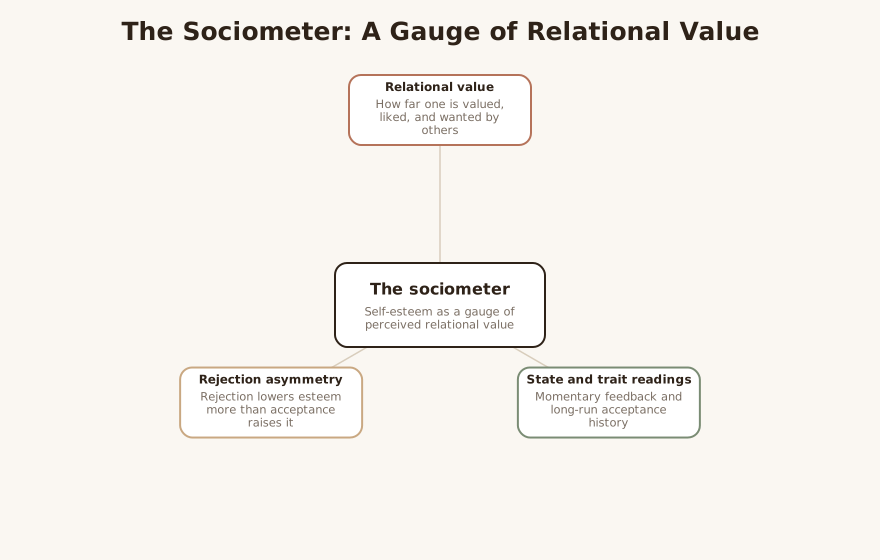
The foundational principle is that self-esteem is a meter — a gauge that reads how accepted or rejected a person is in their relationships 6. What the gauge actually measures is relational value: the extent to which one is valued, liked, and wanted by significant others 6. Many scholars treat relational value as central to self-esteem itself, and Leary’s mature position is that the pursuit people experience as “wanting to feel good about themselves” is, at root, the pursuit of relational value 2.
A second principle is the distinction between state and trait esteem. State self-esteem reflects immediate, in-the-moment feelings of worth and tracks current relational appreciation; trait self-esteem reflects a more enduring sense of worth and indexes one’s general, long-run likelihood of being accepted across situations 65. The same monitor produces both readings: momentary social feedback moves the needle (state), while a stable history of acceptance sets the resting level (trait) 5.
A third principle, well-documented across the literature, is asymmetry: rejection lowers self-esteem more than acceptance raises it 4. This is consistent with a warning system — a smoke detector is built to react strongly to threat, not to reward safety LLM.
The clinically pivotal reframe follows directly: when esteem drops, the gauge is not reporting that the person is defective; it is reporting perceived social devaluation LLM. Low self-esteem, in this model, is less a thing to be inflated and more a signal to be read LLM. When relational appreciation declines, the person experiences relational devaluation, which triggers emotional distress whose function is to motivate behavior that restores social standing 5.
LLM-generated illustrative example (not a guideline): A client says, “After the team meeting I just felt worthless.” A sociometer-informed clinician hears this less as a global verdict on the self and more as a gauge-reading — “something in that room signaled to me that I’m valued less than I thought” — and gets curious about the specific relational cue that moved the needle LLM.
Interventions & Techniques
Sociometer theory does not prescribe techniques; it reframes targets, and clinicians import methods from established modalities to work those targets LLM. Several practical moves follow naturally from the theory LLM.
- Externalizing the gauge. Reframing “I am worthless” as “my sociometer is reading low right now” separates the person from the signal, which can be operationalized with cognitive defusion or Socratic questioning LLM. This rests directly on the theory’s claim that esteem is a monitor of acceptance, not a measure of intrinsic worth 4.
- Tracing the relational cue. Because the needle moves in response to perceived acceptance and rejection, a useful intervention is to identify the specific interpersonal event that preceded the drop, since rejection signals lower the reading more than acceptance raises it 4.
- Testing the reading’s accuracy. The gauge can misfire — reading rejection where none was intended — so behavioral experiments and reality-testing of the inferred devaluation are apt LLM.
- Building genuine relational value. Because the durable lever is actual acceptance, interventions that increase real belonging and connection address trait-level esteem at its source rather than papering over the reading 5.
- Reducing maladaptive restoration behaviors. Distress functions to motivate restoration of standing, but the behaviors it drives — reassurance-seeking, appeasement, withdrawal — can be counterproductive, making them legitimate targets for skills work 5.
Evidence Base
The empirical maturity of the core hypothesis is established. The original 1995 paper reported five experimental studies, and the convergent pattern was strong: changes in state self-esteem mirrored participants’ beliefs about social acceptance, feelings of inclusion correlated with esteem, deliberate exclusion lowered esteem more than random exclusion, and trait self-esteem reflected general patterns of social belonging 1. The authors concluded that the findings provided robust support for the sociometer framework 1.
Subsequent work has been consistent. Laboratory studies show that state self-esteem responds heavily to social feedback, validating the monitoring function at the heart of the theory 5. Research by Cameron and Stinson (2017) demonstrated that acceptance raises state self-esteem while rejection produces negative shifts 5, and a 2018 Dutch study of 1,599 children aged seven to eight found that self-esteem develops alongside changing peer and family relationships 5.
Honesty about scope matters LLM. “Established” applies to the descriptive claim that self-esteem tracks perceived relational value; it does not certify a sociometer-based therapy, because the theory was never operationalized as a manualized treatment with its own outcome trials LLM. Documented limitations include that much of the supporting work is quantitative and cannot capture subjective emotional experience well, that the model can under-attend to individual differences in sensitivity, and that relational standing is not static over time 5. Clinicians should therefore treat it as a strongly supported explanatory model whose therapeutic application borrows its evidence from the host modalities it is layered onto LLM.
Populations & Indications
The theory is most clinically generative where a presenting problem is organized around acceptance, rejection, and worth LLM. It speaks directly to clients with chronic low self-esteem, where the reframe from “defective self” to “low gauge-reading” can reduce the global, identity-level quality of the complaint LLM. It is highly relevant to social anxiety, given the model’s account of how the absence of belonging leaves people susceptible to loneliness, low self-esteem, depression, anxiety, and even suicide 4.
Indications extend to clients with marked rejection sensitivity, contingent or fragile self-worth, and shame-based self-criticism, all of which can be read as a hyper-reactive or chronically low sociometer LLM. Adolescents and young adults — for whom peer relational value is developmentally salient — are a natural fit, consistent with evidence that esteem tracks changing peer and family relationships in childhood 5. The theory is also applied outside the clinic in educational and organizational settings to identify marginalized individuals and strengthen group cohesion 5.
Problems-for-Work
- Low self-esteem. Reframe the global verdict as a relational signal; work to identify what the gauge is reading and whether the reading is accurate 4.
- Social anxiety and fear of rejection. Locate the anticipated devaluation, test it behaviorally, and build experiences of genuine acceptance to recalibrate the baseline 45.
- Rejection sensitivity. Address a sociometer that fires on ambiguous cues, separating perceived from intended devaluation LLM.
- Shame and self-criticism. Treat shame as a high-intensity rejection signal and reduce its identity-fusing quality LLM.
- Loneliness and felt disconnection. Target the trait-level reading by increasing real relational value rather than only challenging thoughts 5.
- Reassurance-seeking / people-pleasing. Reframe these as distress-driven attempts to restore standing, then build more adaptive bids for connection 5.
LLM-generated illustrative example (not a guideline): A client with rejection sensitivity reports a friend “left her on read” and spirals into “nobody actually likes me.” Working the problem, clinician and client distinguish the gauge’s reading (devalued) from the available evidence (one unanswered text), and design a small behavioral test rather than an apology spree LLM.
Contraindications, Cautions & Cultural Humility
Sociometer theory is a framing, so there are no physical contraindications, but there are conceptual cautions LLM. The first is over-application: not every drop in mood is a relational signal, and forcing every complaint into an acceptance-rejection narrative risks missing depression, trauma, or biological contributors LLM. The model itself is honest that it can under-weight individual differences and subjective experience, which should keep the clinician from treating the “gauge” as a literal mechanism rather than a useful metaphor 5.
A second caution concerns the model’s evolutionary framing LLM. The claim that exclusion was costly in ancestral environments is plausible and motivating, but it is a functional hypothesis, not a license to naturalize a client’s distress as fixed or inevitable 5LLM.
Cultural humility is essential because “relational value,” “belonging,” and the very units of social standing are culturally configured LLM. The relationship categories that carry weight — community standing, coalitions, mating, kin, and friendship — are differently prioritized across cultures 5, and what reads as devaluation in one context may be neutral in another LLM. In collectivist or interdependent contexts, the self-as-gauge-of-acceptance may map even more closely onto lived experience, while in others the individualistic “self-esteem as private possession” framing the theory critiques may dominate — clinicians should let the client define what relational value means to them rather than importing assumptions LLM.
Treatment-Plan Suggestions & SMART Objectives
| Goal | SMART objective (example) | Mechanism |
|---|---|---|
| Reframe low esteem as a relational signal | Within 4 sessions, client will reframe 3 self-critical statements as “gauge readings of perceived acceptance” in session | Externalizing self-esteem as a monitor of relational value 4 |
| Identify relational triggers | For 2 weeks, client will log each self-esteem drop with the preceding interpersonal cue, completing ≥5 entries | Tracking the acceptance/rejection input that moves the gauge 4 |
| Reality-test perceived devaluation | Within 6 sessions, client will run 2 behavioral experiments testing an assumed rejection | Distinguishing perceived from actual relational devaluation 5 |
| Reduce the asymmetry’s grip | Over 8 weeks, client will record 1 acceptance cue daily to counter rejection bias | Counterweighting the rejection-over-acceptance asymmetry 4 |
| Build genuine relational value | Within 8 weeks, client will initiate 1 connection-deepening action weekly | Raising trait-level esteem via real belonging 5 |
| Replace maladaptive restoration behaviors | Within 5 sessions, client will substitute 1 reassurance-seeking episode/week with a direct bid for connection | Redirecting distress-driven standing-restoration 5 |
| Reduce shame fusion | Over 6 sessions, client will rate self-as-defect vs. signal-being-read on 3 shame episodes | Separating identity from the gauge’s output LLM |
Common Misconceptions
A frequent misconception is that sociometer theory is a self-esteem-building program LLM. It is the opposite in spirit: it argues that chasing self-esteem directly is misguided, because esteem is a readout of relational value, and the durable lever is the relationship, not the readout 2. A second misconception is that the gauge reflects objective social reality; in fact it reflects perceived acceptance, which is why it can misfire and why reality-testing is useful 4LLM. A third is conflating state and trait esteem — momentary dips are expected gauge behavior and do not necessarily indicate a low baseline 5LLM. Finally, some read the theory as claiming people are merely needy for approval; the more precise claim is that humans are built to monitor belonging because belonging mattered for survival 5.
Training & Certification
There is no certification in sociometer theory, because it is an explanatory model rather than a credentialed treatment LLM. Competence comes from reading the primary literature — chiefly Leary, Tambor, Terdal, and Downs (1995) and Leary’s 2005 review — and from integrating the lens into modalities the clinician is already trained and credentialed to deliver 12LLM. In practice, clinicians apply the framework through whatever evidence-based modality fits the case, supported by ordinary clinical supervision rather than a dedicated training track LLM.
Key Terms
- Sociometer — the internal gauge that monitors one’s social acceptance and belonging 46.
- Relational value — the extent to which one is valued and liked by significant others; the quantity the gauge actually tracks 62.
- Relational devaluation — a perceived decline in how much one is valued, which triggers distress aimed at restoring standing 5.
- State self-esteem — immediate, fluctuating feelings of worth that track current acceptance 6.
- Trait self-esteem — an enduring sense of worth indexing one’s general likelihood of acceptance over time 65.
- Need to belong — the proposed fundamental human motivation underlying the gauge’s existence 5.
Resources & Further Reading
▶ Watch — a video introduction to this concept:
- Leary, Tambor, Terdal & Downs (1995), Self-Esteem as an Interpersonal Monitor (JPSP) — record
- Leary (2005), Sociometer theory and the pursuit of relational value (European Review of Social Psychology)
- Leary (2012), Sociometer Theory — chapter PDF
- Sociometer Theory — Seattle Anxiety Specialists
- Sociometer Theory — EBSCO Research Starters
- Sociometer — Wikipedia
Reflective / Supervision Questions
- When this client reports feeling “worthless,” what specific relational cue might their sociometer be reading — and have we actually identified it, or assumed it? LLM
- Am I implicitly trying to inflate this client’s self-esteem when the theory suggests I should help them build genuine relational value instead? 2LLM
- How might this client’s cultural context define “relational value” differently from my own assumptions about belonging? LLM
- Where am I over-applying the acceptance-rejection lens and possibly missing a non-relational driver of distress? LLM
- For this client, is the clinical problem a chronically low baseline (trait) or a reactive gauge (state), and does my plan match that distinction? 5LLM