
Type & Discipline
Neurologic Music Therapy (NMT) is a clinical modality within the discipline of music therapy and the broader family of creative arts therapies 1. Unlike socio-cultural or psychodynamic models of music therapy, NMT is defined as an evidence-based treatment system that applies the structural elements of music — rhythm, melody, harmony, dynamics, timing — to non-musical brain functions 6. Its targets are functional: motor control, speech and language, and cognition after a neurologic event or diagnosis 4. The defining shift is conceptual: music is treated as a sophisticated auditory stimulus capable of engaging and reshaping perceptual, cognitive, affective, speech/language, and motor processes in the brain, rather than as a primarily emotional or expressive medium 2. For the referring clinician, the practical takeaway is that NMT belongs in the neurorehabilitation column alongside physical, occupational, and speech-language therapy, not only in the wellness or expressive-arts column 4.
Creators & Lineage
NMT was formally established as a clinical model in 1999–2000, growing out of research at the intersection of music neuroscience and rehabilitation 2. Its principal architect is Michael H. Thaut, whose work translated laboratory findings on music and the brain into standardized therapeutic techniques 6. The field’s foundational text is the Handbook of Neurologic Music Therapy, edited by Thaut and Volker Hoemberg and published by Oxford University Press in 2014, which codifies the model and its techniques 1. Thaut, Gerard Francisco, and Hoemberg later articulated the maturing evidence base in a 2021 Frontiers in Neuroscience editorial 2. The lineage draws on four streams: traditional music therapy, the neuroscience of music and rhythm, motor rehabilitation, and cognitive rehabilitation 2. NMT is now practiced by certified therapists in over 60 countries and is medically recognized as an evidence-based therapy by the World Federation of Neurorehabilitation 2.
Core Principles
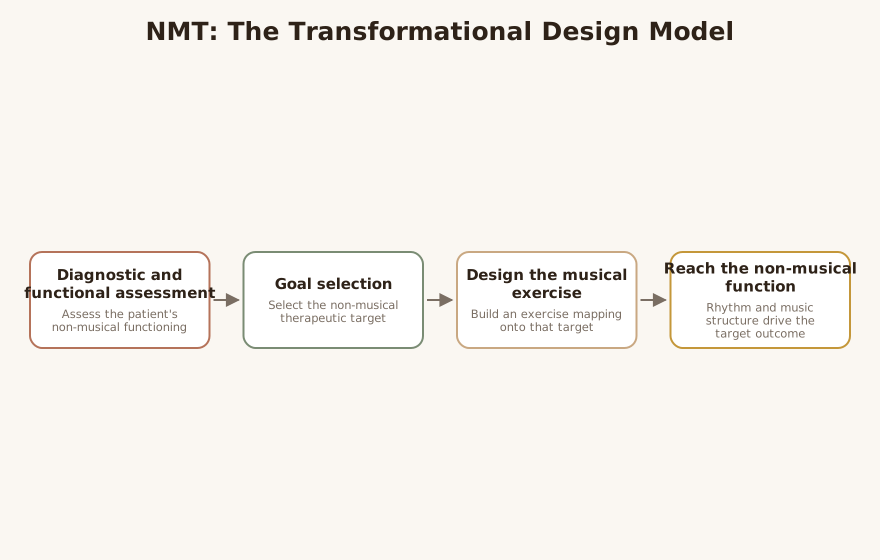
The central principle is that musical perception and production recruit widely distributed, bilateral brain networks, and that activating these networks can drive plasticity in non-musical functions 2. Rhythm is the load-bearing mechanism: rhythmic auditory cues provide a continuous temporal template that the motor system entrains to, modulating motor-neuron activity and producing more efficient, less variable movement 5. Because speech and singing share neural substrate, musical structure can also scaffold language output 4. NMT is built on the Transformational Design Model (TDM), a clinical reasoning framework that moves from diagnostic and functional assessment to goal selection to the design of a specific musical exercise that maps onto a non-musical therapeutic target 3. A foundational claim of the model is that patients need no musical training or ability to benefit, because the active ingredient is the structure of the stimulus, not aesthetic performance 4. Treatment is therefore standardized and reproducible rather than improvisational 6.
Interventions & Techniques
The NMT system comprises 20 standardized techniques organized across three domains and selected via the Transformational Design Model 3. In the sensorimotor domain, the flagship technique is Rhythmic Auditory Stimulation (RAS), which uses metered rhythmic cues to drive gait parameters such as cadence, stride length, and velocity; Patterned Sensory Enhancement (PSE) applies musical structure to non-rhythmic functional movements like reaching and sit-to-stand, and Therapeutic Instrumental Music Performance (TIMP) maps functional movement onto instrument playing for range, strength, and coordination 3. In the speech/language domain, Melodic Intonation Therapy (MIT) uses melody and rhythm to support language recovery in non-fluent aphasia, while Musical Speech Stimulation (MUSTIM) and Rhythmic Speech Cuing (RSC) address automatic speech and rate/intelligibility respectively 3. In the cognitive domain, techniques include Musical Attention Control Training (MACT), Musical Neglect Training (MNT), and Musical Mnemonics Training (MMT) for attention, hemispatial neglect, and memory 3. Each technique is operationalized so that the musical exercise is a functional analog of the rehabilitation goal 3.
Evidence Base
NMT is best described as established overall but uneven by domain, and the honest version of the evidence matters for referral decisions LLM. The strongest evidence is for RAS in gait rehabilitation: a multicenter trial found significantly greater gait improvement than conventional NDT/Bobath training, and RAS appears in clinical guidelines from the US Department of Veterans Affairs/Department of Defense and the Canadian Heart & Stroke Foundation 25. Motor studies document kinematic gains — smoother trajectories, reduced variability — and EMG evidence of more efficient muscle recruitment 5. MIT for non-fluent aphasia is supported by research dating to the mid-1970s with neuroimaging suggesting plasticity that reroutes speech pathways toward right-hemisphere regions, but many studies use small, hard-to-homogenize samples 5. Cognitive applications — neglect, attention, executive function, memory — are promising but explicitly flagged as developing and in need of further investigation 25. The reviewers conclude there is considerable evidence for NMT’s efficacy in stroke rehabilitation while calling for larger, more rigorous trials 5.
Populations & Indications
NMT is indicated across acquired and developmental neurological conditions 4. Reported populations include stroke survivors, people with Parkinson’s disease, traumatic brain injury, multiple sclerosis, cerebral palsy, autism, and various dementias 4. Service-setting descriptions add Down syndrome, sensory integration difficulties, and developmental delay among pediatric clients 6. Indications map to functional deficits rather than diagnoses: gait dysfunction and parkinsonian movement symptoms (RAS, PSE, TIMP), expressive aphasia and dysarthria (MIT, RSC), and attention, neglect, memory, and executive deficits following TBI or stroke (MACT, MNT, MMT) 34. For a psychotherapist or primary clinician, the indication is typically a referral question: a client with a neurorehabilitation profile who might benefit from a structured, music-based adjunct to PT, OT, or SLP 4. NMT is delivered by board-certified music therapists with additional NMT Academy training, not by general mental-health clinicians 6.
Problems-for-Work
The model organizes around concrete functional problems 3. For motor rehabilitation and gait dysfunction, RAS provides a metronomic template that improves walking velocity, symmetry, and stride length in hemiparetic gait 5.
LLM-generated illustrative example (not a guideline): A post-stroke client whose physical therapist reports asymmetric, slow gait might be referred for RAS as an adjunct, with the music therapist matching cue tempo to a target cadence and progressing speed as symmetry improves LLM.
For aphasia and speech/language impairment, MIT uses intoned, rhythmically paced phrases to elicit language in non-fluent presentations, while RSC paces rate to improve intelligibility in dysarthria and apraxia 35. For cognitive impairment and TBI sequelae, MACT structures exercises that drill sustained, selective, and divided attention, and MNT positions instruments in space to recruit attention toward a neglected field 3. For attention deficits and stroke recovery more broadly, musical structure supplies external timing and salience that can be superior to verbal cues for some targets such as neglect 5. For parkinsonian symptoms, auditory rhythm helps compensate for impaired internal timing during movement 5.
Contraindications, Cautions & Cultural Humility
The provided sources do not enumerate formal contraindications, so cautions here are framed as clinical reasoning rather than guideline statements LLM. NMT is an adjunctive rehabilitation modality and should not be positioned as a replacement for PT, OT, SLP, or medical management of the underlying condition 4. Because it is a standardized neuro-rehabilitative system rather than a psychotherapy, it is not a substitute for indicated mental-health treatment, and a referring therapist should keep psychological needs in their own scope LLM. Caution is warranted in extrapolating the strong gait evidence to weaker-evidence domains such as executive function, where claims should be made tentatively 25. On cultural humility, musical material carries cultural meaning, and the structural elements (tempo, meter) are foregrounded over any particular musical idiom; clinicians should ensure musical selections are acceptable and familiar to the client rather than imposed LLM. Hearing status and auditory processing should be considered, since the modality is fundamentally auditory LLM.
Treatment-Plan Suggestions & SMART Objectives
| Goal | SMART objective (example) | Mechanism |
|---|---|---|
| Improve hemiparetic gait | Within 8 weeks, increase self-selected gait velocity by a clinically meaningful margin during RAS-cued walking, per PT measures 5 | Rhythmic auditory entrainment of motor timing 5 |
| Increase functional speech output (non-fluent aphasia) | Over 12 sessions, produce target functional phrases using MIT with reduced cueing, per SLP scoring 5 | Recruitment of right-hemisphere language networks via melody/rhythm 5 |
| Improve speech intelligibility (dysarthria) | Within 6 weeks, raise listener intelligibility on a standard passage using RSC pacing 3 | Rhythmic control of speech rate and timing 3 |
| Strengthen sustained/selective attention | Across 10 sessions, complete graded MACT exercises at increasing difficulty without redirection 3 | Structured musical attention demands 3 |
| Reduce hemispatial neglect | Over 8 sessions, increase instrument strikes initiated in the neglected field during MNT 3 | Spatially configured musical cueing of attention 3 |
| Improve sequenced recall | Within 6 weeks, recall a target functional sequence using a musical mnemonic with fading support 3 | Musical mnemonic chunking and sequencing 3 |
| Improve upper-limb coordination | Over 10 sessions, complete TIMP reaching patterns with improved smoothness, per OT measures 35 | Rhythmic cueing and movement-to-sound mapping 5 |
Common Misconceptions
A frequent misconception is that NMT is the same as general or recreational music therapy; in fact it is a distinct, standardized system aimed at non-musical functional goals rather than emotional or expressive aims 6. A second is that clients must be musical — the model holds explicitly that no musical ability is required because the active ingredient is the musical stimulus structure 4. A third is that “music heals the brain” as a vague claim; the actual proposition is mechanistic, with rhythmic entrainment and network plasticity as specified pathways 5. A fourth is that the evidence is uniform — it is strongest for RAS/gait and weaker for several cognitive applications 25. Finally, NMT is sometimes mistaken for a freestanding alternative to conventional rehab, when sources describe it as working closely alongside PT, OT, and SLP 4.
Training & Certification
NMT is a credentialed specialty, not an open-access technique 6. The standard pathway requires that a clinician first hold board certification as a music therapist (MT-BC) and then complete an Academy training institute — described as a roughly 30-hour course — to practice the NMT system 6. The Academy of Neurologic Music Therapy maintains the standardized technique set and the Transformational Design Model that practitioners are trained to apply 3. The foundational knowledge base is consolidated in the Handbook of Neurologic Music Therapy and related texts such as Rhythm, Music, and the Brain 16. For a referring clinician, this means verifying that a prospective collaborator holds both MT-BC and NMT training before assuming NMT-specific competence 6.
Key Terms
Neurologic Music Therapy (NMT): A standardized, evidence-based system using musical elements to treat motor, speech/language, and cognitive functions 6. Transformational Design Model (TDM): The clinical reasoning model that translates assessment and goals into a targeted musical exercise 3. Rhythmic Auditory Stimulation (RAS): A sensorimotor technique using rhythmic cues to drive gait parameters 3. Rhythmic entrainment: The synchronization of motor activity to an external rhythmic template, the proposed mechanism behind RAS 5. Melodic Intonation Therapy (MIT): A speech technique using melody and rhythm to support language in non-fluent aphasia 3. Neuroplasticity: Structural and functional brain reorganization that NMT aims to drive through repeated, structured stimulation 5.
Resources & Further Reading
▶ Watch — a video introduction to this concept:
- Handbook of Neurologic Music Therapy — Thaut & Hoemberg (eds.), Oxford University Press, 2014
- Editorial: The Clinical Neuroscience of Music — Thaut, Francisco & Hoemberg, Frontiers in Neuroscience (2021)
- NMT System of Standardized Techniques — Academy of Neurologic Music Therapy
- Neurologic Music Therapy in Neurorehabilitation — Brain Injury Association of America
- Neurologic Music Therapy in Stroke Rehabilitation — Current Physical Medicine and Rehabilitation Reports (Springer, 2014)
- What Is Neurologic Music Therapy — NMTSA
Reflective / Supervision Questions
- When you refer a neurorehabilitation client, how do you distinguish NMT from general music therapy, and do you verify that the provider holds both MT-BC and NMT credentials?
- For which of your clients is the evidence genuinely strong (e.g., gait), and where would you frame NMT as promising-but-developing?
- How do you coordinate NMT goals with the PT/OT/SLP plan so that objectives reinforce rather than duplicate each other?
- How do you ensure musical material is culturally acceptable to the client rather than imposed by the clinician?
- What stays in your scope as the psychotherapist when a client is also receiving NMT, and how do you avoid overclaiming what the modality can do?