
Type & Discipline
Mindfulness-Based Relapse Prevention (MBRP) is a manualized, group-based aftercare program for adults recovering from substance use disorders 3. It sits within addiction psychology and belongs to the family of acceptance- and mindfulness-based behavioral therapies, alongside its lineage relatives Mindfulness-Based Stress Reduction (MBSR) and Mindfulness-Based Cognitive Therapy (MBCT) 5. MBRP is best understood not as a standalone treatment for active dependence but as a structured continuing-care intervention layered on top of, or following, an initial course of more intensive treatment 3. Clinically, it is a hybrid: it grafts formal mindfulness meditation practice onto the cognitive-behavioral skeleton of relapse prevention, so that the awareness skills cultivated in meditation are deployed at exactly the moments — high-risk situations, cravings, negative affect — that relapse-prevention theory identifies as pivotal 5.
Creators & Lineage
MBRP was developed at the Addictive Behaviors Research Center at the University of Washington and articulated in a 2010 clinician’s guide by Sarah Bowen, Neharika Chawla, and G. Alan Marlatt 3. Marlatt is the through-line: his classical relapse prevention (RP) model — which framed relapse as a process driven by high-risk situations, expectancies, and coping deficits — supplies the cognitive-behavioral architecture that MBRP retains 5. Onto that architecture, the developers integrated the meditation curricula of MBSR and MBCT, adapting their formal and informal practices for the specific phenomenology of addiction 5. The result is explicitly described by its developers as an aftercare program that integrates mindfulness practices and principles with cognitive-behavioral relapse-prevention skills 3. The second edition of the clinician’s guide, authored by Bowen, Chawla, Grow, and Marlatt, remains the authoritative manual for delivering the protocol 2.
Core Principles
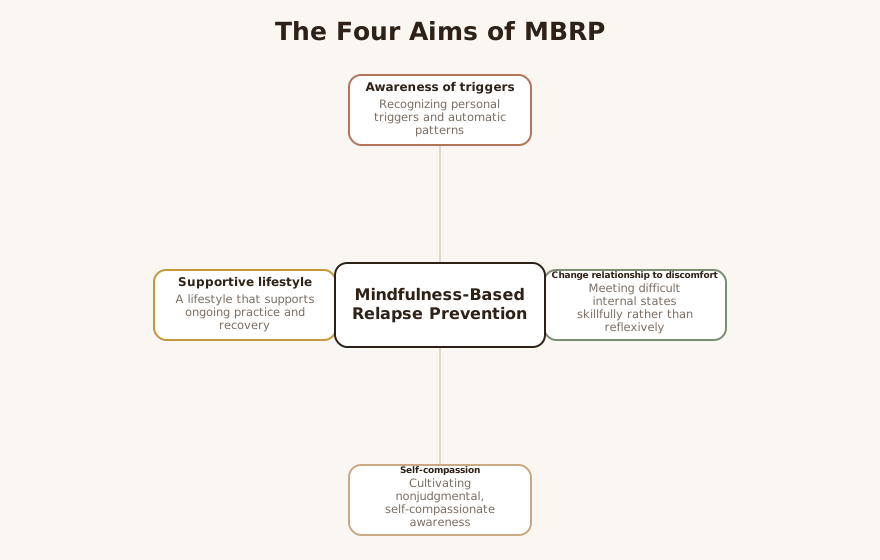
The program organizes itself around four stated aims: building awareness of personal triggers and automatic patterns; changing one’s relationship with discomfort so that difficult internal states are met with skillful rather than reflexive responses; cultivating self-compassion and nonjudgmental awareness; and establishing a lifestyle that supports both ongoing practice and recovery 3. The animating insight is that craving and the impulse to use are largely automatic, overlearned sequences, and that mindfulness inserts a deliberate pause — a moment of metacognitive awareness — between stimulus and response 5. Rather than suppressing or arguing with a craving, the client learns to observe it as a transient mental and bodily event that arises, peaks, and passes 5. This reframes the clinical target: the goal is not to eliminate cravings but to decouple the experience of craving from the behavior of using 5. LLM In practice this is a shift from a control paradigm (fight the urge) to an acceptance paradigm (allow the urge to move through awareness without acting), which is what most distinguishes MBRP from purely skills-based relapse prevention.
Interventions & Techniques
MBRP is delivered as eight weekly sessions, typically run as two-hour groups of roughly six to ten participants, combining psychoeducation with both formal and informal mindfulness practice 65. The signature technique is urge surfing: clients learn to observe a craving the way one watches a wave — noticing it build, crest, and subside — acknowledging its presence without acting on it 6. The body scan trains systematic, nonjudgmental attention to physical sensations, helping clients detect the somatic early-warning signs of stress and craving 6. The SOBER breathing space — Stop, Observe, Breathe, Expand awareness, Respond — is a brief, portable practice designed for use in real-world high-risk moments 5. Shorter daily meditations, often ten to fifteen minutes of breath-focused practice, build the capacity to observe thoughts without immediately reacting to them 6. Across these practices the operative mechanisms are reduced reactivity to cravings, decentering (seeing thoughts and urges as mental events rather than facts that demand action), acceptance of uncomfortable internal states, decoupling of craving from use, reduced reliance on substances to regulate negative affect, and strengthened metacognitive awareness 5. Homework — daily home practice between sessions — is integral, and adherence to it was a feasibility marker in early trials 1.
Evidence Base
Honesty about the evidence requires holding two things at once. MBRP is an established, well-specified protocol with a published manual, a defined curriculum, and a substantial dissemination footprint 23. The original pilot efficacy trial (n=168 adults who had recently completed intensive treatment) randomized participants to eight weeks of MBRP versus treatment as usual and reported significantly lower rates of substance use in the MBRP group over the four-month post-intervention period, along with greater reductions in craving and increases in acceptance and awareness 1. That was a genuinely encouraging early signal 1.
The more sobering picture comes from systematic review. A RAND systematic review (Grant, Hempel, et al., 2015) pooled six randomized controlled trials reporting on 685 participants, using GRADE methodology 4. Across studies it found no consistent evidence that MBRP outperforms its comparators — whether treatment as usual or standard relapse prevention — on relapse, frequency of substance use, or craving/withdrawal symptoms, and it rated the overall quality of evidence as very low 4. There were scattered positive signals (for example, a quality-of-life advantage over standard relapse prevention, and one trial’s reduction in alcohol relapse versus TAU), but these rested on single unreplicated trials with wide confidence intervals 4. The review’s bottom line was blunt: the available evidence in support of MBRP is very limited, the number of studies small, and firmer conclusions await further RCTs 4. LLM The practical reading for clinicians is that MBRP is a reasonable, low-risk, theoretically coherent aftercare option whose protocol is mature, but it should not be presented to clients as a proven superior alternative to standard relapse prevention — the comparative efficacy data simply do not yet support that claim.
Populations & Indications
MBRP is designed for individuals in recovery from addictive behaviors and works best as an aftercare program for those who have completed an initial course of treatment 3. Trials have enrolled adults who had recently finished intensive inpatient or outpatient programs, positioning MBRP squarely in the continuing-care or step-down phase 1. The studies pooled by the RAND review took place in substance use disorder specialty-care settings and enrolled polysubstance-using samples, with average ages in the mid-to-late thirties 4. Indicated populations therefore include people with alcohol use disorder, people with substance use disorders more broadly, and adults in aftercare treatment 43. LLM By clinical extension, the model is frequently applied to people with co-occurring depression and anxiety and to behavioral addictions, on the rationale that the same decoupling-and-decentering skills target the craving, stress, and emotional dysregulation that drive those problems — though direct trial evidence in those specific populations is thinner than the broad application would suggest.
Problems-for-Work
MBRP’s core clinical leverage is on the internal antecedents of relapse. For cravings, urge surfing gives the client a concrete behavioral alternative to acting on the urge: stay with the sensation, track its rise and fall, and let it pass 6. LLM For example, a client who feels a craving spike when driving past a former dealing spot uses SOBER at the next red light rather than white-knuckling or detouring in panic.
LLM-generated illustrative example (not a guideline): A client with alcohol use disorder describes 6 pm as the “danger hour.” In session she maps the chain: fatigue and irritability → the thought “I deserve a drink” → reaching for the bottle. Over several weeks she practices a body scan at 5:45 pm and a SOBER pause when the thought arises, learning to name the craving as a wave rather than a command. By week six she reports the urge still comes but no longer feels like an instruction. LLM
For emotional dysregulation and stress, the body scan and breath practices build interoceptive awareness and reduce the reflexive use of substances to manage negative affect 56. For relapse prevention broadly, the program reframes a lapse as a learnable event to be met with curiosity rather than shame, which is intended to interrupt the abstinence-violation spiral 5. LLM For co-occurring depression and anxiety, the decentering skill borrowed from MBCT lets the client relate to depressive or anxious thoughts as passing mental events, reducing their power to trigger use — although clinicians should treat the mood disorder on its own merits rather than assuming MBRP alone is sufficient.
Contraindications, Cautions & Cultural Humility
MBRP is generally low-risk, and the trials that tracked adverse events largely reported none, though reporting was inconsistent across the literature 4. LLM Standard cautions for intensive meditation apply: clients in acute psychosis, acute mania, active suicidality, or unmanaged severe trauma may find sustained interoceptive attention destabilizing, and a body scan can surface dissociation or trauma activation in some trauma-exposed clients — screen for this and titrate practice length accordingly. Because MBRP is an aftercare intervention, it presumes the client is past acute withdrawal and medically stabilized; it is not a substitute for medically managed detoxification or for pharmacotherapy where indicated 3. LLM On cultural humility: mindfulness practices are rooted in contemplative traditions, and some clients hold religious or cultural commitments that make secularized “meditation” feel foreign, appropriative, or at odds with their faith — name the practices in plain functional terms (focused attention, noticing sensations) and invite adaptation rather than presenting a fixed ritual. Group format also assumes a degree of psychological safety and shared language that may not hold across all communities, so attend to who is and is not represented in the room.
Treatment-Plan Suggestions & SMART Objectives
| Goal | SMART objective (example) | Mechanism |
|---|---|---|
| Reduce reactivity to cravings | Client will practice urge surfing during at least 4 of 7 daily craving episodes and log intensity/duration each week for 8 weeks | Reduced reactivity; decoupling craving from use 56 |
| Build a portable in-the-moment skill | Client will use the SOBER breathing space in 3 identified high-risk situations per week and report outcomes in group | Metacognitive pause between stimulus and response 5 |
| Increase interoceptive awareness of early relapse signs | Client will complete a 10-15 min body scan 5 days/week and identify 2 somatic craving cues by week 4 | Acceptance; early detection of triggers 6 |
| Decenter from relapse-related thoughts | Client will label “I deserve a drink”-type thoughts as passing mental events in session, with examples from 3 instances/week | Decentering borrowed from MBCT 5 |
| Reduce substance use as affect regulation | Client will substitute a mindfulness practice for substance use in 2 negative-affect episodes/week and rate distress before/after | Reduced reliance on substances for affect regulation 5 |
| Reframe lapses without shame | Following any lapse, client will complete a written chain analysis within 24 hours and bring it to the next session | Interrupts the abstinence-violation effect 5 |
| Sustain home practice | Client will complete and log assigned daily home practice on at least 6 of 8 weeks | Adherence/feasibility marker linked to skill acquisition 1 |
Common Misconceptions
LLM First, that MBRP is “proven” to beat standard relapse prevention — the pooled randomized evidence does not support superiority, and the most rigorous systematic review rated the evidence as very low quality. LLM Second, that the goal is to make cravings disappear; the actual target is to change the client’s relationship to cravings so the urge no longer dictates behavior 5. LLM Third, that mindfulness is relaxation — MBRP trains nonjudgmental awareness, and a session can be uncomfortable rather than soothing. LLM Fourth, that it is a frontline or standalone treatment for active dependence; it is designed and tested as an aftercare add-on for people who have completed initial treatment 3. LLM Fifth, that it replaces medication-assisted treatment or 12-step involvement — it is positioned to complement, not substitute for, those supports.
Training & Certification
The definitive practitioner resource is the second-edition clinician’s guide by Bowen, Chawla, Grow, and Marlatt, which provides the full session-by-session protocol 2. The official program site is the home for current curriculum materials, facilitator information, and dissemination resources 3. LLM As with MBSR and MBCT, competent delivery is generally understood to require the facilitator’s own established personal mindfulness practice in addition to familiarity with the manual, since the instructor models the stance being taught; clinicians should seek protocol-specific facilitator training and supervised experience rather than relying on the manual alone.
Key Terms
Urge surfing — observing a craving as a wave that rises, peaks, and subsides, without acting on it 6. SOBER breathing space — a brief five-step practice (Stop, Observe, Breathe, Expand, Respond) for high-risk moments 5. Decentering — relating to thoughts and cravings as transient mental events rather than facts requiring action 5. Decoupling — breaking the automatic link between craving and substance use 5. Metacognitive awareness — the capacity to observe one’s own mental processes as they unfold 5. Aftercare — continuing-care intervention delivered after an initial, more intensive course of treatment 3. High-risk situation — Marlatt’s term for the contexts and internal states that precede relapse 5.
Resources & Further Reading
▶ Watch — a video introduction to this concept:
- Bowen et al., 2009 — pilot efficacy trial (PubMed)
- Bowen, Chawla, Grow & Marlatt — Clinician’s Guide, 2nd ed. (publisher page)
- Official MBRP program site (mindfulrp.com)
- Grant, Hempel et al. — RAND systematic review (RR-1031, PDF)
- MBRP: History & Mechanisms review (University of Virginia, PDF)
- MBRP: Techniques & Benefits explainer (Olympic Behavioral Health)
Reflective / Supervision Questions
- LLM How do I talk to a client about MBRP’s evidence base honestly — conveying that it is a coherent, low-risk aftercare option without overstating proven superiority to standard relapse prevention? LLM
- When a client’s body scan surfaces trauma or dissociation, how do I titrate or pause the practice while keeping them engaged? LLM
- Am I positioning MBRP as a complement to medication-assisted treatment, mutual-help, and ongoing care, or am I inadvertently letting it crowd those out? LLM
- How robust is my own personal mindfulness practice, and how does its state show up in the room when I facilitate? LLM
- How do I adapt the language and rituals of the protocol for clients whose cultural or religious frameworks make secular “meditation” uncomfortable? LLM
- When a client lapses, am I helping them treat it as a learnable chain of events, or am I reinforcing the shame that fuels the abstinence-violation effect?