
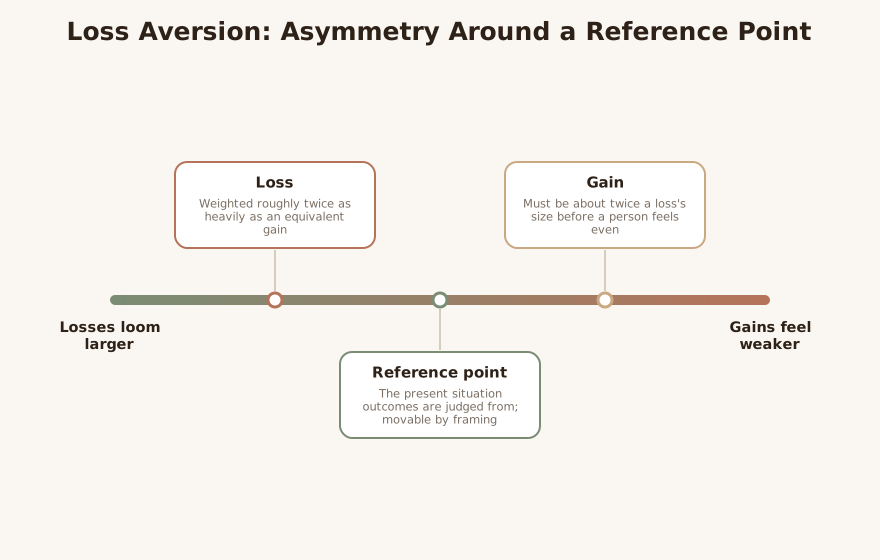
Loss aversion is the observation that, for most people, the pain of losing something is felt more keenly than the pleasure of gaining the same thing — losses loom larger than equivalent gains 6. It is one of the central building blocks of prospect theory, the descriptive model of choice under risk that Daniel Kahneman and Amos Tversky introduced in 1979 2. For a practicing therapist the construct is quietly everywhere: it offers a precise, evidence-grounded vocabulary for why clients cling to a familiar but painful status quo, why “what you stand to lose” can move a person whom “what you stand to gain” leaves cold, and why so much ambivalence about change is structurally weighted toward staying put LLM. The catch, which this article treats honestly, is that the size and even the universality of the effect are now genuinely contested in the research literature 5.
Type & Discipline
Loss aversion is a theoretical construct from behavioral economics, not a therapy, a diagnosis, or a treatment protocol 1. It belongs to the family of prospect theory and, more broadly, to the study of judgment and decision-making under risk and uncertainty 2. It describes a regularity in how human beings evaluate outcomes relative to a reference point: the same objective situation is experienced as worse when it is framed as a loss than when it is framed as a gain 6. Its clinical value is therefore explanatory and conceptual rather than procedural — it is a lens to layer onto established interventions, not a stand-alone modality LLM. Used that way, it gives the clinician a way to name, without pathologizing, why a client can sincerely want to change and still find the prospective costs of changing more vivid than the prospective benefits LLM.
Creators & Lineage
The construct was introduced by Amos Tversky and Daniel Kahneman in their 1979 paper “Prospect Theory: An Analysis of Decision under Risk,” which proposed prospect theory as a descriptive alternative to the long-dominant expected utility theory 2. In expected utility theory, outcomes are evaluated against final states of wealth; prospect theory’s innovation was to evaluate them as gains and losses relative to a reference point, with a value function that is markedly steeper for losses than for gains 3. Kahneman received the Nobel Memorial Prize in Economic Sciences in 2002 for this body of work, by which time Tversky, who would likely have shared it, had died 2.
The intellectual lineage runs forward from prospect theory into the larger program of cognitive heuristics and biases, and into the applied behavioral-economics work — choice architecture, framing, and nudging — that draws on loss aversion to design defaults and messages 4. It also runs into clinical practice by affinity rather than by direct descent: cognitive behavioral therapy already treats predictions and appraisals as testable, and motivational interviewing already works directly with the felt balance of costs and benefits that loss aversion describes LLM. The construct’s most prominent contemporary critic is David Gal, whose work with Derek Rucker argues that loss aversion has been substantially overstated as a general principle 5.
Core Principles
The central claim is asymmetry around a reference point: people evaluate outcomes not in absolute terms but as gains or losses from where they currently stand, and the function mapping losses to subjective value is steeper than the function for gains 3. The reference point is usually the present situation, but it is not fixed — it can be shaped by past experience, current circumstances, expectations, and framing, which is precisely what makes the construct clinically malleable 3.
The classic quantification is that losses are weighted roughly twice as heavily as equivalent gains, the widely cited loss-aversion coefficient (lambda) of about two 6. A loss of a given size, on this account, must be offset by a gain something like twice as large before a person feels even 4. This magnitude should be held loosely: it is an average from particular experimental paradigms, not a fixed personal constant, and as the evidence section discusses, both its size and its presence vary considerably 6.
Two well-known phenomena are usually read as downstream consequences of loss aversion. The endowment effect is the tendency to value a thing more once you own it, so that the price at which people will sell an item they hold exceeds the price they would pay to buy it 6. Status quo bias is the related preference for leaving things as they are, because any change is parsed as a loss of the current state as well as a potential gain 6. Both help explain a clinical intuition: for many clients, the devil they know is weighted more heavily than the unknown that might be better LLM.
Interventions & Techniques
Loss aversion does not come packaged with proprietary techniques; it informs how a clinician frames and conceptualizes change work within existing interventions LLM. Its most direct translation is to message framing — choosing whether to emphasize what a client stands to gain by changing or what they stand to lose by not changing LLM. Because losses tend to be felt more strongly, loss-framed messaging (“here is what continued use is costing you”) can in some contexts be more activating than the equivalent gain frame (“here is what sobriety would give you”), and this is a recognized application in health-behavior communication 4. This claim should be applied with care, for reasons taken up under cautions LLM.
The construct also reframes the work of decisional balance. When a client is ambivalent, mapping the costs and benefits of changing and of staying the same makes visible that the “losses of changing” column is, by default, psychologically heavier than its size alone would warrant LLM. Naming this externalizes the pull of inertia and converts “I can’t seem to commit” into “my mind, like everyone’s, gives extra weight to what I’d give up” 5. A clinician can also work the reference point itself: because loss aversion is anchored to a reference state, helping a client re-anchor — to treat the healthier behavior, rather than the old one, as the baseline — changes which outcomes register as losses 3. Finally, the endowment and status-quo dynamics suggest that highlighting what a client has already invested in change, and what relapse would forfeit, can recruit loss aversion in the service of maintenance rather than against it LLM.
LLM-generated illustrative example (not a guideline): A client weighing whether to taper off alcohol keeps describing the gains of quitting (“I’d sleep better, save money”) with flat affect. The clinician, with permission, shifts the frame to what continued drinking is already costing — eroded trust with a partner, mornings lost — and the client’s engagement visibly sharpens. The clinician names this out loud as loss aversion, normalizing it, and the pair re-anchor the reference point so that the sober week becomes “normal” and a drinking day becomes the felt loss. LLM
Evidence Base
The maturity of loss aversion is best described as established as an influential framework, while its magnitude and universality are genuinely contested — and the honest clinical reading must hold both halves at once 5. As a foundational component of prospect theory, loss aversion is one of the most cited ideas in behavioral economics, with a long record of laboratory demonstrations and convergent findings: neuroimaging associates anticipated losses with stronger limbic (amygdala) engagement than equivalent gains, capuchin monkeys show loss-averse-like choices suggesting deep roots, and there is evidence that potential losses bias the very control of attention 67. The attention work is a good example of nuance rather than simple confirmation: in that study, participants did not simply orient toward loss-laden options but tended to direct attention away from targets that carried potential losses, an avoidant pattern consistent with losses being weighted more heavily 7.
The serious caveat is that a substantial critique has emerged questioning whether loss aversion is the robust, general principle it is often taken to be 5. Gal and Rucker’s “The Loss of Loss Aversion” argues that the phenomenon is far more contextual than the textbook version implies, that in many situations no loss-gain asymmetry is observed at all, and that loss aversion may be superfluous as an explanation where simpler accounts suffice 5. A recurring alternative is David Gal’s “psychological inertia” — the idea that much of what looks like loss aversion (status-quo clinging, the endowment effect) is better explained by a general tendency to stay put than by losses specifically outweighing gains 6. Other work indicates the asymmetry depends on payoff magnitude and on competitive or task context, so that the ~2:1 coefficient is a feature of certain paradigms rather than a universal constant 6. The cautious synthesis for clinicians: the idea that losses can loom larger than gains is a useful and frequently observed pattern, but it is neither automatic nor uniform, and clinical inferences from it — for example, that loss-framing will reliably motivate a given client — are reasoned extensions, not settled findings LLM.
Populations & Indications
The construct is most illuminating wherever a presentation turns on the disproportionate weight of what would be given up LLM. Adults in general are a fair target, since the reference-dependent asymmetry is described as a broadly human pattern rather than a niche one 4. Clients in motivational work are a natural fit, because ambivalence is, in part, a contest between the salient losses of changing and the less salient gains, and loss aversion names why that contest is tilted LLM. People with addictions illustrate the same dynamic acutely: the immediate, concrete losses entailed by giving up a substance often outweigh, in felt terms, the larger but more diffuse and distant gains of recovery LLM.
Patients facing health decisions are a well-studied applied group, where whether an option is framed as a “loss” or a “gain” can shift the choice despite identical underlying information 3. Procrastinators and people resistant to change can both be read through status-quo bias and the endowment effect: the present arrangement is “owned” and therefore overvalued, and acting incurs an upfront, vivid loss against an uncertain future benefit 6. Across all of these, loss aversion is an adjunct formulation lens, not a diagnosis-specific protocol, and its fit should be checked against the person rather than assumed LLM.
Problems-for-Work
Ambivalence about change. Loss aversion gives ambivalence a structure: the costs of changing are not merely listed against the benefits but are systematically over-weighted, which is why a decisional balance can feel “stuck” even when the rational tally favors change 5. Naming this can shift the client from self-blame to a shared, normalized account LLM.
Treatment nonadherence and health-behavior resistance. Both can be reframed as the present routine being “endowed” and any new regimen registering as a loss of comfort, time, or identity; loss-framed messaging and reference-point work target that asymmetry directly 4.
Substance use disorders. The vivid, immediate losses of giving up use can dominate the diffuse gains of recovery; making the ongoing losses of continued use concrete and present-tense can recruit the same mechanism toward change LLM.
Procrastination and avoidance. Acting incurs a certain, near-term cost while the payoff is delayed and uncertain, so status-quo bias favors delay; surfacing the accumulating, often hidden losses of not acting can rebalance the felt equation 6.
Decision-making difficulties. When every option is parsed against a current reference point, the fear of forgoing what one has can paralyze choice; clarifying and, where appropriate, re-anchoring the reference point loosens that grip 3.
LLM-generated illustrative example (not a guideline): A client has avoided scheduling a long-overdue medical follow-up for months. The clinician notes that, framed as a gain, “peace of mind” is abstract and easy to defer, whereas framed as a loss, “each month of not knowing is a month a treatable problem could be quietly worsening” is more activating. They make the cost of continued avoidance concrete and time-bound, and the client books the appointment that week. LLM
Contraindications, Cautions & Cultural Humility
Because loss aversion is a conceptual model rather than a treatment, it carries no direct contraindications, but its misuse does LLM. The largest caution concerns loss-framing itself: the claim that emphasizing losses reliably motivates change is an over-simplification, and loss-framed or fear-based messaging can backfire, provoking defensiveness, reactance, or shame rather than action LLM. This sits in real tension with the spirit of motivational interviewing, which warns against scare tactics and against the clinician arguing the case for change; loss-framing should therefore be offered collaboratively, in the client’s own terms, and abandoned the moment it produces resistance LLM. A second caution is tone: telling a struggling client that their inertia is “just a cognitive bias” can read as dismissal, so the asymmetry is best offered as a universal feature of human minds — the clinician’s included — rather than a personal failing LLM.
A third caution follows directly from the evidence: loss aversion is contested, context-dependent, and sometimes absent, so a clinician should treat it as a tentative hypothesis about a given client rather than a law to apply 5. Culturally, what counts as the relevant reference point, what is experienced as a meaningful loss, and how much change is desirable all vary across individuals and communities, and the implicit “rational” calibration of a textbook gamble is not the right target for every person’s life LLM. There is also a justice dimension: for a client from a precarious or marginalized context, heavy weighting of a potential loss may track a genuinely elevated risk and a thinner margin for error, so what looks like bias may be accurate prudence that should not be pathologized LLM.
Treatment-Plan Suggestions & SMART Objectives
| Goal | SMART objective (example) | Mechanism |
|---|---|---|
| Build awareness of the loss-gain asymmetry in ambivalence | Within 3 weeks, the client will complete a written decisional balance for one target behavior and identify which “losses of changing” feel over-weighted, reviewing it in session | Externalizes how losses are weighted more heavily than equivalent gains 5 |
| Re-anchor the reference point toward the healthier behavior | Over 4 weeks, the client will track the new behavior daily and describe in session how it is becoming the “baseline,” noting what now registers as a loss | Reference-point shift changes which outcomes are coded as losses 3 |
| Recruit loss aversion to support maintenance | By session 6, the client will list in writing what relapse or stopping would forfeit (time, trust, progress already invested) and keep the list accessible | Endowment / status-quo weighting applied toward sustaining change 6 |
| Test loss-framed vs. gain-framed self-talk | For 2 weeks, the client will phrase one daily motivation as a gain and once as a loss, rating which feels more activating, and report the pattern | Compares framing effects on motivation, checking fit per client 4 |
| Reduce procrastination on an avoided task | Within 2 weeks, the client will make the accumulating cost of delay concrete and time-bound for one task and complete a first step | Surfaces hidden ongoing losses of the status quo 6 |
| Address health-behavior nonadherence | By session 5, the client will articulate what continued nonadherence is already costing in present-tense terms and set one adherence target | Loss-frame applied to an over-valued current routine 4 |
| Protect against framing backfire | Ongoing, the client and clinician will check after each loss-framed reflection whether it increased motivation or defensiveness, adjusting accordingly | Guards against reactance from loss/fear framing 5 |
Common Misconceptions
A frequent misreading is that loss aversion means people are simply “irrational about losses” in a fixed, universal way; the more accurate and contested picture is that the asymmetry is reference-dependent and strongly context-dependent, present in many settings but absent or reversed in others 5. A second misconception is that the ~2:1 coefficient is a stable personal constant; it is an average from particular paradigms, and both its magnitude and its presence vary with task, stakes, and context 6. A third is treating the endowment effect and status-quo bias as proof of loss aversion specifically, when critics argue these are at least as well explained by a general psychological inertia that has nothing to do with losses outweighing gains 6. A fourth is the clinical over-extension that loss-framing always motivates: framing effects are real but mixed, and loss or fear frames can backfire LLM. Finally, clinicians sometimes treat loss aversion as a validated therapy in its own right, when its evidence concerns decision behavior rather than the outcomes of any branded treatment LLM.
Training & Certification
There is no certification, credential, or formal training pathway specific to loss aversion, because it is a theoretical construct rather than a practice modality LLM. Clinicians typically encounter it within graduate coursework in judgment and decision-making, behavioral economics, or cognitive psychology, and through the primary and secondary literature, beginning with prospect theory and its accessible explainers 23. Engaging the critical literature — particularly Gal and Rucker’s reassessment — is part of using the construct responsibly, so that it is applied as a contested hypothesis rather than a settled law 5.
For applied competence, the relevant skills live in the established interventions the construct informs: decisional-balance and discrepancy work within motivational interviewing, cognitive restructuring and framing work within cognitive behavioral therapy, and behavioral experiments — each with its own evidence base and training routes LLM. The most useful preparation is therefore to learn the model well enough to use it as psychoeducation and case formulation, while building credentialed skill in the treatments it complements LLM.
Key Terms
- Loss aversion — the tendency for losses to loom larger than equivalent gains relative to a reference point 6.
- Reference point — the baseline (often the current situation) against which outcomes are coded as gains or losses, which can itself be shifted by experience, expectation, and framing 3.
- Loss-aversion coefficient (lambda) — the ratio by which losses are weighted relative to gains, classically around two, but variable across context and task 6.
- Value function — the prospect-theory curve that is steeper for losses than for gains, capturing the asymmetry 3.
- Endowment effect — valuing a good more once it is owned, so selling prices exceed buying prices 6.
- Status quo bias — the preference for leaving things unchanged, since change is parsed partly as a loss of the current state 6.
- Framing effect — the shift in choice produced by describing the same situation as a loss versus a gain 6.
- Psychological inertia — the proposed general tendency to stay put that critics argue explains many “loss aversion” phenomena more parsimoniously 6.
Resources & Further Reading
▶ Watch — a video introduction to this concept:
- Loss aversion — BehavioralEconomics.com Mini-Encyclopedia
- Prospect theory — Wikipedia
- Prospect Theory in Psychology: Loss Aversion Bias — Simply Psychology
- Loss aversion — The Decision Lab
- Gal & Rucker, “The Loss of Loss Aversion: Will It Loom Larger Than Its Gain?” (discussion via PMC)
- Loss aversion — Wikipedia
- Loss aversion in the control of attention — PubMed
Reflective / Supervision Questions
- When a client is “stuck” in ambivalence, do I routinely distinguish the size of the losses of changing from the extra psychological weight they carry, and does that change how I respond? 5
- How do I offer the idea of loss aversion so it lands as normalizing — a universal feature of minds, including my own — rather than as telling a struggling client their inertia is “just a bias”? LLM
- Where am I assuming loss-framing will motivate a client, and how would I notice if it were instead producing defensiveness or shame? LLM
- Given that loss aversion is contested and context-dependent, how do I hold it as a hypothesis to test with this person rather than a law to apply? 5
- For clients from precarious or marginalized contexts, where might heavy weighting of a potential loss reflect an accurate, elevated risk rather than a distortion I should challenge? LLM
- When I help a client re-anchor a reference point, whose definition of the “right” baseline am I importing, and have I checked it against their values and circumstances? 3