
Type & Discipline
Prospect Theory is a descriptive theory of decision-making under risk, originating in behavioral economics and cognitive psychology rather than clinical science 1. It belongs to the broader family of judgment-and-decision-making research and stands as the principal descriptive alternative to the normative expected utility theory that preceded it 6. Where expected utility theory specifies how a rational agent should weigh probabilities and outcomes, Prospect Theory documents how real people do — a distinction that matters enormously to clinicians, who work with how clients actually experience and evaluate choices rather than with idealized rationality 4. LLM
The theory is not a treatment modality and was never intended as one LLM. Its clinical value is interpretive and translational: it gives therapists a precise vocabulary for the systematic, predictable ways that anxious, depressed, or impulsive clients distort the felt value of outcomes, and it points toward reframing strategies that already live inside cognitive and behavioral approaches 5. LLM
Creators & Lineage
Prospect Theory was developed by psychologists Daniel Kahneman and Amos Tversky and published in Econometrica in 1979 1. It grew directly out of their earlier program on cognitive heuristics and biases — the demonstration that human judgment relies on mental shortcuts that produce systematic, lawful errors 6. The intellectual lineage runs from expected utility theory (the target of critique), through the heuristics-and-biases literature, into a formal model capable of predicting the specific choices people make when those choices violate rationality 5. LLM
In 1992, Tversky and Kahneman published cumulative prospect theory, a revision that applied the probability-weighting function to cumulative rather than individual probabilities, extended the model to outcomes with many possible results, and resolved a technical flaw in which the original version could predict choices that violated stochastic dominance 2. Kahneman received the 2002 Nobel Memorial Prize in Economic Sciences for this body of work; Tversky had died in 1996 and the prize is not awarded posthumously 3. Kahneman’s Nobel lecture, “Maps of Bounded Rationality,” situates Prospect Theory within a larger account of two systems of thinking — fast, intuitive, automatic judgment versus slow, effortful reasoning — a framing many clinicians will recognize as cognate to dual-process models used in therapy 3. LLM
Core Principles
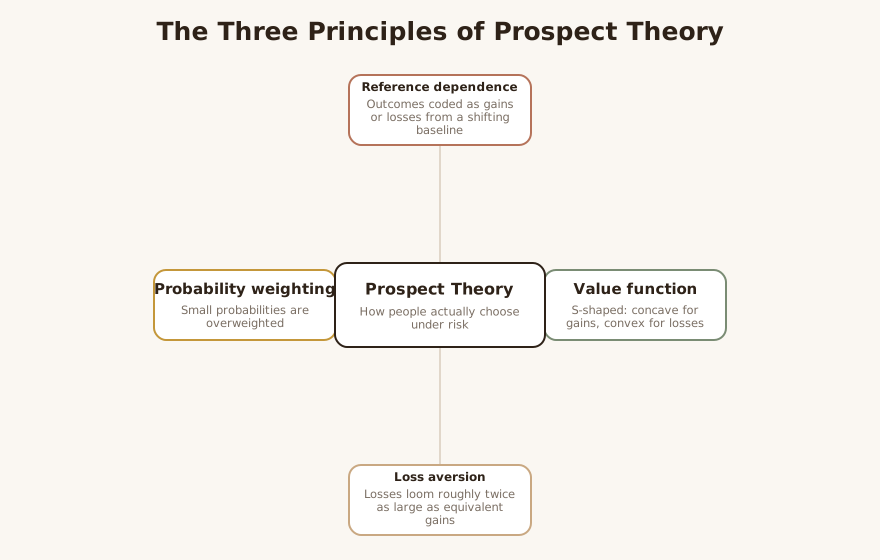
Three interlocking principles define the theory. The first is reference dependence: people do not evaluate outcomes in terms of absolute final wealth or states, but as gains or losses measured against a neutral reference point — usually the current situation, but a point that can shift with expectation, framing, and circumstance 4. Because the reference point is movable, the same objective outcome can be experienced as a gain or a loss depending on where the baseline sits 6. LLM
The second principle is the value function, which is S-shaped and asymmetric 6. It is concave for gains (each additional dollar of gain adds less subjective value than the last — diminishing sensitivity) and convex for losses (each additional unit of loss hurts somewhat less than the last) 6. Critically, the function is markedly steeper on the loss side than the gain side — this is loss aversion, the finding that losses loom larger than equivalent gains 1. In the 1992 estimation, the loss-aversion coefficient was approximately 2.25, meaning a loss is felt roughly twice as intensely as a gain of the same magnitude 2. LLM
The third principle is probability weighting. People do not use objective probabilities; they pass them through a nonlinear weighting function that overweights small probabilities and underweights moderate-to-large ones 4. This produces the certainty effect (outcomes that are certain are weighted disproportionately relative to merely probable ones) and the possibility effect (a tiny chance of a large outcome is given more weight than its probability warrants) 6. 6
These principles combine into the fourfold pattern of risk attitudes: people tend to be risk-averse for high-probability gains and low-probability losses, but risk-seeking for low-probability gains (the lottery pull) and high-probability losses (gambling to avoid a sure loss) 6. The model also describes an editing phase, in which prospects are simplified and coded into gains and losses before an evaluation phase computes their weighted value 4. LLM
Interventions & Techniques
Prospect Theory yields no proprietary techniques, but it sharpens several that clinicians already use LLM. The central clinical lever is reference-point reframing: because felt value depends on the baseline, deliberately shifting the reference point can change a client’s emotional response to an identical objective situation 4. A choice framed as “what you might lose” recruits loss aversion and avoidance; the same choice framed as “what you stand to gain” or “where you already are” often shifts the affective charge 6. LLM
LLM-generated illustrative example (not a guideline): A client paralyzed about leaving an unsatisfying job frames the decision entirely as “giving up my stable salary” — a pure loss frame. The clinician helps re-anchor the reference point to the client’s actual lived experience (“relative to the dread you feel each Sunday night, what would staying cost you?”), making the status quo itself visible as an ongoing loss rather than a safe baseline. LLM
A second technique is decoupling probability from magnitude. Because clients overweight small probabilities, anxious catastrophizing often attaches near-certainty-level dread to genuinely rare outcomes 4. Naming this distortion explicitly — separating “how bad would it be?” from “how likely is it, really?” — directly targets the probability-weighting bias 6. A third is gain/loss recoding of behavioral targets, presenting the same goal in whichever frame is more motivating for the specific behavior and client 5. LLM
Evidence Base
The maturity of Prospect Theory is best described as established. The 1979 paper is among the most cited works in the social sciences, and its core empirical claims — reference dependence, loss aversion, and probability weighting — have been replicated across decades, cultures, and laboratories 6. The 1992 cumulative version put the model on firmer axiomatic footing and provided quantitative parameter estimates that have been widely reproduced 2. The Nobel committee’s recognition reflects the theory’s standing as foundational descriptive science rather than a contested hypothesis 3. LLM
Honesty requires two qualifications for clinicians. First, Prospect Theory is robust as a descriptive economic and psychological model, but it was not validated as a clinical intervention; its therapeutic applications are extrapolations, not the subject of the original randomized evidence 1. Second, the model has acknowledged limitations: the reference point can be difficult to specify in advance, which weakens predictive precision in any individual case, and critics note the theory may oversimplify the underlying neural decision processes 4. The construct travels well into the consulting room as an explanatory frame, but a clinician should treat “reframe the reference point” as a hypothesis to test with a given client, not a guaranteed mechanism 6. LLM
Populations & Indications
The theory is most clinically illuminating with populations whose presenting problems hinge on the valuation of uncertain outcomes LLM. People with anxiety disorders, including those with generalized anxiety disorder, show in clinical form the probability-weighting distortion the theory formalizes — small risks experienced as near-certainties 4. People with depression often inhabit a loss-saturated reference frame in which neutral or positive outcomes are coded as losses against an idealized or past baseline LLM. LLM
Individuals with gambling disorder map onto the fourfold pattern with unusual directness — the lottery-like pull of low-probability gains and the loss-chasing risk-seeking that the convex loss limb predicts 6. Patients making medical decisions are exquisitely sensitive to whether outcomes are framed as survival or mortality, a classic demonstration of framing effects 5. Adults with maladaptive risk behavior and clients facing major life decisions — career, relationship, relocation — present the reference-point and loss-aversion dynamics in their most consequential, real-world form 5. LLM
Problems-for-Work
Loss aversion and avoidance is the prototypical target: the convexity and steepness of the loss limb explain why clients will work harder to avoid a loss than to secure a larger gain, fueling avoidance cycles 1. Application — surfacing the hidden, ongoing costs of the avoided action so the status quo stops reading as a costless baseline LLM. Catastrophizing and intolerance of uncertainty reflect probability overweighting; the work is to decouple severity from likelihood 4. LLM
Decision-making difficulties and indecisiveness often stem from a status-quo/reference-point lock in which every option is coded as a loss relative to keeping things as they are 6. Gambling disorder and maladaptive financial behavior engage the risk-seeking limbs of the fourfold pattern, where chasing losses and overvaluing slim chances drive behavior 6. Risk misperception — over- or under-estimating the weight of a low-probability event — is directly addressed by naming the weighting distortion and re-grounding the client in base rates 4. Generalized anxiety disorder integrates several of these: a loss-coded reference frame plus probability overweighting LLM. LLM
Contraindications, Cautions & Cultural Humility
Prospect Theory describes statistical regularities across populations; it is not a diagnostic instrument and should never be used to label an individual client’s judgment as defective LLM. Reframing a client’s reference point can shade into invalidation if it implies their fear or grief is merely a cognitive error — losses that loom large are often losses that are large, and the steep loss limb sometimes reflects accurate appraisal of genuine threat LLM. The clinical art is to distinguish distorted valuation from proportionate response, and to do the former collaboratively rather than by correction LLM.
Cultural humility is essential because the reference point itself is culturally and contextually shaped — what counts as a baseline, a loss, or an acceptable risk varies with cultural norms, socioeconomic precarity, and lived history 4. For a client with limited material security, loss aversion around money is not a bias to be reasoned away but an adaptive response to real stakes LLM. A further caution: the theory’s parameters are population averages, and individual reference points are notoriously hard to specify, so clinicians should treat any reframing as an experiment co-designed with the client rather than a correction imposed on them 4. LLM
Treatment-Plan Suggestions & SMART Objectives
| Goal | SMART objective (example) | Mechanism |
|---|---|---|
| Reduce loss-aversion-driven avoidance | Within 6 weeks, client will complete 3 previously avoided tasks after listing the ongoing cost of avoidance for each | Re-anchoring the reference point so the status quo reads as a loss 1 |
| Improve risk calibration in anxiety | Within 8 sessions, client will separate “how bad” from “how likely” for 5 feared outcomes, logging base-rate estimates | Counteracting overweighting of small probabilities 4 |
| Reduce catastrophizing | Daily for 2 weeks, client will record one catastrophic prediction and its actual outcome | Recalibrating distorted probability weighting through disconfirmation 6 |
| Increase decisional follow-through | Within 4 weeks, client will make and act on 2 deferred decisions using a gain-framed pros/cons grid | Loosening status-quo/reference-point lock 6 |
| Reduce loss-chasing in gambling behavior | Within 30 days, client will identify 3 loss-chasing episodes and apply a pre-set stop rule | Interrupting risk-seeking on the convex loss limb 6 |
| Improve medical/financial decision quality | Before next major decision, client will reframe the choice in both gain and loss terms and compare | Neutralizing framing effects 5 |
| Build tolerance of uncertainty | Within 8 weeks, client will rate distress before and after 4 deliberate uncertainty exposures | Reducing the affective premium placed on certainty 4 |
Common Misconceptions
A frequent error is conflating Prospect Theory with expected utility theory or treating it as merely a tweak; it is a fundamentally descriptive model of actual behavior, deliberately departing from the normative account of how a rational agent should choose 6. A second misconception is that loss aversion means people are simply “risk-averse” — in fact the theory predicts risk-seeking in two of its four cells, most notably when facing a probable loss 6. LLM
Clinicians sometimes assume the reference point is fixed at zero or at current wealth; the whole power of the theory is that the reference point is movable and frame-dependent, which is precisely what makes therapeutic reframing possible 4. Another is treating loss aversion as a personal flaw rather than a near-universal feature of human valuation 1. Finally, the model is often misremembered as proven in clinical treatment; its robust evidence is behavioral-economic, and its therapeutic use remains a reasoned extension 1. LLM
Training & Certification
There is no certification in Prospect Theory; it is a body of knowledge, not a credentialed practice LLM. Clinicians absorb it through the primary literature — the 1979 Econometrica paper and the 1992 cumulative-theory paper — and through Kahneman’s accessible synthesis in his Nobel lecture 1. The most efficient clinical on-ramp is to read the original framing examples and then map the fourfold pattern onto one’s own caseload 3. Skill in applying the ideas develops through existing training in cognitive and behavioral therapies, where reframing, probability estimation, and behavioral experiments are already core competencies 5. LLM
Key Terms
- Reference point — the neutral baseline against which outcomes are coded as gains or losses; movable and frame-dependent 4.
- Loss aversion — losses loom larger than equivalent gains, with a coefficient of roughly 2.25 in the 1992 estimation 2.
- Value function — the S-shaped curve, concave for gains and convex for losses, steeper on the loss side 6.
- Probability weighting — the nonlinear transformation that overweights small probabilities and underweights large ones 4.
- Certainty effect — disproportionate weight given to outcomes that are certain versus merely probable 6.
- Framing effect — the same outcome evaluated differently depending on whether it is presented as a gain or a loss 5.
- Fourfold pattern — the predictable mix of risk-averse and risk-seeking attitudes across high/low probability and gain/loss 6.
- Editing and evaluation phases — the two-stage process of simplifying prospects, then computing their weighted value 4.
- Cumulative prospect theory — the 1992 revision applying weighting to cumulative probabilities and many-outcome prospects 2.
Resources & Further Reading
▶ Watch — a video introduction to this concept:
- Kahneman & Tversky (1979), Prospect Theory: An Analysis of Decision under Risk
- Tversky & Kahneman (1992), Advances in Prospect Theory: Cumulative Representation of Uncertainty (PDF)
- Kahneman (2002), Maps of Bounded Rationality — Nobel Prize Lecture (video)
- Prospect Theory in Psychology: Loss Aversion Bias — Simply Psychology
- Prospect Theory — The Decision Lab
- Prospect theory — Wikipedia
Reflective / Supervision Questions
- When I help a client “reframe,” am I shifting their reference point toward a more accurate appraisal, or am I subtly invalidating a loss that is genuinely large? LLM
- For this client, is the steep loss limb a distortion to be softened, or a proportionate response to real precarity I should respect? LLM
- Where on the fourfold pattern does my client’s risk behavior sit — and am I treating risk-seeking and risk-aversion as if they were the same problem? LLM
- How do this client’s cultural and economic circumstances define what counts as their reference point, and have I assumed a baseline that is mine rather than theirs? LLM
- Am I separating “how bad” from “how likely” in my own case formulation, or am I importing the client’s probability overweighting into my clinical judgment? LLM
- What evidence would tell me that a reference-point reframe actually changed felt value for this client, rather than that they simply agreed with me in session? LLM