
Type & Discipline
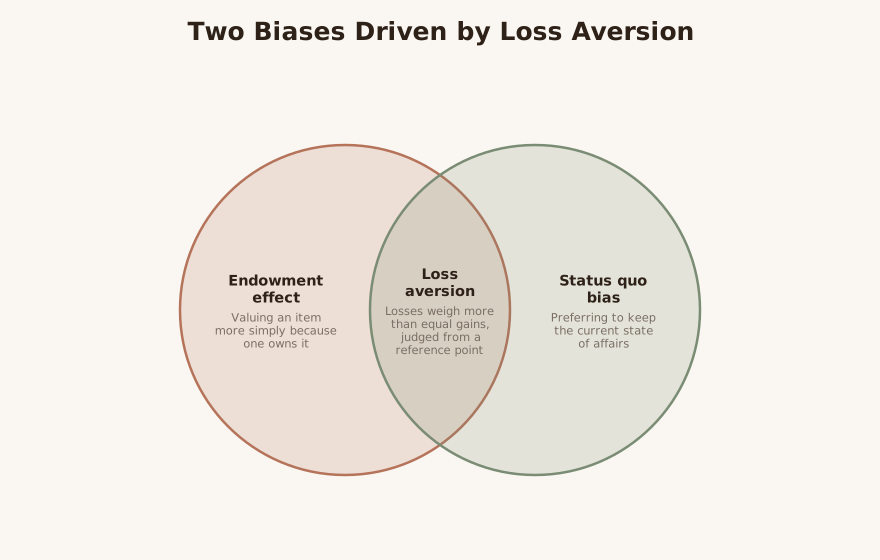
The endowment effect and status quo bias are constructs from behavioral economics rather than clinical interventions, modalities, or named therapies 1. They describe robust deviations from the “rational actor” of classical economics: a person’s choices depend not only on the objective options in front of them but on which option they currently hold or own 1. The endowment effect names the finding that people demand substantially more to give up an object than they would have been willing to pay to acquire it in the first place 1. Status quo bias names the closely related tendency to disproportionately prefer leaving things as they are, so that the current arrangement carries an advantage over equally attractive alternatives 1. Both belong to the family of cognitive biases organized around loss aversion, the asymmetry by which losses loom larger than equivalent gains 1. They are not diagnoses, and there is no clinical literature establishing them as a treatment target in their own right LLM. For therapists, they function as an explanatory lens on familiar phenomena such as ambivalence and reluctance to change LLM.
Creators & Lineage
The constructs grew out of the prospect-theory program developed by Daniel Kahneman and Amos Tversky, which reframed decision-making around reference points, diminishing sensitivity, and loss aversion rather than absolute wealth 1. The 1991 Journal of Economic Perspectives paper “Anomalies: The Endowment Effect, Loss Aversion, and Status Quo Bias,” authored by Kahneman, Jack Knetsch, and Richard Thaler, consolidated the experimental evidence and gave these phenomena their canonical statement 1. Richard Thaler had earlier coined the term “endowment effect” to describe the gap between selling and buying valuations 1. The status quo bias strand draws on experimental and field work by William Samuelson and Richard Zeckhauser, whose 1988 studies documented a systematic preference for the current option across hypothetical and real choices LLM. Their original paper is not among the sources provided here, so the specifics of their design should be checked against that primary source before being cited in clinical materials LLM. The lineage runs forward into the wider cognitive-bias research tradition and, by clinical analogy rather than formal descent, connects to motivational interviewing’s focus on ambivalence about change LLM.
Core Principles
The organizing principle is loss aversion: for most people the pain of giving something up outweighs the pleasure of acquiring something of equal value 1. Because ownership reframes a potential trade as a loss rather than a forgone gain, owners place a premium on what they hold 1. The endowment effect is the direct consequence: the minimum a person will accept to sell an item (willingness-to-accept) exceeds the maximum they would pay to buy the same item (willingness-to-pay), often by roughly a factor of two in the classic experiments 2. Status quo bias generalizes this beyond goods to states of affairs: any move away from the current situation is evaluated as incurring losses on some dimensions, and those losses are weighted more heavily than the corresponding gains, so inertia wins 1. A second principle is reference dependence: value is judged relative to a reference point, typically the present endowment, not in absolute terms 1. Together these imply that the “rational” expectation of frictionless trade and easy switching systematically overstates how readily people will change 2. An immediate corollary is that change has a built-in headwind that is psychological, not just practical LLM.
Interventions & Techniques
These constructs are descriptive, so there is no manualized “endowment-effect therapy”; what follows are translations into clinical practice, none of which carry their own outcome evidence LLM. Reframing the reference point invites a client to evaluate a current state as if newly choosing it (“if you did not already have this job, would you take it today?”), which can loosen the grip of ownership-driven overvaluation LLM. Reversing the default asks clients to articulate the cost of staying the same rather than only the cost of changing, surfacing the hidden losses that status quo bias keeps invisible LLM. Decisional balance, drawn from motivational interviewing, can be weighted to make the losses of inaction explicit alongside the losses of action LLM. Psychoeducation about loss aversion can normalize a client’s reluctance as a predictable feature of human valuation rather than a personal failing LLM. Behavioral experiments from cognitive behavioral therapy can test predicted losses of change against actual outcomes, recalibrating an inflated sense of what would be given up LLM.
LLM-generated illustrative example (not a guideline): A client describes keeping a draining friendship “because we have so much history.” The clinician asks, “If you met this person today and did not already have that history, would you choose to invest in them now?” The reframe shifts the friendship from an endowment to be defended into one option among several, making the ongoing cost newly visible. LLM
Evidence Base
The phenomenon itself is well established and has been replicated many times 1. In the Cornell mug experiments, participants randomly given a mug demanded roughly twice as much to sell it as buyers were willing to pay, and the actual volume of trade was about half of what standard economic theory predicts 2. The 1991 paper documents the effect across multiple goods and links it directly to loss aversion and to status quo bias as parallel manifestations of reference dependence 1. Status quo bias has likewise been observed in real and hypothetical choices 1. Honesty requires two qualifications. First, the maturity rating “established” applies to the behavioral-economics finding, not to any therapeutic use; there are no controlled trials in the provided sources testing endowment-effect or status-quo framing as a clinical intervention, so its application to therapy is inference, not demonstrated efficacy LLM. Second, the interpretation is contested: at least one line of work argues the gap can arise from rational considerations or experimental artifacts such as misconceptions about the trading task, rather than from a genuine valuation bias 5. A responsible clinician should hold the construct as a useful heuristic, not a settled mechanism LLM.
Populations & Indications
The constructs are most relevant to adults actively contemplating a change yet stalling at the threshold of action LLM. They illuminate clients who present as “resistant to change,” reframing that stance as a predictable consequence of how losses are weighted rather than as oppositionality LLM. They map onto decisional ambivalence, where the perceived loss of the familiar option keeps competing options from gaining traction LLM. They are clinically suggestive for hoarding tendencies, where ownership and anticipated loss of possessions can be intensely aversive, though the construct does not by itself explain or treat hoarding disorder LLM. They speak to consumers and negotiators, the populations where the effect was first measured 1. They also help conceptualize low treatment engagement, where staying with current coping patterns can feel safer than the uncertain losses of doing something new LLM. Indication here means “useful framing,” not “indicated treatment,” since no source establishes these constructs as an intervention LLM.
Problems-for-Work
Resistance to change: naming the status quo’s hidden advantage can convert a stuck stance into a workable cost-benefit conversation, for example mapping what staying the same actually costs across health, relationships, and time LLM. Decisional ambivalence: weighting decisional balance toward the losses of inaction counteracts the default pull, as when a client weighing a job change lists the accumulating costs of staying LLM. Loss aversion: psychoeducation reframes reluctance as a universal asymmetry, reducing shame and opening curiosity LLM. Hoarding tendencies: graded discarding paired with reference-point reframing (“would you buy this today?”) can target the overvaluation of owned items, within an evidence-based hoarding protocol rather than as a freestanding technique LLM. Procrastination and avoidance: framing delay as a choice to keep a costly status quo makes the cost of waiting concrete LLM. Difficulty with treatment engagement: surfacing the losses of remaining unchanged can recruit motivation that “benefits of change” framing alone misses LLM.
Contraindications, Cautions & Cultural Humility
There are no formal contraindications because this is a framing tool, not a procedure, but several cautions apply LLM. Pressing a client to “rationally” abandon an endowment can feel invalidating, especially when the attachment is to people, traditions, identity, or culturally meaningful possessions whose value is not reducible to a market comparison LLM. Attachment to the familiar is sometimes wise; the goal is to examine a bias, not to assume every status quo is irrational, and source 5’s argument that the gap can reflect rational considerations is a useful corrective against overreach 5. Cultural humility matters because collectivist values, religious commitments, intergenerational obligations, and experiences of scarcity or displacement can make holding on to what one has both adaptive and meaningful rather than a “bias” to be corrected LLM. With clients who have histories of loss, trauma, or material insecurity, framing reluctance as a cognitive error risks rupture LLM. The construct should support, not override, the client’s stated values LLM.
Treatment-Plan Suggestions & SMART Objectives
| Goal | SMART objective (example) | Mechanism |
|---|---|---|
| Reduce avoidance of a stalled decision | Within 4 weeks, client completes one written decisional-balance grid weighting the costs of staying the same, in 2 of 3 sessions | Makes status-quo losses explicit against reference dependence 1 |
| Loosen overvaluation of an owned item or situation | Within 6 weeks, client applies a “would I choose this today?” reframe to 3 specified situations and reports the shift | Reframes endowment as a current choice 2 |
| Normalize reluctance to change | By session 3, client describes loss aversion in their own words and names one place it operates in their life | Psychoeducation reduces shame-driven rigidity 1 |
| Test catastrophized losses of change | Within 8 weeks, client runs 2 behavioral experiments comparing predicted vs. actual losses of a small change | Recalibrates inflated anticipated loss LLM |
| Increase treatment engagement | Within 4 weeks, client identifies 3 concrete costs of remaining unchanged and rates motivation pre/post | Surfaces inertia’s hidden cost LLM |
| Support graded discarding (hoarding tendencies) | Within 8 weeks, client discards 5 low-value items using a reference-point reframe, within a hoarding protocol | Reduces ownership-driven overvaluation LLM |
| Strengthen values-aligned decisions | By week 6, client distinguishes 2 situations where keeping the status quo is values-aligned from 2 where it is avoidance | Separates wise attachment from bias 5 |
Common Misconceptions
A first misconception is that the endowment effect proves people are simply irrational; the better reading is that valuation is reference-dependent, and at least one body of work argues the observed gap can stem from rational considerations or task misconceptions rather than a pure bias 5. A second is that willingness-to-pay and willingness-to-accept should be identical for the same item; the empirical reality is a sizable and replicable gap, often around twofold 2. A third is that status quo bias means inertia is always a mistake; staying put can be the correct and values-consistent choice, and the construct only flags that the current state carries an undeserved thumb on the scale 1. A fourth, specific to clinicians, is that these constructs constitute a validated therapy; they do not, and no provided source supports treating them as an intervention with established efficacy LLM. A fifth is conflating the endowment effect with mere sentimental attachment; it appears even for ordinary, fungible goods like mugs that carry no sentimental history 2.
Training & Certification
There is no certification, credential, or accredited training program for the endowment effect or status quo bias, because they are research constructs rather than a therapeutic modality LLM. Clinicians typically encounter them through behavioral-economics coursework, decision-science reading, or motivational interviewing training that addresses ambivalence LLM. Foundational fluency comes from the primary 1991 source and the prospect-theory literature behind it 1. For applied clinical use, the relevant competencies are those of the host modality, such as motivational interviewing or cognitive behavioral therapy, within which these constructs are deployed as framing rather than as standalone techniques LLM. A study guide treatment of the topic can orient newcomers to the core definitions before they turn to the primary literature 4.
Key Terms
Endowment effect — the tendency to value an item more once one owns it, so the selling price demanded exceeds the buying price one would pay 1. Status quo bias — a disproportionate preference for the current state over equally good alternatives 1. Loss aversion — the asymmetry by which losses are felt more strongly than equivalent gains, the engine behind both effects 1. Reference dependence — evaluating outcomes relative to a reference point (often the present endowment) rather than in absolute terms 1. Willingness-to-accept (WTA) — the minimum a person will take to give up a good 2. Willingness-to-pay (WTP) — the maximum a person will pay to acquire the same good; the WTA-WTP gap is the operational signature of the endowment effect 2. Prospect theory — the Kahneman-Tversky model of choice under risk that supplies the reference-dependent, loss-averse value function 1.
Resources & Further Reading
▶ Watch — a video introduction to this concept:
- Anomalies: The Endowment Effect, Loss Aversion, and Status Quo Bias (Kahneman, Knetsch & Thaler, 1991, JEP)
- Kahneman, Knetsch & Thaler (1991) — full PDF (UF Warrington mirror)
- Anomalies: The Endowment Effect, Loss Aversion, and Status Quo Bias — Kahneman scholar archive (Princeton)
- Endowment effect and status quo bias — Fiveable study guide
- The Endowment Effect, Status Quo Bias and Loss Aversion: Rational Alternative Explanation (J. Risk & Uncertainty)
Reflective / Supervision Questions
- When a client looks “resistant,” how often am I weighing the losses they fear from changing, rather than only the benefits I see in change? LLM
- Where in this case is the client defending an endowment that is genuinely values-aligned, versus one inflated by loss aversion? LLM
- Am I using reference-point reframing to open inquiry, or to subtly pressure the client toward the change I prefer? LLM
- How might this client’s cultural background, history of scarcity, or experiences of loss make holding on to the status quo adaptive rather than biased? LLM
- Given that the therapeutic application of these constructs is untested, am I presenting them to the client as a useful lens rather than as established fact? LLM
- What would it look like to name loss aversion in a way that reduces the client’s shame instead of adding a new label to manage? LLM