
Type & Discipline
Probability weighting and the certainty effect are theoretical constructs from behavioral economics, not a treatment modality or a clinical technique 1. They are two of the core components of prospect theory, the descriptive account of decision-making under risk that Daniel Kahneman and Amos Tversky published in 1979 1. The construct belongs to the family of decision-under-risk research, sitting at the intersection of behavioral economics, judgment-and-decision-making science, and the broader study of cognitive heuristics and biases 4. It describes a systematic regularity in how human beings transform stated probabilities into the subjective weights that actually drive their choices, rather than prescribing any course of treatment 3. For the practicing clinician its value is explanatory: it gives a precise, evidence-grounded account of why a client can “know” a feared event is unlikely and still act as though it were nearly certain, and why guarantees and certainty hold such disproportionate power over decisions LLM. It is best used as a conceptual lens layered onto established cognitive and behavioral interventions, not as a stand-alone therapy LLM.
Creators & Lineage
The construct was introduced by Amos Tversky and Daniel Kahneman in their 1979 paper “Prospect Theory: An Analysis of Decision under Risk,” published in Econometrica 1. That paper proposed prospect theory as a descriptive alternative to expected utility theory, the long-dominant normative model formalized by von Neumann and Morgenstern in 1944, in which probabilities enter the valuation of a gamble linearly 6. Kahneman received the Nobel Memorial Prize in Economic Sciences in 2002 for this body of work; Tversky, who would almost certainly have shared it, had died in 1996 6. A direct intellectual ancestor is the economist Maurice Allais, whose 1953 “Allais paradox” demonstrated that people systematically violate the independence axiom of expected utility theory, choosing in ways that reveal a special sensitivity to the difference between certainty and near-certainty 6. Prospect theory’s lineage thus runs from expected utility theory, which it was built to correct, through Allais’s early anomaly, into the modern program of cognitive heuristics and biases that Kahneman and Tversky founded and that now anchors behavioral economics 6. The 1992 cumulative-prospect-theory revision later refined the mathematics of the weighting function, but the qualitative claims about overweighting and certainty date to the original framework 3.
Core Principles
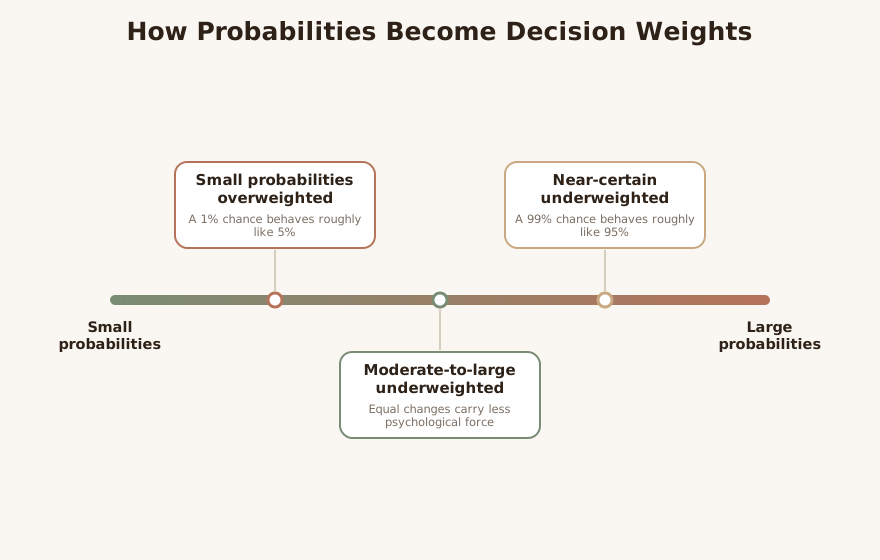
The central claim is that people do not respond to objective probabilities directly; they respond to decision weights, the subjective transformations of probability that the weighting function produces 3. Where expected utility theory assumes probability enters a choice linearly, so a one-percentage-point change matters equally wherever it falls on the scale, prospect theory substitutes a nonlinear function in which equal changes in probability carry very unequal psychological force 4.
That function has a characteristic inverse-S shape: small probabilities are overweighted while moderate-to-large probabilities are underweighted 3. In Tversky and Kahneman’s 1992 weighting curve, an objective probability of about 0.05 is given a decision weight near 0.15, and one of about 0.95 receives a weight of only around 0.8 3. A useful approximation is that people behave roughly as though a 1% chance were closer to 5% and a 99% chance were closer to 95% — inflating the rare, discounting the near-sure 2. Crucially this is a distortion of weighting, not estimating: a person may state the correct probability and still assign it a weight that does not match, which separates this phenomenon from simple misjudgment of odds 2.
Two effects sit at the ends of the function. The possibility effect is the disproportionate jump from impossibility to mere possibility — moving from a 0% to a 5% chance feels far larger than an identical move from 30% to 35% 3. The certainty effect is its mirror at the top: the move from 95% to a guaranteed 100% carries far more psychological value than an equal move from 50% to 55% 3. People place disproportionate value on certain outcomes relative to merely highly probable ones, which is why a guarantee can dominate a slightly better but uncertain alternative — and is precisely what the Allais paradox exposes and expected utility theory cannot accommodate 4.
Interventions & Techniques
Probability weighting does not arrive packaged with proprietary techniques; it is a model that informs how a clinician conceptualizes and reframes a client’s reasoning within existing interventions LLM. Its most immediate clinical translation is psychoeducational: naming for a client the gap between the probability they can state and the weight they actually assign it externalizes the distortion and turns “I’m irrational” into “my mind systematically overweights small risks — and so does everyone’s” LLM. This maps directly onto the cognitive-behavioral work of distinguishing thoughts from facts and examining the evidence behind a probability estimate LLM.
Because the distortion is one of weighting rather than estimating, the standard cognitive technique of “calculating the realistic odds” is necessary but often insufficient: a client can compute a 0.1% risk and still feel governed by it, because the felt weight outruns the figure 2. The construct therefore supports pairing probability re-estimation with work on the weight itself — behavioral experiments that let the feared rare event remain unweighted by experience, exposure that habituates the affective charge attached to the small probability, and decatastrophizing that targets the inflated cost rather than only the inflated likelihood LLM. The certainty effect, in turn, gives a name to a client’s craving for guarantees and reassurance: the demand for 100% safety is not stubbornness but a predictable feature of how minds weight certainty, which can be addressed through acceptance-oriented work on tolerating residual uncertainty rather than chasing an unattainable guarantee LLM.
LLM-generated illustrative example (not a guideline): A clinician working with a client who has health anxiety sketches the inverse-S curve and shows where the client’s feared 0.5% risk of a serious illness lands — assigned a felt weight closer to a coin flip. The client recognizes that repeatedly seeking “100% reassurance” is the certainty effect at work, and the pair shift the goal from eliminating the small probability to loosening the oversized weight attached to it. LLM
Evidence Base
The maturity of this construct is best described as established as a theory and as an empirical regularity, not as an evidence-based treatment 1. The overweighting of small probabilities, the underweighting of moderate-to-large ones, and the certainty effect are among the most replicated findings in behavioral economics, demonstrated across many laboratory gamble studies and consolidated in the heavily cited 1979 and 1992 papers 1. Prospect theory is one of the foundational frameworks of behavioral economics, and the weighting function it describes has been formalized mathematically and observed repeatedly across domains of risky choice 4. The construct also accounts for stubborn real-world anomalies that expected utility theory cannot, most notably why the same person buys both insurance and lottery tickets: overweighting rare events makes an unlikely catastrophe feel worth insuring against and an unlikely jackpot feel worth chasing 6.
Honesty requires several caveats for clinical use LLM. First, “established” describes the standing of the theory of how people weight probabilities, not the outcomes of any therapy derived from it; there is no manualized “probability-weighting treatment” with its own trial base LLM. The clinical inferences here — that naming the distortion reduces shame, or that the certainty effect explains reassurance-seeking — are reasoned extensions of established cognitive-behavioral practice, not direct findings from prospect-theory research LLM. Second, the magnitude and even the shape of the weighting function vary across individuals, tasks, and how a choice is described, so the curve is a population-level pattern rather than a fixed personal constant 3. Third, the original evidence comes largely from monetary gambles in controlled settings, and its transfer to the affect-laden, real-stakes probabilities of clinical worry is plausible and useful but is itself an extrapolation LLM.
Populations & Indications
The construct is most clinically illuminating wherever a presentation turns on the over-feeling of an unlikely bad outcome or the over-demand for certainty LLM. People with anxiety disorders are a natural fit, because so much of pathological anxiety consists of a low-probability threat being assigned a near-certain felt weight 4. People with generalized anxiety disorder and chronic worry illustrate the pattern across many domains at once, each catastrophe improbable yet weighted heavily LLM. Clients with health anxiety show the certainty effect vividly in their pursuit of definitive reassurance that no test can fully provide LLM. Clients with obsessive-compulsive disorder display both halves of the distortion: rare feared outcomes overweighted, and certainty pursued through compulsions that promise a 100% guarantee the weighting function makes feel indispensable LLM.
Beyond the anxiety spectrum, individuals with gambling disorder are a textbook application, since overweighting the small probability of a large win is the very engine of persistent play that the model predicts 6. Patients facing medical decisions weigh small risks of side effects or small chances of benefit through the same distorting function, which is why framing a treatment as “95% effective” versus “5% failure rate” can move a choice despite identical information 5. Adults with marked risk-aversion or risk-seeking patterns can be understood through the fourfold structure the theory describes, in which the same person is cautious about probable gains and reckless about probable losses 5. Across all of these, the construct is an adjunct formulation lens, not a diagnosis-specific protocol LLM.
Problems-for-Work
Catastrophizing. The construct sharpens catastrophizing work by separating its two inflations — the overestimated likelihood and the overweighted, oversized cost — and showing that even a correctly estimated small probability can be assigned a crushing weight, so treatment must address the weight, not only the odds 2.
Intolerance of uncertainty. The certainty effect supplies a mechanism: the disproportionate pull of 100% explains why “I just need to know for sure” feels non-negotiable, and reframes the goal as loosening the demand for certainty rather than achieving it 4.
Risk misperception. Naming that the mind overweights rare events and underweights moderate ones helps a client see why their felt sense of danger and the actual base rates diverge, supporting evidence-gathering and behavioral experiments 3.
Gambling disorder. The model frames continued play as the predictable product of overweighting a small chance of a large win, which can normalize the pull without excusing it and target the distorted weight in relapse-prevention work 6.
Worry and rumination. Chronic worry can be framed as repeatedly re-running an overweighted low-probability scenario; making the weighting distortion explicit gives the client a name for the loop and a rationale for postponing or limiting the rehearsal LLM.
LLM-generated illustrative example (not a guideline): A client with generalized anxiety disorder lists six feared outcomes for the coming week and rates each one’s true probability; all fall under 5%, yet each “feels like a near-certainty.” The clinician uses the inverse-S curve to show that this gap between stated probability and felt weight is exactly what the construct predicts, and the pair design a behavioral experiment to let one feared outcome go unweighted by lived evidence. LLM
Contraindications, Cautions & Cultural Humility
Because probability weighting is a conceptual model rather than a treatment, it carries no direct contraindications, but its misuse does LLM. The chief caution is not to let an elegant framework substitute for assessment or evidence-based care; the construct should sit alongside established interventions, never replace them LLM. A second caution is tone: telling a frightened client that their fear is “just a cognitive bias” can read as dismissal, so the distortion should be offered as a shared, universal feature of human minds — the clinician’s mind included — rather than a personal failing LLM. A third is that small probabilities are sometimes correctly weighted heavily, because some rare events are genuinely catastrophic and worth attending to; the goal is calibration, not the blanket dismissal of every low-probability concern LLM.
Cultural humility matters in two ways LLM. First, what counts as an acceptable level of residual uncertainty, and how much value is placed on guarantees, varies across individuals and cultures, and a clinician should not assume that the “rational” calibration of a textbook gamble is the right target for a given person’s life LLM. Second, real differences in exposure to danger shape weighting for sound reasons: a client from a marginalized or unsafe environment who weights a “rare” adverse outcome heavily may be tracking a base rate that is genuinely higher for them, and pathologizing that vigilance as mere bias would be both inaccurate and harmful LLM. The clinician should offer the model tentatively, check how it lands, and set it aside whenever it does not fit the person in the room LLM.
Treatment-Plan Suggestions & SMART Objectives
| Goal | SMART objective (example) | Mechanism |
|---|---|---|
| Build awareness of the weighting distortion | Client logs 1 feared event daily for 2 weeks, recording stated probability and felt likelihood, for 14 days | Externalizes the gap between probability and decision weight 2 |
| Re-estimate inflated probabilities | Client completes a probability-estimation worksheet on 5 worries, gathering base-rate evidence, by session 4 | Corrects overestimation alongside the overweighting 3 |
| Target the inflated weight, not just the odds | Client runs 1 behavioral experiment on a low-probability feared outcome within 3 weeks | Lets the rare event go unweighted by lived experience LLM |
| Reduce reassurance-seeking driven by the certainty effect | Client delays reassurance-seeking by 30 minutes on 5 of 7 days for 4 weeks | Loosens the disproportionate pull of 100% certainty 4 |
| Increase tolerance of residual uncertainty | Client practices an uncertainty-acceptance exercise 10 minutes daily, 5 of 7 days, for 4 weeks | Shifts the goal from guarantee to tolerable uncertainty LLM |
| Decatastrophize the overweighted cost | Client completes a decatastrophizing worksheet on 3 worries by session 6 | Addresses the inflated cost as well as the inflated weight 2 |
| Interrupt the worry-rehearsal loop | Client confines worry to one 15-minute scheduled period on 5 of 7 days for 3 weeks | Limits repeated re-running of overweighted scenarios LLM |
| Reframe choices sensitive to framing | Client identifies 3 decisions reframed gain-vs-loss and notes how framing shifts the pull by session 5 | Surfaces how decision weights, not facts, move the choice 5 |
Common Misconceptions
A frequent misreading is that the construct claims people misestimate probabilities — that they think a 1% risk is literally 5% 2. The actual claim is subtler and more clinically useful: people can state the correct probability and still weight it as though it were larger, so the distortion lives in the transformation from probability to felt importance, not in the number itself 2. A second misconception is that the weighting function is uniform — that everyone overweights everything small; in fact the function is inverse-S, so small probabilities are overweighted while moderate-to-large ones are underweighted, and the two errors coexist in the same person 3. A third is treating the certainty effect as irrationality to be scolded away; it is a stable, near-universal feature of human choice that the same mechanism behind buying insurance also produces, and it is better worked with than shamed 6. A fourth is assuming prospect theory replaced expected utility theory as a normative ideal; it is a descriptive account of what people actually do, not a prescription for what they should do 1. Finally, clinicians sometimes treat the construct as a validated therapy in its own right, when its evidence concerns decision behavior, not the outcomes of any branded treatment LLM.
Training & Certification
There is no certification, credential, or formal training pathway specific to probability weighting or the certainty effect, because they are theoretical constructs rather than a practice modality LLM. Clinicians typically encounter them within graduate coursework in judgment and decision-making, behavioral economics, or cognitive psychology, and through the primary literature, beginning with the 1979 Econometrica paper 1. Accessible explainer summaries and overviews are widely available and are sufficient for most clinical conceptual use 34.
For applied competence, the relevant training is in the established interventions the construct informs — cognitive restructuring and behavioral experiments within cognitive behavioral therapy, acceptance- and uncertainty-tolerance work, and exposure-based methods — each of which has its own evidence base and training routes LLM. The most useful preparation is therefore to learn the model well enough to use it as psychoeducation and case formulation, while building credentialed skill in the treatments it complements LLM.
Key Terms
Probability weighting function: the nonlinear function (often written π) that transforms an objective probability into the subjective decision weight a person actually uses, in contrast to the linear treatment assumed by expected utility theory 4.
Decision weight: the subjective weight assigned to an outcome’s probability, which drives choice and need not match the stated probability 3.
Certainty effect: the disproportionate value placed on outcomes that are certain relative to those that are merely highly probable, so that the jump from 95% to 100% feels far larger than an equal jump in the middle of the scale 3.
Possibility effect: the disproportionate value of the jump from impossibility to mere possibility, so that moving from 0% to 5% feels far larger than an equal mid-range change 3.
Overweighting of small probabilities: the tendency to assign rare events more decision weight than their objective probability warrants, which helps explain both insurance purchase and lottery play 6.
Allais paradox: Maurice Allais’s 1953 demonstration that people violate expected utility theory by being unusually sensitive to the shift between certainty and near-certainty, an anomaly the certainty effect explains 6.
Fourfold pattern of risk attitudes: the pattern in which people are risk-averse for probable gains and risk-seeking for probable losses (and the reverse for unlikely outcomes), produced by combining the weighting function with loss aversion 5.
Resources & Further Reading
▶ Watch — a video introduction to this concept:
- Prospect Theory: An Analysis of Decision under Risk (Kahneman & Tversky, 1979) — The Econometric Society
- Probability weighting — Notes on Behavioural Economics (Jason Collins)
- Prospect Theory — ScienceDirect Topics (overview)
- Prospect Theory and Loss Aversion: How Users Make Decisions — Nielsen Norman Group
- Prospect Theory: How Kahneman & Tversky Changed Economics — maseconomics
- Prospect theory — Wikipedia
Reflective / Supervision Questions
- When you help a client “calculate the realistic odds,” how do you tell whether the residual fear is an estimation problem or a weighting problem, and how does that change what you do next? LLM
- How do you introduce the idea of a universal weighting distortion so it lands as normalizing rather than as telling a frightened client their fear is “just a bias”? 2
- Where in your caseload might a client’s heavy weighting of a “rare” adverse event actually reflect a genuinely elevated base rate for them, and how would you avoid pathologizing accurate vigilance? LLM
- For clients with health anxiety or obsessive-compulsive disorder, how do you reframe the demand for 100% certainty as the certainty effect without dismissing the distress that drives it? 4
- How do you decide when the probability-weighting frame is helping a particular client versus when it feels reductive and should be set aside? LLM
- When a client faces a real medical or financial decision, how might the framing you choose be tilting their decision weights, and what is your responsibility in how you present the options? 5