
Type & Discipline
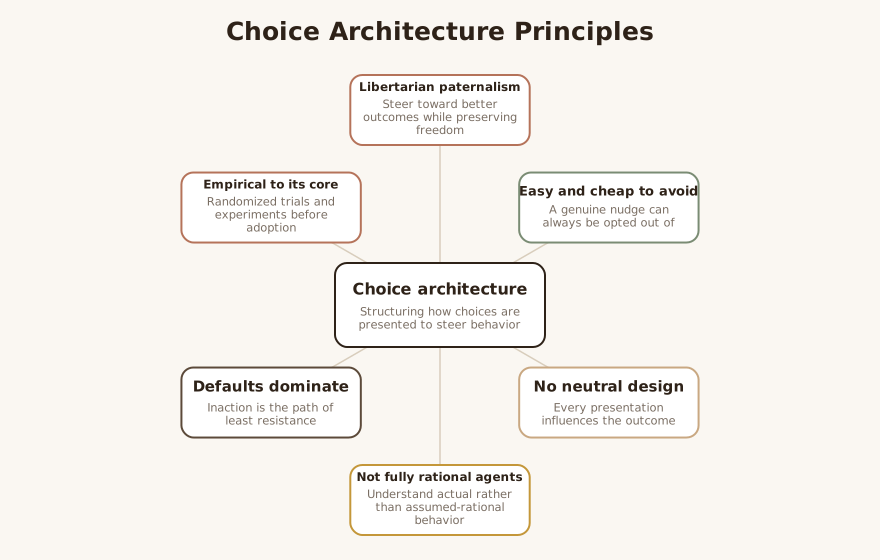
Nudge theory is a framework from behavioral economics and behavioral public policy rather than a psychotherapy modality 2. Its central construct, choice architecture, refers to how options are arranged and presented and the impact that presentation has on the resulting decision 6. A nudge is defined as “any aspect of the choice architecture that alters people’s behavior in a predictable way without forbidding any options or significantly changing their economic incentives” 5. The discipline that hosts it — behavioral insights — is described by the OECD as “an inductive approach to policy making that combines insights from psychology, cognitive science, and social science with empirically-tested results to discover how humans actually make choices” 4.
For clinicians, the relevance is not that nudge theory replaces therapy but that it sharpens attention to the small, often-invisible details of how a treatment plan, a self-care routine, or a between-session task is structured LLM. Much of what derails behavior change is not a deficit of insight or motivation but friction in the choice environment, and choice architecture supplies a vocabulary for finding and removing that friction LLM.
Creators & Lineage
The framework was popularized by economist Richard H. Thaler and legal scholar Cass R. Sunstein in their 2008 book Nudge, published by Yale University Press 2. Thaler is a University of Chicago economist and Nobel laureate; Sunstein is a Harvard Law School professor 2. The two coined the term “choice architecture” in that book 6. The closely associated working paper “Choice Architecture” by Thaler, Sunstein, and John Balz lays out the practical toolkit of the choice architect in more applied detail 1.
The applied lineage runs through government. The Behavioural Insights Team (BIT), informally the “Nudge Unit,” was established in 2010 within the UK Cabinet Office under psychologist David Halpern, later spinning out as a company and becoming owned by the charity Nesta 3. BIT and parallel units catalyzed a global movement of behavioral-insights teams that the OECD now tracks and supports across the policy cycle 4. Conceptually, nudge theory sits downstream of behavioral economics and the heuristics-and-biases tradition, and it shares intellectual DNA with the behavior-change strategies clinicians already use — the environmental restructuring of Cognitive Behavioral Therapy, the autonomy-preserving stance of Motivational Interviewing, and the activity-scheduling logic of behavioral activation LLM.
Core Principles
The defining commitment is libertarian paternalism: the “paternalistic” element allows a choice architect to steer behavior toward better outcomes, while the “libertarian” element preserves the person’s full freedom to choose otherwise and to opt out 2. A genuine nudge must therefore be easy and cheap to avoid — banning junk food is not a nudge, but placing fruit at eye level is 2.
A second principle is that there is no neutral design: every way of presenting options influences the outcome, so the architect cannot abstain from shaping choice, only choose to shape it thoughtfully 6. A third is that people are not the fully rational agents of classical economics; the OECD frames behavioral insights as a way to understand “actual” behavior rather than assume classical economic rationality 4. Defaults exert outsized influence precisely because inaction is the path of least resistance, and whatever a person receives by doing nothing shapes a large share of outcomes 5.
Finally, the discipline is empirical to its core. Behavioral insights rely on rigorous inductive methods — randomized controlled trials, lab and online experiments, and pilot tests — before any solution is scaled 4. Thaler and Sunstein’s own canonical examples, from automatic enrollment in retirement savings to “Save More Tomorrow,” are presented as testable design choices rather than slogans 2.
Interventions & Techniques
The choice architect’s toolkit, as developed by Thaler, Sunstein, and Balz, includes a recognizable set of levers 1. Defaults preselect an option the person must actively change, and because consumers strongly prefer defaults, the chosen default tends to dominate 6. Expecting error means structuring choices to anticipate predictable human mistakes — for example, designing for myopia about future outcomes — and building in forgiveness for them 1. Giving feedback structures the environment so people learn from the results of their actions 1. Understanding mappings translates options into terms a person can actually grasp, such as converting a confusing metric into an intuitive one to reduce cognitive effort 6. Structuring complex choices organizes large option sets so a person is not overwhelmed, since too many options can paradoxically reduce satisfaction and motivation 6. Incentives are arranged so the salient, immediate ones align with the person’s longer-term goals 1.
Beyond this core, popular accounts add framing (gain versus loss language), anchors (initial reference points that reset what seems reasonable), social proof (showing peer behavior), salience (making key information impossible to miss), and commitment devices (locking in a future behavior to overcome present bias) 5. The public-policy field condenses these into the EAST framework — make the desired behavior Easy, Attractive, Social, and Timely — offered by BIT as four simple ways to apply behavioral insights, alongside structured guides such as the OECD’s BASIC model for embedding behavioral insights across the policy process 4.
LLM-generated illustrative example (not a guideline): A clinician working with a client who repeatedly misses morning medication co-designs three small changes — placing the pill bottle next to the coffee maker (salience), pairing the dose with an already-automatic habit (timing), and setting the pharmacy to auto-refill so a missed refill is the exception rather than the default (defaults). None of these involve new insight; they re-engineer the choice environment so the desired behavior becomes the easy one LLM.
Evidence Base
The maturity of nudge theory as an applied field is best described as established, with an unusually large empirical footprint for a behavior-change framework LLM. The Behavioural Insights Team alone has conducted more than 400 randomized controlled trials across over 1,800 projects globally, prioritizing RCTs precisely to build empirical evidence rather than rely on intuition 3. Documented effects include norm-based tax letters that increased on-time payments by £1.6 million within 23 days, text reminders that doubled court-fine payment rates and saved an estimated £30 million annually, removal of practical barriers that increased loft-insulation uptake roughly fivefold, and SMS reminders that improved timely welfare reporting by 13.5% 3.
Honesty about limits is part of the evidence story. Critics have raised concerns about scope creep — the question of when nudging shades into coercion — have questioned whether the evidence always substantiates effectiveness, and have noted that the term became overused to the point of losing meaning 2. Applied commentators caution that nudges decay, often losing a substantial share of their effect over time, and warn that the same techniques become manipulative “dark patterns” when they serve the designer’s interests rather than the person’s welfare 5. The clinical implication is to treat any nudge as a hypothesis to be tested and re-tested in the individual case, never as a permanent fix LLM.
Populations & Indications
Choice architecture is most useful with populations whose difficulty lies less in understanding what to do than in reliably doing it under real-world friction LLM. This includes people with chronic illness and patients with adherence challenges, where structured reminders and defaults can support consistent medication-taking and appointment attendance 3. It applies to public-health populations broadly, the original target of the behavioral-insights movement 4. Within a clinical caseload, adults seeking behavior change, people with substance use disorders, and individuals with health-risk behaviors are natural candidates, because each involves a gap between intention and follow-through that environmental design can narrow LLM. The approach pairs especially well with modalities that already attend to environment and contingency, such as behavioral activation and Cognitive Behavioral Therapy LLM.
Problems-for-Work
- Medication non-adherence — Re-engineer the routine using defaults (auto-refill), salience (visible placement), and feedback (a tracked pill organizer) so the dose becomes the easy default 5.
- Appointment non-attendance — Apply timely, social, and easy principles: well-timed reminders and norm-referenced messaging, mirroring the text-reminder trials that doubled payment rates 3.
- Procrastination on between-session tasks — Use commitment devices and “structuring complex choices” so a large task is broken into the smallest next action 5.
- Health-behavior change (diet, activity) — Restructure the environment so the healthier option is the salient, default one, as in placing nutritious food at eye level 2.
- Smoking cessation and substance use — Combine commitment devices with feedback loops, anticipating predictable lapses (“expecting error”) rather than treating them as failures 1.
LLM-generated illustrative example (not a guideline): A client trying to reduce evening drinking sets up a commitment device with their clinician — pre-pouring a non-alcoholic alternative and removing alcohol from immediate reach so the default after work is the substitute. The plan explicitly “expects error” by scripting a non-shaming recovery for slip nights, keeping the architecture forgiving LLM.
Contraindications, Cautions & Cultural Humility
Nudging is not value-neutral, and the ethical line is consent and transparency LLM. Because every design steers behavior, a clinician using choice architecture is exercising influence, and the libertarian-paternalist test — could the client easily decline, and would they endorse the nudge on reflection? — must be met explicitly 25. The OECD emphasizes ethical guidelines and transparency precisely because the same tools can be deployed manipulatively 4. Applied commentators warn that nudges curdle into “dark patterns” when they serve the architect rather than the person 5.
In therapy specifically, a covert nudge risks reproducing the very dynamics of control and diminished agency that many clients — particularly those with trauma histories or experiences of coercion — are working to recover from LLM. The autonomy-honoring stance of Motivational Interviewing is the natural corrective: nudges should be co-designed with the client, named openly, and revisable LLM. Cultural humility matters because “better outcomes” is not a neutral judgment; defaults that reflect the clinician’s assumptions about diet, family structure, or health priorities may not fit the client’s values, and the architect must let the client define the destination while only helping smooth the path LLM. Finally, choice architecture does not treat the conditions that require diagnosis and clinical treatment; it is an adjunct to care, not a substitute for it LLM.
Treatment-Plan Suggestions & SMART Objectives
| Goal | SMART objective (example) | Mechanism |
|---|---|---|
| Improve medication adherence | Client will take the prescribed evening dose on at least 6 of 7 days for 3 consecutive weeks, verified by a pill organizer | Defaults + salience: dose pre-sorted and placed at point of an existing habit 6 |
| Increase appointment attendance | Client will attend 4 consecutive scheduled sessions, supported by a self-selected reminder 24 hours prior | Timely + easy cues mirroring reminder-trial effects 3 |
| Reduce procrastination on a goal task | Client will complete the agreed “smallest next step” within 48 hours of each session for 4 weeks | Structuring complex choices into one minimal action 6 |
| Establish a daily self-care behavior | Client will perform a 5-minute morning practice on at least 5 days/week for one month, paired with coffee | Habit-stacking with a default trigger 5 |
| Reduce a health-risk behavior | Client will substitute the target behavior with a pre-arranged alternative on at least 4 of 7 evenings for 3 weeks | Commitment device + environment restructuring 5 |
| Improve follow-through despite lapses | Client will log slips without dropout and resume the plan within 24 hours across an 8-week period | Expecting error + feedback, removing shame as a barrier 1 |
| Sustain a behavior after early gains | Client will re-review and refresh one element of the plan monthly to counter decay over 3 months | Anticipating nudge decay through scheduled re-design 5 |
Common Misconceptions
A frequent error is conflating a nudge with any persuasion or any incentive; by definition a nudge must not forbid options or significantly change economic incentives, so a fine or a mandate is not a nudge 5. A second is the belief that nudges are inherently manipulative or “tricks”; the framework’s defining ethic is preserved freedom and easy opt-out, and the legitimate test is whether the person would endorse the nudge on reflection 25. A third is treating nudges as permanent solutions, when applied evidence indicates they often decay and need renewal 5. A fourth is assuming nudging means not informing people; transparency and “understanding mappings” are themselves core tools, so good choice architecture frequently makes information clearer rather than hiding it 64. Finally, clinicians sometimes assume choice architecture is only for policymakers, when in fact its smallest unit — how a single between-session task is framed and defaulted — is squarely within everyday practice LLM.
Training & Certification
There is no clinical licensure or therapy-specific certification in nudge theory, because it is a public-policy and behavioral-economics framework rather than a regulated treatment modality LLM. Practitioner knowledge is built through the primary literature — the book Nudge and the “Choice Architecture” working paper — and through the applied guidance produced by behavioral-insights organizations 21. The Behavioural Insights Team and the OECD’s Observatory of Public Sector Innovation publish frameworks, case libraries, and methods guidance (including EAST and BASIC) that function as the field’s de facto curriculum 34. For clinicians, the realistic path is conceptual fluency plus disciplined local experimentation — treating each applied nudge as a small test within an existing evidence-based modality rather than seeking a credential LLM.
Key Terms
- Nudge — Any aspect of choice architecture that predictably alters behavior without forbidding options or significantly changing economic incentives 5.
- Choice architecture — The design of how options are arranged and presented, and the influence that arrangement has on decisions 6.
- Libertarian paternalism — Steering toward better outcomes while preserving full freedom to choose and to opt out 2.
- Default — The option a person receives by inaction, which tends to dominate outcomes 6.
- EAST — A behavioral-insights framework: make the behavior Easy, Attractive, Social, and Timely 4.
- Expecting error — Designing choices to anticipate and forgive predictable human mistakes 1.
- Dark pattern — A design that uses nudge techniques to serve the architect’s interest rather than the person’s welfare 5.
Resources & Further Reading
▶ Watch — a video introduction to this concept:
- Choice Architecture (Thaler, Sunstein & Balz) — SSRN working paper
- Nudge (book) — Wikipedia
- Behavioural Insights Team (the “Nudge Unit”) — Wikipedia
- Behavioural Insights — OECD Observatory of Public Sector Innovation
- Nudge Theory: Thaler & Sunstein’s Choice Architecture — Yu-kai Chou
- Choice architecture — Wikipedia
Reflective / Supervision Questions
- Where in this client’s treatment plan is the obstacle actually friction in the choice environment rather than a deficit of insight or motivation? LLM
- For each nudge I am considering, can the client easily decline it, and would they endorse it on reflection? LLM
- Am I co-designing choice architecture transparently with the client, or quietly engineering their behavior in a way that could undermine their sense of agency? LLM
- Whose definition of a “better outcome” is encoded in the defaults I am proposing, and does it fit this client’s culture and values? LLM
- How will I detect and respond to nudge decay over the coming months rather than assuming the design will hold? LLM
- Which established modality — behavioral activation, Cognitive Behavioral Therapy, Motivational Interviewing — is hosting this nudge, and is the nudge serving that treatment’s goals? LLM