
Type & Discipline
Ethnopolitical psychology is an integrative clinical and community framework rather than a single branded protocol, sitting at the intersection of clinical psychology and sociopolitical analysis 1. It belongs to the broader family of liberation and political psychology, and it treats ethnicity, culture, race, and political context as central variables in psychological functioning rather than background detail 1. Its defining move is to read much of the distress carried by oppressed and marginalized people as a response to oppression, racism, and political repression — conditions that affect both individuals and whole societies — rather than as decontextualized intrapsychic pathology 1. For the practicing therapist, this means the framework operates as an overlay on existing clinical work: it changes the formulation, the stance, and some of the techniques, while remaining compatible with conventional assessment and treatment LLM.
Because the framework spans the individual and the collective, it draws equally on clinical psychology (the consulting room, the diagnostic frame) and community psychology (systems, institutions, and group identity) 1. The result is a discipline-bridging approach that is comfortable naming racism and political violence as legitimate clinical material rather than confining therapy to symptoms abstracted from their social origins 1.
Creators & Lineage
The ethnopolitical approach was articulated by Lillian Comas-Díaz in her 2000 American Psychologist paper, “An ethnopolitical approach to working with people of color,” which laid out the case for psychologists adopting an antiracist stance 1. Comas-Díaz subsequently extended this work into a fuller account of multicultural psychotherapy, examining how culture, ethnicity, and gender converge in the formation of the psychotherapist and the therapeutic relationship 2. Two decades later she co-edited, with Edil Torres Rivera, the American Psychological Association volume Liberation Psychology: Theory, Method, Practice, and Social Justice, which situates the ethnopolitical project inside the larger liberation-psychology tradition 3.
The framework’s lineage is explicitly liberation psychology, community psychology, multicultural counseling, and trauma-informed care LLM. The liberation-psychology strand integrates multicultural, feminist, womanist, trauma, postcolonial, decolonial, Indigenous, and antiracist approaches into a single emancipatory project 5. Comas-Díaz’s own contribution emphasizes emancipatory healing methods — testimonio, autoethnography, ancestrality, creative arts, and artivism — directed at psychosocial and racial trauma among the oppressed 5. A closely allied and more recent development is the radical-healing framework for communities of color advanced by French and colleagues, which carries the same lineage forward into counseling psychology 4.
LLM-generated illustrative example (not a guideline): A clinician trained in cognitive-behavioral therapy who encounters a Central American asylum seeker with intrusive memories of detention can keep the trauma-focused protocol intact while adding an ethnopolitical layer — naming the political nature of the harm, validating righteous anger, and situating symptoms within a history of state violence rather than personal weakness LLM.
Core Principles
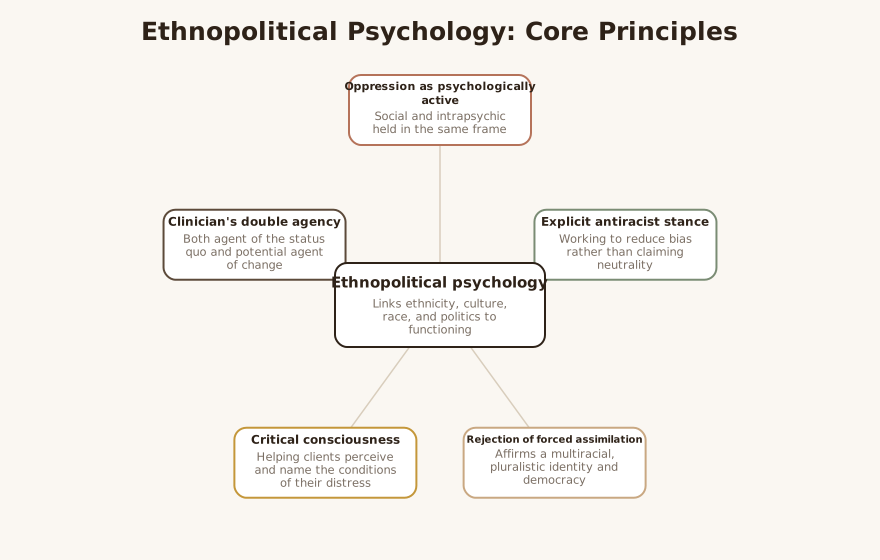
The first principle is that oppression, racism, and political repression are psychologically active forces that shape both individuals and societies, so the clinician must hold the social and the intrapsychic in the same frame 1. The second is that the psychologist should take an explicit antiracist stance, working deliberately to reduce racial bias and promote equitable treatment across society rather than claiming a neutrality that, in practice, defaults to the status quo 1. The third is the rejection of forced assimilation: instead of expecting ethnic minorities to blend into a single homogeneous identity, the framework affirms a multiracial, pluralistic identity and a multiracial democracy 1.
From the liberation-psychology side, the framework adds critical consciousness (conscientization) — helping clients perceive and name the social conditions producing their distress — alongside cultural identity affirmation and an intersectional reading of discrimination 3. It also names the clinician’s “double agency”: liberation-oriented psychologists are simultaneously agents of the status quo and potential agents of social change, and must hold that tension consciously 5. Finally, the therapeutic stance is one of accompaniment, radical empathy, and radical humility, in which the clinician walks alongside rather than above the client 5. The healing orientation is collective as much as individual: the work is framed less as the expert “helping” and more as mutual accompaniment in which liberation is shared 5.
Interventions & Techniques
Comas-Díaz names three primary strategies through which psychologists can ameliorate racism: taking an explicit antiracist stance, promoting societal safety grounded in racial-social equity and justice, and helping clients and communities formulate a collective identity that ensures freedom for all members 1. These operate at the level of stance and formulation and shape everything downstream 1.
At the level of concrete technique, the liberation tradition supplies a recognizable toolkit. Testimonio — structured first-person testimony bearing witness to political trauma — converts private suffering into named historical injustice and is a core emancipatory method 5. Autoethnography and ancestrality connect present distress to lineage, ancestors, and cultural inheritance 5. Creative-arts methods and artivism (art as activism) give nonverbal and collective channels for processing racial and political trauma 5. Participatory action research and other participatory methods extend the work from the consulting room into community-level change 3. The consciousness-raising work of conscientization runs through all of these, helping clients move from self-blame toward a structural understanding of their experience 3.
LLM-generated illustrative example (not a guideline): In a community group for survivors of political violence, a clinician might invite members to share brief testimonios, then collectively map the political events behind their symptoms — reframing what each person had carried as private shame into a shared, externally caused injury LLM.
These techniques are typically layered onto, not substituted for, evidence-based trauma treatment such as trauma-focused cognitive-behavioral therapy or stabilization-first phased approaches LLM. The ethnopolitical contribution is the meaning-making frame — political, collective, antiracist — within which those established methods are delivered LLM.
Evidence Base
The evidence base for ethnopolitical psychology is best described as emerging LLM. The foundational literature is conceptual and theoretical: Comas-Díaz’s 2000 paper is a position and framework article published in American Psychologist, arguing for an antiracist clinical stance and a multiracial identity model rather than reporting a controlled trial 1. The broader liberation-psychology corpus, including the 2020 APA volume, is similarly oriented toward theory, method, clinical application, and social-justice implications, with participatory action research featured as a signature method rather than randomized outcome evaluation 3.
The most structured recent contribution is the radical-healing framework of French and colleagues, published in The Counseling Psychologist in 2020, which offers a defined psychological framework for healing in communities of color and brings greater conceptual precision to this space 4. Even so, much of the work remains at the level of framework articulation, qualitative inquiry, and clinical wisdom rather than large-scale efficacy data LLM. Clinicians should therefore treat ethnopolitical psychology as a well-reasoned, ethically grounded orienting framework with strong face and ecological validity for marginalized populations, while being honest with clients and supervisors that controlled outcome evidence specific to the approach is still developing LLM.
Populations & Indications
The framework was developed explicitly for people of color and for those whose distress is entangled with oppression, racism, and political repression 1. In practice this includes refugees and asylum seekers, ethnic and racial minorities, survivors of political violence and torture, Indigenous populations, immigrants, and communities affected by armed conflict LLM. These are populations for whom a purely intrapsychic formulation can feel invalidating, because it can erase the very real external forces that produced the symptoms LLM.
Indications cluster around presentations in which sociopolitical context is doing clinical work: post-traumatic stress disorder and complex post-traumatic stress disorder following political violence, racial trauma, intergenerational and collective trauma, acculturation stress, and the depression and anxiety that frequently accompany them LLM. The framework is also well suited to presentations of survivor guilt, internalized oppression, and identity distress, where the therapeutic task is partly to externalize blame from the self onto unjust conditions and to rebuild a affirmed collective identity 1.
Problems-for-Work
Racial trauma and internalized oppression. Here the ethnopolitical move is to name racism as the agent of harm and to use conscientization to shift self-blame toward a structural reading, supported by an explicitly antiracist clinical stance 1. For example, a client who interprets workplace discrimination as evidence of personal inadequacy is helped to see the pattern as systemic, loosening the grip of internalized oppression LLM.
Complex PTSD and trauma from political violence or torture. Testimonio and witnessing convert isolating, shame-laden memory into named historical injustice, typically layered onto phased trauma stabilization 5. A torture survivor giving structured testimony, with the clinician accompanying rather than interrogating, may experience the account as restitution of dignity rather than re-traumatization LLM.
Acculturation stress and immigrant identity conflict. The rejection of forced assimilation and the affirmation of a multiracial, pluralistic identity give the client permission to hold multiple cultural belongings without choosing one 1. An immigrant adolescent caught between family and host-culture expectations can be supported toward an integrated rather than either-or identity LLM.
Survivor guilt and collective trauma. Collective and accompaniment-based methods reframe individual guilt as a shared community wound, so the client is not alone with it 5. Ancestrality and connection to lineage can locate present grief within a longer story of community survival 5.
Contraindications, Cautions & Cultural Humility
There are no formal contraindications in the medical sense, but the framework carries real cautions LLM. The most important is the clinician’s “double agency”: a therapist who is also an agent of mainstream institutions can inadvertently reinscribe the very power dynamics the work means to address, and must monitor this tension continuously 5. The stances of radical empathy and radical humility are meant to guard against this, but they require ongoing self-examination rather than a one-time competency 5.
A second caution is the risk of imposing the framework’s political reading onto a client who does not share it; conscientization is an invitation, not an agenda to be installed LLM. Clinicians should be especially careful not to assume that every member of a marginalized group experiences their distress politically, which would simply replace one form of stereotyping with another LLM. Cultural humility — treating the client as the authority on their own ethnocultural experience, and recognizing that the therapist’s own culture, ethnicity, and gender shape the encounter — is therefore foundational 2. Finally, because outcome evidence is still emerging, clinicians should pair the approach with established trauma and mood treatments and avoid presenting it as a stand-alone cure LLM.
Treatment-Plan Suggestions & SMART Objectives
| Goal | SMART objective (example) | Mechanism |
|---|---|---|
| Reduce internalized oppression | Within 8 sessions, client will identify and reframe 3 self-critical beliefs as products of systemic racism, rated weekly on a self-report log | Conscientization / antiracist reframing 1 |
| Process political/racial trauma | Over 6 sessions, client will complete one structured testimonio and report a ≥2-point drop on a distress rating tied to the targeted memory | Testimonio and witnessing 5 |
| Resolve acculturation conflict | Within 10 sessions, client will articulate an integrated bicultural identity statement without endorsing forced choice between cultures | Affirmation of pluralistic, multiracial identity 1 |
| Rebuild collective belonging | Within 12 weeks, client will engage in 2 community or lineage-connected activities and log perceived support | Accompaniment and collective healing 5 |
| Restore agency and hope | Over 8 sessions, client will name 3 areas of personal or collective efficacy, tracked on a brief hope/agency scale | Critical consciousness and empowerment 3 |
| Address survivor guilt | Within 6 sessions, client will reattribute responsibility for a traumatic loss from self to external/political causes in session narrative | Externalization via structural reframing 5 |
| Stabilize trauma symptoms | Within 4 sessions, client will use 2 grounding skills to keep arousal manageable during testimony work, self-rated each session | Phased stabilization layered with ethnopolitical framing LLM |
Common Misconceptions
A frequent misconception is that ethnopolitical psychology is “just politics in the therapy room” and therefore unprofessional; in fact its argument is that ignoring the political determinants of a client’s distress is itself a clinical and ethical choice with consequences, not a neutral one 1. A related error is hearing “antiracist stance” as license to lecture clients, when the framework actually centers accompaniment, radical empathy, and radical humility, with the clinician walking alongside the client rather than instructing them 5.
Another misconception is that the approach replaces evidence-based treatment; more accurately, it is an overlay that supplies formulation and meaning while remaining compatible with established trauma and mood interventions LLM. Some also assume the framework promotes a single “correct” cultural identity, when its actual stance rejects forced assimilation and affirms plural, multiracial identities 1. Finally, it is sometimes read as relevant only to one population; while developed for people of color, its core logic — that oppression and political context shape psychological functioning — extends to any community marked by political violence or marginalization 1.
Training & Certification
There is no formal credential or certification in ethnopolitical psychology, and clinicians should be skeptical of anyone claiming a proprietary license to it LLM. The realistic training pathway is scholarly and supervised rather than certificate-based LLM. The foundational readings are Comas-Díaz’s 2000 American Psychologist article on the ethnopolitical approach and her 2005 work on becoming a multicultural psychotherapist 1 2. The most comprehensive single text is the 2020 APA volume Liberation Psychology: Theory, Method, Practice, and Social Justice, which covers origins, methods, clinical application, and social-justice implications and functions effectively as a course in the framework 3.
For the allied radical-healing model, French and colleagues’ 2020 framework article is the anchor reference 4. Beyond reading, competence is built through supervision and consultation that attends to the clinician’s own cultural, ethnic, and gendered positioning and to the management of double agency 2 5. Community-based and participatory-action experience deepens the systems-level dimension of the work 3.
Key Terms
Antiracist stance — the clinician’s deliberate, non-neutral commitment to reducing racial bias and promoting equity, treated as a clinical posture rather than an optional add-on 1.
Conscientization (critical consciousness) — the process of helping clients perceive and name the social and political conditions producing their distress, shifting from self-blame to structural understanding 3.
Testimonio — structured first-person testimony bearing witness to political and racial trauma, converting private suffering into named historical injustice 5.
Accompaniment — a relational stance of walking alongside the client, supported by radical empathy and radical humility, rather than positioning the therapist as detached expert 5.
Double agency — the clinician’s simultaneous role as agent of the status quo and potential agent of social change, a tension to be managed consciously 5.
Multiracial / pluralistic identity — an identity model that rejects forced assimilation and affirms belonging to multiple cultures and a multiracial democracy 1.
Radical healing — an allied framework for healing in communities of color that brings structured psychological language to collective and political wounds 4.
Resources & Further Reading
▶ Watch — a video introduction to this concept:
- Comas-Díaz, L. (2000). An ethnopolitical approach to working with people of color. American Psychologist.
- Comas-Díaz, L. (2005). Becoming a multicultural psychotherapist: The confluence of culture, ethnicity, and gender. Journal of Clinical Psychology.
- Comas-Díaz, L., & Torres Rivera, E. (Eds.). (2020). Liberation Psychology: Theory, Method, Practice, and Social Justice. American Psychological Association.
- French, B. H., et al. (2020). Toward a psychological framework of radical healing in communities of color. The Counseling Psychologist.
- Liberation Psychology resource hub — Lillian Comas-Díaz (tag archive).
Reflective / Supervision Questions
- When I formulate a marginalized client’s distress, how often do I name political or racial context as a cause — and what changes if I do? LLM
- Where am I currently operating as an agent of the status quo with this client, and where could I be an agent of change, and am I holding that tension consciously? 5
- How do my own culture, ethnicity, and gender shape what I notice and miss in the room? 2
- Am I inviting conscientization, or imposing my political reading onto a client who has not chosen it? LLM
- When I introduce testimonio or witnessing, am I adequately layering it onto trauma stabilization so the work restores dignity rather than re-traumatizes? LLM
- How honestly am I representing the emerging evidence base to clients and supervisees, neither overselling nor dismissing the framework? LLM