
Type & Discipline
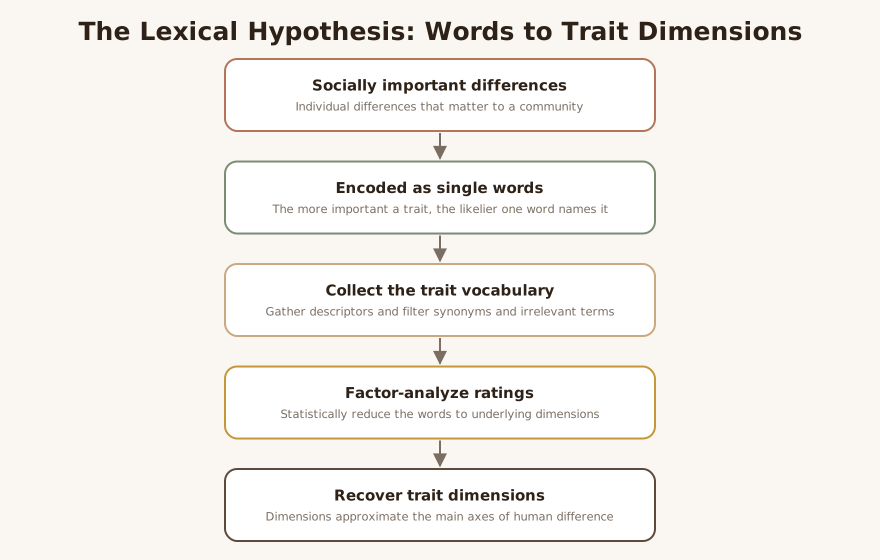
The lexical hypothesis is a foundational theory in personality psychology, sitting squarely within the trait-psychology family 1. It is not a treatment modality and not a clinical intervention; it is a meta-theory about where personality structure comes from and how it can be discovered 1. In one sentence: socially important individual differences become embedded in everyday language, and the more important a difference, the more likely it is to be captured by a single descriptive word 15.
For clinicians, this matters because nearly every trait instrument you encounter — the Big Five, the Five-Factor Model, the NEO inventories, HEXACO — traces its descriptive vocabulary back to this hypothesis 1. When you read a personality report describing a client as “high in conscientiousness” or “low in agreeableness,” you are reading the downstream output of a lexical research program 4. Understanding the hypothesis helps you read those reports critically rather than reifying them LLM.
The discipline is personality psychology; the family is trait psychology; the immediate descendants are psychometrics and factor analysis on one side and the Five-Factor Model on the other 14.
Creators & Lineage
The earliest articulation is usually credited to Sir Francis Galton, who in 1884 surveyed a dictionary and estimated roughly a thousand English words describing character 14. Galton’s wager — that “every important human phenomenon must be somehow represented in the lexicon of a language” — is the seed of the entire program 4. Subsequent counts grew: George Partridge identified about 750 adjectives in 1910, M. L. Perkins about 3,000 terms in Webster’s by 1926, and Ludwig Klages estimated some 4,000 German words for inner states in 1929 1.
The decisive empirical step came from Gordon Allport and Henry Odbert in 1936 3. Working from Webster’s New International Dictionary, they extracted 17,953 unique personality-relevant terms and sorted them into four columns by psychological character — stable traits, temporary states, evaluative judgments, and a miscellaneous residue 13. This psycho-lexical catalogue became the raw material for decades of taxonomic work 1.
Raymond Cattell took the Allport–Odbert list, reduced it, and applied factor analysis to derive his 16-factor model 14. Warren Norman reanalyzed and refined this descriptor pool in the 1960s, trimming a large source list down to a few thousand trait terms 1. Lewis Goldberg built directly on Norman’s foundation to develop and name the Big Five 1. Franziska Baumgarten’s earlier German psycho-lexical classification (1,093 terms) and the John, Angleitner & Ostendorf (1988) historical review map this lineage in detail 12. The critical countervoice in this lineage is Jana Uher, whose 2013 paper argues the field misread the hypothesis from the start 6.
Core Principles
The hypothesis rests on two linked claims 1. First, the encoding principle: personality characteristics that are socially important and frequently relevant to a community become encoded in that community’s language over time 15. Second, the salience principle: the more important a characteristic, the more likely a culture is to have a single word for it rather than a phrase or paragraph 1.
From these two principles follows the program’s central methodological bet: if you systematically collect the personality vocabulary of a language and statistically reduce it, the resulting dimensions should approximate the most important axes of human individual difference 14. The standard procedure is to gather descriptive words from a representative language sample, have experts filter synonyms and irrelevant terms, then factor-analyze ratings to recover underlying dimensions 4.
A third, often under-stated principle is cross-cultural translatability: because important phenomena should be encoded in any language, the same broad dimensions ought to re-emerge when the procedure is repeated in other tongues 4. The recurrent emergence of roughly five factors across several languages became the empirical argument for the Big Five 14.
It is worth holding one distinction in mind that the hypothesis itself blurs: the words are descriptions, not the phenomena being described 6. The lexicon points at behavior and appearance that people found worth naming; it does not, on its own, certify that an internal causal “trait” exists behind the word 6.
Interventions & Techniques
The lexical hypothesis is a research methodology, not a set of in-session techniques LLM. Its “interventions” are the steps by which a trait taxonomy is built 4. The canonical pipeline is: (1) sample the personality lexicon from a dictionary or corpus; (2) reduce the list by removing pure evaluations, states, and rare terms; (3) administer self- and peer-ratings on the surviving adjectives; (4) factor-analyze to extract dimensions; and (5) replicate across samples and languages 14.
For practitioners, the clinically relevant “technique” is the trait instrument that emerges from this pipeline 4. The Big Five — Conscientiousness, Agreeableness, Emotional Stability (or Neuroticism reversed), Openness to Experience, and Extraversion — is the workhorse descriptive framework, used across research, educational, clinical, and vocational settings 4. Allport’s own framing supports applied use: traits are treated as real, statistically identifiable characteristics that describe default tendencies, not absolute rules — an extravert can act introverted in a given situation while extraversion remains the baseline inclination 4.
LLM-generated illustrative example (not a guideline): A clinician administers a brief Five-Factor measure during intake. The client scores very high on Neuroticism and low on Extraversion. Rather than treating these as diagnoses, the clinician uses them as conversation openers — “this profile suggests you experience strong negative emotion and tend to recharge alone; does that fit how you’ve been feeling?” — anchoring the descriptive label to the client’s lived account LLM.
The key clinical caution embedded in the method itself: these dimensions describe and summarize; they do not explain mechanism 4. Treating a trait score as the cause of a behavior is a category error the framework warns against 46.
Evidence Base
Maturity is best described as established but contested 16. As a generative research program, the lexical hypothesis is extraordinarily productive: it underpins the Big Five and HEXACO models and has been replicated across numerous languages, making it one of the most influential ideas in the history of personality structure research 1. The convergence of independent investigators — Cattell, Norman, Goldberg — on overlapping dimensions from the same lexical roots is strong evidence that the procedure recovers stable, reproducible structure 1.
That structural reproducibility, however, is evidence about how people describe persons, not necessarily about what causes behavior 6. The most penetrating critique comes from Uher (2013), who argues that personality psychology focused on the lexical representations themselves while neglecting the actual phenomena those representations describe 6. The hypothesis, on her reading, points at two distinct sets of things — the words and the world they name — and the field largely studied only the words 6.
Uher presses a circularity charge: using a trait score derived from behavior ratings to “explain” behavior is using a description of behavior to explain it, which is no explanation at all 6. She also notes that only behavioral and outer-appearance phenomena actually satisfy the hypothesis’s own criteria of being directly perceivable and socially relevant, yet trait psychology routinely treats internal psychological states — which cannot be directly perceived in others — as if they met the same bar 6. Her conclusion is that the lexical paradigm reveals only half the story and needs supplementing with contextual, temporal, and within-person analysis 6.
For the practicing clinician, the honest summary is: trait instruments are reliable, well-replicated descriptions with real predictive and communicative value, but they are not validated causal models of the person 46.
Populations & Indications
The hypothesis was developed on, and generalizes most cleanly to, the general adult population, since it relies on the shared everyday vocabulary of a speech community 14. Research participants in self- and peer-rating studies are the population on which the taxonomies were actually built 1.
In applied settings, the most relevant populations are clients undergoing personality assessment and the clinicians or assessors interpreting that assessment 4. Trait frameworks derived from the lexical tradition are routinely used to describe presenting style, interpersonal tendencies, and emotional reactivity across clinical and vocational contexts 4.
LLM-generated illustrative example (not a guideline): In a vocational-rehabilitation intake, a counselor uses a Five-Factor profile to help an adult client articulate why structured, predictable roles have suited them better than fast-changing ones — connecting high Conscientiousness and low Openness-to-novelty to concrete past job experiences LLM.
Indication, in clinical terms, is descriptive rather than diagnostic: the framework is indicated when the goal is to characterize a person’s stable style, not to diagnose a disorder 4. The lexical tradition supplies the vocabulary; it does not supply diagnostic thresholds LLM.
Problems-for-Work
The concept maps onto several practical clinical and assessment problems LLM.
- Personality assessment. The lexical hypothesis is the rationale for why a finite set of trait dimensions can summarize a person at all; it justifies using a five-factor profile as a structured starting point for understanding a client 14.
- Trait identification. When a clinician needs to name a client’s stable tendencies, the psycho-lexical catalogue and its descendants provide a vetted descriptive vocabulary rather than ad-hoc impressions 34.
- Self-understanding deficits. A client who struggles to articulate “what I’m like” can use trait language as scaffolding to organize self-knowledge LLM.
- Diagnostic clarification. Trait dimensions can help differentiate stable personality style from episodic state — a distinction Allport and Odbert built into their original four-column sort of traits versus temporary states 3.
- Maladaptive personality traits. Extreme standing on lexically derived dimensions (very high Neuroticism, very low Agreeableness) can flag areas of interpersonal or emotional difficulty for further exploration LLM.
- Self-concept clarification. Comparing self-ratings to peer-ratings — a core lexical method — can surface gaps between how a client sees themselves and how others describe them 1.
In each case the contribution is descriptive structuring, and the clinician supplies the causal and contextual interpretation the framework deliberately withholds 46.
Contraindications, Cautions & Cultural Humility
The hypothesis carries built-in cautions that translate directly into clinical caveats LLM. Most importantly, lexically derived traits describe and do not explain; using a trait score to account for the behavior it was derived from is circular and should not be presented to a client as a causal mechanism 46.
Several biases are baked into the lexicon itself 1. Verbal descriptors carry pro-social and negativity biases that may distort dimensions such as Extraversion and Neuroticism 1. Many lay personality terms are used inconsistently and imprecisely, blending folk psychology with anything resembling scientific measurement 1. Complex characteristics may resist single-word encoding altogether, so the lexicon can systematically under-represent traits that require explanation rather than a label 1.
Cultural humility is non-negotiable here LLM. Personality terms shift across time, dialects, languages, and cultures, so a taxonomy built in one language and era is not automatically valid in another 1. Most foundational lexical work was done on English (and some German) dictionaries, and Uher cautions that the field too readily treats socially shared constructions as if they were universal internal entities 16. When applying trait language to a client from a different linguistic or cultural background, the clinician should hold the labels loosely and check them against the client’s own self-description 6.
A practical contraindication: do not use lexically derived trait scores as standalone diagnostic instruments, since the framework provides description without diagnostic thresholds or causal validation 46.
Treatment-Plan Suggestions & SMART Objectives
The lexical hypothesis is a construct, not a standalone modality; in clinical use it operates as descriptive vocabulary within a broader treatment approach LLM. The objectives below illustrate how trait-descriptive thinking can be folded into established care LLM.
| Goal | SMART objective (example) | Mechanism |
|---|---|---|
| Improve self-understanding | Within 4 sessions, client will name 3 stable personal tendencies using trait language and give one real-life example of each | Trait vocabulary as scaffolding for self-concept 4 |
| Clarify self-concept | Over 6 weeks, client will compare self-described traits to feedback from 2 trusted others and identify 1 perception gap | Self- vs. peer-rating comparison 1 |
| Distinguish state from trait | By session 5, client will sort 5 presenting complaints into “stable pattern” vs. “current episode” categories | Trait/state distinction from psycho-lexical sorting 3 |
| Reduce reactivity tied to high Neuroticism | Over 8 weeks, client will log emotional triggers and apply 1 coping skill in 80% of high-distress events | Descriptive flag guides skill targeting LLM |
| Build interpersonal flexibility | Within 6 sessions, client will identify 2 situations where acting against their default style improved an outcome | Traits as default tendencies, not fixed rules 4 |
| Support diagnostic clarification | By intake review, clinician and client will map trait profile onto presenting concerns to refine focus | Structured description informing case conceptualization 4 |
| Increase accurate self-appraisal | Over 5 sessions, client will revise 2 overgeneralized self-labels into specific, context-bound descriptions | Counters lexical imprecision and folk-psychology bias 1 |
Common Misconceptions
“A trait word names a real internal cause.” The hypothesis claims important differences are encoded in language; it does not establish that each word corresponds to a discrete internal mechanism, and Uher argues that conflating the description with the cause is the field’s central error 6.
“The Big Five is a theory of personality.” The lexically derived dimensions are a descriptive taxonomy that summarizes how people are characterized; they are explicitly not a causal theory of why people behave as they do 4.
“Allport and Odbert produced the Big Five.” They produced a catalogue of nearly 18,000 trait words; the five-factor structure emerged only later through Cattell’s, Norman’s, and Goldberg’s factor-analytic reductions 13.
“The taxonomy is culturally universal.” Replication across several languages is suggestive, but personality terms vary across cultures, dialects, and eras, and most foundational work was English-based — universality is an empirical claim still being tested, not a settled fact 1.
“More words means more trait.” The salience principle is about encoding importance, not measuring a person; a culture having many words for a domain says something about the culture’s concerns, not about any individual’s standing 1.
Training & Certification
There is no certification in “the lexical hypothesis” itself; it is a theoretical foundation taught within personality psychology and psychometrics coursework 14. Competence relevant to clinicians lives instead in the instruments the hypothesis spawned LLM.
Practical training points are: graduate coursework in personality theory and assessment; supervised administration and interpretation of Five-Factor and related trait inventories; and grounding in factor analysis sufficient to understand how the dimensions were derived 14. Familiarity with the primary historical literature — Allport & Odbert (1936) and the John, Angleitner & Ostendorf (1988) review — gives the assessor the context to interpret scores responsibly 23. Reading at least one structural critique, such as Uher (2013), is what separates mechanical score-reporting from thoughtful interpretation 6.
Key Terms
- Lexical hypothesis — the claim that important individual differences become encoded as words, more important ones as single words 15.
- Psycho-lexical study — systematic extraction and classification of personality terms from a language, as in Allport & Odbert’s dictionary survey 3.
- Trait — a real, statistically identifiable characteristic describing a person’s default tendency across situations 4.
- Factor analysis — the statistical reduction that collapses many trait words into a few underlying dimensions 14.
- Big Five / Five-Factor Model — the five-dimension taxonomy (Conscientiousness, Agreeableness, Emotional Stability, Openness, Extraversion) derived from the lexical tradition 4.
- Salience principle — the idea that the social importance of a trait predicts whether a language encodes it in a single word 1.
- State vs. trait — the distinction between temporary conditions and stable characteristics, present in Allport & Odbert’s original column sort 3.
- Circularity critique — Uher’s argument that explaining behavior with a trait derived from behavior is no explanation at all 6.
Resources & Further Reading
▶ Watch — a video introduction to this concept:
- Lexical hypothesis (Wikipedia) — overview of history, principles, and criticisms 1.
- Allport, G. W., & Odbert, H. S. (1936). Trait-names: A psycho-lexical study — the foundational catalogue of ~18,000 trait terms 3.
- John, Angleitner & Ostendorf (1988). The lexical approach to personality: A historical review of trait taxonomic research — the standard historical review of the lineage 2.
- The Trait Approach & the Lexical Hypothesis (Arcadia Personality Series) — accessible explainer linking Galton, Allport, Cattell, and the Big Five 4.
- Lexical Hypothesis definition (AlleyDog Psychology Glossary) — concise glossary definition 5.
- Uher, J. (2013). Personality psychology: Lexical approaches… why it is time for a paradigm shift (PMC) — the major contemporary critique 6.
Reflective / Supervision Questions
- When I describe a client with trait language, am I treating the label as a description of their style or sliding into using it as a causal explanation the framework does not support? 6
- Whose lexicon am I using? Does the trait vocabulary I apply fit this client’s linguistic and cultural background, or am I importing an English-dictionary taxonomy? 1
- How do I hold the tension between a trait instrument’s strong reliability and its weak claim to explain behavior when I present results to a client? 46
- Where might pro-social or negativity bias in trait words be shaping how I read this client’s profile? 1
- For this case, would comparing self-description with peer or collateral report reveal a perception gap worth exploring? 1
- Am I distinguishing stable pattern from current episode, as the original trait/state sorting demands, before committing to a characterization? 3