
Type & Discipline
The HEXACO model is a descriptive, dimensional theory of personality structure drawn from the discipline of personality psychology and the broader tradition of trait psychology 1. It is not a therapy, a diagnostic system, or a treatment protocol; it is a framework for organizing stable individual differences into six broad factors, each subdivided into measurable facets 7. For clinicians, this distinction matters: HEXACO describes who a person tends to be across situations, not what disorder they have or what intervention they need LLM.
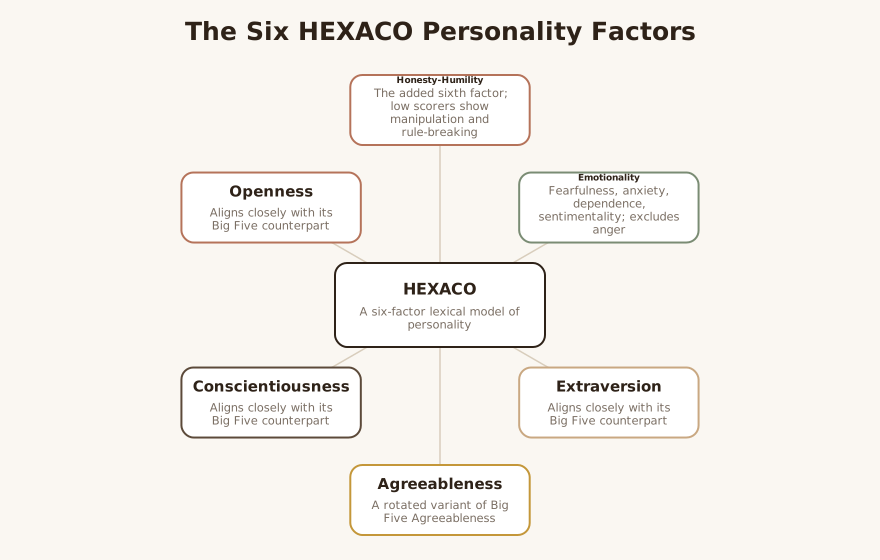
The model belongs to the same family as the Big Five (Five-Factor Model) and shares its empirical method, the lexical study of natural-language trait adjectives, but it resolves personality into six factors rather than five 7. The acronym HEXACO names those factors: Honesty-Humility (H), Emotionality (E), eXtraversion (X), Agreeableness (A), Conscientiousness (C), and Openness to Experience (O) 3. In clinical settings it functions as an assessment-adjacent vocabulary, most useful for case formulation, psychoeducation, and treatment planning rather than as a standalone billable service LLM.
Creators & Lineage
HEXACO was developed in the early 2000s by Canadian psychologists Kibeom Lee and Michael Ashton 5. Their work grew directly out of the lexical hypothesis, the long-standing premise that the most socially important personality characteristics become encoded as single words in everyday language 7. Earlier English-language lexical studies had repeatedly produced five factors, which became the Big Five; Lee and Ashton’s contribution was to examine adjective sets across multiple languages 7.
When researchers compared personality-descriptive adjectives across languages including Dutch, French, Korean, and Polish, a sixth factor appeared consistently that English-only studies had missed 7. That recurring sixth dimension became Honesty-Humility, and its cross-linguistic robustness is the model’s central empirical claim 1. Lee and Ashton operationalized the structure in the HEXACO Personality Inventory-Revised (HEXACO-PI-R), the instrument maintained on the model’s official site 2. They later wrote a trade book, The H Factor of Personality, framing low Honesty-Humility as the trait underlying manipulative, self-entitled, materialistic, and exploitative behavior 4.
The lineage thus runs: trait theory of personality and the lexical hypothesis produced the Big Five; cross-cultural lexical replication revealed a sixth factor; and the resulting six-factor model overlaps conceptually with Dark Triad research, because the constructs of narcissism, Machiavellianism, and psychopathy map cleanly onto low Honesty-Humility 7.
Core Principles
The first principle is that six factors, not five, are needed to capture the replicable structure of personality lexicons across languages 1. Three HEXACO factors, Extraversion, Conscientiousness, and Openness, align closely with their Big Five counterparts 7. The remaining three differ: Honesty-Humility is new, while Agreeableness and Emotionality are rotated variants whose content has been redistributed relative to Big Five Agreeableness and Neuroticism 7.
The second principle is the centrality of Honesty-Humility. High scorers avoid manipulating others for personal gain, feel little temptation to break rules, and are uninterested in excessive wealth and status; low scorers show flattery, rule-breaking, materialism, and a sense of superiority 3. Ashton and Lee argue this dimension confers empirical and theoretical advantages because it predicts exploitative and unethical behavior that the Big Five capture only diffusely 1.
The third principle is the rotation of Emotionality and Agreeableness. HEXACO Emotionality excludes irritability and anger and instead incorporates fearfulness, anxiety, dependence, and sentimentality, along with low courage 3. HEXACO Agreeableness, by contrast, absorbs the lack of anger, emphasizing forgiveness, gentleness, flexibility, and patience 7. This means anger and temper sit on the Agreeableness axis in HEXACO rather than on the Emotionality/Neuroticism axis as in the Big Five, a difference with direct clinical implications for how irritability is conceptualized LLM.
The fourth principle is hierarchy: each of the six factors decomposes into four narrower facets, plus an interstitial Altruism facet capturing overlap among Honesty-Humility, Emotionality, and Agreeableness 7. The facets give clinicians more precise targets than the broad factor scores alone LLM.
Interventions & Techniques
HEXACO is not itself an intervention; it supplies a structured lens that clinicians fold into recognized therapeutic work LLM. The most direct use is assessment-informed case formulation. The HEXACO-PI-R is a self-report inventory available through the official site, measuring the six factors across their facets 2. A self-assessment version exists for use as a psychoeducational starting point 5.
A second technique is trait psychoeducation. Reviewing a client’s profile, particularly the Honesty-Humility and Agreeableness facets, can externalize patterns the client experiences as chronic interpersonal friction, reframing them as describable, modifiable tendencies rather than fixed character flaws LLM. Because the model names anger under low Agreeableness (low patience, low gentleness), it offers a clean entry point for anger and forgiveness work 7.
A third technique is collateral or dyadic interpretation. In couples work, comparing two HEXACO profiles can surface complementary or clashing facet patterns, for example one partner low in Flexibility paired with one low in Patience, and translate vague complaints into specific, workable behavioral targets LLM.
LLM-generated illustrative example (not a guideline): A clinician treating a client whose presenting complaint is “people keep betraying me” might use a HEXACO-PI-R review to notice the client scores very low on the Forgivingness and Flexibility facets of Agreeableness. Rather than debating who betrayed whom, the clinician anchors CBT and skills work on perspective-taking and flexible appraisal, using the facet language as a shared map LLM.
Evidence Base
The maturity of HEXACO as a descriptive trait model is best characterized as established 1. It is built on replicated cross-language lexical studies and a validated, widely used inventory, and its six-factor structure has accumulated substantial empirical support since 2007 1. Ashton and Lee’s review explicitly catalogues empirical, theoretical, and practical advantages over the Five-Factor Model, particularly in predicting behaviors tied to the Honesty-Humility dimension 1.
Honesty-Humility shows incremental predictive validity beyond the Big Five for outcomes including exploitation, entitlement, and unethical conduct 3. Low Honesty-Humility corresponds to higher levels of psychopathy, Machiavellianism, and narcissism, the Dark Triad constructs that correlate inconsistently with Big Five measures but clearly with this single HEXACO dimension 7. Psychology Today notes research linking Honesty-Humility to crime resistance, health outcomes, and charitable behavior 5.
The honest caveat for clinicians: the model is a strong descriptive and predictive framework, but its evidence base is for measurement and prediction of traits, not for treatment outcomes LLM. There is no body of randomized trials showing that a “HEXACO intervention” changes symptoms, because no such standalone intervention exists; its clinical value is as an assessment and formulation aid embedded in established therapies LLM.
Populations & Indications
HEXACO is designed primarily for adults in personality assessment, where the HEXACO-PI-R provides a normed profile 2. It is well suited to organizational and personnel settings, where Honesty-Humility predicts counterproductive and unethical workplace behavior, and these same indications carry over to occupational and forensic evaluation 1.
Forensic and correctional populations are a natural fit because low Honesty-Humility maps onto exploitative and rule-breaking tendencies relevant to risk formulation 7. Clients with personality disorders, particularly those with narcissistic or antisocial features, can be described dimensionally through low Honesty-Humility and low Agreeableness rather than only categorically 7. The model is also useful with couples and with people presenting interpersonal difficulties, where facet-level differences illuminate recurring conflict LLM.
Problems-for-Work
The model is most clinically generative for problems involving integrity, exploitation, and interpersonal friction LLM. Narcissistic traits and antisocial or manipulative behavior are the prototypical applications: both express as low Honesty-Humility, and naming the specific facets (low Sincerity, low Fairness, low Modesty, high greed) gives the work concrete targets 4. Integrity and honesty concerns, including deception within therapy or relationships, sit directly on this dimension 3.
Interpersonal conflict and relationship difficulties often track low Agreeableness facets, low Forgivingness, Patience, Gentleness, or Flexibility, which can be addressed with emotion-regulation and communication skills 7. Trait-based emotional dysregulation and anxiety patterns may relate to high Emotionality facets such as Fearfulness, Anxiety, and Dependence 3. Low self-awareness is addressable through the psychoeducational act of reviewing one’s own profile LLM.
LLM-generated illustrative example (not a guideline): In a forensic evaluation, a clinician describes a client’s manipulative interview presentation not as a character verdict but as a profile low in Honesty-Humility (Sincerity and Fairness facets) and low in Agreeableness, then ties this to specific documented behaviors for the report LLM.
Contraindications, Cautions & Cultural Humility
The chief caution is that HEXACO is descriptive, not diagnostic: a low Honesty-Humility score is not a diagnosis of antisocial or narcissistic personality disorder, and using it that way overreaches the instrument LLM. Trait scores should never substitute for clinical interview, history, and formal diagnostic criteria LLM.
Self-report is the model’s standard mode, which makes it vulnerable to social-desirability distortion precisely on the Honesty-Humility dimension, where low scorers may present themselves favorably LLM. In forensic and personnel contexts where there is motivation to dissemble, results must be interpreted with that limitation explicit LLM.
Cultural humility is essential despite the model’s cross-linguistic origins. Although HEXACO’s structure was derived from multiple languages, including Dutch, French, Korean, and Polish, lending it more cross-cultural support than English-only models, this does not guarantee that facet norms or the social meaning of traits transfer cleanly to every cultural group a clinician sees 7. Behaviors that read as low Agreeableness or low Modesty in one cultural frame may be adaptive or normative in another, and clinicians should hold trait interpretations lightly and collaboratively LLM. Framing any feedback as describing tendencies rather than fixed essence reduces the risk of stigmatizing language, especially around the morally loaded Honesty-Humility factor LLM.
Treatment-Plan Suggestions & SMART Objectives
| Goal | SMART objective (example) | Mechanism |
|---|---|---|
| Increase self-awareness of trait patterns | Client will complete a HEXACO-PI-R review and name two facet patterns linked to a presenting problem within 3 sessions | Trait psychoeducation externalizes patterns into describable tendencies 2LLM |
| Reduce manipulative/exploitative interpersonal behavior | Client will identify and log 3 instances of low-Honesty-Humility behavior (flattery, rule-bending) per week for 4 weeks | Self-monitoring of behaviors tied to low Honesty-Humility 3LLM |
| Improve forgiveness and reduce grudge-holding | Client will practice one perspective-taking exercise per conflict and report reduced rumination over 6 weeks | Targets low Forgivingness facet of Agreeableness 7LLM |
| Increase patience/flexibility in conflict | Client will use a paced-response skill in 80% of identified high-conflict interactions over 8 weeks | Targets low Patience and Flexibility facets of Agreeableness 7LLM |
| Manage fear/anxiety-linked Emotionality | Client will apply a grounding skill at first sign of anxiety in 4 of 5 logged episodes weekly | Addresses high Anxiety and Fearfulness facets of Emotionality 3LLM |
| Build integrity-consistent behavior | Client will define 3 personal fairness standards and act consistently with them, reviewed biweekly | Strengthens Sincerity and Fairness facets of Honesty-Humility 4LLM |
| Improve relational understanding (couples) | Both partners will review paired profiles and agree on 2 facet-based communication adjustments within 4 sessions | Dyadic facet comparison translates complaints into targets 4LLM |
Common Misconceptions
A frequent misconception is that HEXACO is simply the Big Five plus an honesty scale LLM. In reality it also redistributes content: Agreeableness and Emotionality are rotated, so anger and temperament that load on Neuroticism in the Big Five load on Agreeableness in HEXACO 7. Clinicians who assume one-to-one factor equivalence will misread profiles LLM.
A second misconception is that Honesty-Humility measures honesty in the narrow sense of truth-telling. The factor is broader, spanning sincerity, fairness, greed-avoidance, and modesty, and is better understood as a tendency toward fair, non-exploitative dealing with others 3. A third is that a low Honesty-Humility score equals psychopathy; the Dark Triad constructs correlate with low Honesty-Humility but are not identical to it, and a trait score is not a clinical diagnosis 7. Finally, some assume Emotionality is just Neuroticism renamed, but HEXACO Emotionality excludes irritability and includes sentimentality and low courage, a meaningfully different construct 3.
Training & Certification
There is no formal certification required to use the HEXACO model or its inventory, and clinicians should be wary of any product implying one is needed LLM. The HEXACO-PI-R and its scoring materials are available through the official site maintained by Lee and Ashton, which is the authoritative source for the instrument and its facet definitions 2.
Competent use rests on general training in psychological assessment and test interpretation rather than a HEXACO-specific credential LLM. For grounding, the foundational peer-reviewed paper is Ashton and Lee (2007), and the accessible trade treatment of the Honesty-Humility factor is Lee and Ashton’s The H Factor of Personality 14. Clinicians using any self-report inventory should already be trained to interpret results within ethical and diagnostic limits LLM.
Key Terms
- Honesty-Humility (H): The sixth factor unique to HEXACO; high scorers avoid exploiting others, low scorers tend toward manipulation, greed, and a sense of superiority. Facets: Sincerity, Fairness, Greed-Avoidance, Modesty 37.
- Emotionality (E): Fearfulness, Anxiety, Dependence, Sentimentality; excludes the irritability found in Big Five Neuroticism 3.
- Extraversion (X): Social Self-Esteem, Social Boldness, Sociability, Liveliness 7.
- Agreeableness (A): Forgivingness, Gentleness, Flexibility, Patience; absorbs the lack-of-anger content 7.
- Conscientiousness (C): Organization, Diligence, Perfectionism, Prudence 7.
- Openness to Experience (O): Aesthetic Appreciation, Inquisitiveness, Creativity, Unconventionality 7.
- Lexical hypothesis: The premise that important personality traits are encoded in everyday language, the method behind both the Big Five and HEXACO 7.
- HEXACO-PI-R: The HEXACO Personality Inventory-Revised, the self-report instrument measuring the six factors across 24 facets plus an Altruism facet 72.
Resources & Further Reading
▶ Watch — a video introduction to this concept:
- Ashton & Lee (2007), Empirical, Theoretical, and Practical Advantages of the HEXACO Model
- The HEXACO Personality Inventory-Revised (official site)
- The HEXACO Model of Personality (SAPA Project)
- Lee & Ashton, The H Factor of Personality (2013)
- HEXACO (Psychology Today Basics)
- HEXACO model of personality structure (Wikipedia)
Reflective / Supervision Questions
- When I notice a client behaving in an exploitative or manipulative way, do I reach for diagnostic labels where a dimensional, facet-level description (low Honesty-Humility, low Agreeableness) would be more accurate and less stigmatizing? LLM
- How do I guard against social-desirability distortion when a self-report instrument asks clients to rate their own honesty and modesty? LLM
- Am I treating a low trait score as a fixed verdict on character, or as a describable, workable tendency I can fold into an evidence-based modality? LLM
- Given a client’s cultural background, which trait interpretations might I be over-reading, and how do I check those assumptions collaboratively? LLM
- When anger or irritability shows up, am I conceptualizing it under Emotionality out of Big Five habit, when the HEXACO map places it under low Agreeableness, and does that change my intervention target? LLM
- How am I documenting trait information so that it supports the billable therapy I provide rather than implying HEXACO is itself the treatment? LLM