
Type & Discipline
LeDoux’s fear-conditioning model is a theory in affective neuroscience, not a treatment or therapeutic technique LLM. It describes how the mammalian brain detects threat, learns to associate neutral cues with danger through Pavlovian conditioning, and mounts rapid defensive responses, with the amygdala at the center of that circuitry 3. The model sits at the intersection of behavioral neuroscience, learning theory, and emotion research, and it gave the laboratory study of fear a concrete neural substrate rather than a purely behavioral or cognitive one LLM. For clinicians, its value is not as a procedure you deliver but as the mechanistic account of why exposure-based treatments work — it specifies the threat-learning and extinction processes that exposure therapy targets 3.
A second feature makes this model unusual among the theories a therapist encounters: its own originator later cautioned against the most popular reading of it LLM. Joseph LeDoux came to argue that the brain circuits he had spent decades mapping should not be called “fear circuits,” because doing so wrongly implies that activity in those circuits is the conscious feeling of fear 1. That refinement, discussed throughout this article, is the model’s most clinically important nuance LLM.
Creators & Lineage
The model is the work of Joseph E. LeDoux (born December 7, 1949, in Eunice, Louisiana), a neuroscientist who earned his Ph.D. at SUNY Stony Brook in 1977 and, after years at Cornell Medical School, joined New York University’s Center for Neural Science as its first outside hire in 1989 1. At NYU he holds the Henry and Lucy Moses Professorship and directs the Emotional Brain Institute, a collaboration between NYU and the Nathan Kline Institute for Psychiatric Research 1. His scientific lineage runs back through Michael Gazzaniga, with whom he conducted split-brain research in the 1970s and co-authored The Integrated Mind (1978) before turning to the neural basis of emotion 1.
LeDoux’s signature contribution emerged from studying Pavlovian fear conditioning in rodents — pairing a neutral cue with an aversive event and tracing the neural pathway that produces the learned defensive response 1. He synthesized this program for a general readership in The Emotional Brain: The Mysterious Underpinnings of Emotional Life (1996), which argued that “emotional responses are hard-wired into the brain’s circuitry, but the things that make us emotional are learned through experience,” and that the brain can detect danger before conscious awareness of being afraid 2. Later books — Synaptic Self (2002), Anxious (2015), and The Deep History of Ourselves (2019) — extended and, importantly, revised the framework 1. The intellectual lineage of the model draws on classical (Pavlovian) conditioning for its learning paradigm, on the broader project of affective neuroscience for its aim of locating emotion in the brain, and on extinction research for the bridge to exposure-based treatment LLM. Key collaborators include Elizabeth Phelps, who helped translate the rodent findings to human threat processing, and Karim Nader and Glenn Schafe, whose work on memory reconsolidation grew out of the same laboratory 1.
Core Principles
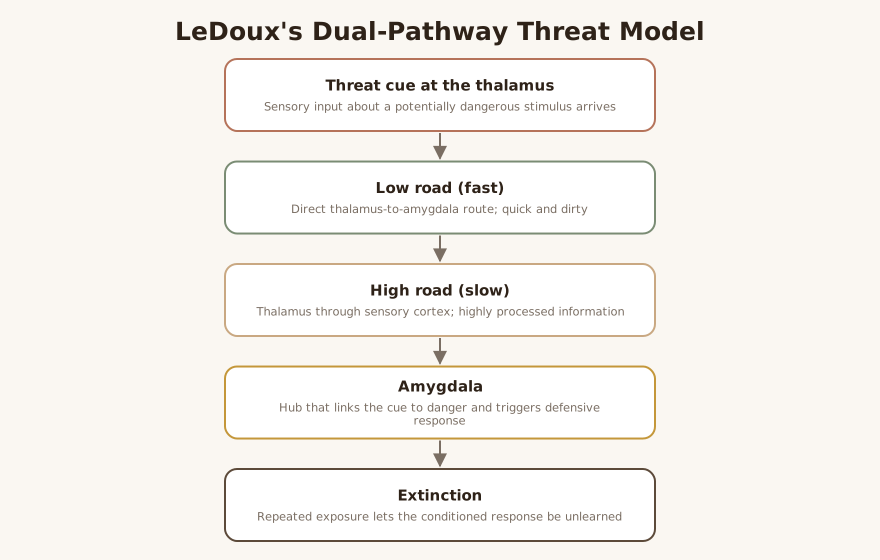
The first principle is that the amygdala is the hub of threat learning 3. It receives sensory inputs about potentially dangerous stimuli and forms the emotional memories that link a cue to danger, enabling swift defensive responses 3. In LeDoux’s account, the cellular and synaptic changes underlying conditioned threat responses are concentrated in the amygdala, which made it a tractable site for studying how an emotional memory is physically stored 1.
The second principle is the dual-pathway architecture — the famous “low road” and “high road” 1. The low road is a fast, subcortical route running from the thalamus directly to the amygdala, allowing immediate reactions to danger before detailed analysis 31. The high road runs from the thalamus through the sensory cortex to the amygdala, processing information more thoroughly before a response is generated 31. LeDoux described the low road as a “quick and dirty” pathway and the high road as carrying “highly processed cortical information,” the brain balancing speed against accuracy 1.
The third principle is that conditioned threat responses are learned and can be unlearned 3. Through repeated exposure to the conditioned cue without any negative outcome, the conditioned response can be extinguished over time — the empirical foundation on which exposure therapy rests 3. Extinction is not erasure of the original learning but the formation of new, inhibitory learning, which is why fear can return; this is the mechanistic reason exposure must be thorough and well-generalized LLM.
The fourth principle is LeDoux’s later and decisive refinement: the threat-detection circuitry is not the same thing as the feeling of fear 1. He argued that brain circuits that detect and respond to threats should not be labeled “fear circuits,” because that implies animals consciously experience fear, when what the circuits actually do is nonconscious threat detection and defensive responding 1. In his revised framing, fear and anxiety are conscious experiences — “the consequence of the cognitive processing of nonemotional ingredients” — assembled by cortical, higher-order processes, while the subcortical “defensive survival circuits” operate without producing a felt emotion 1. The model’s behavioral and physiological half (threat conditioning, defensive responses) is therefore distinct from the experiential half (the conscious feeling), and conflating them is the error LeDoux spent his later career correcting LLM.
Interventions & Techniques
The model is not itself a procedure a therapist performs; it is the mechanistic rationale beneath an existing family of techniques LLM. What it offers a practicing clinician is an explanation of why certain interventions work and where in the system they act LLM.
The most direct application is exposure therapy and its variants 3. By repeatedly presenting the feared cue in a safe context, the clinician leverages extinction — the same process LeDoux’s laboratory studied — to weaken the conditioned threat response 3. This is the engine of prolonged exposure for posttraumatic stress disorder, in-vivo and imaginal exposure for specific phobia, interoceptive exposure for panic disorder, and exposure-based work for social anxiety LLM. The model clarifies that the target of these procedures is the threat-learning system, not the client’s verbal reasoning about danger, which is why insight alone rarely extinguishes a conditioned fear LLM.
The model also informs a more recent translational line: extinction during reconsolidation, in which a reactivated threat memory is rendered temporarily labile and updated, an approach developed by LeDoux’s collaborators that aims to reduce the return of fear 1. For the bedside clinician this remains largely a research frontier rather than a routine protocol, but it illustrates that the model continues to generate treatment ideas LLM.
Finally, LeDoux’s two-system refinement carries a concrete clinical implication: because exposure and extinction act on the defensive/threat-learning system while the conscious feeling of fear is cortically assembled, a complete treatment often pairs exposure (to retrain threat learning) with cognitively mediated work (to address the conscious appraisal and experience of fear) 1. The two halves of the model map onto two complementary therapeutic targets LLM.
LLM-generated illustrative example (not a guideline): A clinician treating a driving phobia after a collision might use the model to explain why the client’s heart races on a highway on-ramp before any conscious thought — the low-road threat circuit firing — and then design graded in-vivo exposure to extinguish that conditioned response, while separately using cognitive work to address the conscious, catastrophic appraisal that the racing heart triggers LLM.
Evidence Base
The maturity of this model is established, and an honest account separates what is well-supported from what LeDoux himself flagged as overreach LLM. The amygdala’s central role in Pavlovian threat conditioning is one of the most robustly replicated findings in affective neuroscience, demonstrated across species and confirmed in human neuroimaging, and the extinction of conditioned responses through unreinforced exposure is equally well established and directly clinically actionable 3. The dual-pathway architecture — fast subcortical and slower cortical routes to the amygdala — emerged from careful lesion and tracing studies and remains a standard textbook account of threat processing 31.
The contested part is not the existence of these circuits but their interpretation, and the most pointed critic is the model’s own author 1. LeDoux came to argue that the “quick and dirty” low road has been over-read, and, more fundamentally, that equating amygdala activity with the conscious feeling of fear conflates two different things — nonconscious defensive survival circuitry on one hand and consciously experienced emotion on the other 1. In his revised view, fear and anxiety are not “biologically wired” feelings produced by the amygdala but conscious constructions — “the consequence of the cognitive processing of nonemotional ingredients” — a position he developed in Anxious (2015) and after 1. The defensible clinical stance is therefore to treat the threat-conditioning and extinction findings as solid mechanism worth building treatment on, while treating any claim that the amygdala “is where fear lives” as a simplification the originator explicitly rejected LLM.
Populations & Indications
The model is most directly relevant to the fear- and anxiety-related presentations in which conditioned threat responses are central LLM. People with specific phobias are a paradigm case, because a phobia is, in this framework, a conditioned threat response to a circumscribed cue, and exposure-based extinction is the indicated treatment 3. Trauma survivors and people with posttraumatic stress disorder are a second core population, since the model explains how a traumatic experience can install a durable threat memory that drives reactions even without elaborated conscious recall — a phenomenon LeDoux highlighted in describing how early or implicit emotional memories shape later behavior 2.
Panic disorder patients fit the model where bodily sensations become conditioned threat cues, and people with social anxiety disorder where social-evaluative cues acquire threat value, both treatable through exposure that engages extinction LLM. Veterans and others with high trauma exposure are an indicated group for the same reasons, and people with generalized anxiety and chronic hyperarousal are relevant insofar as a sensitized threat system underlies their persistent vigilance LLM. Across all of these, the indication is not a “LeDoux therapy” but the use of the model to formulate the problem as threat learning and to justify exposure-based intervention LLM.
Problems-for-Work
The model reframes a recognizable cluster of clinical problems as expressions of conditioned threat learning LLM. Conditioned fear responses are the central case: a cue that was once neutral now reliably elicits a defensive reaction, and exposure that allows the cue to occur without harm is the mechanism of change 3. Specific phobia is the cleanest clinical instantiation — the spider, the elevator, the needle functions as a conditioned threat cue, and graded exposure extinguishes the response 3.
PTSD presents as an over-consolidated, easily reactivated threat memory, where the model explains both the involuntary reactivity and the rationale for exposure and, on the research frontier, reconsolidation-based updating 1. Panic disorder can be worked as conditioned fear of interoceptive cues, treated with interoceptive exposure; social anxiety disorder as conditioned fear of social-evaluative cues; and hyperarousal and avoidance as the downstream behavioral signatures of an active defensive system LLM. Generalized anxiety is a looser fit but is usefully framed as a chronically sensitized threat system maintained partly by avoidance that prevents extinction LLM.
LLM-generated illustrative example (not a guideline): A veteran who startles and scans exits whenever a door slams may be conceptualized as carrying a conditioned threat response in which sudden sound is the cue; framing the avoidance and hypervigilance as a defensive survival circuit doing its job — rather than as a character weakness — orients treatment toward graded exposure and extinction rather than toward reassurance alone LLM.
Contraindications, Cautions & Cultural Humility
A theory has no contraindications; the cautions concern how clinicians use it LLM. The foremost, voiced by LeDoux himself, is the conflation caution: do not tell a client that their amygdala “creates” their fear or that fear simply “lives” in a brain circuit, because the model’s author argues that the threat circuits and the conscious feeling of fear are different things 1. Over-reading the “low road” into a story of a hijacking, all-powerful amygdala oversimplifies a system in which cortical processing and conscious appraisal do substantial work 1.
A second caution concerns translation across species and from lab to clinic LLM. The cleanest demonstrations of threat conditioning come from rodent studies, and human fear and anxiety involve layers of conscious meaning, language, and culture that the rodent paradigm does not capture — a gap LeDoux’s later two-system framework was specifically designed to respect 1. Treating a person’s anxiety as nothing more than a conditioned reflex risks missing the appraisal and meaning that often drive the presenting problem LLM.
Cultural humility is essential. What counts as a threat cue, how fear is expressed and displayed, and which avoidance behaviors are adaptive are all shaped by cultural and social context, and a behavior that reads as pathological hypervigilance in one setting may be a reasonable response to a genuinely dangerous environment in another LLM. Before framing a client’s responses as a conditioned threat reaction to be extinguished, the clinician must establish that the feared situation is in fact safe in the client’s actual life context, not merely in an abstract one LLM.
Treatment-Plan Suggestions & SMART Objectives
The model does not generate goals about changing a client’s brain; the appropriate goals concern exposure, extinction, and the conscious experience of fear, delivered inside an existing modality LLM.
| Goal | SMART objective (example) | Mechanism |
|---|---|---|
| Extinguish a conditioned fear response | Over 10 weeks, client completes a graded exposure hierarchy with peak SUDS dropping ≥40% from baseline across sessions | Repeated unreinforced exposure to the conditioned cue drives extinction learning 3 |
| Reduce phobic avoidance | Within 8 weeks, client enters the feared situation (e.g., elevator) on ≥3 occasions weekly without escape, logged | Avoidance prevents extinction; sustained contact allows new safety learning 3 |
| Process a trauma-linked threat memory | Over 12 sessions of imaginal exposure, client’s distress to the trauma narrative declines ≥50% on a standardized measure | Reactivating and re-experiencing the memory in safety weakens the conditioned threat response 1 |
| Target interoceptive cues (panic) | Within 6 weeks, client completes interoceptive exposure to ≥3 feared bodily sensations with reduced avoidance | Bodily sensations function as conditioned cues; interoceptive exposure extinguishes the response LLM |
| Address the conscious appraisal of fear | Within 4 sessions, client identifies and reframes ≥2 catastrophic appraisals that follow a threat-circuit reaction | The conscious feeling of fear is cortically assembled and is a separate target from threat conditioning 1 |
| Build tolerance for physiological arousal | Over 6 weeks, client practices an arousal-tolerance skill during 2 triggering situations weekly, tracked | Hyperarousal reflects an active defensive system; tolerance reduces escape and supports extinction LLM |
| Reduce hypervigilant scanning | Over 8 weeks, partner/observer-rated safety-scanning behaviors decrease in 2 routine settings | Hypervigilance is a defensive output; extinction and corrective experience reduce its triggering LLM |
Common Misconceptions
The most consequential misconception is that the amygdala is the seat of fear — that the feeling of being afraid is simply amygdala activation 1. LeDoux’s own revised position is the corrective: the amygdala-centered circuits perform nonconscious threat detection and defensive responding, while the conscious experience of fear is a separate, cortically assembled process 1. A clinician who tells a client “your amygdala is making you afraid” is repeating the very simplification the model’s author rejected 1.
A second misconception is that the “low road” means an emotional brain that routinely “hijacks” rational control LLM. The dual-pathway architecture is about speed versus thoroughness in threat processing, not about a primitive brain overriding a rational one, and LeDoux cautioned against over-reading the quick-and-dirty pathway 1. A third error is that extinction erases the original fear memory; in fact extinction is new inhibitory learning layered over the old, which is why fear can return and why exposure must be robust LLM. Finally, the model is sometimes taken to reduce all anxiety to conditioned reflex, when human fear and anxiety also involve conscious meaning and appraisal that the threat-conditioning paradigm does not, by itself, capture 1.
Training & Certification
There is no certification in “fear-conditioning theory,” because it is a body of scientific knowledge rather than a credentialed therapy LLM. The clinically relevant competency lies in the exposure-based treatments that operationalize the model: prolonged exposure for PTSD, exposure therapy for phobias and panic, and exposure components within cognitive behavioral therapy, each of which has its own established training pathways and supervised practice requirements LLM. Mastery of the model itself is a matter of scientific literacy — understanding Pavlovian threat conditioning, extinction, and LeDoux’s two-system refinement well enough to formulate cases and explain treatment rationale accurately 3.
For the practicing clinician, the realistic goal is twofold: enough grasp of the mechanism to design and justify exposure work, and enough familiarity with LeDoux’s later caution to avoid the common over-claims about the amygdala and fear 1. That conceptual literacy is best paired with formal credentialing in the exposure-based modalities within which the model is actually applied LLM.
Key Terms
Fear (threat) conditioning: Pavlovian learning in which a neutral cue paired with an aversive event comes to elicit a conditioned defensive response 3.
Amygdala: the brain structure LeDoux identified as the hub for processing threat-related information and forming emotional memories 3.
Low road: the fast subcortical thalamus-to-amygdala pathway allowing immediate reactions to danger; LeDoux called it “quick and dirty” 31.
High road: the slower thalamus-to-cortex-to-amygdala pathway that processes information more thoroughly before a response is generated 31.
Extinction: the weakening of a conditioned response through repeated exposure to the cue without a negative outcome — the basis of exposure therapy 3.
Defensive survival circuits: LeDoux’s preferred term for the nonconscious threat-detection-and-response circuits, chosen to avoid implying conscious fear 1.
Emotional memory: the stored association, concentrated in the amygdala, linking a cue to danger and capable of driving behavior even without elaborated conscious recall 2.
Resources & Further Reading
▶ Watch — a video introduction to this concept:
- Joseph E. LeDoux — Wikipedia
- LeDoux, J. (1996). The Emotional Brain: The Mysterious Underpinnings of Emotional Life — Google Books
- The Emotional Brain, Fear, and the Amygdala (LeDoux) — review article (ResearchGate record)
- Joseph E. LeDoux: Fear, Anxiety, Emotions, Consciousness and Evolution — Springer (chapter)
- What I’ve Been Reading: ‘Anxious’ by Joseph LeDoux — Conflict Management Academy
- LeDoux’s Research on Fear Conditioning — Fiveable study term
Reflective / Supervision Questions
- When I explain a client’s anxiety in neural terms, am I respecting LeDoux’s distinction between nonconscious threat circuits and the conscious feeling of fear, or am I telling the client their amygdala simply “makes” them afraid? 1
- For this case, am I clear about which target I am working on — the conditioned threat response (via exposure and extinction) or the conscious appraisal and experience of fear (via cognitive work) — and am I addressing both where needed? 1
- Have I confirmed that the feared situation is genuinely safe in this client’s real-life context before framing their response as a conditioned reaction to be extinguished? LLM
- Is avoidance in this case preventing the extinction learning that exposure depends on, and have I structured treatment to interrupt it? 3
- Am I treating this person’s anxiety as more than a conditioned reflex — attending to the meaning, memory, and cultural context that shape it — as LeDoux’s later two-system view would require? 1