
Type & Discipline
Lectio divina is a technique — a structured contemplative practice — rather than a standalone psychotherapy or a theoretical orientation LLM. The phrase is Latin for “divine reading” or “spiritual reading,” and the practice consists of a slow, prayerful, listening engagement with Scripture 3. It belongs to the discipline of Christian contemplative practice and the broader family of contemplative and spiritual disciplines 1.
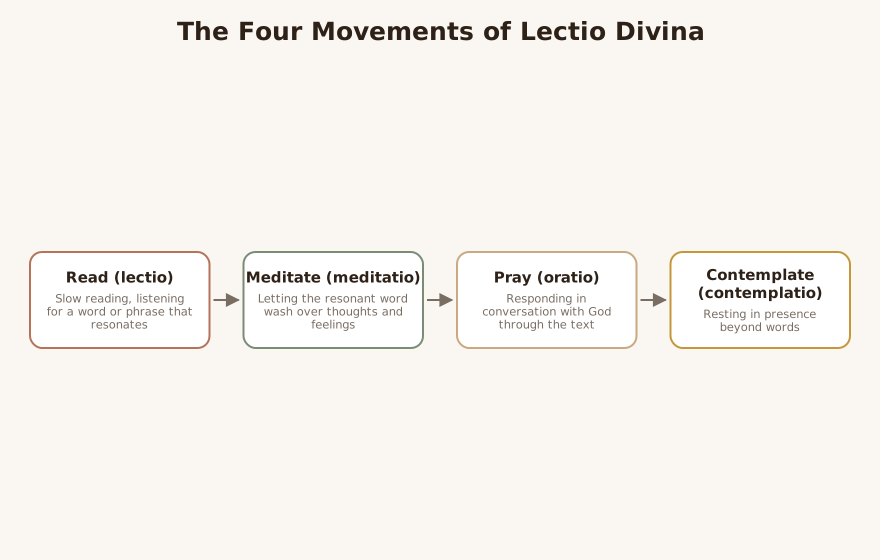
Structurally, the practice unfolds through four classical movements — reading (lectio), meditation (meditatio), prayer (oratio), and contemplation (contemplatio) — each of which involves returning to the same passage with a different inner posture 2. Unlike analytical biblical study, lectio divina treats the text not as material for intellectual dissection but as a “Living Word” through which the practitioner seeks to encounter God 1. For the clinician, the most useful framing is that lectio divina is a spiritually congruent attentional practice: a way of slowing down, narrowing attentional focus to a single phrase, and resting in receptive stillness — operations that overlap meaningfully with the attentional and decentering processes targeted in secular contemplative interventions LLM.
It is worth stating clearly at the outset that lectio divina is not a clinical protocol and was never designed as one LLM. It is a devotional discipline with theological aims, and its appearance in a clinical wiki reflects its potential role as a client-led, faith-integrated coping practice — not an evidence-based treatment in the way that exposure therapy or cognitive restructuring are LLM.
Creators & Lineage
Lectio divina has no single founder; it developed cumulatively across the Christian monastic tradition 1. Its roots trace to Origen of Alexandria in the third century, who treated Scripture as a sacrament incarnating the Word, with Christ as the interpretive key to its meaning 1. Origen’s approach passed to the Western Church Fathers Ambrose and Augustine, who absorbed his methods and helped introduce them into Western monastic traditions by the late fourth century 1.
The practice became a structural pillar of monastic life through Benedict of Nursia in the sixth century, whose Rule scheduled set times for prayerful reading alongside liturgy and manual labor 1. Saint Meinrad Archabbey, a Benedictine community, accordingly presents lectio divina as integral to Benedictine spirituality and oblate formation to this day 3. The familiar four-stage sequence was first formally articulated by Guigo II, a Carthusian monk who died in the late twelfth century; in his work The Ladder of Monks he named the four movements with the Latin terms still in use 1. Bernard of Clairvaux championed the practice within the Cistercian order in the early twelfth century, regarding it as essential to nourishing Christian spirituality 1.
The practice was not confined to Catholic monasticism. Protestant reformers, including John Calvin and the Puritan theologian Richard Baxter, continued to advocate methods of this kind in the sixteenth century 1. In the modern era, the Second Vatican Council reaffirmed lectio divina through the constitution Dei Verbum (1965), and Pope Benedict XVI emphasized its importance in the twenty-first century as a source of spiritual renewal 1.
Within this wiki’s conceptual map, lectio divina sits alongside contemplative prayer and, more loosely, the secular lineage of mindfulness meditation and mindfulness-based stress reduction — practices it resembles in form (sustained, non-discursive attention) while differing in aim and theological content LLM.
Core Principles
Several principles distinguish lectio divina from ordinary reading or study LLM. First is slowness and repetition: the same short passage is read multiple times, each pass inviting a different mode of engagement 2. Second is receptivity over analysis: the practitioner ponders the passage gently, considering it from various angles without analytically dissecting it, allowing meaning to emerge rather than imposing interpretation 1.
Third is the principle of the resonant word or phrase. In the reading movement, the practitioner listens for a particular word or phrase that “resonates,” then in meditation lets that word wash over and permeate thoughts and feelings 2. This deliberate narrowing of attention to a single phrase is, mechanistically, an anchoring operation comparable to a meditation object in secular contemplative practice LLM.
Fourth is dialogue: lectio divina is framed as a conversation with God through Scripture, engaging thoughts, images, memories, and desires rather than the intellect alone 2. The tradition captures this reciprocity in the formula that “we speak to Him when we pray; we hear Him when we read” 1. Fifth is resting in presence — the contemplative movement is characterized by stillness and receptivity, a silent abiding rather than active doing 1.
A final principle is flexibility. Saint Meinrad explicitly notes there is “no standard way” to practice lectio divina, which makes it accessible to beginners and adaptable to individual temperament 3. The tradition also holds that genuine contemplation is “a gift of grace that depends on the movement of the Holy Spirit” — meaning the deepest movement cannot be willed or guaranteed by technique 3. Clinically, this theological humility is useful: it discourages a performance mindset and reduces the risk of clients judging themselves for “not doing it right” LLM.
Interventions & Techniques
The core technique is the four-movement sequence, typically applied to a Scripture passage of moderate length — comparable to a single Mass reading 2.
Preparation. The practitioner sits comfortably with feet grounded, an upright posture, and open hands, mentally releasing worries and agendas and asking God for receptivity to the Word 2. A brief preparatory prayer inviting the Holy Spirit’s guidance traditionally precedes the reading 1.
Lectio (Read). The passage is read slowly and meditatively, often aloud, while the practitioner listens for a word or phrase that resonates 2.
Meditatio (Meditate). The passage is read again, and the chosen word or phrase is allowed to wash over the person and permeate thoughts and feelings; one ponders it from various angles without analytic dissection 2.
Oratio (Pray). On a third reading, the practitioner considers what God may be communicating, notices their own response and the emotions that accompany it, and shares these with God in prayer 2.
Contemplatio (Contemplate). On a final reading, the focused word or phrase is released; the practitioner rests in God’s presence, discerns any gifts received or invitations to action, and concludes with gratitude 2.
The Notre Dame guide notes that the contemplative movement may surface a “potential invitation to action,” and the practice may be done alone or communally 2. Clinicians adapting this should keep it client-led: the therapist’s role is to support the client’s own practice and to process what arises, not to direct the spiritual content LLM.
LLM-generated illustrative example (not a guideline): A clinician working with a devout client troubled by nighttime rumination might suggest the client try a five-minute lectio divina with a familiar psalm before bed — reading slowly, settling on one phrase, and resting in it — then bring to session what they noticed about their attention and mood. The therapist treats the practice as a behavioral coping experiment and helps the client reflect on it, without prescribing the spiritual meaning LLM.
Evidence Base
Honesty about evidence requires a distinction here. As a spiritual practice, lectio divina is established — it has roughly seventeen centuries of continuous use, formal codification by Guigo II, magisterial reaffirmation in Dei Verbum, and a stable, well-documented method described consistently across reputable contemporary sources 123. Its standing as a contemplative discipline is not in doubt 1.
As a clinical intervention, however, the direct empirical evidence base is thin and far less mature than the practice’s spiritual pedigree might suggest LLM. The provided sources document the method, history, and theological rationale of lectio divina, but they are reference and devotional materials rather than clinical trials, and they make no claims about symptom reduction, effect sizes, or outcomes for any diagnosis 123. Clinicians should therefore not represent lectio divina to clients as a tested treatment for anxiety, depression, or grief LLM.
The defensible clinical position is mechanistic and analogical: lectio divina shares structural features — sustained focused attention, an anchoring object, repetition, and receptive non-judgmental resting — with secular contemplative practices that do have a clinical literature, and it delivers these within a meaning system the religious client already values LLM. For a client whose worldview is genuinely Christian, a faith-congruent contemplative practice may be more acceptable and more readily sustained than a secularized alternative LLM. That is a reasonable hypothesis for individualized care, not a substitute for established treatments, and it should be framed to clients as such LLM.
Populations & Indications
Lectio divina is most clearly indicated for religious or Christian clients for whom Scripture and prayer are already meaningful and who express interest in a spiritually integrated coping practice 2. For these clients the practice is congruent rather than foreign, which supports engagement and adherence LLM.
It may also suit people explicitly seeking spiritual coping during distress, grieving individuals looking for a structured way to sit with loss in a faith frame, and clergy and contemplatives for whom the practice is part of vocational formation — Saint Meinrad situates it precisely within oblate and Benedictine formation 3LLM. Older adults, particularly those with long-standing devotional habits, may find the practice familiar and accessible, and the “no standard way” flexibility lowers the barrier to entry 3LLM. Because lectio divina can be done alone or in a group, it adapts to both individual and communal settings 2.
The strongest indication, across all these groups, is client-initiated interest combined with an existing or emerging faith framework; clinician-imposed religious practice is not indicated LLM.
Problems-for-Work
The following are plausible problems-for-work where a clinician might support a client’s use of lectio divina as an adjunctive, client-led coping practice — always alongside, not instead of, indicated evidence-based treatment LLM.
- Anxiety and stress. The slow reading and receptive resting may function as a faith-congruent down-regulation and attentional anchoring exercise, analogous in form to a breathing or focus anchor 2LLM.
- Rumination. Narrowing attention to a single resonant phrase and gently returning to it offers a structured alternative to circular worry, redirecting attention rather than suppressing it 2LLM.
- Grief. The dialogical, prayerful movements give a grieving client a contained, repeatable way to bring loss into relationship with God and to “share their response and emotions” rather than avoid them 2LLM.
- Existential distress and meaning/purpose concerns. Engaging sacred text as a “Living Word” can reconnect a client to a meaning system, and the contemplative movement’s “invitation to action” can surface values-based next steps 12LLM.
- Spiritual struggle and demoralization. For a client whose distress includes feeling distant from God, the practice’s framing as dialogue — “we hear Him when we read” — provides a concrete, low-pressure way to re-approach that relationship 1LLM.
LLM-generated illustrative example (not a guideline): A bereaved older client describes feeling “spiritually numb” after her husband’s death. With her consent, the clinician supports a weekly home practice of lectio divina using a psalm of lament, then uses session time to process the emotions and memories the practice surfaces. The lectio practice is the client’s spiritual coping ritual; the therapeutic work is the clinician helping her stay with, name, and integrate the grief that arises LLM.
Contraindications, Cautions & Cultural Humility
Lectio divina is a religious practice and must never be imposed; introducing it to a non-religious, differently religious, or religiously ambivalent client risks alliance rupture and is ethically inappropriate without the client’s clear interest and consent LLM. The clinician’s role is to support the client’s own faith resources, not to act as a spiritual director or to supply religious content — boundaries of competence and scope of practice apply LLM.
Several cautions deserve attention. For clients with scrupulosity or religious/spiritual OCD, a repetitive devotional practice can be co-opted into compulsive reassurance-seeking or “praying correctly” rituals; here the practice may reinforce pathology and should be approached with care or avoided LLM. For clients with trauma histories, silence and inward focus can increase contact with distressing internal experience; the contemplative resting movement may need to be shortened, grounded, or deferred LLM. Clients in acute crisis, psychosis, or severe depression with strong guilt may experience the introspective movements as destabilizing or may interpret “not feeling God’s presence” as evidence of personal failure or abandonment, and the tradition itself notes contemplation cannot be willed, which such clients may misread as their own inadequacy 3LLM.
Cultural humility also requires recognizing that lectio divina is specifically Christian and largely Catholic-Benedictine in form; it should not be presented as a generic “mindfulness” technique stripped of its theological context, nor offered to clients of other faiths as if interchangeable with their own contemplative traditions 1LLM. When a client’s tradition differs, the appropriate move is to honor and explore their practices, not to substitute this one LLM.
Treatment-Plan Suggestions & SMART Objectives
The table below offers example objectives for incorporating client-led lectio divina as an adjunctive coping practice within a broader, evidence-based plan LLM.
| Goal | SMART objective (example) | Mechanism |
|---|---|---|
| Reduce nighttime rumination | Client will practice a 5-minute lectio divina with a chosen passage 4 nights per week for 4 weeks and rate pre/post rumination (0-10) in a log | Attentional anchoring to a single phrase redirects from circular worry 2LLM |
| Lower physiological anxiety | Client will complete the four movements once daily for 2 weeks, noting any change in felt tension, and review the log in session | Slow reading and receptive resting support down-regulation 2LLM |
| Process grief in a faith frame | Client will use lectio divina with a lament psalm weekly for 6 weeks and bring emerging emotions/memories to session | Dialogical prayer and sharing of emotion counters avoidance 2LLM |
| Reconnect with meaning | Client will identify one “invitation to action” arising from the contemplative movement each week and name one values-based step | Re-engagement with a meaning system surfaces values 12LLM |
| Address spiritual distance | Client will practice the prayer (oratio) movement 3 times weekly and reflect on the sense of dialogue in session | “We hear Him when we read” reframes prayer as reciprocal contact 1LLM |
| Build a sustainable coping ritual | Client will establish a consistent time, posture, and passage selection for daily practice over 3 weeks | Routine and grounded posture lower the barrier to engagement 23LLM |
| Reduce performance pressure | Client will practice without self-rating “success,” noting only what they observed, for 2 weeks | “No standard way” framing counters self-judgment and scrupulous striving 3LLM |
Common Misconceptions
A frequent misconception is that lectio divina is simply Bible study or analytical reading; in fact it deliberately avoids analytic dissection, engaging the text as Living Word rather than as material for intellectual examination 1. A second is that it is the same as secular mindfulness — while the two share attentional features, lectio divina is explicitly theistic, framed as dialogue with God, and oriented toward communion rather than non-judgmental awareness for its own sake 12LLM.
A third misconception, relevant clinically, is that there is one correct method that must be performed precisely; Saint Meinrad states plainly there is “no standard way” to practice it 3. A fourth is that the contemplative outcome can be achieved by effort or technique — the tradition holds contemplation to be a “gift of grace” dependent on the Holy Spirit, not a guaranteed product of doing the steps correctly 3. Finally, clinicians sometimes assume the practice is a proven treatment; the provided sources establish it as a spiritual discipline but make no clinical-outcome claims, so it should be offered as supportive coping, not as therapy 123LLM.
Training & Certification
There is no clinical certification in lectio divina, and none is implied by the practice’s tradition LLM. It is transmitted within Christian formation contexts — for example, Benedictine oblate and monastic formation, as at Saint Meinrad Archabbey — and through pastoral and devotional guides such as the McGrath Institute’s practical instruction at Notre Dame 23. For a clinician, the relevant “training” is twofold: competence in spiritually integrated psychotherapy generally, and respect for the boundary between clinician and spiritual director LLM. Clinicians who wish to understand the practice experientially can learn it from the same accessible guides clients use, but offering or supervising the spiritual content itself falls outside the typical clinical scope and is better referred to clergy or a spiritual director when appropriate LLM.
Key Terms
- Lectio (reading): Slow, meditative reading of a passage, listening for a resonant word or phrase 2.
- Meditatio (meditation): Letting the chosen word permeate thoughts and feelings; pondering without analytic dissection 12.
- Oratio (prayer): Responding to the text in prayerful dialogue, sharing one’s response and emotions with God 2.
- Contemplatio (contemplation): Releasing the focused word and resting silently in God’s presence; a stillness held to be a gift of grace 13.
- Divine reading: The literal translation of lectio divina; prayerful, listening engagement with Scripture 3.
- The Ladder of Monks: Guigo II’s twelfth-century work that first formally named the four movements 1.
- Dei Verbum: The Second Vatican Council constitution (1965) that reaffirmed lectio divina in the modern Church 1.
Resources & Further Reading
▶ Watch — a video introduction to this concept:
- Lectio Divina — Wikipedia — history, lineage, and the four movements 1.
- How to Practice Lectio Divina, Praying with Scripture — McGrath Institute, University of Notre Dame — a clear practical step-by-step guide 2.
- Lectio Divina — Saint Meinrad Archabbey — Benedictine framing and the flexibility of the practice 3.
Reflective / Supervision Questions
- Has this client initiated interest in a faith-based practice, or am I introducing it from my own framework? How would I know the difference? LLM
- Am I staying within my scope as a clinician, or am I drifting into the role of spiritual director — and where is the boundary for this client? LLM
- Could the repetitive, introspective elements of this practice interact badly with this client’s scrupulosity, trauma, or acute symptom picture? LLM
- How will I frame lectio divina so the client understands it as supportive coping alongside, not instead of, indicated treatment? LLM
- If the client reports “not feeling anything” or “doing it wrong,” how will I use the tradition’s own teaching — no standard way, contemplation as gift — to reduce self-judgment? 3LLM
- For a client of a different faith, how would I honor their contemplative tradition rather than defaulting to this one? LLM