
Type & Discipline
Learned optimism is a theory within positive psychology that describes optimism not as a fixed temperament but as a modifiable cognitive habit 2. Its central construct is explanatory style—the characteristic way a person explains the causes of good and bad events to themselves 3. The theory sits at the intersection of attribution theory, learned helplessness research, and cognitive behavioral therapy, and it predates the formal launch of positive psychology while becoming one of its anchoring ideas 4. LLM
Although “optimism” colloquially implies a sunny disposition or positive expectancies about the future, the learned-optimism construct is more precise: it is operationalized through how a person attributes setbacks rather than what they predict will happen 3. This makes it a cognitive-process theory rather than a mood or trait theory, which is why it lends itself to structured intervention LLM.
Creators & Lineage
The lineage begins with Martin Seligman’s experimental work on learned helplessness in the 1960s and 1970s, which showed that organisms exposed to uncontrollable aversive events later failed to escape even when escape became possible 3. The pivotal theoretical shift came in 1978, when Lyn Abramson, Martin Seligman, and John Teasdale published a reformulation of learned helplessness in humans, arguing that the original model could not explain why people differed so widely in their responses to uncontrollability 1. Their answer was attributional: the explanation a person generates for an uncontrollable event determines whether helplessness becomes chronic, global, and self-esteem-damaging 1.
This reformulation introduced the three attributional dimensions—internal versus external, stable versus unstable, and global versus specific—that remain the backbone of explanatory-style assessment 1. Seligman later popularized and extended this framework for general and clinical audiences in his 1990 book Learned Optimism: How to Change Your Mind and Your Life, reframing the same dimensions as permanence, pervasiveness, and personalization 2. The work draws directly on the cognitive tradition—particularly the attributional and cognitive-restructuring methods shared with cognitive behavioral therapy—and Seligman went on to make optimism a foundational theme of the positive psychology movement he helped found 4. He presented these ideas to a broad public audience in his TED talk on the new era of positive psychology 5.
Core Principles
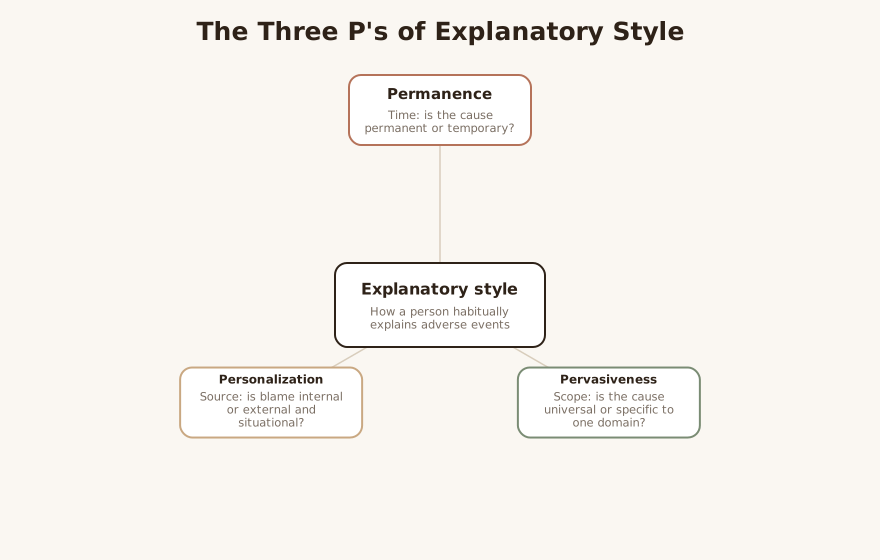
The core of the theory is the “three P’s” of explanatory style, which describe how an individual habitually explains adversity 6:
- Permanence concerns time: does the person see the cause of a setback as permanent (“I always fail”) or temporary (“that didn’t work this time”)? 6
- Pervasiveness concerns scope: does the person see the cause as universal, spilling across all of life (“I’m useless at everything”), or specific to one domain (“I’m not good at this particular task”)? 6
- Personalization concerns source: does the person internalize blame (“it’s my fault, I’m defective”) or locate causes more externally or situationally (“the circumstances were stacked against me”)? 6
A pessimistic explanatory style explains bad events as permanent, pervasive, and personal, and—crucially—tends to explain good events in the opposite way (temporary, specific, external), discounting one’s own successes 2. An optimistic explanatory style reverses this pattern: setbacks are framed as temporary, specific, and external, while successes are credited as more durable, broad, and personal 2. The pessimistic pattern of attributing bad events to internal, stable, and global causes is the configuration most strongly linked to depressive helplessness and lowered self-esteem 1.
A second principle is that explanatory style is learned and therefore unlearnable and relearnable 2. Because the pattern is a cognitive habit rather than a fixed trait, it can be identified, disputed, and revised—this is what makes “learned optimism” both a description and an intervention 2. LLM
Interventions & Techniques
The signature clinical technique is disputation, adapted from cognitive therapy and built around the ABCDE model 2. The model walks a client from Adversity (the activating event) to Beliefs (the automatic explanation that arises) to Consequences (the emotional and behavioral fallout), then to Disputation (actively challenging the pessimistic belief) and Energization (the felt shift when a more accurate, less catastrophic explanation takes hold) 2. LLM
Disputation itself can be structured around four lines of attack on a pessimistic belief: examining the evidence for and against it, generating alternatives (other plausible causes, especially temporary and specific ones), evaluating the real implications even if the belief were partly true (decatastrophizing), and assessing the usefulness of holding the belief at all 2. LLM
A practical entry point many clinicians use is the 3 P’s worksheet, which has clients name a recent setback and then deliberately re-examine it across permanence, pervasiveness, and personalization, rewriting permanent into temporary, pervasive into specific, and personal into situational where the evidence allows 6. The aim is not relentless positivity but accuracy—replacing distorted, globally negative explanations with explanations that fit the facts 4. LLM
LLM-generated illustrative example (not a guideline): A graduate student fails a qualifying exam and concludes, “I’m not smart enough—I’ll never make it in this field.” A clinician using disputation might prompt: What is the evidence (prior passing grades, a single bad week, illness)? What is an alternative, more specific explanation (under-prepared for one section, slept poorly)? Even if partly true, what are the real implications (a retake is permitted)? The reframed belief—“I underprepared for one section this time and can target it”—is temporary, specific, and actionable. LLM
Evidence Base
The evidence base for the underlying theory is established, in the sense that explanatory style is a well-validated, decades-old construct with substantial empirical grounding. The 1978 reformulation is a heavily cited foundational paper in clinical and abnormal psychology, and the attributional account of helplessness it introduced has generated a large research literature on pessimistic explanatory style as a risk factor for depression 1. Pessimistic explanatory style has been studied as a correlate and predictor of depression, lowered achievement, and reduced persistence across student, athletic, and workplace samples 4.
Honesty about maturity requires several caveats. First, much of the foundational support is correlational and predictive—pessimistic style is associated with and forecasts depressive outcomes—which does not by itself establish that changing style causes durable clinical improvement 1. Second, learned-optimism disputation overlaps heavily with cognitive behavioral therapy techniques, so it is not always possible to attribute outcomes specifically to the “optimism” framing rather than to generic cognitive restructuring 4. Third, the popular and applied literature (self-help books, worksheets, motivational talks) outpaces the controlled treatment-outcome literature, and clinicians should weight the original empirical sources more heavily than promotional accounts 2. In short, the construct and its link to depression risk are well established; learned optimism as a standalone, branded treatment is best understood as a cognitive intervention nested within the broader, more rigorously evaluated CBT tradition LLM.
Populations & Indications
Learned-optimism methods have been applied across a wide range of populations. In clinical contexts, they are most directly relevant to people with depression, where pessimistic explanatory style is a documented vulnerability factor 1. The framework has also been applied with adolescents and at-risk youth as a preventive and resilience-building tool, and with students, where explanatory style has been studied in relation to academic persistence and achievement 4.
Beyond mental-health settings, learned optimism has been used with athletes—where explanatory style relates to recovery after setbacks and sustained effort—and with employees and broader workplace populations as a resilience and burnout-mitigation approach 4. It is also frequently offered to people prone to anxiety, where re-examining catastrophic, globally negative interpretations overlaps naturally with anxiety-focused cognitive work LLM. Across these groups, the common indication is a habitual pattern of explaining setbacks in permanent, pervasive, and personal terms 6.
Problems-for-Work
The framework maps onto a cluster of presenting problems, each addressable by targeting one or more of the three P’s:
- Pessimism and negative cognitive bias are the most direct targets: the client’s default reading of events is systematically more global and permanent than the evidence warrants, and disputation aims to recalibrate this 2.
- Hopelessness and demoralization are closely tied to the permanence dimension—the belief that bad conditions will never change—so work often centers on testing the “always/never” quality of the client’s predictions 2. LLM
- Low self-esteem maps onto personalization, where the client over-attributes setbacks to a defective self; disputation introduces situational and external contributors without abdicating responsibility 1. LLM
- Rumination can be interrupted by externalizing structured disputation (writing the ABCDE chain) so the loop has a defined endpoint rather than recycling indefinitely LLM.
- Burnout and low resilience in workplace or athletic settings are framed as recoverable and domain-specific rather than as a permanent collapse of capacity, targeting permanence and pervasiveness 4. LLM
- Major depressive disorder and anxiety are addressed through the shared cognitive-restructuring mechanism, typically as one component within a fuller treatment LLM.
LLM-generated illustrative example (not a guideline): A mid-career employee facing layoff says, “This proves I’m a failure and my whole career is over.” A clinician targets pervasiveness (“this is one role in one company, not your entire career”) and permanence (“a layoff in a downturn is a setback, not a verdict”), helping the client distinguish a painful but bounded event from a global, permanent self-assessment. LLM
Contraindications, Cautions & Cultural Humility
Learned optimism is a low-risk cognitive approach, but several cautions apply. The most important is that it is not a mandate for forced positivity or denial—the goal is accurate explanation, and pushing a client to reframe genuine, ongoing adversity (abuse, discrimination, real loss) as merely “external and temporary” can invalidate legitimate experience and rupture the alliance 4. LLM When a setback truly is due to an external, persistent, and unjust cause, the optimistic reattribution should not erase that reality; the clinical task is calibration, not relentless reframing LLM.
In acute presentations—active suicidality, severe major depression, or trauma—cognitive disputation is rarely sufficient on its own and should be embedded within a comprehensive treatment plan rather than offered as a stand-alone fix LLM. There is also a real risk of subtly communicating that distress is the client’s “fault” for explaining things pessimistically; clinicians should frame explanatory style as a learned habit, not a moral failing 2. LLM
Cultural humility is essential because attributions are not culturally neutral. What looks like “external” attribution may, in some cultural frameworks, reflect accurate appraisal of collective, systemic, or relational realities rather than a cognitive distortion to be corrected LLM. Practitioners should examine whether a client’s “pessimistic” attributions are tracking genuine structural barriers—racism, poverty, marginalization—before treating them as targets for disputation, and should adapt the work to the client’s values and worldview LLM.
Treatment-Plan Suggestions & SMART Objectives
| Goal | SMART objective (example) | Mechanism |
|---|---|---|
| Reduce pessimistic explanatory style | Over 8 weeks, client will complete an ABCDE disputation log for at least 3 setbacks per week, increasing temporary/specific reframes to ≥70% of entries | Cognitive disputation of permanence and pervasiveness 2 |
| Decrease hopelessness | Within 6 weeks, client will reduce “always/never” permanence statements during sessions, evidenced by self-report and clinician tally, by 50% | Targeting the permanence dimension 2 |
| Improve self-esteem | Over 10 weeks, client will identify ≥2 external/situational contributors for each self-blaming attribution in a weekly worksheet | Recalibrating personalization without abdicating responsibility 1 |
| Interrupt rumination | Within 4 weeks, client will use a written ABCDE chain to bring 3 rumination episodes per week to a defined endpoint | Externalizing disputation to terminate the loop LLM |
| Build resilience to setbacks | Over 8 weeks, client will reframe ≥1 weekly setback as domain-specific using the 3 P’s worksheet, rated ≥7/10 for believability | Limiting pervasiveness via structured reattribution 6 |
| Reduce burnout-related demoralization | Within 6 weeks, client will distinguish recoverable from permanent stressors in ≥80% of logged work stressors | Permanence + pervasiveness reattribution 4 |
| Increase balanced appraisal of success | Over 8 weeks, client will credit ≥1 personal, durable factor for each success logged weekly | Reversing the success-discounting pattern 2 |
Common Misconceptions
A first misconception is that learned optimism means “thinking positive” or affirmations—it does not; it is about generating accurate explanations, and an optimistic reframe that ignores real evidence is not the goal 4. A related error is believing optimism requires denying that bad things are bad; the technique works on the causal attribution for an event, not on pretending the event is pleasant 2. LLM
A second misconception is that explanatory style is a fixed personality trait. The entire premise of the theory is that it is learned and therefore changeable, which is precisely what distinguishes it from dispositional optimism research 2. Third, some assume learned optimism is a fully independent, free-standing therapy; in practice its core technique is cognitive disputation drawn from and overlapping with cognitive behavioral therapy 4. LLM
Finally, clinicians sometimes assume more optimism is always better. Seligman’s own framing acknowledges contexts where caution and accurate pessimism serve people well (e.g., high-stakes risk assessment), so the clinical aim is flexible, accurate explanatory style rather than maximal optimism 2. LLM
Training & Certification
There is no single credentialing body or formal certification for “learned optimism” as a distinct license-bearing modality LLM. Clinicians typically learn the framework through Seligman’s primary text, Learned Optimism, which lays out the explanatory-style model and the ABCDE disputation method in detail 2. Because the technique is functionally a form of cognitive restructuring, training in cognitive behavioral therapy provides most of the transferable clinical skill, and the disputation steps integrate directly into existing CBT practice 4. LLM
Accessible secondary resources include applied explainers and structured tools such as the 3 P’s worksheet, which can be used to teach the framework to clients or to practice it as a clinician 6. Seligman’s broader positive-psychology work and public talks provide conceptual orientation but are not a substitute for supervised cognitive-therapy training 5. LLM
Key Terms
- Explanatory style — the habitual way a person explains the causes of events, especially adverse ones, along the dimensions of permanence, pervasiveness, and personalization 3.
- Permanence — the time dimension of an attribution: temporary versus permanent causes 6.
- Pervasiveness — the scope dimension: specific versus global/universal causes 6.
- Personalization — the source dimension: external/situational versus internal/self-blaming causes 6.
- Pessimistic explanatory style — explaining bad events as permanent, pervasive, and personal; linked to depression risk 1.
- Optimistic explanatory style — explaining bad events as temporary, specific, and external 2.
- Disputation (ABCDE) — the technique of challenging pessimistic beliefs via Adversity, Beliefs, Consequences, Disputation, and Energization 2.
- Learned helplessness — the precursor phenomenon in which exposure to uncontrollable events produces passivity; reformulated attributionally in 1978 1.
Resources & Further Reading
▶ Watch — a video introduction to this concept:
- Abramson, Seligman & Teasdale (1978), Learned helplessness in humans: Critique and reformulation
- Seligman (1990), Learned Optimism: How to Change Your Mind and Your Life
- Learned optimism (Wikipedia)
- Learned Optimism: Is Martin Seligman’s Glass Half Full? (PositivePsychology.com)
- Martin Seligman: The new era of positive psychology (TED Talk)
- The 3 P’s: A Framework for Learned Optimism (DAU worksheet)
Reflective / Supervision Questions
- When a client describes a setback as permanent, pervasive, and personal, how do I distinguish a genuine cognitive distortion from an accurate appraisal of real, ongoing adversity? LLM
- Am I helping the client reach accurate explanations, or am I subtly pushing forced positivity that invalidates their experience? LLM
- How might a client’s cultural or systemic context make an “external” attribution the realistic one—and how do I honor that rather than dispute it? LLM
- Where does my own explanatory style show up in how I interpret a difficult case or a client’s lack of progress? LLM
- For this client, is learned-optimism disputation a sufficient intervention, or should it be nested within a fuller treatment plan for depression, anxiety, or trauma? LLM
- How do I frame explanatory style as a learnable habit so the client does not hear “your distress is your own fault”? LLM