
Type & Discipline
Parataxic distortion is not a treatment modality, a technique, or a diagnosis. It is a construct — a way of naming a recurring clinical phenomenon: the tendency to perceive and respond to a present person as though they were someone from the past 1. It belongs to the disciplines of psychiatry and psychoanalysis, and specifically to the school of interpersonal psychoanalysis founded by Harry Stack Sullivan 4. LLM
The construct is most useful to clinicians as a lens rather than a tool. It reframes “irrational” or “overreactive” interpersonal behavior as a perceptual error with a developmental history, which is a stance that tends to lower the temperature in the room and invite curiosity rather than correction. LLM
Sullivan situated parataxic distortion within his broader theory of the modes of experience — prototaxic (the earliest, fragmented, undifferentiated experience of infancy), parataxic (perceiving causal links between events that occur together but are not logically related), and syntaxic (logical, consensually validated thinking that others can understand and share) 6. The “parataxic” in parataxic distortion points to that middle mode: a private, illogical linkage that has not been checked against shared reality 6.
Creators & Lineage
The term was coined by Harry Stack Sullivan (1892–1949), the American psychiatrist who insisted that “the field of psychiatry is the field of interpersonal relations under any and all circumstances” and that “personality can never be isolated from the complex interpersonal relationships in which [a] person lives” 4. Sullivan moved psychiatry away from a purely intrapsychic focus toward the interactional field between people 4. He co-founded the William Alanson White Institute and the journal Psychiatry, helping establish interpersonal psychoanalysis as a major school 4.
Parataxic distortion is explicitly an outgrowth of Freud’s transference. BehaveNet defines it as a defense mechanism manifested by “distortion in judgement to align with the individual’s needs, an expansion of the concept of transference” 2. Where classical analysis located transference primarily on the analytic couch, Sullivan generalized the phenomenon to all relationships — friendships, work, marriage, the therapy dyad — and grounded it in the patient’s interpersonal history rather than in drive theory 4. LLM
The construct’s lineage runs forward into interpersonal psychotherapy and into group work. Irvin Yalom adopted parataxic distortion as a core mechanism in group psychotherapy, where the group functions as a social microcosm in which members’ distortions surface, are observed, and can be corrected against the feedback of other members 3. It also sits comfortably alongside object relations theory, which describes internalized templates (“objects”) that shape present perception, though the two traditions use different vocabularies. LLM
Core Principles
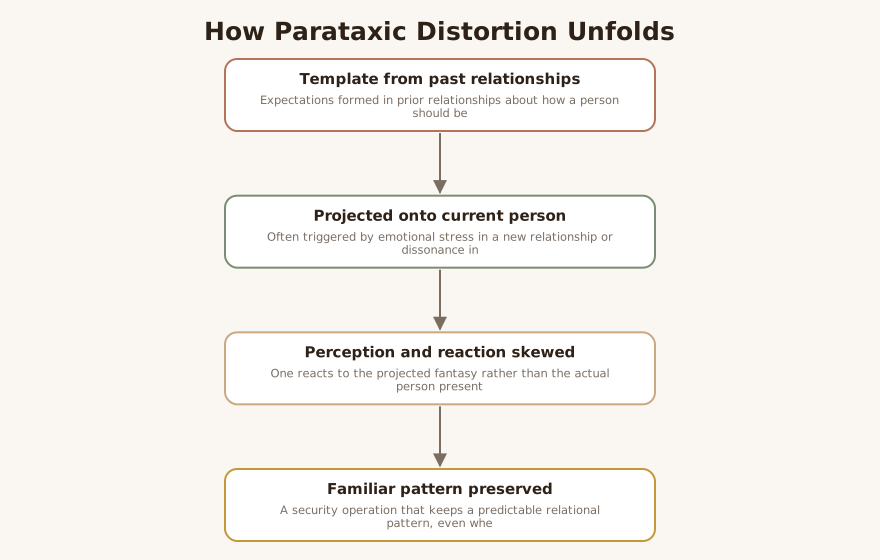
Perception is relational, not neutral. Sullivan’s central claim is that we do not perceive other people as they are; we perceive them through expectations formed in prior relationships 1. Parataxic distortion is the inclination to skew perception of others based on fantasy and on “past experiences and expectations as to how the person should be,” typically triggered by emotional stress in a new relationship or by cognitive dissonance in an existing one 1.
It is a security operation. Within Sullivan’s framework, much interpersonal behavior is organized to protect self-esteem and reduce anxiety 6. The 1973 study by MacDonald examined parataxic distortion as a defense mechanism in relation to perceived parenting, situating it among the defenses that manage the self-concept 7. Distorting the other can be self-protective: it keeps the person inside a familiar, predictable relational pattern, even when that pattern is painful. LLM
It is a parataxic-mode error. The distortion is, structurally, a failure of consensual validation — a private linkage (“people in authority will humiliate me”) that has not been tested against the actual behavior of the present person 6. The corrective is to move the experience from the parataxic into the syntaxic mode by checking it against shared, validated reality 6.
It exists on a continuum. Everyone distorts to some degree. Sullivan’s modes describe normal cognition, and adults routinely engage in parataxic linkages under stress — for example, reading rejection into a delayed reply 6. The clinical question is not whether a client distorts, but how rigid, pervasive, and impairing the distortions are. LLM
Interventions & Techniques
Parataxic distortion is a target, not a method, so the “interventions” are the techniques of the modalities that work with it. LLM
- Naming the distortion in the here-and-now. When a client reacts to the therapist as if to a critical parent, the interpersonal move is to notice it as it happens and make it discussable, rather than interpreting it as fixed pathology 3. The therapy relationship becomes the laboratory.
- Consensual validation. The therapist offers their own experience of the interaction as a reality check: “I notice I don’t feel critical, yet you’re bracing as if I am — can we look at that?” This moves the perception from the private parataxic mode toward shared syntaxic understanding 6. LLM
- Participant observation. Sullivan’s interpersonal stance asks the clinician to attend to the interactional field rather than analyze from detachment; therapy reduces anxiety through genuine engagement rather than detached interpretation 6.
- Group feedback. In group psychotherapy, multiple members reflect back how a person’s behavior lands, so a single distorted expectation is corrected by several independent observations — a powerful disconfirmation that individual therapy cannot replicate 3.
- Linking present to past. Once a distortion is identified in the room, the clinician helps the client trace it to its relational origins, which both explains the pattern and loosens its grip 1. LLM
LLM-generated illustrative example (not a guideline): A client repeatedly hears the therapist’s clarifying questions as interrogation and shuts down. The therapist names it gently — “When I ask for detail, something in you reads it as me catching you out.” The client connects this to a parent who used questions to corner him. Over several sessions, each non-punitive question becomes a small disconfirmation of the old template. LLM
Evidence Base
Honesty about maturity: parataxic distortion is an established construct, but “established” here means conceptually durable and clinically influential, not validated by a robust controlled-trial literature. It has been a stable, widely taught idea in interpersonal psychoanalysis for roughly eighty years and is a load-bearing concept in Yalom’s framework for group therapy 34. LLM
The empirical literature specific to the construct is thin and old. MacDonald’s 1973 study examined parataxic distortion in relation to perceived parenting in the Journal of Genetic Psychology, treating it as a measurable defense linked to self-concept and parent-child dynamics 7. It is one of the few studies to operationalize the term directly. LLM
For the practicing clinician, the practical evidentiary point is this: the construct’s value is heuristic and integrative. It earns its place by organizing observations and guiding relational technique, and its downstream therapeutic actions (here-and-now relational work, interpersonal and group psychotherapy) carry their own, stronger evidence bases. Do not present parataxic distortion to a client or a treatment team as an empirically validated mechanism in the way you would present, say, exposure for a phobia. LLM
Populations & Indications
Parataxic distortion is most clinically relevant for adults in psychodynamic or interpersonal therapy, where the relationship itself is the working medium 1. It is especially apt for people with relationship difficulties and recurrent, maladaptive relational patterns — clients who report “the same thing keeps happening with every partner/boss/friend” 1. LLM
It is a natural frame for individuals with personality disorders, whose rigid, pervasive interpersonal expectations are, in this language, entrenched distortions 1. It is similarly useful for people with attachment trauma and attachment insecurity, where early caregiving has installed strong, anxiety-driven templates that the later study by MacDonald connects to perceived parenting 7. LLM
The construct travels well into couples work — each partner perceiving the other through a parataxic lens drawn from family of origin — and is a primary teaching frame for clients explicitly exploring transference patterns, including the transference to the therapist 2. LLM
Problems-for-Work
- Relationship conflict / interpersonal difficulties. A client whose conflicts recur with the same structure is often importing an old template; naming the distortion shifts work from “who is right” to “what are you expecting me/them to be” 1. LLM
- Transference reactions. When the client’s reaction to the therapist is disproportionate to the therapist’s actual behavior, parataxic distortion gives both parties a non-blaming language for examining it in real time 23.
- Distorted interpersonal perceptions / projection. The client attributes to the other person feelings or intentions that originate in their own history — for example, projecting a parent’s contempt onto neutral colleagues 1.
- Trust and intimacy difficulties. Bracing against betrayal that has not occurred is a parataxic anticipation; the therapy relationship offers repeated, disconfirming evidence 6. LLM
- Personality disorders. Pervasive, cross-situational distortions are a defining feature; the construct frames them developmentally rather than as fixed character flaws 1. LLM
- Attachment insecurity. Early relational templates drive present misreadings; MacDonald’s work ties parataxic distortion to perceived parenting 7.
Contraindications, Cautions & Cultural Humility
There is no “contraindication” to a construct, but there are misuses. LLM
First, do not weaponize the frame. Telling a client “that’s just your distortion” can replicate the very invalidation that built the template. The therapeutic value comes from joint, curious examination, not from the clinician unilaterally declaring the client’s perception false 6. LLM
Second, distortion is a judgment about reality, and the clinician’s reality is not neutral. What looks like a parataxic overreaction may be an accurate reading of a genuine threat — including, for clients from marginalized communities, accurate perception of bias, surveillance, or hostility that the clinician does not share and may not recognize. Cultural humility requires holding the possibility that the “distortion” is in fact valid pattern recognition. The construct must never be used to pathologize justified vigilance. LLM
Third, timing and stability matter. Working the transference in the here-and-now presumes enough alliance and affect tolerance to withstand the discomfort; with clients in acute crisis or with fragile self-structure, premature interpretation of distortion can be destabilizing. Stabilize first. LLM
Finally, the construct is a psychodynamic lens with limited empirical specificity 7. Hold it lightly, alongside other formulations, rather than as a single explanatory key. LLM
Treatment-Plan Suggestions & SMART Objectives
| Goal | SMART objective (example) | Mechanism |
|---|---|---|
| Increase awareness of distorted perceptions | Client will identify, in session, 2 instances per week of reacting to someone as if they were a figure from the past, for 6 weeks | Builds observing ego; surfaces parataxic linkages 1 |
| Reality-test interpersonal assumptions | Client will check one anxious assumption about another person against actual evidence before reacting, ≥3 times/week for 8 weeks | Moves experience from parataxic toward syntaxic mode via consensual validation 6 |
| Work transference in the here-and-now | Client will name a reaction to the therapist as it occurs in ≥4 sessions over 10 weeks | Uses the dyad as a corrective laboratory 3 |
| Reduce recurrent relational conflict | Client will map the repeating template across 3 relationships and articulate it in session within 8 weeks | Externalizes the pattern, loosening its grip 1 |
| Strengthen trust/intimacy capacity | Client will tolerate one feared-but-disconfirmed interaction (e.g., asking for support) weekly for 6 weeks without withdrawing | Accumulates disconfirming evidence against the old template 6 |
| Link present distortions to attachment history | Client will connect 2 current interpersonal misreadings to early caregiving experiences over 8 weeks | Developmental insight reduces automaticity 7 |
| Generalize gains beyond the dyad | Client will apply one reality-checking skill in a real-world relationship and report the outcome weekly for 6 weeks | Transfers in-session learning to the social field 3 |
Common Misconceptions
“It’s just a synonym for transference.” It overlaps heavily and was built as an expansion of transference, but Sullivan generalized it beyond the analytic relationship to all interpersonal life and grounded it in relational history rather than drive theory 24. LLM
“It only happens in therapy.” Parataxic distortion is an everyday cognitive event; adults under stress routinely misread neutral cues, such as inferring rejection from a delayed reply 6. Therapy simply makes it observable.
“Distortion means the client is being irrational or weak.” It is better understood as a self-protective security operation with a developmental logic, not a deficiency of intelligence 6. LLM
“Naming it fixes it.” Insight alone rarely dissolves a well-grooved template; correction requires repeated disconfirming experience, often in the relationship itself 3. LLM
“If the client feels strongly, it must be distortion.” Strong affect is not proof of error; the perception may be accurate. Distortion is established by checking against shared reality, not assumed 6. LLM
Training & Certification
There is no certification in “parataxic distortion” — it is a concept, not a credential. LLM Clinicians acquire fluency with it through training in the modalities that use it: interpersonal and psychodynamic psychotherapy, where transference and here-and-now work are taught, and group psychotherapy, where Yalom’s framework treats it as central 3. Formal grounding in Sullivan’s interpersonal psychiatry is offered through institutions in that lineage, including the William Alanson White Institute, which Sullivan co-founded 4. Supervised experience working with one’s own countertransference is, in practice, the real training ground. LLM
Key Terms
- Parataxic distortion — perceiving and reacting to a present person on the basis of projected past relationship templates rather than the actual person 1.
- Modes of experience — Sullivan’s three levels of cognition: prototaxic (fragmented, infantile), parataxic (illogical private linkages), and syntaxic (logical, consensually validated) 6.
- Consensual validation — checking a private perception against shared, agreed-upon reality, the corrective for parataxic distortion 6. LLM
- Transference — the classical analytic concept that parataxic distortion expands and generalizes 2.
- Self-system — the personality configuration that develops to protect self-esteem and manage anxiety through security operations 4.
- Security operation — behavior organized to reduce anxiety and protect the self, of which distortion can be one form 6. LLM
- Participant observation — Sullivan’s stance in which the clinician is part of the interpersonal field, not a detached analyst 6.
Resources & Further Reading
▶ Watch — a video introduction to this concept:
- Parataxic distortion — Wikipedia
- Parataxic distortion (Sullivan) — BehaveNet
- The Theory and Practice of Group Psychotherapy — Irvin D. Yalom (Google Books)
- Harry Stack Sullivan — Wikipedia
- Interpersonal Theory of Psychiatry: Harry Stack Sullivan’s Social Approach — Social Work Institute
- Parataxic distortion and perceived parenting — MacDonald (1973), PubMed
Reflective / Supervision Questions
- When a client’s reaction to me feels disproportionate, do I treat it as data about their relational history, or as something to correct? LLM
- How would I distinguish, with this particular client, a parataxic distortion from an accurate perception of a real threat — including bias I may not share? LLM
- What templates from my own history shape how I perceive this client (my countertransference as my own parataxic distortion)? LLM
- Is the alliance stable enough to make a here-and-now distortion discussable, or would naming it now feel like an attack? LLM
- Where am I relying on insight to do work that only repeated disconfirming experience can accomplish? LLM
- Am I holding this construct as one lens among several, or letting it become the single key that explains everything? LLM