
Type & Discipline
Internet-/computer-delivered cognitive behavioral therapy (ICBT) is a delivery modality within clinical psychology, not a distinct theoretical school LLM. It takes the structured, protocol-driven content of cognitive behavioral therapy and packages it into sequential online or computerized lessons, worksheets, and exercises that a client works through over several weeks LLM. The defining feature is the medium and structure of delivery rather than any new model of psychopathology, so the underlying change theory remains conventional CBT LLM.
A central distinction in this literature separates guided ICBT, in which a clinician or coach provides asynchronous support and feedback, from unguided or fully self-guided programs that run without human contact 1. This distinction matters more than almost any other design feature, because guidance is consistently associated with better adherence and larger effects 2. The modality sits within the broader family of technology-mediated and digital CBT, alongside telehealth videoconferencing and smartphone-app interventions, and it is frequently positioned as an early step within stepped-care service models LLM.
Creators & Lineage
ICBT grew directly out of cognitive behavioral therapy and its component techniques, particularly behavioral activation for depression and exposure-based methods for anxiety, all rendered into self-administered digital form LLM. Its lineage also runs through bibliotherapy and self-help manuals, which established that structured CBT content could produce benefit with limited therapist time LLM. As internet access spread, researchers asked whether the same content delivered online, with brief guidance, could approximate the results of in-person therapy 1.
Several figures anchor the field. In Australia, Gavin Andrews and colleagues developed and evaluated computerized and internet CBT courses for anxiety and depression, helping demonstrate that the approach could work at scale within routine services LLM. In Sweden, Gerhard Andersson and Per Carlbring led much of the foundational randomized and meta-analytic work comparing guided ICBT directly with face-to-face treatment 1. Pim Cuijpers contributed extensively to the meta-analytic evidence base on CBT and its digital delivery for depression and anxiety 1. Andersson and colleagues later framed the field’s trajectory explicitly as a movement “from innovation to implementation,” signaling a shift from proving efficacy to embedding ICBT in real-world care 2.
Core Principles
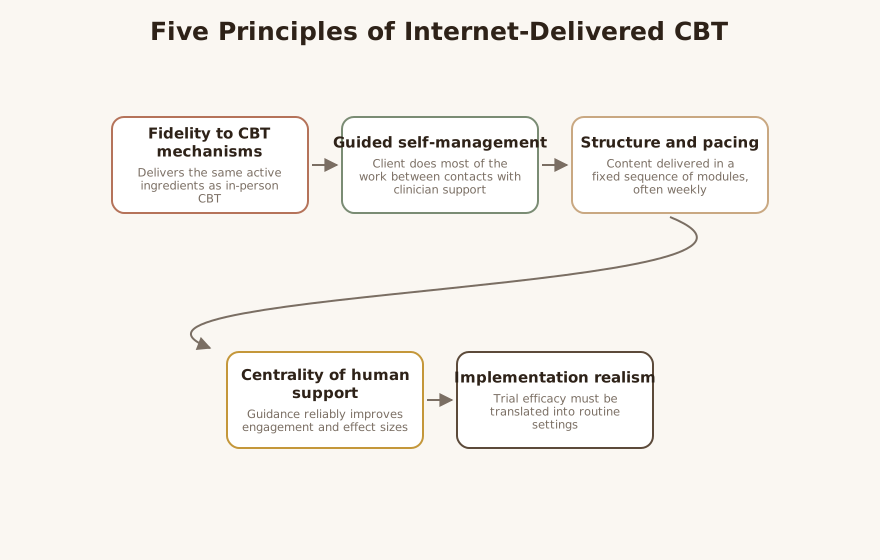
The first principle is fidelity to CBT mechanisms: ICBT aims to deliver the same active ingredients as in-person CBT, including cognitive restructuring, behavioral activation, exposure, and skills practice, through a structured curriculum LLM. The second is guided self-management, in which the client does most of the therapeutic work independently between contacts while a clinician monitors progress and provides targeted support 2. This redistribution of therapist time is the economic engine of the modality, allowing one clinician to support many more clients than traditional therapy permits LLM.
The third principle is structure and pacing: content is delivered in a fixed or semi-fixed sequence of modules, often weekly, mirroring a manualized treatment course LLM. The fourth is the centrality of human support to outcomes, because guidance reliably improves engagement and effect sizes relative to unguided programs 2. A fifth, increasingly emphasized principle is implementation realism, the recognition that efficacy demonstrated in trials must be deliberately translated into routine settings where adherence, recruitment, and case mix differ 2.
Interventions & Techniques
The component techniques are those of standard CBT, adapted for self-administration LLM. For depression, programs typically lead with psychoeducation and behavioral activation, guiding clients to schedule and monitor rewarding activities LLM. For anxiety disorders, modules emphasize cognitive restructuring and graded exposure, with panic protocols adding interoceptive exposure and social anxiety protocols targeting avoidance and safety behaviors LLM. For insomnia, internet-delivered CBT for insomnia (ICBT-i) packages stimulus control, sleep restriction, sleep hygiene, and cognitive work around sleep-related worry 6.
Delivery techniques include sequential lessons, downloadable worksheets, symptom-tracking questionnaires, automated reminders, and clinician feedback messages LLM. In guided formats, the clinician reviews submitted homework, reinforces progress, troubleshoots obstacles, and prompts re-engagement when a client stalls, usually through secure messaging rather than live sessions 2. The guidance need not be lengthy to be useful; brief, consistent contact appears to carry much of the benefit attributed to human support 2.
LLM-generated illustrative example (not a guideline): A clinician supporting a guided ICBT depression program might spend ten minutes weekly reading a client’s activity log, noting that the client completed two of five planned activities, and sending a message that normalizes the partial completion, highlights the mood lift the client recorded after a walk, and proposes one smaller activity for the coming week LLM.
Evidence Base
The maturity of this modality is best described as established, with the strongest evidence concentrated in guided formats LLM. A landmark systematic review and meta-analysis directly comparing guided ICBT with face-to-face CBT across psychiatric and somatic disorders found no significant overall difference in outcomes between the two delivery formats 1. This equivalence finding is the empirical foundation for treating guided ICBT as a credible alternative to in-person CBT for appropriate presentations 1.
The evidence has since extended from controlled trials into routine care. A systematic review and meta-analysis of ICBT delivered in routine clinical care for adults treated for depression and anxiety found that benefits persist in real-world settings, though clinicians should expect effects to be more modest than the often larger estimates from tightly controlled efficacy trials 3. Recruitment context also shapes results: a meta-analysis of ICBT for anxiety disorders compared trials recruiting from the open community against those recruiting through clinical services, underscoring that effect sizes and generalizability can differ depending on how participants enter treatment 4. For sleep, a meta-analysis of randomized controlled trials of ICBT-i showed that treating insomnia online also improved comorbid anxiety and depression, supporting a transdiagnostic benefit 6.
Guideline bodies have incorporated this evidence. NICE recommends guided self-help and digital CBT as treatment options within a stepped-care approach for adults with depression, particularly for less severe presentations 5. The field’s own assessment, however, is candid about the gap between efficacy and implementation, noting that demonstrated innovations have not always been translated into accessible routine services 2. The honest summary is that guided ICBT is well-supported and guideline-endorsed, that unguided programs show smaller effects and weaker adherence, and that routine-care outcomes sit below trial benchmarks 2.
Populations & Indications
ICBT has been studied across the adult lifespan and beyond it LLM. Adults are the most extensively researched group, with robust evidence for common anxiety and mood disorders 1. Adolescents, college students, and older adults have all been targeted by adapted programs, reflecting the modality’s flexibility across developmental stages LLM. The format is especially attractive for rural, underserved, and access-limited populations, for whom geography, clinician shortages, scheduling, or stigma make in-person care difficult to reach LLM.
The indications most strongly supported include major depressive disorder, generalized anxiety disorder, panic disorder, and social anxiety disorder, where guided ICBT approximates face-to-face outcomes 1. Insomnia is a strong indication on its own and as a lever for comorbid mood and anxiety symptoms 6. Subthreshold and milder presentations are a natural fit for ICBT as a first stepped-care intervention, consistent with guideline placement of digital CBT for less severe depression 5.
Problems-for-Work
For major depressive disorder, ICBT can deliver behavioral activation and cognitive restructuring with clinician guidance, suitable as a first-line option in less severe cases or as an adjunct to in-person work 5. For generalized anxiety disorder, panic disorder, and social anxiety disorder, structured online modules combining cognitive techniques and graded exposure approximate the outcomes of face-to-face CBT in guided formats 1.
LLM-generated illustrative example (not a guideline): A clinician with a client presenting subthreshold depressive symptoms and a long commute to the office might offer a guided ICBT depression program with weekly asynchronous messaging, reserving in-person sessions for periods when symptoms intensify LLM.
For insomnia, ICBT-i directly targets sleep and can secondarily reduce comorbid anxiety and depression, making it useful when poor sleep maintains mood symptoms 6. For health anxiety, PTSD, OCD, and chronic pain, ICBT protocols exist and form part of the broad disorder coverage examined in comparative reviews, though clinicians should weigh the strength of evidence for each specific condition 1. For subthreshold symptoms, ICBT functions well as a low-intensity entry point within stepped care, escalating to higher-intensity treatment if response is inadequate 5.
Contraindications, Cautions & Cultural Humility
ICBT is not appropriate as a standalone intervention for acute risk, including active suicidality, severe presentations requiring close monitoring, or crises that demand real-time clinical contact LLM. Because asynchronous guidance introduces delay, programs require clear risk-screening and escalation pathways, and clients with significant risk are better served by, or supplemented with, higher-intensity care LLM. Guideline placement of digital CBT toward less severe depression reflects this graded matching of intensity to need 5.
Adherence and dropout are practical cautions: unguided programs in particular suffer attrition, and effectiveness depends on clients actually completing the work 2. Clinicians should also note that outcomes observed in self-selected trial samples may not transfer cleanly to clients who enter through routine services, so expectations should be calibrated to real-world data 3. Recruitment-context differences in the anxiety literature reinforce that the “average” client in a community trial may differ from a referred clinical patient 4.
Cultural humility requires attending to digital access, literacy, and language, since ICBT presupposes connectivity, devices, and comfort with written self-guided learning, which are unevenly distributed LLM. The same tool that widens access for some clients can deepen exclusion for those without reliable internet or who do not read fluently in the program’s language LLM. Clinicians should assess fit individually rather than assuming a digital format is automatically more accessible LLM.
Treatment-Plan Suggestions & SMART Objectives
| Goal | SMART objective (example) | Mechanism |
|---|---|---|
| Improve depressive symptoms | Client completes one ICBT behavioral-activation module weekly for 8 weeks, logging at least 3 scheduled activities per week 1 | Behavioral activation increasing reinforcing activity LLM |
| Reduce anxiety avoidance | Client completes a graded exposure hierarchy within the ICBT anxiety program, attempting one exposure step per week for 6 weeks 1 | Exposure and habituation reducing avoidance LLM |
| Improve sleep | Client follows ICBT-i sleep-restriction and stimulus-control instructions nightly for 4 weeks, recording a daily sleep diary 6 | Behavioral sleep regulation and reduced sleep-related worry LLM |
| Increase engagement/adherence | Client submits weekly homework and reads clinician feedback for at least 6 of 8 program weeks 2 | Guidance sustaining adherence and effect size 2 |
| Address subthreshold symptoms early | Client completes a low-intensity guided digital CBT course as a first stepped-care step, with PHQ-9 re-administered at week 6 5 | Stepped-care matching of intensity to severity 5 |
| Maintain gains in routine care | Client identifies two relapse-prevention strategies from the final module and schedules a 4-week follow-up check 3 | Skills consolidation translated to real-world practice LLM |
| Reduce comorbid mood symptoms via sleep | Client completes ICBT-i and tracks weekly mood ratings to monitor secondary improvement 6 | Transdiagnostic benefit of treating insomnia 6 |
Common Misconceptions
A frequent misconception is that ICBT is a watered-down or inferior substitute for “real” therapy, when guided ICBT shows outcomes broadly comparable to face-to-face CBT for appropriate presentations 1. A second is that the software does the therapy, when in fact human guidance is a major driver of adherence and effect size, and unguided programs perform less well 2. Clinicians who treat ICBT as a hands-off tool are likely to see the weaker outcomes associated with no support 2.
A third misconception is that trial results will automatically reproduce in everyday practice, when routine-care effects are real but typically smaller than efficacy-trial estimates 3. A fourth is that any digital format is inherently more accessible, when access barriers around connectivity, literacy, and severity can exclude some clients and make ICBT unsuitable for acute or high-risk presentations LLM. A fifth is that ICBT is only for mild cases; while guidelines place digital CBT prominently for less severe depression, the comparative evidence spans a range of disorders 5.
Training & Certification
ICBT does not constitute a separate licensure or a wholly new clinical discipline; competent delivery rests on existing CBT training applied through a digital workflow LLM. Clinicians providing guided ICBT should already hold core competencies in CBT for the relevant disorders, since the feedback they give clients is fundamentally clinical reasoning about CBT content LLM. Beyond that foundation, training focuses on the specifics of guidance: how to provide brief, supportive, timely asynchronous feedback, how to monitor adherence, and how to manage risk within a delayed-contact format 2.
Practical readiness also requires familiarity with the particular platform or program in use, its module structure, and its risk-escalation procedures LLM. Because the field has emphasized the move from efficacy to implementation, clinicians and services adopting ICBT should attend to the organizational competencies that sustain it, including referral pathways, supervision, and integration into stepped care 2. Service-level adoption frameworks, rather than individual certification alone, are central to doing ICBT well at scale 2.
Key Terms
Guided ICBT — internet-delivered CBT in which a clinician or coach provides support and feedback alongside the program, the format with the strongest evidence 1. Unguided/self-guided ICBT — programs delivered without human contact, generally showing smaller effects and weaker adherence 2. Stepped care — a service model in which lower-intensity interventions such as guided self-help are offered first, with escalation to higher-intensity treatment as needed 5.
Adherence — the degree to which clients complete program modules and homework, a key determinant of real-world effectiveness 2. ICBT-i — internet-based CBT specifically for insomnia, which can also improve comorbid anxiety and depression 6. Implementation gap — the distance between demonstrated efficacy in trials and actual availability and uptake in routine services 2. Routine-care effectiveness — outcomes observed when ICBT is delivered in everyday clinical settings, typically more modest than efficacy-trial estimates 3.
Resources & Further Reading
▶ Watch — a video introduction to this concept:
- Guided Internet-based vs. face-to-face CBT for psychiatric and somatic disorders: a systematic review and meta-analysis (Andersson et al., 2014, World Psychiatry)
- Internet-delivered psychological treatments: from innovation to implementation (Andersson et al., 2019, World Psychiatry)
- Effects of Internet-Based CBT in Routine Care for Adults in Treatment for Depression and Anxiety: Systematic Review and Meta-Analysis
- Internet-Delivered CBT for Anxiety Disorders in Open Community vs. Clinical Service Recruitment: Meta-Analysis
- NICE — Depression in adults: treatment and management (NG222)
- Internet-Based CBT for Insomnia (ICBT-i) Improves Comorbid Anxiety and Depression — Meta-Analysis of RCTs
Reflective / Supervision Questions
- For which of my current clients is the access advantage of ICBT genuine, and for which would connectivity, literacy, or severity make a digital format an exclusion rather than a bridge? LLM
- When I recommend a guided ICBT program, am I prepared to provide the consistent asynchronous support that the evidence ties to better outcomes, or am I implicitly relying on the software alone? 2
- How will I calibrate my expectations and my client’s expectations given that routine-care effects tend to be smaller than the figures reported in efficacy trials? 3
- What is my explicit risk-screening and escalation plan for a client on a delayed-contact ICBT program, and have I documented the criteria for stepping up to higher-intensity care? 5
- Where does ICBT fit in my service’s stepped-care pathway, and do referral, supervision, and follow-up structures actually exist to support it rather than just the program itself? 2