
Type & Discipline
Cognitive Behavioral Therapy for Insomnia (CBT-I) is a structured, time-limited, multicomponent behavioral protocol situated within the field of behavioral sleep medicine 4. It belongs to the family of targeted CBT protocols: rather than a general cognitive-behavioral approach applied loosely to sleep, it is a defined package of behavioral and cognitive techniques delivered over roughly 4–8 sessions 7. The American Academy of Sleep Medicine (AASM) positions multicomponent CBT-I as the recommended treatment for chronic insomnia disorder in adults, and the American College of Physicians similarly endorses it as first-line care 1 5.
CBT-I is distinguished from generic “talk therapy for poor sleep” by its mechanistic specificity. It does not aim primarily at insight or at the precipitating stressor; it targets the perpetuating behaviors and cognitions that keep an acute sleep disturbance from resolving on its own 4. For practicing clinicians, this means CBT-I is best understood as a procedural, data-driven intervention organized around the sleep diary and a small set of behavioral prescriptions 4.
Creators & Lineage
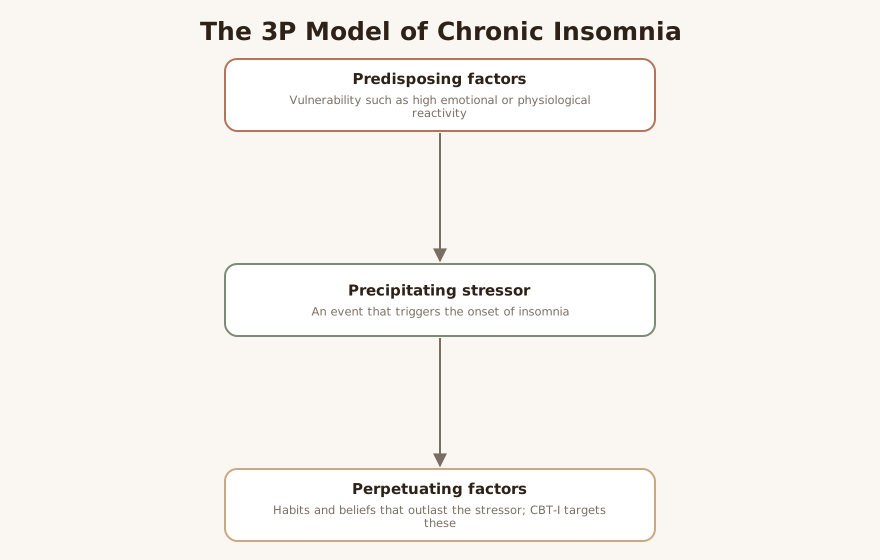
CBT-I assembles several independently developed components into a single protocol. Its behavioral backbone draws on stimulus control therapy and sleep restriction therapy, two distinct techniques that the AASM still recognizes as effective single components in their own right 1. The conceptual scaffolding is the 3P (Spielman) model from behavioral sleep medicine, which frames insomnia in terms of predisposing, precipitating, and perpetuating factors 4.
Richard Bootzin is associated with the development of stimulus control therapy, and Charles Morin is among the most influential figures in formalizing and validating the multicomponent CBT-I package and its cognitive elements LLM. Arthur Spielman is the originator of the 3P framework that explains why insomnia becomes chronic and gives CBT-I its rationale 4. The contemporary guideline literature, led by authors such as Jack Edinger for the AASM, consolidated decades of trials into the current recommendation structure, with Edinger noting that “the multicomponent treatment, cognitive behavioral therapy for insomnia, is the most supported therapy” 7.
Core Principles
The central principle is that chronic insomnia is maintained by factors distinct from whatever originally triggered it. The 3P model holds that a person with predisposing vulnerability (such as high emotional or physiological reactivity) experiences a precipitating stressor, and then develops perpetuating habits and beliefs that outlast the stressor 4. CBT-I targets these perpetuating factors directly, which is why it can resolve insomnia even when the original trigger is long gone 4.
A second principle is the strengthening of the homeostatic sleep drive and the realignment of the bed with sleep. Spending excessive time in bed awake dilutes sleep drive and erodes the learned association between the bed and sleeping; CBT-I deliberately reverses both 4. A third principle is the reduction of conditioned hyperarousal — the somatic and cognitive activation that builds at bedtime in people who have come to dread the bed 4. Finally, CBT-I is explicitly behavioral and measurable: progress is tracked through sleep efficiency (time asleep divided by time in bed) and titrated weekly from diary data rather than from subjective impression 4.
Interventions & Techniques
Stimulus control therapy (SCT) re-establishes the bed as a cue for sleep by eliminating competing behaviors. Patients are instructed to go to bed only when sleepy, reserve the bed for sleep and sex only, leave the bed if awake more than roughly 15–20 minutes and return only when sleepy, repeat this as often as needed during the night, maintain a fixed wake time, and avoid daytime naps 4.
Sleep restriction therapy (SRT) corrects the mismatch between time in bed and actual sleep ability. After a 1–2 week diary baseline, the prescribed time in bed is set to match average total sleep time, anchored to a consistent rise time 4. The window is then titrated weekly: increase by about 15 minutes when sleep efficiency exceeds roughly 90 percent, hold steady in the 85–90 percent range, and reduce when efficiency falls below 85 percent 4. In older adults, a gentler “sleep compression” approach is often substituted for strict restriction 5.
Cognitive therapy (CT) restructures the dysfunctional, often catastrophic beliefs about sleep that drive nighttime arousal 4. Using thought records, the clinician helps the patient identify maladaptive cognitions, examine their accuracy through guided discovery, decatastrophize, and substitute more realistic appraisals 4.
Sleep hygiene education addresses environmental and lifestyle factors — caffeine and alcohol timing, the sleep environment, exercise, and napping — but is delivered as one component within the package, never as the whole treatment 4. Relaxation training (progressive muscle relaxation, diaphragmatic breathing) and mindfulness-based strategies target physiological and cognitive arousal and are recognized by the AASM as effective single components as well 1 4.
A representative course runs 6–8 sessions of 30–90 minutes, weekly or biweekly, delivered individually or in groups 4. Digital CBT-I (dCBT-I) delivers the same components through apps and online platforms, including clinician-supported and fully automated formats, and has demonstrated efficacy across children, adolescents, and adults 5.
Evidence Base
The maturity of CBT-I’s evidence base is established. The AASM issued a strong recommendation for multicomponent CBT-I in chronic insomnia — its highest tier, meaning clinicians should follow it under most circumstances 1 7. Stimulus control, sleep restriction, relaxation, and brief multicomponent therapies each received conditional (“suggest”) recommendations, while sleep hygiene as a standalone therapy received a conditional recommendation against use 1.
Honesty about the evidence requires holding two findings together. A systematic review applying Tolin’s criteria concluded there is “high-quality evidence that CBT-I produces a clinically meaningful and statistically significant effect on symptoms of insomnia,” with medium-to-large effect sizes — sleep efficiency g = 0.73, ISI g = 0.85, sleep onset latency g = 0.51, and wake after sleep onset g = 0.57 3. CBT-I earned a “strong” rating under those criteria but did not reach “very strong,” because long-term maintenance and functional (non-sleep) outcomes remain under-studied 3.
The AASM’s own meta-analysis was more tempered on some continuous measures: pooled improvements in sleep onset latency (about 12.7 minutes) and sleep efficiency did not always clear pre-specified clinical-significance thresholds, and GRADE quality “ranged from low to moderate because of imprecision and a risk of bias” 2. The strongest signals were on the critical clinical outcomes the panel weighted most heavily — a roughly 33 percent higher remission rate and 45 percent greater responder rate versus controls, plus a large effect on insomnia severity (ISI effect size ~0.95) 2. Clinically, 70–80 percent of patients with primary insomnia improve, gains remain stable up to about 24 months, and CBT-I matches hypnotics acutely while outperforming them long-term 4 5.
Populations & Indications
CBT-I is indicated for chronic insomnia disorder in adults and has been validated across a broad range of comorbid presentations 1. It is effective in older adults (with sleep compression in place of strict restriction), people with comorbid depression and anxiety, those with chronic pain, cancer survivors, pregnant individuals, and patients with PTSD 5. The AASM meta-analysis specifically found that benefits held across both psychiatric-comorbid and non-comorbid subgroups, with the comorbid group showing the largest sleep-onset-latency reductions 2.
It is also a primary tool for patients seeking to taper hypnotic medication and for those whose insomnia persists despite addressing an underlying mood or anxiety disorder 5. Shift workers and patients with circadian disruption can benefit, though clinicians should pair CBT-I with circadian and scheduling strategies appropriate to the disorder LLM.
Problems-for-Work
CBT-I maps cleanly onto the discrete problems clinicians encounter at intake.
- Sleep-onset difficulty. Stimulus control plus sleep restriction concentrates sleep drive into a consolidated window, shortening latency 4.
- Sleep-maintenance difficulty (frequent or prolonged awakenings). The “get out of bed if awake 15–20 minutes” rule, combined with a tightened sleep window, reduces wake after sleep onset 4.
- Bedtime hyperarousal. Relaxation training, mindfulness, and cognitive restructuring directly lower somatic and cognitive activation 4.
- Dysfunctional beliefs about sleep (e.g., “I need eight hours or I’ll be useless tomorrow”). Cognitive therapy with thought records targets these appraisals 4.
- Hypnotic dependence. CBT-I provides a durable behavioral alternative, often used during a structured medication taper 5.
LLM-generated illustrative example (not a guideline): A 52-year-old with 9 hours in bed but ~6 hours of sleep is prescribed a 6.25-hour window anchored to a 6:30 a.m. rise time. After two weeks her diary shows sleep efficiency climbing past 90 percent, and the window is extended by 15 minutes; concurrent thought records target her belief that “one bad night ruins the whole day.” LLM
Contraindications, Cautions & Cultural Humility
Sleep restriction is the highest-risk component. It is generally not recommended where acute sleep loss is dangerous — including bipolar disorder, where restriction may precipitate a manic episode, and seizure disorders, where it can lower the seizure threshold 4 5. Untreated obstructive sleep apnea may worsen with restriction, and patients with significant daytime sleepiness face elevated risk of accidents, so clinicians must screen for and address these before or alongside CBT-I 4. Caution is warranted for patients in safety-sensitive occupations or who drive long distances during the transient sleepiness that early restriction can produce LLM.
CBT-I also asks patients to tolerate discomfort: examining painful thoughts and feelings, and enduring a temporary increase in sleepiness, can be distressing in the early weeks 5. Clinicians should frame this honestly and monitor adherence and mood 5.
Cultural humility matters in operationalizing “sleep hygiene” and rigid schedules. Co-sleeping norms, shift and caregiving demands, multigenerational households, and culturally embedded bedtime practices all shape what is feasible and respectful LLM. Prescriptions should be negotiated collaboratively rather than imposed, and the clinician should remain curious about how a given household actually sleeps before tightening a window LLM.
Treatment-Plan Suggestions & SMART Objectives
| Goal | SMART objective (example) | Mechanism |
|---|---|---|
| Improve sleep efficiency | Patient will raise diary-recorded sleep efficiency from 70% to ≥85% over 4 weeks | Sleep restriction consolidates sleep and rebuilds homeostatic drive 4 |
| Reduce sleep-onset latency | Patient will reduce average time to fall asleep from 45 to ≤20 minutes within 6 weeks | Stimulus control re-pairs the bed with sleep 4 |
| Reduce nighttime wakefulness | Patient will cut wake-after-sleep-onset by ≥20 minutes over 6 sessions | “Leave the bed if awake” rule plus tightened window reduce WASO 4 |
| Modify maladaptive sleep beliefs | Patient will complete 3 thought records/week and report ≥30% drop on a dysfunctional-beliefs measure by session 8 | Cognitive restructuring decatastrophizes sleep appraisals 4 |
| Lower bedtime arousal | Patient will practice relaxation 5 nights/week and rate pre-sleep tension ≤3/10 by week 4 | Relaxation/mindfulness reduce somatic and cognitive hyperarousal 4 |
| Stabilize the sleep schedule | Patient will keep a fixed rise time (±30 min) 7 days/week for 4 consecutive weeks | Consistent wake time anchors circadian and homeostatic systems 4 |
| Reduce reliance on hypnotics | Patient will taper PRN hypnotic use under prescriber coordination while sustaining sleep-efficiency gains | CBT-I provides a durable non-pharmacologic alternative 5 |
| Reach clinical remission | Patient will lower Insomnia Severity Index score below the clinical threshold by treatment end | Multicomponent CBT-I drives remission and responder gains 2 |
Common Misconceptions
“Sleep hygiene is the treatment.” It is not. The AASM explicitly recommends against sleep hygiene as a standalone therapy; Edinger noted that “sleep hygiene recommendations do not constitute an effective stand-alone therapy” 1 7. It is one supporting component within the package 4.
“More time in bed means more sleep.” The opposite is often true in insomnia: excess time in bed dilutes sleep drive and weakens the bed–sleep association, which is precisely why restriction works 4.
“Medication is the obvious first step.” Guidelines reserve hypnotics for patients who cannot access CBT-I, who have residual symptoms after it, or as temporary adjuncts; CBT-I is the first-line recommendation 7. “CBT-I is just generic CBT.” It is a distinct, protocolized, diary-driven intervention with its own behavioral mechanisms 4.
Training & Certification
CBT-I is delivered by licensed clinicians — psychologists, therapists, and psychiatrists — who have trained in the protocol 5. Provider-finding and professional-development resources include the Society of Behavioral Sleep Medicine and the American Board of Sleep Medicine 5. A practical access constraint is real and worth naming to patients: there are not enough trained CBT-I providers to meet demand, which is a major driver of interest in group delivery and digital CBT-I 5. Clinicians expanding into behavioral sleep medicine should expect to learn the diary-titration workflow and the management of common adherence obstacles, which the primer literature treats as core competencies 4.
Key Terms
- 3P (Spielman) model — Predisposing, precipitating, and perpetuating factors; CBT-I targets the perpetuating factors 4.
- Perpetuating factors — Behaviors and beliefs that convert acute insomnia into a chronic disorder 4.
- Stimulus control — Re-pairing the bed with sleep by removing competing behaviors and wakefulness 4.
- Sleep restriction / sleep compression — Limiting time in bed to match sleep ability to build sleep drive; compression is the gentler variant for older adults 4 5.
- Sleep efficiency — Time asleep divided by time in bed; the primary titration metric 4.
- Sleep onset latency / WASO — Time to fall asleep / wake after sleep onset; core outcome measures 2.
- dCBT-I — Digital delivery of CBT-I via app or online platform 5.
Resources & Further Reading
▶ Watch — a video introduction to this concept:
- AASM clinical practice guideline: behavioral and psychological treatments for chronic insomnia (Edinger et al., 2021)
- AASM systematic review, meta-analysis, and GRADE assessment (Edinger et al., 2021)
- Evaluation of CBT-I using Tolin’s criteria for empirically supported treatments
- Cognitive Behavioral Therapy for Insomnia (CBT-I): A Primer
- Cognitive Behavioral Therapy for Insomnia: An Overview — Sleep Foundation
- New guideline supports behavioral, psychological treatments for insomnia — AASM
Reflective / Supervision Questions
- Before prescribing sleep restriction, did I screen for bipolar disorder, seizure history, untreated apnea, and safety-sensitive daytime demands? 4 5
- Am I titrating the sleep window from objective diary-derived sleep efficiency, or drifting toward subjective impression? 4
- How am I framing the transient early sleepiness and the discomfort of cognitive work so the patient stays adherent rather than dropping out? 5
- For comorbid depression or anxiety, am I documenting how the sleep intervention serves the broader clinical picture, given that benefits hold across comorbid groups? 2
- Have I adapted scheduling and “hygiene” prescriptions to the patient’s actual household, culture, and work life rather than imposing a generic template? LLM
- Where access is limited, have I considered group or digital CBT-I as a legitimate, evidence-supported alternative? 5