
Type & Discipline
Integrative Behavioral Couple Therapy (IBCT) is a manualized couple therapy modality within clinical psychology, belonging to the behavioral and “third-wave” lineage of couples interventions 3. It is “integrative” in a specific sense: it combines the deliberate behavior-change strategies of earlier behavioral couple work with a co-equal emphasis on emotional acceptance 1. Where first-generation behavioral models treated relationship problems primarily as skill deficits to be remediated, IBCT reframes much of couple distress as the predictable collision of stable differences with sensitive reactions — something to be understood and accepted as often as it is to be changed 1. LLM
The modality is delivered in a structured arc: assessment, a feedback (formulation) session, and then an integrated treatment phase that braids acceptance and change techniques together 3. It is fundamentally a dyadic treatment — the unit of care is the couple, not the individual — though its formulation of distress draws on each partner’s individual emotional history 1. LLM
Creators & Lineage
IBCT was developed by Neil Jacobson and Andrew Christensen in the 1990s 1. Jacobson had been a leading figure in Traditional Behavioral Couple Therapy (TBCT), and IBCT grew directly out of the observation that TBCT, despite producing reliable gains, left a substantial subset of couples unimproved and showed weaker maintenance of those gains over time 1. Christensen and Brian Doss, with Jacobson, authored the principal therapist guide, now in its second edition 3.
The lineage is layered. From Traditional Behavioral Couple Therapy IBCT inherits behavior-exchange procedures, communication training, and problem-solving training 1. From the broader acceptance-oriented or “third-wave” cognitive-behavioral tradition — sharing conceptual DNA with Acceptance and Commitment Therapy — it takes the premise that struggling to eliminate an internal experience can entrench it, and that acceptance can itself be change 1. LLM It sits alongside Emotionally Focused Therapy as a contemporary, empirically examined couple model, though IBCT’s theoretical engine is behavioral and contextual rather than attachment-based 1. LLM It also overlaps with cognitive behavioral therapy in its functional, contingency-focused analysis of behavior 1. LLM
Core Principles
IBCT’s central clinical move is to locate the couple’s distress in one or two broad themes rather than a long list of discrete complaints 1. A common theme is the struggle over how interdependent versus independent partners should be — closeness versus autonomy 1. Naming the theme lets partners see recurring fights as variations on a single underlying issue 1. LLM
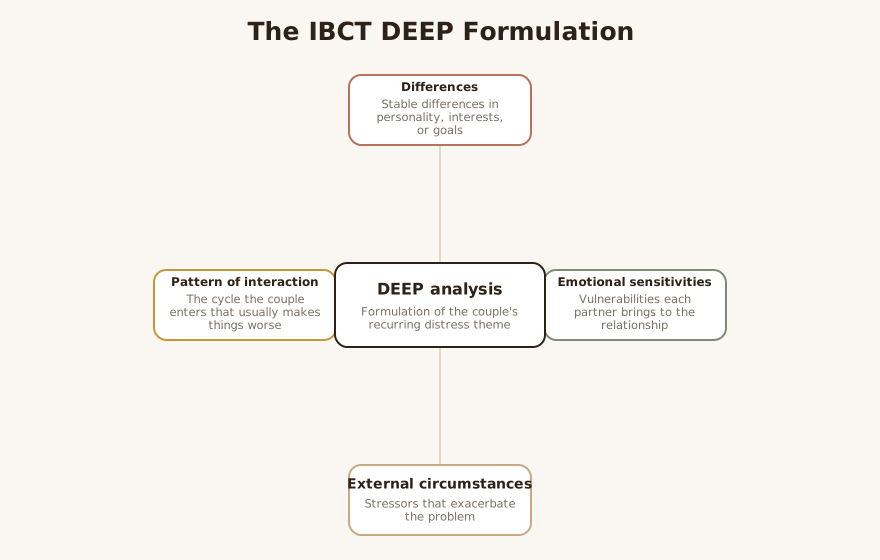
The formulation is organized by the DEEP analysis 1:
- D — Differences: stable differences between partners in personality, interests, or goals 1.
- E — Emotional sensitivities: the vulnerabilities each partner brings to the relationship 1.
- E — External circumstances: stressors that exacerbate the problem 1.
- P — Pattern of interaction: the cycle the couple enters trying to resolve the problem 1.
The pivotal insight is that the pattern of interaction, though intended to solve the problem, usually makes it worse — a self-reinforcing loop 1. Clinicians familiar with the model describe this as a polarization process, in which each partner’s coping response provokes the other’s, driving them to opposite extremes, until they are caught in a mutual trap: both feel stuck, neither sees a way out, and each blames the other. LLM
IBCT further distinguishes between contingency-shaped change — spontaneous shifts that follow from an altered emotional context — and rule-governed change that follows direct instruction 1. IBCT prioritizes contingency-shaped change because it is expected to be more durable and more genuinely the partner’s own 1. The theory holds that relationship problems arise from the combination of a triggering action (or inaction) and a sensitive reaction; acceptance work targets the vulnerable reaction, not only the trigger 1. LLM
Interventions & Techniques
IBCT spans a continuum from acceptance to change. The three signature acceptance strategies are 1:
- Empathic joining: the therapist helps partners express, and hear, the softer vulnerable emotion underneath the hard surface emotion, so each develops compassion for the other’s position 1. A reactive criticism is reframed to expose the hurt or fear beneath it. LLM
- Unified detachment: the couple is helped to step back and describe the problem pattern as an external “it” they observe together — a third thing acting on them both — rather than something one partner does to the other 1. This shifts the stance from adversarial to collaborative 1. LLM
- Tolerance building: the couple practices accepting differences and behaviors that are unlikely to fully change, reducing the sting of recurrent triggers 1. LLM
On the change side, IBCT retains the behavioral toolkit: behavior exchange, communication training, and problem-solving training, deployed when targeted change is feasible and the couple is ready 1. The art of the model is sequencing — acceptance work often softens partners enough that change requests can finally be heard, and the same content (for example, expressing a need while listening without judgment) can be approached through either an acceptance or a change lens 4. LLM
LLM-generated illustrative example (not a guideline): A wife pursues, a husband withdraws; the more she pursues, the more he withdraws. Using unified detachment, the therapist helps them name “the pursue-withdraw cycle” as a shared adversary. Using empathic joining, the husband voices that his withdrawal is not indifference but a flooded shutdown, and the wife voices that her pursuit is fear of abandonment rather than control. Neither behavior is yet “fixed,” but the meaning of each has changed. LLM
Evidence Base
The evidence base for IBCT is established — mature for a couple therapy, though not vast. The anchor study is a two-site randomized controlled trial of 134 seriously and chronically distressed married couples comparing IBCT with TBCT 1. Both treatments produced similar gains at the end of therapy, but IBCT couples showed significantly greater maintenance of gains than TBCT couples during the first two years of follow-up; by the five-year follow-up the differences between the two treatments had disappeared 1. This pattern — comparable acute effects but better early durability — is the clearest empirical signature of the acceptance augmentation 1. LLM
IBCT has also been adapted into a web-based program, OurRelationship, which carried the model into a much larger and more disseminable format 15. In a trial of roughly 300 couples, the program showed a relationship-satisfaction effect size of about d = 0.69, improvements in depressive symptoms (d ≈ 0.50) and anxiety (d ≈ 0.21), a high completion rate (around 86%), and very high consumer acceptability (about 97% would recommend it) 1. The intervention has been disseminated within large systems, including the U.S. Department of Veterans Affairs, where effect sizes for couple distress fell in the low-to-moderate range under real-world conditions 1. LLM
Two honest caveats: the foundational efficacy data rest on a single large RCT rather than a deep replication literature, and effectiveness in routine and system-wide settings is more modest than in the original controlled trial 1. LLM
Populations & Indications
IBCT is indicated for distressed couples broadly, including chronically and seriously distressed married partners — the population in which it was originally tested 1. It is applied to general relationship discord, communication difficulties, conflict and anger, intimacy and sexual concerns, infidelity and trust ruptures, and the strain of life transitions such as job loss, childbirth, or relocation 4. It is also used when one or both partners carry co-occurring conditions — depression, anxiety, or PTSD — that affect the relationship 4.
The model has been deliberately developed for diverse couples: published clinical illustrations include sessions with both heterosexual and same-sex couples, the latter demonstrated by Christopher Martell 5. Its theme-and-acceptance framework is well suited to couples facing irreconcilable differences, where some sources of conflict will not be eliminated and acceptance is the realistic target 1. LLM
Problems-for-Work
IBCT targets a recognizable cluster of presenting problems, each with a characteristic application:
- Relationship distress and marital dissatisfaction — addressed by formulating a unifying theme and reducing the polarization that fuels global unhappiness 1. LLM
- Recurring conflict over a theme — the same fight in different costumes is reframed as one underlying struggle (for example, closeness versus autonomy) 1.
- Communication problems — approached through communication and problem-solving training on the change side, and empathic joining on the acceptance side 14. LLM
- Emotional disengagement — withdrawal is reframed via empathic joining as protection or flooding rather than indifference, opening a path back toward contact. LLM
- Infidelity-related distress — IBCT has a specific applied literature for couples recovering from infidelity, working the rupture as both a trust injury and a pattern 5. LLM
- Partner accommodation difficulties and resentment — addressed by tolerance building and unified detachment, which lower the cost of differences that will not fully change 1. LLM
Contraindications, Cautions & Cultural Humility
The provided sources do not specify a formal list of contraindications, so the following reflects clinical reasoning rather than a published guideline. LLM Conjoint couple therapy of any model is generally contraindicated, or requires major adaptation, where there is ongoing intimate partner violence with fear or coercive control, untreated active substance dependence that precludes meaningful participation, or one partner’s covert, firm decision to end the relationship. LLM Because empathic joining asks partners to expose vulnerability to each other, it can be harmful if one partner will weaponize that disclosure — careful assessment of safety should precede acceptance work. LLM
Cultural humility matters in defining the theme: norms about interdependence versus autonomy, gender roles, family obligation, and emotional expression vary widely across cultures, and a clinician’s default reading of “too enmeshed” or “too distant” can encode bias. LLM The DEEP “Differences” and “External circumstances” elements explicitly invite attention to context, including discrimination and economic stress, and IBCT has been studied with low-income and same-sex couples, signaling that the framework is meant to flex across populations rather than impose one relational ideal 15. LLM
Treatment-Plan Suggestions & SMART Objectives
| Goal | SMART objective (example) | Mechanism |
|---|---|---|
| Articulate the unifying theme | Within 3 sessions, couple states their core theme (e.g., closeness vs. autonomy) in their own words during session | Theme formulation / DEEP analysis 1 |
| Reduce destructive interaction pattern | Over 8 weeks, couple identifies and names their polarization cycle in real time during 3 of 4 in-session conflicts | Unified detachment 1 |
| Increase empathic understanding | Within 6 sessions, each partner verbalizes the other’s underlying vulnerable emotion during a structured exercise | Empathic joining 1 |
| Build acceptance of stable differences | By session 10, couple reports two recurring triggers reframed as tolerable rather than intolerable on a weekly check-in | Tolerance building 1 |
| Improve communication skills | Within 8 weeks, couple completes a speaker-listener exchange on a hot topic without escalation in 2 consecutive sessions | Communication training 1 |
| Increase positive exchanges | Over 4 weeks, each partner initiates 3 valued positive behaviors per week, tracked on a shared log | Behavior exchange 1 |
| Resolve a concrete shared problem | Within 6 sessions, couple reaches a written agreement on one recurring logistical conflict | Problem-solving training 1 |
| Reduce relationship distress | By treatment end, couple reports a clinically meaningful rise in relationship satisfaction on a standardized self-report | Integrated acceptance + change 1 |
Common Misconceptions
“IBCT is just acceptance and giving up on change.” It is integrative by design — change techniques (behavior exchange, communication and problem-solving training) remain part of the model; acceptance is added, not substituted 1. LLM
“Acceptance means tolerating anything, including mistreatment.” Tolerance building targets stable, non-harmful differences, not abuse; the model still pursues change where change is appropriate and safe 1. LLM
“It’s the same as TBCT.” IBCT places equal or greater emphasis on changing the vulnerable reaction through emotional acceptance, and the RCT showed better two-year maintenance than TBCT 1. LLM
“It’s interchangeable with Emotionally Focused Therapy.” Both are acceptance-informed couple therapies, but IBCT’s engine is a behavioral, contextual, contingency-based analysis rather than an attachment framework 1. LLM
Training & Certification
The provided sources describe a substantial set of training resources but no formal certification credential. LLM Core training materials include the therapist guide, Integrative Behavioral Couple Therapy: A Therapist’s Guide to Creating Acceptance and Change (2nd ed., 2020), and the companion self-help book Reconcilable Differences (2nd ed., 2014) used with clients 35. The Christensen lab provides video illustrations of full sessions — a heterosexual couple session led by Andrew Christensen and a gay couple session led by Christopher Martell — distributed through the American Psychological Association 5. The web program OurRelationship offers a structured, disseminable adaptation, and IBCT has been delivered through large-system training efforts such as the VA rollout 15. Clinicians seeking to learn the model typically combine the therapist guide, the session videos, and supervised practice 5. LLM
Key Terms
- Theme: the one or two broad underlying issues organizing a couple’s recurring conflicts 1.
- DEEP analysis: the formulation framework — Differences, Emotional sensitivities, External circumstances, Pattern of interaction 1.
- Polarization process: the cycle in which each partner’s coping response intensifies the other’s, pushing them to opposite extremes 1. LLM
- Mutual trap: the stuck point both partners feel when the polarization process leaves no apparent exit. LLM
- Empathic joining: eliciting and sharing the vulnerable emotion beneath surface reactivity to build compassion 1.
- Unified detachment: describing the problem pattern as an external, shared “it” to be examined collaboratively 1.
- Tolerance building: practicing acceptance of differences and behaviors unlikely to change 1.
- Contingency-shaped vs. rule-governed change: durable change emerging from an altered context versus change following direct instruction 1.
Resources & Further Reading
▶ Watch — a video introduction to this concept:
- Integrative Behavioral Couple Therapy: Theoretical Background, Empirical Research, and Dissemination — Roddy et al., Family Process (PMC full text)
- Same article, Family Process / Wiley
- Integrative Behavioral Couple Therapy: A Therapist’s Guide to Creating Acceptance and Change, 2nd ed. — Christensen, Doss & Jacobson (W. W. Norton)
- How Integrative Behavioral Couple Therapy Works — Psychology Today
- UCLA IBCT Resources (Christensen lab)
Reflective / Supervision Questions
- When you formulate a couple’s theme, whose cultural norms about closeness and autonomy are you implicitly treating as the baseline — and how would you check that? LLM
- Can you identify the polarization cycle in a current couple, and articulate how each partner’s “solution” feeds the other’s problem? 1 LLM
- Where do you tend to reach for change techniques too early, before acceptance work has softened the partners enough for requests to land? 1 LLM
- How do you assess for safety (coercion, fear, weaponized disclosure) before inviting vulnerability through empathic joining? LLM
- Given that IBCT’s durability advantage over TBCT faded by five years, how do you talk with couples honestly about what therapy can and cannot durably change? 1 LLM