
Type & Discipline
Traditional Behavioral Couple Therapy (TBCT) is a structured, skills-based modality within the discipline of couples therapy and clinical psychology LLM. It belongs to the broader family of behavioral couples therapies and is frequently labeled in the older literature as Behavioral Marital Therapy 6. The approach treats relationship distress as a behavioral problem maintained by the moment-to-moment exchanges between partners, rather than as a property residing inside one individual 1. It is time-limited, present-focused, and explicitly pedagogical, teaching couples concrete skills they are expected to rehearse between sessions LLM. Among couple treatments, it holds the distinction of being the model with the most extensive empirical support at the time it was developed and the comparison standard against which later behavioral couple therapies were tested 4.
Creators & Lineage
TBCT was codified by Neil Jacobson and Gayla Margolin in their 1979 text, which laid out the model’s strategies based on social learning and behavior exchange principles 1. Robert Weiss is a parallel founding figure whose early behavioral analysis of marital interaction shaped the assessment and treatment logic of the behavioral marital tradition 6. The lineage draws on two converging streams: social learning theory, which frames relationship behavior as learned and modifiable through reinforcement and modeling, and social exchange theory, which conceptualizes satisfaction in terms of the ratio of rewarding to costly exchanges between partners 1. TBCT in turn became the direct parent of Integrative Behavioral Couple Therapy (IBCT), which Andrew Christensen and Jacobson developed to address the limits of the traditional change-focused model 4. Understanding TBCT therefore situates a clinician within the entire arc of behavioral couples work, from its social-learning roots to its contemporary acceptance-based successors LLM.
Core Principles
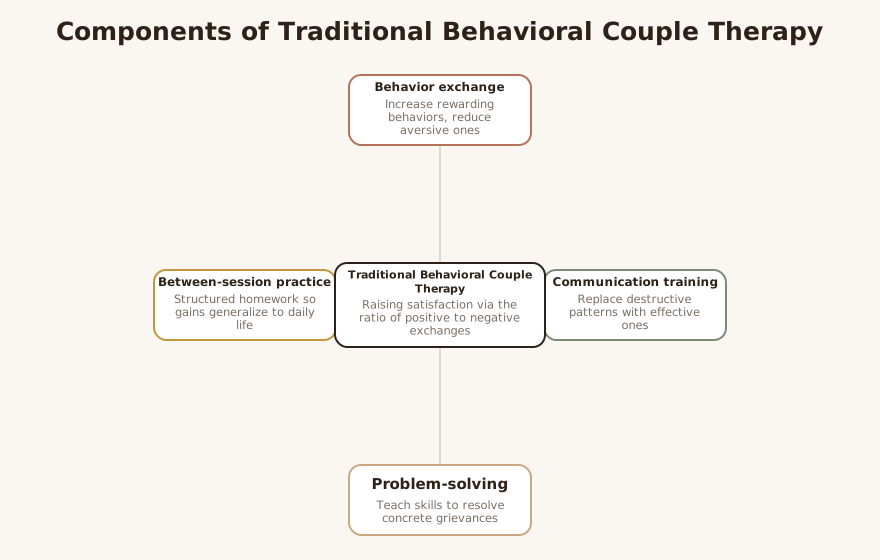
The organizing assumption of TBCT is that relationship satisfaction tracks the ratio of positive to negative behavioral exchanges between partners 4. Distress is understood to develop and persist through learning processes, including the erosion of positive reinforcement and the escalation of coercive, mutually punishing interaction cycles 1. Because behavior is learned, it is treatable: partners can be taught to increase rewarding behaviors, reduce aversive ones, and replace destructive communication patterns with effective ones 1. The model is collaborative and skills-oriented, positioning the therapist as an active teacher and coach rather than an interpreter of unconscious dynamics LLM. It privileges observable, specific behaviors over global complaints, translating vague grievances such as “he never cares” into concrete, countable, and changeable actions LLM. Generalization is a core aim, so structured between-session practice is built into the treatment so that gains transfer from the consulting room to daily life 1.
Interventions & Techniques
TBCT rests on three principal intervention sets 4. Behavior exchange procedures increase the frequency of pleasing behaviors by having each partner identify and deliberately provide actions the other values, shifting the daily reinforcement balance toward the positive 4. Communication training teaches partners to express feelings as a speaker and to attend accurately as a listener, using skills such as paraphrasing, validating, and making specific rather than character-based statements 4. Problem-solving training provides a stepwise method for defining a problem narrowly, brainstorming solutions, evaluating options, and negotiating a written, behaviorally specific agreement 4. These components are typically sequenced, often beginning with behavior exchange to build goodwill before introducing the more demanding communication and problem-solving work LLM. Therapists rely heavily on in-session rehearsal, modeling, coaching, and structured homework to consolidate skills 1.
LLM-generated illustrative example (not a guideline): A couple reports constant friction over evening routines. The therapist coaches them through problem-solving training: they define the problem as “we have no agreed plan for childcare between 5 and 7 p.m.,” generate options, and negotiate a written agreement specifying who does what. LLM
Evidence Base
The maturity of TBCT’s evidence base is best described as established LLM. The Society of Clinical Psychology (APA Division 12) maintains the behavioral couple therapy tradition within its database of research-supported psychological treatments 5. The largest controlled test comes from a two-site randomized trial of 134 seriously and chronically distressed married couples comparing TBCT with IBCT 2. By the end of treatment, 59% of TBCT couples were reliably improved or recovered on the Dyadic Adjustment Scale, compared with 71% for IBCT, a difference that was not the primary finding of interest 2. The trajectories differed: TBCT couples improved more quickly early in treatment but then plateaued, whereas IBCT couples improved more steadily across the course 2. At five-year follow-up the two treatments converged, with effect sizes of d = 0.92 for TBCT and d = 1.03 for IBCT, and 45.9% of TBCT couples showing clinically significant improvement 3. Crucially, the durability limits of the traditional change-focused approach—IBCT showed greater maintenance of gains through the first two years before differences disappeared—were part of what motivated the development of acceptance-based extensions 4. The honest summary is that TBCT works and produces substantial effect sizes even in seriously distressed couples, while its non-response and relapse patterns spurred the field beyond it 3.
Populations & Indications
TBCT was designed for and validated with distressed dyads, most often married couples, and the model extends naturally to cohabiting partners and adults in committed relationships seeking help with their relationship as the unit of treatment 2. It is indicated when both partners are willing to participate, the presenting concern is the relationship itself, and the couple can tolerate a structured, skills-focused format LLM. The trial evidence specifically supports its use with significantly and chronically distressed couples, not only mildly dissatisfied ones, which strengthens its applicability to the clinically distressed populations that present to most practitioners 2. It is well suited to couples whose difficulties center on observable behavior, communication breakdowns, and unresolved practical disputes LLM. Clinicians should still confirm that each partner endorses the relationship goal and that no individual contraindication is present before proceeding LLM.
Problems-for-Work
TBCT directly targets a cluster of relational problems-for-work LLM. Communication problems and problem-solving deficits are addressed by their corresponding training modules, which teach speaker-listener skills and a structured negotiation sequence 4. Relationship dissatisfaction and marital distress are approached through behavior exchange that shifts the positive-to-negative ratio of daily interaction 4. Coercive interaction patterns, in which partners mutually escalate aversive control, are interrupted by replacing punishment-driven exchanges with reinforced positive behavior 1.
LLM-generated illustrative example (not a guideline): Partners locked in a withdraw-attack cycle around finances are coached to replace criticism with specific requests and scheduled problem-solving, reducing the coercive escalation that had become their default. LLM
Behavioral disengagement, intimacy problems, relationship conflict, and co-parenting conflict are all amenable to the same toolkit, applied to the specific domains the couple nominates LLM.
Contraindications, Cautions & Cultural Humility
TBCT is not appropriate when intimate partner violence is present, because skills-based negotiation can be unsafe and ineffective where coercion or fear dominates the relationship LLM. Active, unaddressed substance use, untreated severe individual psychopathology, or a unilateral decision to end the relationship may all require individual or stabilization work before conjoint behavioral treatment can succeed LLM. A documented caution is durability: the traditional, change-only emphasis showed weaker maintenance of gains relative to acceptance-augmented approaches, so clinicians should monitor for relapse and consider integrative extensions when change strategies stall 4. Cultural humility is essential because what counts as a “rewarding” behavior, an acceptable division of labor, or appropriate emotional expression is shaped by culture, gender norms, and family-of-origin expectations LLM. The therapist should elicit each couple’s own definitions of valued behavior rather than importing a normative template, and remain alert to imbalances of power that a purely behavioral frame can obscure LLM.
Treatment-Plan Suggestions & SMART Objectives
| Goal | SMART objective (example) | Mechanism |
|---|---|---|
| Increase positive exchanges | Each partner provides at least 3 specific pleasing behaviors per week for 4 weeks, tracked on a shared log | Behavior exchange shifting positive-to-negative ratio 4 |
| Improve expressive communication | Partners complete 2 in-session speaker-listener rehearsals using specific, non-blaming statements within 3 sessions | Communication training 4 |
| Build problem-solving capacity | Couple negotiates one written, behaviorally specific agreement on a chosen dispute within 4 weeks | Problem-solving training 4 |
| Reduce coercive escalation | Couple identifies their escalation cycle and substitutes a time-out plus request in 80% of monitored conflicts over 4 weeks | Interrupting reinforced coercive patterns 1 |
| Raise relationship satisfaction | Both partners increase Dyadic Adjustment Scale scores by a reliable margin by session 12 | Cumulative positive exchange and skill use 2 |
| Generalize skills to daily life | Couple completes assigned between-session homework in at least 3 of 4 weeks | Structured practice promoting transfer 1 |
| Address co-parenting conflict | Couple agrees on a specific weekday childcare division and reviews it weekly for 1 month | Problem-solving applied to a defined domain 4 |
Common Misconceptions
A frequent misconception is that TBCT is purely “transactional,” reducing love to a tally of favors; in practice the exchange principle is a lens on reinforcement, not a prescription for quid-pro-quo bargaining LLM. A second is that behavioral couple therapy ignores emotion, when in fact communication training is built around expressing and validating feelings accurately 4. A third is the belief that TBCT has been superseded and is no longer worth knowing; the comparison trials show it produces substantial, durable effect sizes and converges with IBCT by five years 3. A fourth is that more skills always mean better outcomes, whereas the evidence points to the importance of maintenance and acceptance, not just initial skill acquisition 4. Finally, clinicians sometimes assume TBCT is only for mildly distressed couples, but it was validated with seriously and chronically distressed dyads 2.
Training & Certification
TBCT does not have a single proprietary certification body, and clinicians most often acquire it through graduate coursework, the foundational Jacobson and Margolin text, and supervised practice in behavioral couple work 1. The original 1979 manual remains the primary reference for the model’s assessment logic and intervention sequence 1. Because the field has largely moved toward integrative successors, structured training programs and certification pathways are more developed for Integrative Behavioral Couple Therapy, and clinicians frequently learn TBCT components as the behavioral backbone within those broader curricula 4. Competent practice requires supervised experience with conjoint sessions, behavioral assessment of interaction, and the management of in-session conflict, which a textbook alone cannot supply LLM.
Key Terms
Behavior exchange — interventions that increase each partner’s rate of pleasing behaviors to improve the daily balance of rewarding versus costly interactions 4. Communication training — structured teaching of speaker and listener skills, including specific, non-blaming expression and accurate listening 4. Problem-solving training — a stepwise method of defining a problem, generating and evaluating options, and negotiating a written agreement 4. Coercion / coercive cycle — a self-reinforcing pattern in which partners use aversive control, escalating mutual punishment 1. Social exchange theory — the framework that ties relationship satisfaction to the ratio of rewards to costs in partner exchanges 1. Social learning theory — the view that relationship behavior is learned and modifiable through reinforcement, modeling, and practice 1.
Resources & Further Reading
▶ Watch — a video introduction to this concept:
- Jacobson & Margolin (1979). Marital Therapy: Strategies Based on Social Learning and Behavior Exchange Principles
- Christensen et al. (2004). Traditional versus integrative behavioral couple therapy for significantly and chronically distressed married couples
- Christensen et al. (2010). Marital status and satisfaction five years following the TBCT vs IBCT trial
- Integrative Behavioral Couple Therapy review situating TBCT (PMC)
- Society of Clinical Psychology (APA Division 12): Psychological Treatments
- Behavioral Marital Therapy (SpringerLink chapter)
Reflective / Supervision Questions
- When I translate a couple’s global complaints into specific behaviors, whose definition of “rewarding” am I privileging, and have I asked each partner directly? LLM
- Am I sequencing behavior exchange, communication training, and problem-solving in a way that builds goodwill before tackling the hardest disputes? LLM
- Given TBCT’s documented durability limits, how am I monitoring for relapse and when would I integrate acceptance-based strategies? 4
- Have I screened adequately for intimate partner violence and power imbalances that would make skills-based negotiation unsafe? LLM
- How do culture, gender norms, and family-of-origin expectations shape what this couple counts as fair exchange, and am I imposing a normative template? LLM
- What evidence am I tracking, beyond my clinical impression, to know whether this couple’s satisfaction is reliably improving? 2