
Type & Discipline
Pranayama is a technique-level practice drawn from the discipline of classical yoga philosophy rather than from any single psychotherapy school 5. The word combines prana (breath or vital life force) with ayama, variously rendered as control, restraint, or expansion, so the term can be read either as “restraint of breath” or “expansion of vital energy” 5. In practice it refers to a family of techniques for consciously regulating the rate, depth, rhythm, and patterning of respiration in order to influence the flow of prana and, through it, the state of the mind 4. For the practicing clinician, pranayama is most usefully understood not as a standalone therapy but as a portable physiological skill that can be embedded inside established modalities to target arousal, autonomic dysregulation, and somatic tension LLM. Because it operates through the breath—a system that is both automatic and voluntarily controllable—it offers a direct behavioral lever on the autonomic nervous system that requires no equipment and can be practiced between sessions LLM.
Creators & Lineage
Pranayama has no single modern creator; it is codified in classical Indian texts and transmitted through living yoga traditions 5. Its most influential formalization appears in Patanjali’s Yoga Sutras, where pranayama is named the fourth of the eight limbs (angas) of the ashtanga, or eight-limbed, system of yoga 5. In that framework, breath regulation sits after ethical observances and physical posture and serves as a bridge toward concentration and meditation, aiming to steady the mind through controlled breathing 5. Later hatha-yoga texts such as the Hatha Yoga Pradipika elaborate the specific techniques and their purifying functions 5. The contemporary clinical lineage that carries pranayama into mental-health work runs through yoga-based therapy, mindfulness-based interventions, somatic therapies, and polyvagal-informed practice, each of which has adapted breath regulation to its own theory of change LLM. Clinicians should hold this provenance honestly: the practice is ancient and culturally embedded, while its operationalization as a discrete clinical intervention is comparatively recent LLM.
Core Principles
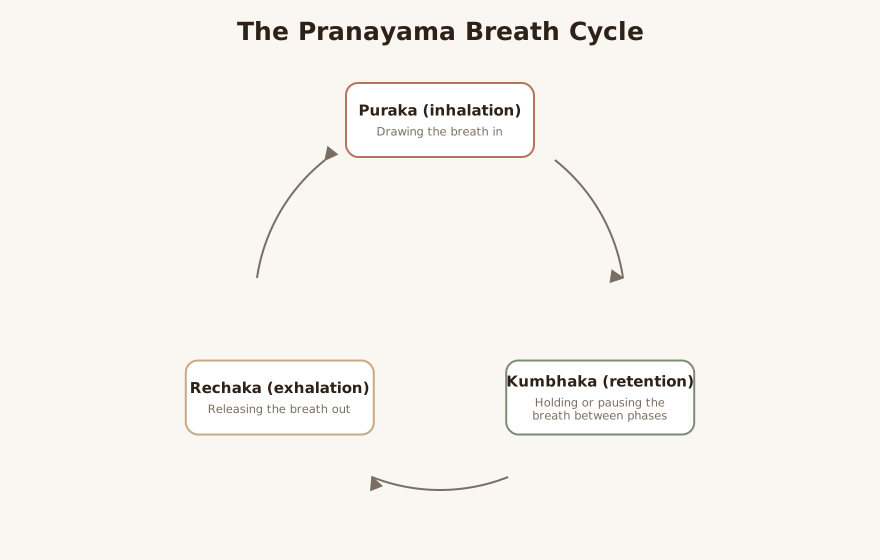
The foundational unit of pranayama is the breath cycle, traditionally divided into three phases: puraka (inhalation), kumbhaka (retention), and rechaka (exhalation) 5. By deliberately lengthening, shortening, or pausing these phases, the practitioner alters the mechanical and chemical signals the respiratory system sends to the brainstem and autonomic centers LLM. The classical rationale is energetic—regulating prana to clear the subtle channels (nadis) and stabilize attention—while the contemporary physiological rationale is autonomic, framing slow and extended-exhale breathing as a route to increased parasympathetic (vagal) tone 4LLM. A central principle is that the breath is a two-way interface: it both reflects emotional state and can be used to change it, which is why slowing and deepening respiration tends to down-regulate the stress response LLM. A second principle is graduated control, beginning with simple awareness of natural breathing before introducing ratios, retention, or forceful techniques 3. A third is that effect depends on technique: calming practices generally emphasize slow rates and prolonged exhalation, whereas activating practices use rapid or forceful breathing, so the clinician must match technique to therapeutic goal 34.
Interventions & Techniques
Several named pranayama techniques recur across the literature and are most relevant to clinical use 5. Nadi shodhana, or alternate-nostril breathing, involves occluding one nostril at a time and is commonly used to promote balance and focus 53. Ujjayi, the “victorious” or ocean-sounding breath, involves a slight constriction at the throat and is widely paired with movement-based yoga 5. Dirga, the three-part or complete breath, directs sequential filling of the lower belly, mid-chest, and upper chest, and is frequently taught to beginners as a foundational relaxation skill 6. Bhramari, or bee breath, uses a humming exhalation and is described as calming and as a candidate for reducing stress-related blood pressure 3. Kapalabhati (“skull-shining”) and bhastrika (“bellows breath”) are forceful, activating techniques that increase respiratory rate and are generally not first-line for anxious or hyperaroused clients 53. Box breathing, a four-count inhale-hold-exhale-hold pattern, is a simplified entry point often recommended for beginners 3. WebMD-style introductory guidance suggests starting with simple techniques for roughly five minutes daily and building gradually under qualified instruction 3.
LLM-generated illustrative example (not a guideline): A clinician treating a client with panic disorder might introduce dirga three-part breath in session, coaching a 4-count inhale and a 6-count exhale, then assign two five-minute daily practices logged in a breathing diary, reserving forceful techniques like kapalabhati entirely LLM.
Evidence Base
The maturity of the evidence is best described as established as a practice with a robust short-term physiological signal but preliminary, mixed evidence for specific psychiatric outcomes LLM. Systematic reviews of yogic breathing report effects on cardiovascular parameters, including reductions in heart rate and blood pressure in hypertensive populations 1. A separate systematic review focused specifically on the hypotensive effect of yoga’s breathing exercises likewise concludes that these practices are associated with reductions in blood pressure 2. The magnitude of blood-pressure change reported in the broader yoga literature is generally modest—on the order of a few millimeters of mercury—and comparable to other lifestyle modifications, though clinicians should treat any specific figure as background rather than a precise treatment target LLM. An important interpretive caution is that much of the blood-pressure evidence comes from multi-component yoga programs combining postures, meditation, and breathing, which makes the isolated contribution of pranayama alone difficult to separate LLM. The proposed mechanism—shifting autonomic balance toward parasympathetic dominance and improving the coupling between respiration and cardiovascular rhythms—is physiologically coherent and consistent with the cardiovascular findings 1LLM. By contrast, evidence for discrete mental-health indications such as PTSD hyperarousal, panic disorder, and depression rests on smaller, more heterogeneous trials and should be presented to clients as promising rather than definitive LLM. The honest clinical summary is that pranayama reliably and acutely lowers physiological arousal, while its durable effect on specific diagnoses is still being established LLM.
Populations & Indications
Pranayama is most clearly indicated for adults seeking a low-cost, self-administered tool for down-regulating arousal 3. It is commonly applied with people experiencing chronic stress, where slow breathing can reduce subjective tension and stress-related blood-pressure elevation 3. People with anxiety disorders are a frequent target population, as introductory sources note that pranayama may significantly lower anxiety and support emotional regulation 3. Clients with insomnia may use calming techniques before bed as part of a wind-down routine 3. People with chronic pain and those carrying somatic tension may benefit from the parasympathetic shift and the redirection of attention onto the breath LLM. Trauma survivors and clients with PTSD-related hyperarousal are a population where breath work is often introduced cautiously and in a titrated, choice-based way rather than as a forced relaxation protocol LLM. Practitioners already engaged in yoga and mindfulness frequently arrive with familiarity that lowers the barrier to integrating pranayama into therapy LLM. Across these groups, indications are strongest when the clinical target is autonomic dysregulation or acute arousal, and weaker when the breath work is expected to function as a standalone treatment for a primary mood or psychotic disorder LLM.
Problems-for-Work
For generalized anxiety disorder, slow extended-exhale breathing can be framed as an in-the-moment skill to interrupt the worry-arousal spiral and as a daily practice to lower baseline tension 3LLM. For panic disorder, paced breathing with a longer exhale can counter the hyperventilation and CO2 dysregulation that fuel panic, though it must be introduced carefully so it does not become a safety behavior or trigger interoceptive fear LLM. For acute stress, a brief structured technique such as box breathing offers a discrete, teachable intervention that a client can deploy before a stressor 3LLM. For PTSD hyperarousal, titrated breath awareness with explicit permission to stop can help widen the window of tolerance without overwhelming the client LLM. For insomnia, a calming evening practice supports the transition to sleep as part of stimulus-control and wind-down work 3LLM. For emotional dysregulation and somatic tension, breath regulation pairs naturally with distress-tolerance and grounding work, giving the client a physiological anchor LLM. For autonomic dysregulation specifically, pranayama provides a direct behavioral route to increasing vagal tone and rebalancing sympathetic-parasympathetic activity 1LLM.
LLM-generated illustrative example (not a guideline): For a client with chronic stress and tension headaches, a clinician might pair a daily five-minute bhramari bee-breath practice with a brief log of pre- and post-practice tension ratings to test whether the breath work reliably lowers the client’s somatic tension LLM.
Contraindications, Cautions & Cultural Humility
Forceful and breath-retention techniques warrant the most caution, and introductory guidance recommends that people with heart problems or other significant health conditions consult a physician before practicing 3. Rapid techniques such as kapalabhati and bhastrika can provoke dizziness, hyperventilation, or lightheadedness and are generally inappropriate for clients prone to panic or with cardiovascular or respiratory conditions 3LLM. With trauma survivors, interoceptive focus on the breath can itself be activating, so breath work should be offered as an invitation with clear opt-out rather than imposed, and clinicians should watch for dissociation or escalating distress LLM. Breath holding (kumbhaka) should be introduced conservatively, if at all, and avoided in pregnancy, uncontrolled hypertension, or seizure history without medical guidance LLM. Pranayama is not a substitute for indicated pharmacological or psychotherapeutic treatment of moderate-to-severe psychiatric illness and should be positioned as an adjunct LLM. Cultural humility is essential: pranayama is a sacred practice embedded in Hindu and broader Indian spiritual traditions, and extracting it as a mere “breathing exercise” can flatten its meaning, so clinicians should name its origins, avoid appropriative framing, and learn from credible teachers rather than presenting the technique as their own invention 5LLM. Introductory sources themselves recommend learning from certified instructors initially, which respects both safety and lineage 3.
Treatment-Plan Suggestions & SMART Objectives
| Goal | SMART objective (example) | Mechanism |
|---|---|---|
| Reduce baseline anxiety | Client will practice slow extended-exhale breathing 5 minutes daily for 6 days/week over 4 weeks, logged in a breathing diary 3 | Increased parasympathetic (vagal) tone lowers tonic sympathetic arousal 1 |
| Abort acute stress spikes | Client will use box breathing within 2 minutes of noticing acute stress, on at least 5 occasions/week for 4 weeks 3 | Slowed respiration interrupts the stress-arousal feedback loop LLM |
| Improve sleep onset | Client will complete a 5-minute calming breath practice nightly before bed for 3 weeks, rating sleep latency each morning 3 | Pre-sleep down-regulation supports parasympathetic shift and wind-down LLM |
| Manage panic-linked hyperventilation | Client will practice 4-count inhale / 6-count exhale paced breathing 2x daily for 4 weeks without using it as avoidance LLM | Exhale-lengthened breathing corrects hyperventilation and CO2 dysregulation LLM |
| Lower physiological hyperarousal (PTSD) | Client will engage in titrated breath awareness for 3 minutes, 4 days/week for 4 weeks, with explicit permission to stop LLM | Graded interoceptive exposure widens the window of tolerance LLM |
| Reduce somatic tension | Client will pair dirga three-part breath with a body scan 3x/week for 4 weeks, rating tension 0-10 pre/post 6 | Diaphragmatic breathing and attentional shift reduce muscular and somatic tension LLM |
| Support autonomic regulation | Client will practice nadi shodhana alternate-nostril breathing 5 minutes daily for 4 weeks, tracking adherence 5 | Balanced, slow breathing improves respiration-cardiovascular coupling and vagal tone 1 |
Common Misconceptions
A frequent misconception is that all pranayama is calming, when in fact several core techniques are deliberately activating and can heighten arousal rather than reduce it 35. Another is that pranayama is “just deep breathing,” which ignores the technique-specific ratios, retention, and patterning that distinguish named practices and produce different physiological effects 5LLM. Clinicians sometimes assume that more is always better, but forceful overbreathing can cause dizziness and is not a route to faster results 3LLM. A clinical misconception is that breath work is universally safe for trauma survivors, when interoceptive focus can in fact be destabilizing for some clients LLM. Finally, the strength of the cardiovascular evidence is sometimes overgeneralized into firm claims about treating specific psychiatric disorders, but the documented short-term effects on heart rate and blood pressure do not by themselves establish pranayama as a proven monotherapy for conditions like depression or PTSD 12LLM.
Training & Certification
There is no single regulated certification that licenses a clinician to teach pranayama, and competence is typically built through yoga teacher training and supervised contemplative practice rather than a mental-health credential LLM. Introductory sources consistently recommend that newcomers learn the techniques from certified yoga instructors before practicing independently, which applies to clinicians as much as clients 3. Mental-health practitioners who wish to integrate pranayama are best served by experiential training in the techniques themselves, grounding in the autonomic rationale, and supervision on how to titrate breath work for trauma-affected and medically complex clients LLM. Familiarity with the classical framework—Patanjali’s eight limbs and the three-phase breath cycle—supports both competent instruction and culturally respectful framing 5. Clinicians should practice the techniques personally before teaching them, since coaching breath regulation well depends on embodied familiarity with the subtle effects of each method LLM.
Key Terms
Prana — the vital life force or energy that pranayama seeks to cultivate and channel 5. Ayama — control, restraint, or expansion; the second root of the word pranayama 5. Puraka — the inhalation phase of the breath cycle 5. Kumbhaka — breath retention, held after inhalation or exhalation 5. Rechaka — the exhalation phase of the breath cycle 5. Nadi shodhana — alternate-nostril breathing used for balance and focus 5. Ujjayi — the “victorious” ocean-sounding breath used in movement-based yoga 5. Dirga — the three-part or complete breath filling belly, mid-chest, and upper chest 6. Bhramari — humming bee breath associated with calming and stress reduction 3. Kapalabhati / Bhastrika — forceful, activating cleansing and bellows breaths 53. Ashtanga (eight limbs) — Patanjali’s eight-limbed yoga system in which pranayama is the fourth limb 5.
Resources & Further Reading
▶ Watch — a video introduction to this concept:
- The effect of yogic breathing (Pranayama) on heart rate and blood pressure in patients with hypertension: A systematic review
- The hypotensive effect of Yoga’s breathing exercises: A systematic review
- What Is Pranayama? Benefits, Techniques, and How to Practice (WebMD)
- What Is Pranayama? Definition, Purpose, History, Stages and Types (Yoga Basics)
- Pranayama (Wikipedia)
- Breathing Techniques for Beginners: Three Part Breath Pranayama Tutorial (YouTube)
Reflective / Supervision Questions
- For a given client, am I matching the technique to the goal—calming, slow-exhale practices for hyperarousal versus avoiding forceful techniques that may activate? LLM
- How am I presenting breath work to trauma survivors so that it remains an invitation with a clear opt-out rather than an imposed relaxation demand? LLM
- Am I framing pranayama honestly as an adjunctive skill with strong short-term autonomic effects but preliminary disease-specific evidence, rather than overselling it? LLM
- How am I acknowledging the practice’s cultural and spiritual origins, and am I drawing on credible teachers rather than presenting it as a neutral technique I devised? 5LLM
- What am I monitoring to know whether the breath work is actually helping—diaries, tension ratings, sleep latency—rather than assuming benefit? LLM
- Could the breathing practice be functioning as a safety behavior or avoidance for this client, and how would I detect that? LLM