
Type & Discipline
The matching law is a quantitative theory of choice within behavioral psychology, specifically the experimental analysis of behavior tradition founded on operant conditioning. LLM It is descriptive rather than prescriptive: it states a lawful regularity about how behavior distributes itself, in the same way that a law of physics describes motion rather than instructing an object how to move. LLM In its strict form, the law holds that the relative rate of a response equals the relative rate of reinforcement obtained for that response, expressed as R1/(R1+R2) = Rf1/(Rf1+Rf2). 2 For the practicing clinician, this matters because it reframes behavior not as an isolated symptom to be suppressed but as one allocation within a competitive field of reinforcement, a field the clinician can measure and re-engineer. LLM
Creators & Lineage
Richard J. Herrnstein formulated the matching law in 1961 from experiments with pigeons in operant chambers offering two response keys, each delivering food on its own variable-interval schedule. 2 He observed that the pigeons did not simply maximize by responding only on the richer key; instead, the ratio of their response rates across the two keys matched the ratio of reinforcement rates the keys delivered. 2 The principle was later generalized by William Baum in 1974, who introduced a power-function form, R1/R2 = b(Rf1/Rf2)^s, to accommodate systematic deviations from perfect matching. 2 This added two free parameters that became central to applied work: bias (b), a subject’s preference for one alternative independent of reinforcement rate, and sensitivity (s), the degree to which reinforcement ratios actually move choice ratios. 2
The intellectual lineage runs directly from B. F. Skinner’s operant conditioning, with the matching law representing the quantitative wing of that tradition. LLM It is also a foundational input to behavioral economics, where reinforcement is treated as a commodity for which behaviors compete, and it is a core conceptual tool within applied behavior analysis. LLM
Core Principles
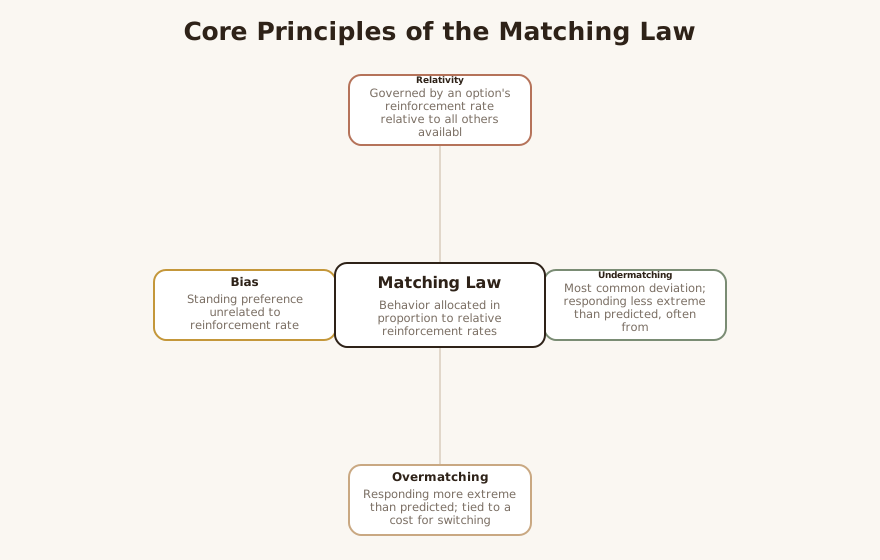
The first principle is relativity: behavior is governed not by the absolute amount of reinforcement an option delivers but by the rate of reinforcement for that option relative to all other options available at the same time. 2 A behavior that earns reinforcement on a fixed schedule can still decline simply because a competing behavior begins earning reinforcement more richly, even though nothing about the first behavior’s own payoff changed. LLM
The second principle is that deviations from strict matching are the rule, not the exception, and these deviations are themselves informative. 2 Undermatching, in which response proportions are less extreme than reinforcement proportions predict, is the most commonly observed pattern; non-human studies consistently produce sensitivity values near 0.8 rather than the 1.0 that perfect matching requires, and undermatching often arises from frequent switching between alternatives. 2 Overmatching, in which responding is more extreme than predicted, is less common and tends to appear when there is a cost or penalty for switching between options. 2 Bias, the b parameter, captures a standing preference unrelated to reinforcement rate, such as a hand preference, a position preference, or a history that makes one option intrinsically easier or more familiar. 2
The third principle concerns mechanism. Several accounts explain how matching emerges, including molecular maximizing (choosing whichever option is most immediately reinforced), molar maximizing (distributing responses to maximize long-run reinforcement), and melioration, in which the organism continually shifts behavior toward whichever alternative currently has the higher local return until the returns equalize, a process that itself produces matching. 2 Melioration is clinically sobering because it predicts that an organism will keep shifting toward the locally better option even when doing so is globally suboptimal, which offers a behavioral grammar for self-defeating choice. LLM
A practical corollary follows from all three: no behavior occurs in a vacuum. LLM Every target behavior sits in a context of alternative reinforcers, and the clinician who attends only to the target while ignoring the competing field will repeatedly be surprised by why an intervention fails to hold. LLM
Interventions & Techniques
The matching law does not prescribe a single technique; it prescribes a way of reasoning that reshapes how several established behavioral techniques are deployed. LLM The central applied insight is that suppressing a problem behavior is not primarily a matter of weakening that behavior in isolation but of changing its reinforcement rate relative to the alternatives. 4
The most direct application is differential reinforcement of alternative behavior. Rather than relying on extinction alone, which can provoke frustration and extinction bursts, the clinician selectively increases the rate, magnitude, or quality of reinforcement delivered for an appropriate alternative so that response allocation shifts toward it without the negative side effects of pure extinction. 4 Because the law operates on relative rates, the clinician engineers concurrent reinforcement so that the adaptive behavior simply becomes the better deal across one or more reinforcement dimensions. 3
A second technique is the deliberate manipulation of multiple reinforcement dimensions at once. Athens and Vollmer (2010) manipulated rate, quality, delay, and effort for appropriate versus problem behavior in children, and found that when several dimensions favored the appropriate behavior, responding matched accordingly. 1 This is a more sophisticated lever than merely increasing how often a reward is delivered: a clinician can win the allocation competition by making the appropriate behavior higher in quality, more immediate, or lower in effort, not only more frequent. 1
A third consideration is individualization of reinforcer dimensions. Neef and colleagues (1992, 1994) demonstrated idiosyncratic client preferences, with some clients weighting immediacy heavily and others weighting effort, meaning the dimension that will move a given client’s behavior must be assessed rather than assumed. 1 Reed and Martens (2008) further showed that students preferred easier academic work even when reinforcement favored harder material, illustrating that effort functions as a powerful biasing variable that can override reinforcement rate. 1
LLM-generated illustrative example (not a guideline): A clinician supervising a token economy notices a teenager keeps blurting out in group rather than raising his hand, despite hand-raising being reinforced. Rather than adding consequences for blurting, the clinician audits the competing reinforcement: blurting earns immediate peer laughter, while hand-raising earns delayed adult praise. The team shortens the delay and adds peer-delivered acknowledgment for hand-raising, shifting the relative rate so the appropriate behavior becomes the richer option. LLM
Evidence Base
Honesty about maturity requires a split judgment. As a descriptive, quantitative law of choice in basic behavior-analytic research, the matching law is firmly established: it has been replicated across species, response types, and reinforcement schedules for decades, and its generalized form reliably fits choice data, with undermatching as the well-documented norm. 2 In this sense its status is comparable to a robust empirical regularity rather than a tentative hypothesis. LLM
The clinical translation is on a different and somewhat less mature footing. Applied demonstrations in human clinical populations are real and well-conducted, including Borrero et al. (2010), who showed that children with developmental disabilities distributed aggression versus appropriate behavior according to relative reinforcement rates, and Murray and Kollins (2000), who found that methylphenidate increased children with ADHD’s sensitivity to reinforcement during academic tasks. 1 However, human data show wider and more variable deviations from matching than animal data, and matching appears cleanly in some concurrent-schedule arrangements with humans while breaking down in others. 2 The honest framing for clinicians is therefore that the matching law is best treated as a powerful and well-grounded conceptual lens for case formulation and intervention design, rather than as a standalone, manualized, independently validated treatment protocol in its own right. LLM
Populations & Indications
The framework is most directly indicated for individuals receiving structured behavioral interventions, including children with behavioral problems and children with developmental disabilities, where concurrent reinforcement can be explicitly arranged and measured. 1 It has a strong rationale for people with ADHD, given evidence that reinforcement sensitivity is itself a modifiable parameter in this population and that academic and attentional allocation track relative reinforcement. 1
By extension into behavioral-economic and contingency-management contexts, the law is highly relevant to people with substance use disorders and to clients in contingency-management programs, where abstinence and substance use can be conceptualized as concurrently reinforced alternatives whose relative payoffs the program is designed to shift. LLM More broadly, any presentation that can be framed as a choice between a maladaptive and an adaptive response under competing reinforcement is a candidate for matching-law analysis. LLM
Problems-for-Work
The law earns its clinical keep on problems that are fundamentally allocation problems. LLM For reinforcement of maladaptive behavior, it supplies the explanation that the maladaptive response is not irrational but is simply currently the richer option, and it directs the clinician to find and out-reinforce that richer option rather than to argue the client out of it. 4 For problem behaviors and behavioral excess in children, it grounds differential reinforcement of alternative behavior as the first-line strategy, replacing extinction-only plans that tend to fail or backfire. 4
For substance use disorders, it frames relapse as the predictable result of substance use offering a higher local rate of reinforcement, often immediate, and supports building competing non-drug reinforcement that is rich and accessible enough to compete on rate and immediacy. LLM For impulsivity and self-control deficits, the melioration account explains why clients keep choosing the locally better but globally worse option, and it points toward reducing the delay and effort attached to the long-term-beneficial alternative. 2 For treatment non-adherence, the law invites the clinician to ask what the client is allocating behavior toward instead, and what reinforcement adherence would need to deliver, on which dimension, to win that competition. LLM
LLM-generated illustrative example (not a guideline): A client in a contingency-management program for stimulant use is missing sessions. Instead of framing this as motivation failure, the clinician maps the competing schedule: skipping earns immediate relief and unstructured time, while attending earns a delayed, modest voucher. The program increases voucher immediacy and adds an escalating bonus, raising the relative reinforcement rate for attendance until allocation shifts. LLM
Contraindications, Cautions & Cultural Humility
The matching law is a lens, not a license to manage people, and several cautions apply. LLM First, treating a person purely as a reinforcement-allocating organism can slide into a reductive, coercive stance that ignores meaning, autonomy, and the therapeutic relationship; the framework describes a mechanism but does not authorize manipulating clients without their understanding and consent. LLM Second, the human evidence shows substantial deviation from clean matching, so clinicians should hold quantitative predictions loosely and treat any sensitivity or bias estimate as a working hypothesis to be revised against the individual in front of them. 2
Third, what functions as reinforcement is deeply individual and culturally situated; Neef’s work on idiosyncratic dimension preferences underscores that the dimensions a clinician assumes are salient may not be the ones that move a given client. 1 Reinforcers, the meaning of effort, the value of immediacy versus delay, and what counts as a desirable alternative are all shaped by culture, context, and history, and assuming a universal currency of reinforcement is a cultural-humility failure waiting to happen. LLM Finally, the approach should not be used to pathologize rational responses to impoverished environments: when a client’s maladaptive behavior is genuinely the richest available option in a depriving context, the ethical intervention is often to enrich the environment, not to extinguish the behavior. LLM
Treatment-Plan Suggestions & SMART Objectives
| Goal | SMART objective (example) | Mechanism |
|---|---|---|
| Reduce a problem behavior in a child | Within 6 weeks, replace 80% of attention-maintained disruptions with a taught request, measured across 5 sessions | Differential reinforcement of an alternative behavior shifts relative reinforcement rate 4 |
| Increase reinforcement for an adaptive alternative | Within 4 weeks, deliver reinforcement for the appropriate response within 5 seconds on 90% of opportunities | Increasing rate and immediacy raises the alternative’s relative payoff 1 |
| Improve contingency-management attendance | Over 8 weeks, raise session attendance from 50% to 85% by escalating immediate vouchers | Raising relative reinforcement rate for attendance vs. non-attendance LLM |
| Build competing non-drug reinforcement | Within 8 weeks, schedule 3 weekly reinforcing non-drug activities and log engagement | Adding rich alternative reinforcers shifts allocation away from use LLM |
| Increase reinforcement sensitivity (ADHD) | Within 4 weeks, pair task completion with preferred immediate reinforcers across 4 academic blocks daily | Heightening sensitivity to reinforcement parameters 1 |
| Lower effort on the adaptive option | Within 3 weeks, reduce steps required to perform the target skill from 5 to 2 and track use | Reducing effort removes a bias favoring the easier maladaptive option 1 |
| Map the competing reinforcement field | Within 2 sessions, complete a concurrent-reinforcement analysis of the target and its alternatives | Functional/allocation assessment to identify what to out-reinforce LLM |
Common Misconceptions
A frequent misconception is that the matching law means organisms maximize reinforcement; in fact strict matching can be globally suboptimal, and the pigeons in Herrnstein’s original work matched rather than maximized by responding only on the richer key. 2 A second misconception is that perfect matching is what one should expect to see; the empirical reality is that undermatching is the norm, with sensitivity values typically below 1.0. 2
A third error is the belief that increasing reinforcement for a desired behavior is sufficient on its own; because the law is about relative rates, an intervention can fail simply because a competing behavior is reinforced even more richly elsewhere. 4 A fourth is conflating the well-established basic law with a fully validated clinical protocol; the basic regularity is robust, but its human-clinical application shows wider deviations and is better treated as a formulation lens than a turnkey treatment. 2 A fifth misconception is that matching is irrational; under the melioration account, persistent allocation toward a locally richer but globally worse option is exactly what the mechanism predicts. 2
Training & Certification
There is no certification specific to the matching law; it is taught as core content within the experimental analysis of behavior and within applied behavior analysis training and supervision. LLM Practitioners most likely to apply it formally are board-certified behavior analysts, who use differential reinforcement and concurrent-schedule manipulation as standard tools, and the law is also accessible to any behaviorally trained clinician working with reinforcement contingencies. 3 Reading the primary practitioner tutorial literature is the most direct route to using the generalized matching law’s bias and sensitivity parameters competently in case analysis. 1
Key Terms
Strict matching: the proposition that relative response rate equals relative reinforcement rate across concurrently available options. 2
Generalized matching law: Baum’s 1974 power-function form, R1/R2 = b(Rf1/Rf2)^s, that adds bias and sensitivity parameters to fit real data. 2
Sensitivity (s): the degree to which choice ratios track reinforcement ratios; perfect matching requires s = 1.0, and values near 0.8 are typical. 2
Bias (b): a standing preference for one alternative that is independent of its reinforcement rate. 2
Undermatching: response proportions less extreme than reinforcement proportions predict, the most common deviation, often tied to frequent switching. 2
Overmatching: response proportions more extreme than predicted, less common, often linked to switching penalties. 2
Melioration: continually shifting behavior toward the locally higher-return alternative until returns equalize, a process that yields matching. 2
Differential reinforcement of alternative behavior: selectively reinforcing an appropriate alternative to shift response allocation away from a problem behavior without relying on extinction alone. 4
Resources & Further Reading
▶ Watch — a video introduction to this concept:
- The Matching Law: A Tutorial for Practitioners (Reed & Kaplan, PMC)
- Matching law (Wikipedia)
- The Power of Matching Law in ABA Therapy (Mastermind Behavior)
- What is matching law and how does it apply to ABA (Skill Builders ABA)
Reflective / Supervision Questions
- For this client’s target behavior, what are the concurrent alternatives, and on which reinforcement dimension is the maladaptive option currently winning? LLM
- Am I trying to weaken a behavior in isolation when I should be enriching its alternative until the alternative becomes the better deal? LLM
- Which reinforcement dimension (rate, quality, immediacy, effort) actually moves this particular client, and have I assessed that rather than assumed it? LLM
- Where might melioration be driving a self-defeating choice, and how could I reduce the delay or effort attached to the long-term-beneficial option? LLM
- Am I respecting this client’s autonomy and cultural context, or am I treating reinforcement as a universal currency and the client as something to be managed? LLM
- If my intervention assumes clean matching and the client’s data show wide deviation, what is that deviation telling me about bias or competing reinforcement I have not yet measured? LLM