
Type & Discipline
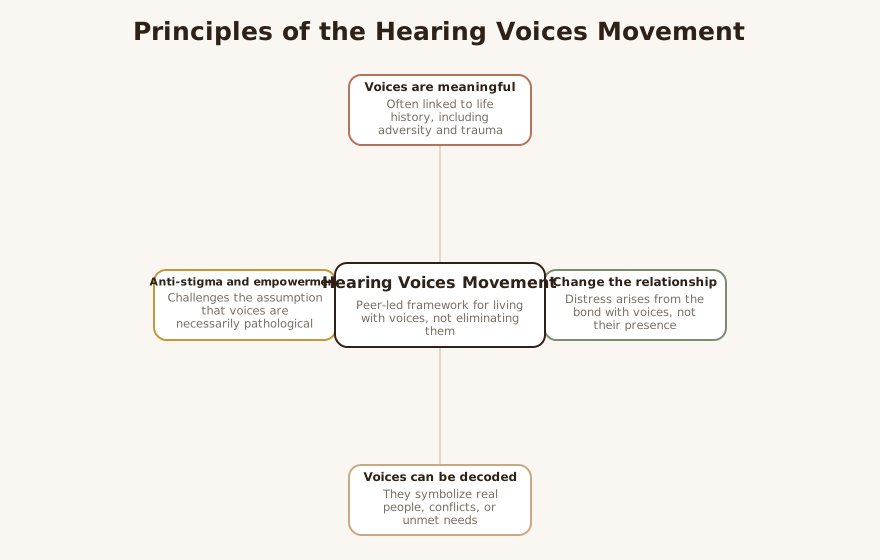
The Hearing Voices Movement (HVM) is a peer-led, survivor-driven framework rather than a manualized psychotherapy 5. It originates in and belongs to the field of peer support and the broader psychiatric survivor/service-user movement, and it sits in deliberate dialogue with mainstream psychiatry rather than wholly inside it 5. Its defining premise is that hearing voices is a meaningful and relatively common human experience to be understood, explored, and lived with, rather than treated solely as a meaningless symptom of illness to be suppressed 5.
The movement is organized internationally through the Hearing Voices Network (HVN) and the umbrella body Intervoice, with national networks such as HVN England and HVN USA coordinating local activity 62. Because HVM is a framework and a social movement, clinicians most often encounter it in two forms: as community peer-support groups that run alongside or independent of services, and as a set of attitudes and tools — chiefly the Maastricht approach — that can be carried into clinical work 4. It is best understood as a paradigm and an organizing stance, not a stand-alone billable modality LLM.
Creators & Lineage
The movement’s intellectual origins are usually traced to the Dutch social psychiatrist Marius Romme and the science journalist Sandra Escher, working with a voice-hearer named Patsy Hage in the late 1980s 5. The pivotal moment came when Hage challenged Romme to take her voices seriously as real experiences rather than as noise to be medicated away; a 1987 Dutch television appearance generated a large response from other voice-hearers, many of whom were coping well outside services, and revealed a hidden population that conventional psychiatry had largely overlooked 5. Romme and Escher’s subsequent research and writing established the founding claim of the movement: that voices can be meaningful, often connected to a person’s life history, and that learning to relate to them differently can reduce distress 4.
From this base the movement grew internationally. The Hearing Voices Network was founded in England, and a global federation, Intervoice, was later established to coordinate national networks across many countries 6. The first formal Hearing Voices Network in England dates to the late 1980s and early 1990s, and the model has since spread to numerous countries through affiliated networks 6. Key contemporary figures who have shaped its clinical and public profile include the psychologist and voice-hearer Eleanor Longden, whose widely viewed TED talk recounts her own recovery and reframing of her voices, and Jacqui Dillon, a long-standing activist and national figure in the English network 36.
A central lineage thread is the movement’s emphasis on lived experience and survivor leadership: the framework was built substantially by voice-hearers, not only for them, which distinguishes it from clinician-authored treatments 4. It draws on and overlaps with trauma-informed thinking, the recovery model, and dialogical approaches such as Open Dialogue, while remaining organizationally independent of any single therapeutic school 4.
Core Principles
First, voice-hearing is a meaningful human experience, not inherently a sign of illness 5. The movement holds that voices frequently carry significance and are often linked to the hearer’s life history, including adversity and trauma, rather than being random neuropathology 4. Eleanor Longden’s account frames the question as not “what is wrong with you?” but “what happened to you?” — a reframing that situates voices within a person’s biography 3.
Second, the goal is to change the relationship with the voices, not necessarily to eliminate them 4. Distress is understood to arise substantially from the relationship between the hearer and their voices — how the person interprets, fears, fights, or negotiates with them — so recovery can mean living well with voices that persist 4.
Third, voices have meaning that can be decoded 4. The Maastricht approach treats voices as understandable in the context of the hearer’s emotional and relational life, often representing or symbolizing real people, conflicts, or unmet needs 4.
Fourth, the movement is anti-stigma and empowerment-oriented 5. It challenges the assumption that hearing voices is necessarily pathological and works to normalize the experience, reduce shame, and restore the hearer’s authority over their own account of what is happening to them 52.
Fifth, peer support and mutual aid are foundational 6. Shared experience among voice-hearers — rather than expert-to-patient instruction alone — is treated as a primary vehicle of change and connection 6.
Interventions & Techniques
Because HVM is a framework rather than a protocol, its “interventions” are a blend of community structures and transferable clinical tools LLM.
- Hearing Voices Groups (HVGs): peer-led, voluntary groups in which voice-hearers share experiences, coping strategies, and meaning-making in a non-judgmental, accepting environment, typically without requiring a diagnosis or a goal of voice elimination 61.
- The Maastricht Interview: a semi-structured interview developed by Romme and Escher to explore the phenomenology and biography of a person’s voices — their characteristics, triggers, history, the hearer’s explanations, and the relationship between voices and life events 4.
- Constructing and using a “construct” / formulation: information from the interview is organized into a shared understanding linking the voices to life history and emotional themes, which then guides how the person relates to them 4.
- Relating differently to voices: techniques that shift the hearer from fear and avoidance toward dialogue, boundary-setting, and negotiation with voices, treating them as communications to be understood rather than enemies to be defeated 4.
- Normalization and psychoeducation: framing voice-hearing as part of the spectrum of human experience to reduce shame and catastrophic interpretation 5.
LLM-generated illustrative example (not a guideline): A young adult who hears a harsh, commanding voice attends a Hearing Voices Group and, with a clinician trained in the Maastricht approach, traces the voice’s tone and phrasing to a critical figure from childhood. Over several months the work shifts from “make the voice stop” to “understand what the voice is protesting and set limits with it,” and the client reports the voice as less terrifying even though it has not disappeared. LLM
Evidence Base
Evidence maturity must be characterized carefully. As a social movement and peer-support infrastructure, HVM is well established — international in scope, with durable national networks and a substantial body of first-person and qualitative testimony 65. As a clinical, outcome-driven intervention, the evidence is best described as emerging rather than fully established 4.
The 2014 Schizophrenia Bulletin paper “Emerging Perspectives From the Hearing Voices Movement” is the key scholarly bridge between the movement and mainstream research; its title alone signals that the clinical-research program is developing rather than mature 4. That paper synthesizes the movement’s core claims — that voices are often trauma-related and meaningful, and that changing the relationship with voices can reduce distress — and frames them as hypotheses with growing but incomplete empirical support, calling for further research and practice integration 4. Lines of supporting evidence include research connecting voice-hearing to trauma and adversity, and the convergent observation that many voice-hearers in the general population function well without ever entering services 45.
Clinicians should hold this honestly with clients and colleagues: the framework’s normalizing and empowering stance and its peer-support structures rest on strong experiential and movement-based foundations, while its specific therapeutic techniques are an active research area rather than a settled, manualized evidence base on par with, say, CBT for psychosis 4LLM. The movement’s strength is as much ethical and organizational as it is narrowly clinical LLM.
Populations & Indications
HVM is oriented toward anyone who hears voices, whether or not they carry a psychiatric diagnosis 1. Core populations include voice-hearers in general, people diagnosed with schizophrenia-spectrum conditions and psychosis, and psychiatric survivors and service users who have felt disempowered by conventional care 52. Given the movement’s emphasis on the trauma–voices link, it is frequently relevant to trauma survivors whose voices map onto adverse life experiences 4.
It also reaches young people who hear voices — an area Escher in particular studied — and people who experience other unusual or extreme states beyond classically defined hallucinations 45. Groups operate in community settings and, increasingly, within inpatient and other service contexts, making psychiatric inpatients a relevant population as well 6. The framework is indicated wherever the clinical priority is reducing distress, isolation, and self-stigma and increasing the hearer’s sense of agency — including cases where voices are likely to persist despite treatment 52.
Problems-for-Work
- Distressing auditory verbal hallucinations: shifting from a war against the voices toward understanding and renegotiating the relationship to lower fear and distress 4.
- Psychosis and schizophrenia-spectrum experiences: offering a meaning-based, non-pathologizing complement to medical treatment for people for whom “symptom elimination” alone has not produced recovery 5.
- Trauma and post-traumatic reactions: using the Maastricht approach to link voices to life history and adversity, opening trauma-informed work 4.
- Isolation and stigma: Hearing Voices Groups directly counter shame and aloneness through shared experience and mutual aid 61.
- Disempowerment in mental health care: restoring the hearer’s authorship over their own narrative and choices, a core movement aim 2.
LLM-generated illustrative example (not a guideline): A client diagnosed with schizophrenia describes feeling “spoken about” rather than spoken with by past providers. The clinician introduces a local Hearing Voices Group and adopts a curious, collaborative stance toward the content of the voices; the client begins to experience the voices as something to be understood with help, which reduces both isolation and the secrecy that had been fueling distress. LLM
Contraindications, Cautions & Cultural Humility
HVM is intended to complement, not replace, clinical care, and the movement does not categorically reject medication or psychiatry; it positions itself as an alternative framework of understanding and a source of peer support alongside services 5. The principal caution for clinicians is therefore not to weaponize the framework against necessary treatment: encouraging a client to “relate to” voices should never displace risk assessment, attention to command hallucinations that direct harm, or appropriate psychiatric and crisis care LLM. Where voices carry serious risk to self or others, safety planning and standard clinical safeguards take precedence over exploratory voice-dialogue work LLM.
A second caution concerns scope of practice: the Maastricht interview and voice-dialogue techniques are best delivered by, or in collaboration with, those trained in them, and peer-led groups derive much of their value from being genuinely peer-led rather than clinician-controlled 46. Clinicians should respect the autonomy and survivor-leadership ethos of HVN groups rather than colonizing them LLM.
Cultural humility is central to the movement’s own logic 5. HVM explicitly challenges the assumption that hearing voices is universally pathological, noting that voice-hearing is interpreted very differently across cultures and spiritual traditions 5. Clinicians should attend to the client’s own cultural, religious, and personal framework for understanding their voices rather than imposing a single explanatory model, and should be aware that the medicalized Western reading is one frame among several 5LLM.
Treatment-Plan Suggestions & SMART Objectives
| Goal | SMART objective (example) | Mechanism |
|---|---|---|
| Reduce voice-related distress | Within 8 sessions, client will report a 2-point reduction (0–10) in distress associated with their most troubling voice | Shifts focus from elimination to changing the relationship with voices 4 |
| Decrease isolation and stigma | Within 4 weeks, client will attend ≥2 Hearing Voices Group meetings and identify ≥1 shared coping strategy from peers | Mutual aid and normalization through shared experience 61 |
| Build a shared understanding of the voices | Over 4 sessions, client and clinician will complete a Maastricht-style exploration linking ≥2 voices to identifiable life themes or events | Meaning-making connects voices to biography and trauma 4 |
| Develop a new way of relating to voices | Within 6 weeks, client will practice ≥1 boundary-setting or dialogue strategy with a voice ≥3x/week and log the outcome | Reframes voices as communications rather than enemies 4 |
| Reduce shame and self-stigma | Within 6 sessions, client will reframe ≥2 self-stigmatizing beliefs about hearing voices, rated on a 0–10 conviction scale | Normalizes voice-hearing as a human experience 5 |
| Increase sense of agency in care | By session 5, client will articulate ≥2 personal goals and preferences that shape their own treatment plan | Restores authorship and counters disempowerment 2 |
| Link voices to a trauma-informed formulation | Over 8 sessions, client and clinician will draft a written formulation connecting voices to life history, reviewed and agreed by the client | Situates voices within “what happened to you” 34 |
Common Misconceptions
- “HVM tells people to stop their medication or reject psychiatry.” The movement positions itself as a complementary framework of understanding and peer support, not a directive against treatment 5.
- “The goal is always to make the voices go away.” The aim is typically to change the relationship with voices and reduce distress, with persistence of voices being compatible with recovery 4.
- “Hearing voices is always a sign of serious mental illness.” A core movement claim, supported by research on voice-hearers outside services, is that voice-hearing occurs across a spectrum and is not inherently pathological 54.
- “It is an unevidenced fringe idea.” Its clinical techniques are an emerging research area, but the trauma–voices link and the movement’s international peer infrastructure are well documented 46.
- “HVM is a clinician-delivered therapy.” It is fundamentally a survivor-led movement; clinicians participate within it rather than owning it 46.
Training & Certification
There is no single licensing body or universal certificate that confers “Hearing Voices” practitioner status, consistent with the movement’s status as a framework and social movement rather than a proprietary modality LLM. National networks such as Hearing Voices Network England and Hearing Voices Network USA provide training, resources, and group-facilitation support, and the international body Intervoice coordinates across countries 126. Facilitator training for Hearing Voices Groups and training in the Maastricht interview are offered through these networks and affiliated trainers, often emphasizing co-facilitation with people who have lived experience 14.
Clinicians wishing to integrate the approach typically pursue network-affiliated training and apply the framework within their existing scope and credentials, while voice-hearers and peers are central to facilitation and leadership 4. Foundational orientation is widely available through the networks’ own resources and through accessible first-person accounts such as Eleanor Longden’s talk 13.
Key Terms
- Voice-hearer: a person who hears voices, used in preference to clinical-symptom language to center the experience and the person 1.
- Hearing Voices Group (HVG): a peer-led mutual-support group for voice-hearers, non-judgmental and not requiring a diagnosis or a voice-elimination goal 61.
- Maastricht approach / interview: the structured method developed by Romme and Escher to explore the phenomenology and biography of voices and build a shared understanding 4.
- Construct / formulation: the shared account linking a person’s voices to their life history and emotional themes, used to guide a new relationship with the voices 4.
- Intervoice: the international umbrella organization coordinating national Hearing Voices networks 6.
- Survivor / service-user leadership: the principle that the movement is led substantially by people with lived experience of voices and psychiatric services 4.
Resources & Further Reading
▶ Watch — a video introduction to this concept:
- Emerging Perspectives From the Hearing Voices Movement (Schizophrenia Bulletin, 2014)
- Hearing Voices Network (England) — official site
- About Us — Hearing Voices Network USA
- Eleanor Longden: The voices in my head (TED Talk)
- Hearing Voices Movement — Wikipedia
- Hearing Voices Network — Wikipedia
Reflective / Supervision Questions
- When a client describes hearing voices, how readily do I move to “what happened to you?” alongside “what is wrong?” — and what in my training pulls me toward symptom-elimination by default? 3
- How do I hold the honest evidence picture — strong movement and peer-support foundations, emerging clinical-technique evidence — without either overselling or dismissing the approach? 4
- Where am I respecting the survivor-led, peer-driven nature of Hearing Voices Groups, and where might I be tempted to over-clinicalize or control them? 6
- For a client at risk, how do I integrate voice-exploration work with risk assessment and crisis care rather than letting one displace the other? LLM
- Whose explanatory framework — medical, cultural, spiritual, or the client’s own — is governing my formulation of this person’s voices? 5
- Within which established therapeutic modality am I actually delivering this work, and does my documentation reflect that nesting? LLM